Henry Neville’s wife Anne appealed for his release from the Tower in a letter endorsed 23 May 1602:
I can bear the loss of anything, so I lose not him.1
Increasing deafness hindered her personal appeals to Robert Cecil and the queen. Anne was prepared to petition Elizabeth if Cecil advised it, and asked him to tell her bearer what the petition should contain. She also quoted Seneca in Latin. Chapter 7 examines her efforts during Neville’s imprisonment; Chapter 31 compares the Seneca passage with Macbeth.
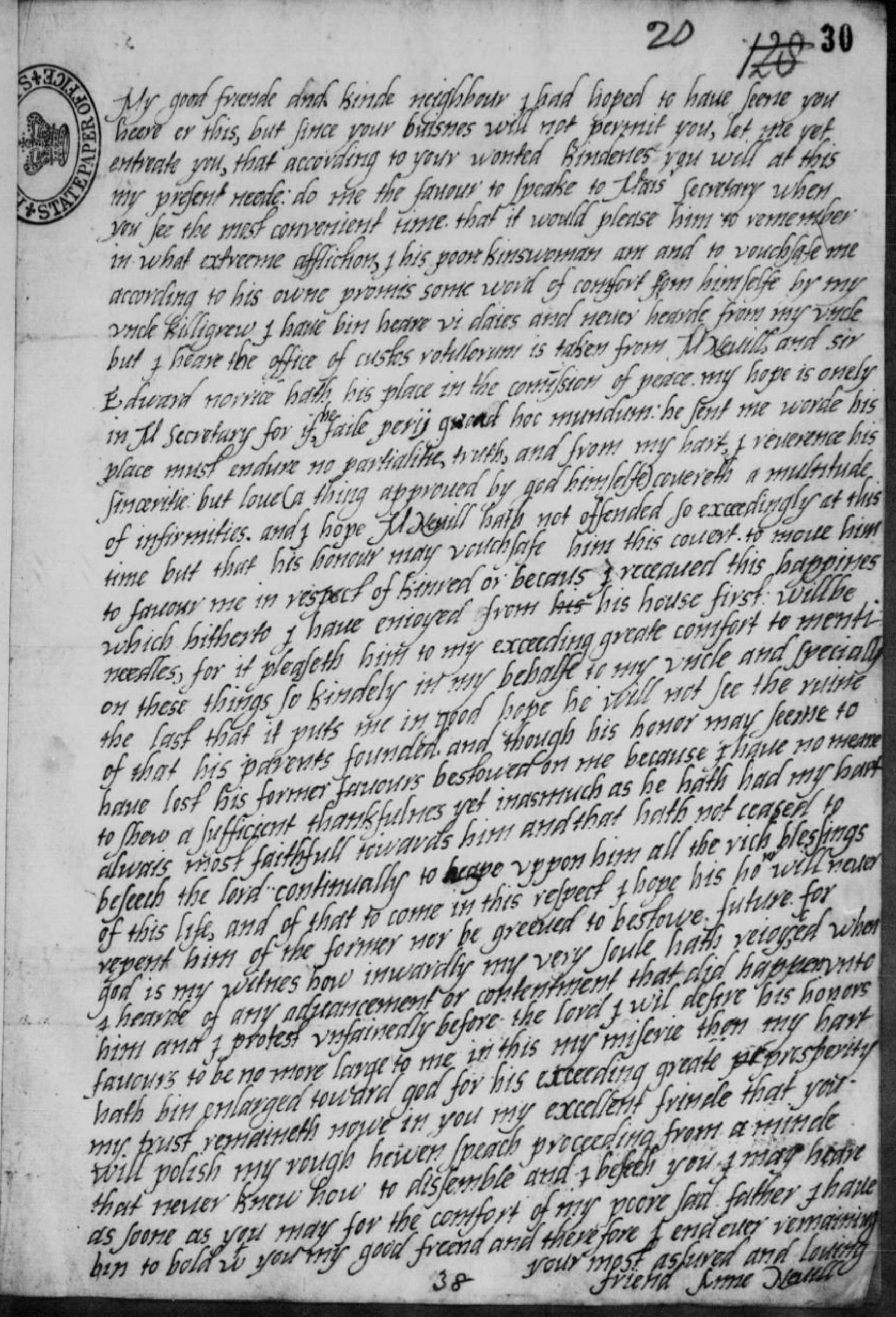
More than a year earlier, on 6 March 1600/1, Anne had written to Thomas Windebank, the clerk of the signet and their neighbour, asking him to approach Cecil after the Essex rising. She acknowledged Cecil’s insistence on impartiality, then pressed the case for compassion:
From my heart I reverence his sincerity: but love, a thing approved by God himself, covereth a multitude of infirmities.
In the same appeal she wrote “perii quoad hoc mundum”—“I am lost as far as this world is concerned.” She ended by asking Windebank to improve its presentation:
My trust remaineth now in you my excellent friend, that you will polish my rough-hewn speech proceeding from a mind that never knew how to dissemble.2
Anne’s request for polish accompanies a forceful argument of her own, combining Latin, scripture and family obligation. The surviving papers of Neville’s family contain women’s writing about estates, marriages, religion and Parliament as well as his imprisonment.
Learning in Neville’s family
Neville married into a family whose women translated, collected books and wrote to ministers. His wife Anne Killigrew was Katherine Cooke’s daughter.3 Katherine’s sisters included Anne Bacon, the translator of John Jewel’s Apologia, and Mildred Cecil, a donor of books to St John’s College, Cambridge. Chapter 3 describes their learning and surviving work. When Anne Neville later petitioned Robert Cecil, she was addressing her first cousin: their mothers, Katherine and Mildred, were sisters.
On 22 June 1601, Anne’s stepmother Jael Killigrew wrote in French to Thomas Windebank about her naturalization. Her postscript included Anne and her sister Dorothy Seymour:
Madame Neville et ma fille Seymour retournent aussi leurs recommandations…
Madame Neville and my daughter Seymour also return their greetings…4

Estates, marriages and religion
On 4 November 1604, Neville’s stepmother Elizabeth Bacon, by then Lady Periam, wrote to him from Greenland about appointing a steward. She opened “Good son” and explained that she was “not yet resolved who to make my steward.” She knew that “the tenants have been badly used.” Her letter also promised help to Neville and his friends:
I desire you make this account of me, that wherein I may pleasure you or any friend of yours, you shall find me as ready as you shall wish or desire.5
Neville’s sister Katherine, wife of Edmund Doyly of Shottisham, consulted him about a marriage for her son. Writing on 30 January, probably in 1605, she explained that she had abandoned one proposed match because the executor would not make the girl’s estate clear. Another, with a daughter of Sir Robert Jermyn, raised questions about age and the provision they could afford with other children to support. She then turned to a public cause:
Good brother, let me entreat you if by any means you can procure the liberty of a very worthy preacher here in the city of Norwich which is suspended.
The preacher was Thomas Newhouse of St Andrew’s, Norwich. Katherine reported that his parishioners were willing to contribute money to obtain relief and asked whether Neville could help.6
Anne’s sister Dorothy Killigrew Seymour also wrote about religion, family business and Parliament. In a letter of 18 January, probably 1605, she hoped Parliament’s postponement would allow Neville to visit Bath for his troublesome leg. She asked for news of a family matter in which he had helped, then expressed her fear about its outcome:
I fear the end of this matter will be the fulfilling of the proverb that might will overcome right.
She also reported ministers losing their livings.7
Phyllis Rackin’s Shakespeare and Women places such work within the substantial economic responsibilities of early modern women, including women who controlled property and managed households and estates.8
“This book is mine Mary Sidney”
A fifteenth-century manuscript of John Lydgate’s Fall of Princes passed from the Neville library at Billingbear to Audley End. Its former owner, Mary Dudley Sidney (c.1530–1586), was the mother of Robert Sidney, Neville’s travelling companion, and of the poets Philip Sidney and Mary Sidney Herbert, Countess of Pembroke.
A faint inscription perhaps reading “Elizabeth Nevell” below Mary’s ownership verse suggests that she gave the book to an Elizabeth Neville. Two possible recipients are Elizabeth Gresham Neville, Henry’s mother, and Elizabeth Bacon Neville, his stepmother; Christie’s proposes the latter.9
Mary dated her verse 28 November 1552:
This book is mine Mary Sidney.
If it [be] found before it be lost,
Let them that find it of it make no boast
In saying they found it before it was lost,
For of such gain is like to come much pain.10
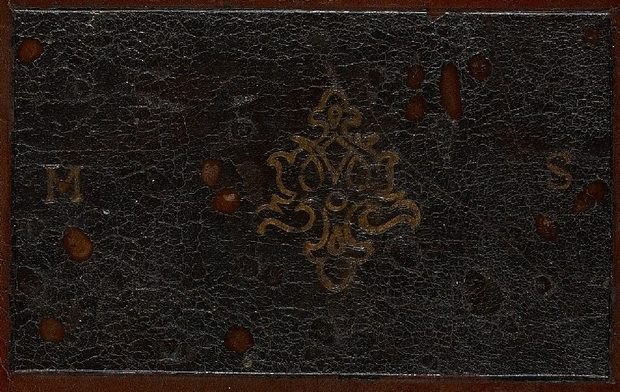
The verse is a book curse: the person who “finds” it before it is lost is a thief, and such gain will bring pain. Yale acquired it in 2018, and it is now Beinecke MS 1222. A panel of sixteenth-century leather, preserved in its later binding, bears her initials “M.S.”
Philip Sidney’s letters discuss Neville and Savile’s studies (Chapter 2).
![Mary Dudley Sidney’s ownership verse and book curse, dated 28 November 1552 (detail). The faint inscription perhaps reading “Elizabeth Nevell” is boxed in red. John Lydgate, Fall of Princes, Beinecke MS 1222, preliminary leaf [ii]v. Yale University Library, image 16655103.](/assets/2f07675429eea08b-full.jpg)
Women reading in the plays
In Titus Andronicus 4.1, Lavinia turns to a book when she can no longer speak. After her attackers have cut out her tongue and severed her hands, she finds the story of Philomela in Ovid’s Metamorphoses and uses it to tell her family what happened. Her father already knows her as a teacher of poetry and rhetoric to young Lucius; the scene makes her learning part of how she communicates.
TITUS
Ah, boy, Cornelia never with more care
Read to her sons than she hath read to thee
Sweet poetry and Tully’s Orator.
— Titus Andronicus 4.1
“Tully” is Cicero: Lavinia has read rhetoric as well as poetry to the boy. Titus offers her the choice of his library. When she selects the Ovid, Lucius identifies another woman behind the book:
YOUNG LUCIUS
Grandsire, ’tis Ovid’s Metamorphosis.
My mother gave it me.
— Titus Andronicus 4.111
The book passes from a mother to her son; his aunt teaches him poetry and rhetoric. Lavinia then uses its story to disclose what has been done to her, before writing her attackers’ names in the sand. Sara Eaton’s study examines the importance of her humanist education to this scene.12
In Cymbeline, the king’s daughter Imogen reads in bed until almost midnight. Her husband, Posthumus, is away; Iachimo, who has wagered that he can seduce her, has gained admission to her bedroom hidden in a trunk. Before she falls asleep, she tells her attendant:
IMOGEN
I have read three hours then. Mine eyes are weak.
[She hands the Lady her book.]
Fold down the leaf where I have left. To bed.
Take not away the taper; leave it burning.
— Cymbeline 2.213
When Iachimo emerges, he notices that the page is turned down at the story of Tereus and Philomela—the same story Lavinia uses to disclose her rape. Charlotte Scott examines these two scenes together in Shakespeare and the Idea of the Book. Lavinia uses her book to make her family understand her; Imogen’s reading is interrupted by an intruder who steals her bracelet and records details of her bedroom and body to fabricate evidence of adultery.14
Bianca’s Latin lesson in The Taming of the Shrew 3.1 becomes a courtship conducted through pretended translations; Chapter 19 compares her wit with Katherine Cooke’s Latin poem.15 In Hamlet 3.1, Polonius tells Ophelia to read as cover for the encounter he and the king intend to overhear. His references to devotion suggest a religious book, though its title is not given.16
Letters in women’s hands
Among the thirty-eight plays surveyed, the table identifies at least fourteen in which women write, commission or read letters. It includes actions reported in dialogue as well as shown onstage. These letters carry marriage proposals, political news, private instructions and invitations to murder.17
| Play | Woman and letter scene |
|---|---|
| 3 Henry VI | Queen Margaret reads political news. (3.3) |
| The Two Gentlemen of Verona | Julia reads; Silvia has Valentine write her letter. (1.2; 2.1) |
| Love’s Labour’s Lost | The princess and her ladies discuss the letters they have received. (5.2) |
| The Merchant of Venice | Jessica writes secretly to Lorenzo. (2.3–4) |
| The Merry Wives of Windsor | Mistresses Page and Ford read and compare Falstaff’s letters. (2.1) |
| As You Like It | Phoebe writes; Rosalind reads her letter. (4.3) |
| Twelfth Night | Maria writes in imitation of Olivia’s hand. (2.3; 2.5; 5.1) |
| Troilus and Cressida | Cressida sends a letter to Troilus. (5.3) |
| All’s Well That Ends Well | The Countess and Helen read Bertram’s letters. (3.2) |
| King Lear | Goneril writes to Edmund; Cordelia’s reading is reported. (4.6; 4.3) |
| Macbeth | Lady Macbeth reads her husband’s letter. (1.5) |
| Pericles | Thaisa writes to her father about marrying Pericles. (2.5) |
| Cymbeline | Imogen reads Posthumus’s letters. (1.6; 3.2; 3.4) |
| Henry VIII | Katherine commissions Patience to write to the king. (4.2) |
In The Merry Wives of Windsor 2.1, Mistress Page and Mistress Ford compare the love letters Falstaff has sent them. The women recognize that he has reused the same text, changing only their names:
MISTRESS PAGE
Letter for letter, but that the name of
Page and Ford differs! […]
— The Merry Wives of Windsor 2.118
Their reading exposes Falstaff’s method and starts their retaliation (Chapter 25).
In Twelfth Night, the successful forger is herself a woman. Maria, Olivia’s attendant, explains how she will make Malvolio believe that his mistress loves him:
MARIA […] I can write very like my
lady your niece; on a forgotten matter, we can
hardly make distinction of our hands.
— Twelfth Night 2.319
When Olivia sees the forgery in Twelfth Night 5.1, she recognizes Maria’s handwriting.
Women also direct another person’s pen. In Henry VIII 4.2, the dying Katherine of Aragon asks her attendant Patience about a letter to the king:
KATHERINE
[…] Patience, is that letter
I caused you write yet sent away?
— Henry VIII 4.220
Katherine gives the letter to the imperial ambassador Capuchius to deliver. Her requests concern their daughter Mary, the marriage prospects of her women and the unpaid wages of her servants.
Notes and sources
Anne Neville to Sir Robert Cecil, Hatfield House, Cecil Papers 93/72, endorsed 23 May 1602; quotation from the manuscript, spelling modernized. Also calendared in HMC, Calendar of the Manuscripts of the Marquess of Salisbury, XII (1910), p.164.↩︎
Anne Neville to Thomas Windebank, 6 March 1600/1, The National Archives, SP 12/279, f.30; State Papers Online, Gale document MC4304680023. Quotations from the manuscript, spelling modernized. See also Mary Anne Everett Green, Calendar of State Papers, Domestic, 1601–1603 (1870), p. 12, no. 20, for the identity, date and summary; the exact quotations remain manuscript-derived. Green also prints perii quoad hoc mundum: the unusual hoc is retained, not silently changed to hunc.↩︎
Katherine Cooke Killigrew, Anne’s mother, died in 1583. William Camden wrote a Latin epitaph for her. William Camden, Latin epitaph for Katharine Killigrew, wife of Sir Henry Killigrew, British Library, Add MS 36294, f.43v (formerly cited as f.43b), undated. The British Library catalogue identifies the undated Latin epitaph at f. 43b, equivalent to 43v; no composition date is assigned here.↩︎
Jael Killigrew to Thomas Windebank, Lothbury, 22 June 1601, The National Archives, SP 12/279, f.215. French postscript quoted with spelling and capitalization normalized; English translation supplied here. The excerpt ends before the concluding formula of commendation. Mary Anne Everett Green, ed., Calendar of State Papers, Domestic, Elizabeth, 1601–1603 (1870), pp.53–54, no.115, summarizes it: “Mrs. Neville and my daughter Seymour send remembrances.” Jael was Sir Henry Killigrew’s second wife and the women’s stepmother; Anne and Dorothy were Katherine Cooke’s daughters. Printed calendar.↩︎
Lady Elizabeth Periam to Sir Henry Neville, Greenland, 4 November 1604, Royal Berkshire Archives, D/EN/F44/1–4; catalogue. The date follows the endorsement; the day numeral in the letter itself is less distinct. Quotations from the manuscript, spelling modernized. She signs herself his “loving mother in law,” an expression then also used for a stepmother.↩︎
Katherine Doyly to Sir Henry Neville, 30 January [1604/5], Royal Berkshire Archives, D/EN/F6/2/8; parent catalogue record. The dateline supplies day and month, not year; 1605 is a contextual dating. Quotation from the manuscript, spelling modernized.↩︎
Dorothy Seymour to Sir Henry Neville, 18 January [1604/5], Royal Berkshire Archives, D/EN/F6/2/7; parent catalogue record. The year is inferred, not written. Quotation from the manuscript, spelling modernized. The parliamentary context fits the proclamation of 24 December 1604, which postponed the next session from 7 February to 3 October 1605; the letter itself gives no year. This supports the inferred context without proving the date or that Dorothy read the proclamation. Published TCP text, B12719.↩︎
Phyllis Rackin, Shakespeare and Women (Oxford University Press, 2005), chapter 2, especially pp.33–36, on property, work and household management. Rackin emphasizes the variety of women’s situations and distinguishes restrictive prescriptions from the activities documented in surviving records.↩︎
Christie’s, 11 July 2018, lot 50, provenance and binding description. The gift and identification with Elizabeth Bacon Neville are the catalogue’s proposals. Its further description of the ambassador as her son is inaccurate: she was his stepmother. The faint inscription alone does not distinguish her from his mother, Elizabeth Gresham Neville. For the preserved initials, see Yale, image 16655096.↩︎
John Lydgate, Fall of Princes, c.1450, Yale, Beinecke MS 1222, preliminary leaf [ii]v, Yale Digital Collections, image 16655103. Spelling and punctuation modernized; “[be]” supplied. The dated ownership verse is also transcribed in Christie’s, Valuable Books and Manuscripts, 11 July 2018, lot 50. Yale records its purchase at that sale.↩︎
William Shakespeare, Titus Andronicus, 4.1, Folger Shakespeare Library. Cornelia was the mother of the Gracchi. The scene establishes Lavinia’s reading and teaching, but does not call Ovid her favourite book.↩︎
Sara Eaton, “A Woman of Letters: Lavinia in Titus Andronicus,” in Shirley Nelson Garner and Madelon Sprengnether, eds., Shakespearean Tragedy and Gender (Indiana University Press, 1996), pp.54–74; text reproduced by eNotes. Eaton relates Lavinia’s education to contemporary humanist ideals and their restrictions on learned women.↩︎
Shakespeare, Cymbeline, 2.2, Folger Shakespeare Library. Iachimo identifies “The tale of Tereus” and the point “Where Philomel gave up”; the dialogue does not name the volume’s author or title.↩︎
Charlotte Scott, Shakespeare and the Idea of the Book (PhD thesis, University of Warwick, 2005), chapter II, pp.25–64, especially pp.48–56; Warwick Research Archive Portal. Scott identifies Imogen’s book as Ovid’s Metamorphoses and also discusses Bianca and Ophelia as readers.↩︎
Shakespeare, The Taming of the Shrew, 3.1, Folger Shakespeare Library.↩︎
Shakespeare, Hamlet, 3.1, Folger Shakespeare Library. The devotional character of the book is inferred from Polonius’s accompanying words; no particular prayer book is named.↩︎
The table gives a conservative minimum from the thirty-eight plays in the Folger Shakespeare texts, including the collaborative Pericles, Henry VIII and The Two Noble Kinsmen. Each play counts once. Writing, commissioning and reading qualify whether enacted or explicitly established by dialogue; Maria’s forgery counts under her name. The women’s comments on their received letters establish their reading in Love’s Labour’s Lost 5.2. Mere receipt, carriage, preparations to write, petitions, poems and metaphorical “reading” are excluded from this letter count. The four book examples are a separate minimum, not four additional plays to add to the fourteen. Act and scene references in the table identify the evidence, not every occurrence in each play. Folger’s King Lear combines quarto and Folio material; Cordelia’s reading in 4.3 is in the quarto-only scene, but Goneril’s letter in 4.6 independently qualifies the play for the count.↩︎
Shakespeare, The Merry Wives of Windsor, 2.1, Folger Shakespeare Library. The quotation is prose, as is Maria’s statement from Twelfth Night below.↩︎
Shakespeare, Twelfth Night, 2.3 and 5.1, Folger Shakespeare Library. Olivia recognizes the forged hand as Maria’s; the women’s hands are similar, not literally indistinguishable in all circumstances.↩︎
Shakespeare, Henry VIII, 4.2, Folger Shakespeare Library. The omitted beginning of the verse line is “Banished the kingdom.” Katherine says she caused Patience to write; the scene does not establish whether she dictated every word.↩︎