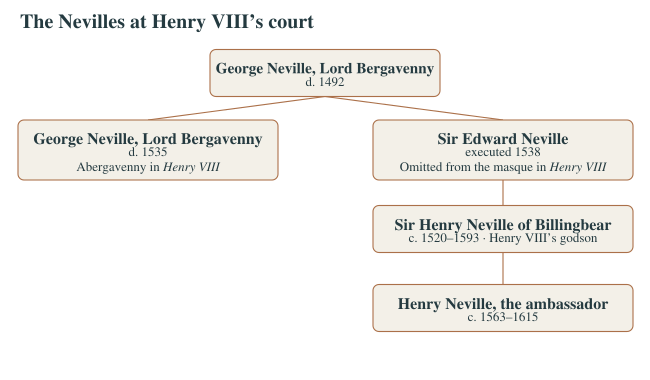
Henry Neville’s grandfather, Sir Edward Neville, was beheaded on Tower Hill on 9 December 1538 under Henry VIII.1
Yet on 27 October 1539, less than a year later, the king granted Sir Edward’s son Henry—Neville’s father—an annuity of £20 because he was the king’s godson. By 1546, the last full year of Henry VIII’s reign, Neville’s father was serving in the Privy Chamber. The king’s will left him £100 and included “Henry Nevell” among its witnesses.2
Neville’s father was knighted under Edward VI in 1551.3 In 1553 he signed the letters patent—a royal document intended to make Lady Jane Grey the next monarch after Edward VI, in place of Edward’s half-sister Mary. He later became a Marian exile: one of the English Protestants who went abroad during Mary I’s restoration of Catholicism. The traveller Thomas Hoby encountered him at Padua in August 1554.
In 1556 Mary’s government sent John Brett to summon named exiles home, Neville’s father among them. Reaching Venice on 16 August, Brett learned that “Sir Henry Nevell was returned into England”: he was reported home while Mary was still queen. His son would visit Padua in 1581, twenty-seven years after his father’s stay.4
The family’s lands also changed hands with the monarchy. In 1551 Edward VI granted Neville’s father the Billingbear estate in Berkshire and lands around Windsor. Revoked under Mary and restored early in Elizabeth’s reign, this grant established Billingbear as the family seat.5
In Elizabeth’s confidence
Elizabeth repeatedly entrusted Neville’s father with sensitive work. In October 1569, when the Duke of Norfolk was arrested over his intended marriage to Mary, Queen of Scots, she directed Sir Francis Knollys to conduct him to the Tower, with Sir Henry to assist and have charge of him. The following August, Elizabeth ordered the Tower’s lieutenant and Sir Henry to move the duke to his own house at the Charterhouse for fear of plague.6
He was later chosen for an assignment involving Mary herself. Instructions signed by Elizabeth in January 1581 named him with the Earl of Shrewsbury and Sir William Pelham for her proposed removal to Ashby-de-la-Zouch.7 A later plan involved bringing Mary from Sheffield, where she was held in Shrewsbury’s house. In December 1583 Sir Henry told his brother-in-law Nathaniel Bacon that his journey had been deferred until spring. He and Sir Ralph Sadler were to go “not as some think to keep her there at his house but to bring her away”.8
Royal instructions of March 1584 set out their intended responsibilities in detail: trustworthy gatekeepers, armed guards, night watches, searches of incoming goods and control over the delivery of letters and books. The plans changed, and John Somer eventually accompanied Sadler in Sir Henry’s place.9
His service also included military preparations and enforcement of the religious settlement. Earlier, in May 1560, he reported mustering 1,000 men at Reading and 1,500 at Newbury, and a shortage of armour. In 1581 the Privy Council thanked him for apprehending printers at Stonor’s Lodge, near Henley, and ordered him to send their press and papers to London. This was a clandestine Catholic press associated with the Jesuit mission: it had printed Edmund Campion’s Rationes decem (Ten Reasons), a Latin challenge to Protestant theologians.10 His investigation of the Windsor witchcraft cases, including a suspected threat to Elizabeth through wax images, is discussed in Chapter 25.11
The family also appears in Henry VIII: the Lord Abergavenny arrested in Act 1, scene 1 represents George Neville, Sir Edward’s brother and the ambassador’s great-uncle.12 The omission of Sir Edward from the play’s masque scene is examined in Chapter 38.
The Greshams
The ambassador’s mother, Elizabeth Gresham, was the daughter and heir of Sir John Gresham and Frances Thwaites. Her father was the elder son of Sir Richard Gresham, the London merchant and lord mayor. Sir John’s brother, Sir Thomas Gresham, founded the Royal Exchange and was Henry Neville’s maternal great-uncle. His parents’ marriage linked the Nevilles’ court connections and estates with the Greshams’ wealth from London trade.5
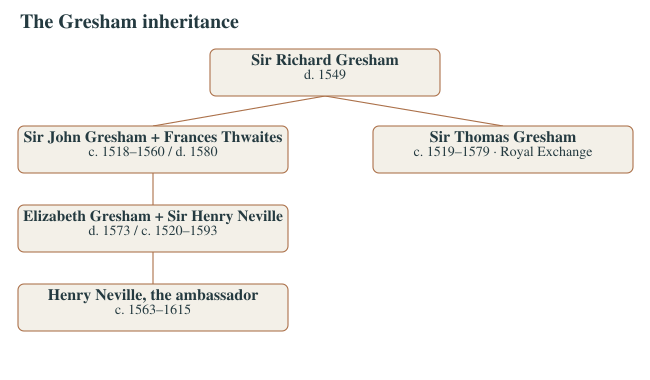
Through Sir Thomas, the family acquired Mayfield in Sussex, where Neville would later live and manufacture cannon (Chapter 3).13
Blackfriars and the first playhouse
In June 1560 Neville’s father leased a house in London’s Blackfriars from William More. The premises had previously housed the scholar John Cheke and been used by the Revels Office, which organized court entertainments.14
Blackfriars was likely the family’s London home before and during the construction of Billingbear House in Berkshire, whose main part Neville’s father built around 1567. The London tenancy ended in March 1568, shortly afterwards.15
In August 1576, writing from Billingbear, Neville’s father asked More to lease his former Blackfriars house to Richard Farrant, his “very friend.” Farrant was Master of the Children of Windsor Chapel and deputy at the Chapel Royal. Neville’s father vouched for him: “I dare answer for him.”16
Farrant obtained the lease in December 1576 and removed partitions to create a space for performances by his boy actors. The house became the first Blackfriars playhouse.14
More later complained that Farrant had turned what was supposed to be a teaching establishment into a “continual house for plays.” Neville’s father had thus helped Farrant secure the premises for an early London theatre: premises he had himself rented during his son’s childhood.17
Birth and baptism
Henry Neville was baptized at St Ann Blackfriars during his father’s tenancy. The parish register records “Henry Newell,” son of Sir Henry Neville, knight, under 20 May 1564.18
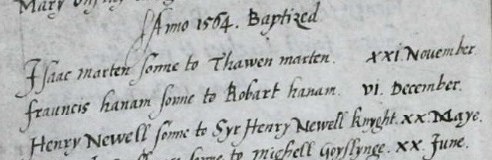
Several age statements, however, point to an earlier birth. His mother’s funeral certificate suggests the spring of 1563, while the age given in the inquisition after Thomas Gresham’s death works back to about 11 April 1563. His portrait gives thirty-six in 1599, and James Whitelocke gives fifty-two at his death in July 1615; both are consistent with a birth around 1563. The Oxford matriculation entry gives fifteen in December 1577, pointing instead to about 1562.
If the birth date inferred from the inquisition is correct, his recorded baptism followed about thirteen months later. That’s an interval we cannot explain.19
Neville may also have been Elizabeth I’s godson, as historian Marion Colthorpe proposes. The royal accounts record sponsorship of “Sir Henry Nevell’s child,” but do not name the child.20
Elizabeth Gresham died in November 1573, leaving six children: Elizabeth, aged twelve; Henry, ten and a half; Edward, six; Francis, five; Katherine, three; and William, just three months old.19
Around May 1578, Neville’s father married Elizabeth Bacon (later Lady Periam), Sir Nicholas Bacon’s daughter and Francis Bacon’s half-sister.21
Notes and sources
Charles Wriothesley, A Chronicle of England during the Reigns of the Tudors, ed. William Douglas Hamilton, I (Camden Society, 1875), p. 92, records the execution on Monday 9 December 1538. For Sir Edward’s career, see “Neville, Edward (d. 1538),” Dictionary of National Biography. The date 8 December given in some later accounts differs from Wriothesley’s contemporary chronicle. Sir Edward had accompanied Henry VIII to France, been knighted at Tournai in 1513, served in the Privy Chamber and attended the Field of the Cloth of Gold. In 1537 he helped carry the canopy at Prince Edward’s baptism. He was caught in the proceedings against the Courtenay and Pole families and executed with Henry Courtenay, Marquess of Exeter, and Henry Pole, Lord Montague.↩︎
Letters and Papers, Foreign and Domestic, Henry VIII, XIV, part 2, p. 158, grant 435(44), 27 October 1539: £20 yearly because he was the king’s godson. Henry VIII’s will, 30 December 1546, in Thomas Rymer, Foedera, XV, second edition (London: J. Tonson, 1728), pp. 110–117, especially p. 117, records the £100 legacy and the witness list. See also “Neville, Sir Henry I (d. 1593),” History of Parliament: The House of Commons 1558–1603, for Privy Chamber service. The printed calendar abstracts the grant and cites S.B.; Patent Roll, 31 Henry VIII, part 4, membrane 38. Neville’s eldest son and grandson were also named Henry.↩︎
History of Parliament and Michael Riordan date the knighthood to 1551; Riordan gives 11 October. VCH gives 1549, citing Shaw, whose index and list are inconsistent. See History of Parliament; Riordan, “Henry VIII, privy chamber of,” Oxford Dictionary of National Biography, article 70825, the elder Neville’s biography; VCH, Waltham St Lawrence, n. 23; Shaw, The Knights of England, II (1906), p. 65.↩︎
Thomas Hoby, The Travels and Life of Sir Thomas Hoby, ed. Edgar Powell (Camden Society, 1902), pp. 116–117, records the Padua company on 23 August 1554; the editor identifies Sir Henry Neville of Billingbear. Hoby was a traveller and translator; the company included Sir John Cheke, Edward VI’s former tutor, and Sir Thomas Wroth, who had served in the king’s Privy Chamber. For the 1553 succession instrument, see N. M. Fuidge, “Neville, Sir Henry I (d.1593)”, The History of Parliament: The House of Commons 1558–1603, ed. P. W. Hasler (1981), biography and note 3. Fuidge also notes that Neville initially retained his office as master of the harriers under Mary. John Brett’s account, edited by I. S. Leadam as “A Narrative of the Pursuit of English Refugees in Germany under Queen Mary,” Transactions of the Royal Historical Society, new series 11 (1897), pp. 113–131, dates his commission to 16 June 1556 (p. 114), names Neville among its recipients (p. 115), and records what he learned on reaching Venice on 16 August (p. 129). The quotation follows that printed edition with modernized spelling. Brett reports information received, not an arrival he witnessed; the precise date and circumstances of Neville’s return remain unestablished. The earlier instruction to Lord Paget is separately catalogued as Mary I’s summons, 7 June 1556, Dartmouth, Rauner Library, Mss 556357. The British Library’s description of the 1557 New Year’s gift roll, Add MS 62525, lists Sir Henry Nevell’s gift of a lute in a black silk-and-gold case and two small round pictures of Habsburg rulers. This catalogue evidence records a gift, not his personal attendance. For his son’s presence at Padua in August 1581, see Jonathan Woolfson, Padua and the Tudors: English Students in Italy, 1485–1603 (Toronto: University of Toronto Press, 1998), pp. 129–131, discussed in Chapter 2. The son’s 1581 stay was part of his travels with his Merton tutor Henry Savile.↩︎
John Ward, The Lives of the Professors of Gresham College (London, 1740), pp. 4–5, distinguishes the two Sir Johns and sets out Elizabeth’s parentage, her marriage to Neville, and the grants to her husband. Sir Richard → Sir John → Elizabeth → the ambassador is the direct descent; Sir Thomas was Sir John’s brother. Property through Frances Thwaites should not be conflated with Sir Thomas’s later testamentary provisions. Ward, p. 5, gives 22 September 1551 for the grant; the Victoria County History account gives 1552. The exact year remains to be reconciled with the Patent Roll.↩︎
Calendar of State Papers, Domestic Series, of the Reigns of Edward VI, Mary, Elizabeth, 1547–1580 (1856), p. 345, 8 and 10 October 1569, vol. LIX, nos. 4, 5, 7; p. 387, 3 August 1570, vol. LXXIII, no. 5. On 10 October 1569 Sir Henry reported Norfolk’s request to write to the Queen or confer with someone she sent (p. 345, no. 7).↩︎
British Library, Add MS 33594, ff. 5, 12–15, commissions and instructions of 16 January 1580/1.↩︎
Sir Henry Neville to Nathaniel Bacon, 19 December 1583, Folger MS L.d.444; The Papers of Nathaniel Bacon of Stiffkey, II (1983), 268–269, as quoted in Marion Colthorpe, The Elizabethan Court Day by Day: 1583, p. 48. The quotation follows Colthorpe’s published extract; it is not a new manuscript transcription.↩︎
William K. Boyd, ed., Calendar of the State Papers relating to Scotland and Mary, Queen of Scots, VII: 1584–1585 (Edinburgh: H. M. General Register House, 1913), no. 44, 47–48, instructions dated 20 March 1583/4; introduction, xiv, records that Somer accompanied Sadler in Sir Henry’s place. The instructions prescribe future arrangements, not completed acts by Neville.↩︎
Calendar of State Papers, Domestic, 1547–1580, p. 153, 24 May 1560, vol. XII, no. 30, with Stucley’s corroborating report of 25 May, no. 31. John Roche Dasent, ed., Acts of the Privy Council of England, new series, XIII, p. 186, records the Council’s thanks and orders concerning the press and papers. For Campion’s book and its clandestine printing, see Museum of Oxford, “‘Ten Reasons’ [Rationes Decem]”, exhibiting a copy from Durham University Library, Bamburgh Select.61/3.↩︎
Dasent, ed., Acts of the Privy Council, new series, XI, 20–22, 16 January 1578/9, especially p. 22. The Council suspected a threat to the Queen; the record does not establish that an actual assassination attempt occurred.↩︎
G. E. Cokayne, The Complete Peerage, revised ed., I (1910), p. 35, identifies Sir Edward as a son of George Neville, Lord Bergavenny (d. 1492), and brother of the succeeding George (d. 1535). Sir Edward’s son was the elder Sir Henry of Billingbear, father of the ambassador. The great-uncle relationship follows those links. Shakespeare, Henry VIII 1.1, presents Abergavenny’s arrest alongside Buckingham’s. Titles are used without ordinal numbers, which differ between numbering conventions. George died in 1535. The play’s arrest belongs to Buckingham’s fall in 1521, seventeen years before Sir Edward’s execution. Later chapters on the histories follow other Neville ancestors and relatives through the plays.↩︎
Sir Thomas Gresham’s land will, 5 July 1575, in John Ward, The Lives of the Professors of Gresham College (1740), pp. 19–25, especially 24–25; private Act settling the inheritance, 23 Elizabeth I (1581), Appendix VI, pp. 16–27, especially 19–20. Will’s Mayfield clause; Act’s settlement. The Act adjusted the burdens attached to the will’s provision rather than simply repeating it. See also Chapter 3, ‘Marriage, Mayfield and Cannon,’ for the dedication signed there in 1587 and the subsequent property transactions.↩︎
Albert Feuillerat, ed., Blackfriars Records, The Malone Society Collections, II, part 1 (1913), documents VII–IX, pp. 19–35, printed edition. The 1560 term begins at the Nativity of St John the Baptist, 24 June. The 1576 lease reserves a large washing room; its premises are not identical in every detail to the 1560 holding. The leases establish the property sequence without identifying an auditorium. These accounts follow Feuillerat’s printed edition, not a new transcription of the deeds.↩︎
Feuillerat, Blackfriars Records, pp. 119–120, notes quoting the garden-key account, water agreement, stairs and rent records; Charles William Wallace, The Evolution of the English Drama up to Shakespeare (Berlin, 1912), pp. 175–176, edition, More’s retrospective memorandum. The latter recalls a twenty-one-year Neville lease; the 1560 instrument specifies sixty years. Its £100 repurchase figure is distinct from the rent More says he forgave. The kitchen and stairs are explicitly attributed to Neville in the later leases; their wainscot and round portal are not explicitly attributed to him as maker. For the main house at Billingbear, built about 1567 by the elder Sir Henry Neville, see “Parishes: Waltham St Lawrence,” A History of the County of Berkshire, vol. 3 (1923), pp. 179–184, Victoria County History.↩︎
Sir Henry Neville the elder to William More, 27 August (1576 supplied), printed in Wallace, p. 131, with the separate Farrant application on the same page. The year is supplied by the edition’s context; Neville’s text gives Billingbear and 27 August. Wallace’s old reference is Loseley MSS., Letters, II, no. 71; no modern replacement item number is asserted. Selected quotations modernize spelling.↩︎
Wallace, pp. 175–176; E. K. Chambers, The Elizabethan Stage, II (Oxford, 1923), pp. 493–498, Blackfriars account. Chambers supplies Farrant’s offices and theatrical purpose, and reconstructs the first auditorium in the old frater. That reconstruction is distinguished from the leases’ wording. The family’s separate Abergavenny branch also patronized players: Chambers, II, “Lord Abergavenny’s Men,” records the London licence of 29 January 1572, provincial notices in 1571–72, and Ludlow in 1575–76. Their patron was Henry Neville, Lord Abergavenny (d. 1587), distinct from both Billingbear men.↩︎
St Ann Blackfriars baptism register, The London Archives, P69/ANN/A/001/MS04508/001 (formerly Guildhall Library MS 4508/1), under 1564; register image, image 3 of 140, left page, third entry under the 1564 heading. I thank James Leyland for supplying the register image reproduced here. John Harley, “‘My Ladye Nevell’ Revealed,” Music & Letters 86, no. 1 (2005), p. 6, note 43, cites MS 4508/1 and transcribes “Henry Newell” and 20 May under that heading; article. James Peller Malcolm, Londinium Redivivum, II (London, 1803), p. 366, “St. Anne, Blackfriers,” printed extract, agrees on the identity and date but regularizes the surname. FamilySearch catalogue 256057 identifies the register series. The full register spread has November and December before May–July under the 1564 heading; its ordering does not establish a correction to Neville’s recorded date. Baptism does not establish a birth date or address.↩︎
Granville Leveson Gower, Genealogy of the Family of Gresham (London: Mitchell and Hughes, 1883), pp.9–10 and 141, published documents. The funeral-certificate extract records Elizabeth’s death on 7 November 1573, burial on 17 November, and Henry’s age as ten and a half; George Harrison, Windsor Herald, certifies his comparison with College of Arms, Funeral Certificates I 5, f.215, on 1 June 1870. The Gresham inquisition is dated 22 March, 22 Elizabeth, and gives Henry’s age on the preceding 21 March; his stated age of sixteen years, eleven months and ten days gives a calculated birth date of about 11 April 1563, not a recorded birthday. James Whitelocke, Liber Famelicus, ed. John Bruce (Camden Society, 1858), pp.46–47, printed memoir, gives the death on 10 July 1615 and age fifty-two. The 1599 portrait carries the age thirty-six. These last two ages allow approximately 1562/63. Joseph Foster, Alumni Oxonienses, 1500–1714, entry “Nevil, (Sir) Henry,” p. 1057, gives the matriculation entry under 20 December 1577, aged fifteen. The interval of about thirteen months depends on accepting both the spring 1563 birth estimate and the registered baptism date; the age statements do not establish the reason for any delay. The sources disagree over the exact days: Gower’s funeral-certificate extract gives death on 7 November and burial on 17 November; Ward, Lives, p. 6, transcribes the monument as 6 November, while Harley, “My Ladye Nevell,” p. 5 n. 33, reports burial on 16 November 1573 from the parish register. The original register has not been checked to resolve the burial dates.↩︎
Constance E. B. Rye, “Queen Elizabeth’s Godchildren,” The Genealogist, new series, II (1885), pp.292–296, especially p.294, item21, printed list. Rye cites enrolled Treasurer of the Chamber accounts, F, no.1, m.67, and explains that the table generally gives accounting periods rather than christening dates. An infant who died before the certificate was compiled, or delayed payment, cannot be excluded. Rye’s extract does not explain the baptism date. Marion E. Colthorpe, The Elizabethan Court Day by Day: 1564, p.17, places the sponsorship beside the baptism on 20 May. Colthorpe cites the Treasurer of the Chamber’s accounts with the siglum T, defined in her bibliography, p. 1; her dependence on Rye is not established. Rye’s table supplies neither that day nor the child’s given name. The original account’s full wording remains to be examined; no claim is made that the Queen attended or that the family delayed baptism for her. Rye’s 1885 article prints “Sir Henry Nevell’s child” under the accounting year 29 September 1564–29 September 1565. Henry’s younger siblings, according to their recorded ages, were born after that period.↩︎
John Harley, “‘My Ladye Nevell’ Revealed,” Music & Letters 86, no. 1 (2005), pp. 1–15, especially pp. 3–5, article. Harley places the marriage probably around May 1578 and identifies Elizabeth as the ambassador’s father’s third wife. She was Francis Bacon’s half-sister, not his full sister. For Sir Edward Neville’s execution, the 1539 date mentioned incidentally in Harley’s discussion is corrected here from Wriothesley’s contemporary account of 9 December 1538. Elizabeth was the widow of Sir Robert Doyley and the daughter of Sir Nicholas Bacon by his first wife, Jane Ferneley. Neville’s later marriage to Anne Killigrew added another Bacon relationship: Francis Bacon was Anne’s first cousin through the Cooke sisters.↩︎
