Gout, debt and a prisoner’s reckoning
POSTHUMUS
Most welcome, bondage, for thou art a way,
I think, to liberty. Yet am I better
Than one that’s sick o’ th’ gout, since he had rather
Groan so in perpetuity than be cured
By th’ sure physician, Death, who is the key
T’ unbar these locks.
— Cymbeline, 5.4.1
Posthumus awaits execution, believing that his wife, Imogen, has been killed on his orders. He compares himself with someone “sick o’ th’ gout”; Neville described his own illness to Winwood on 1 November 1604:
Though in much pain of the gout (which with shame I do now acknowledge), I could not dismiss this messenger, without a line or two of salutations.2
Posthumus welcomes “bondage” as a way to “liberty” and calls Death “the sure physician”. From the Tower, in a letter to Cecil endorsed 4 August 1601, Neville had written that without some mitigation of Queen Elizabeth’s indignation he would “account my life but a burden unto me, and hope to be eased of it ere it be long.”3
POSTHUMUS
My conscience, thou art fettered
More than my shanks and wrists. You good gods,
give me
The penitent instrument to pick that bolt,
Then free forever. Is ’t enough I am sorry?
— Cymbeline, 5.4.1
Posthumus asks, “Is ’t enough I am sorry?” In the same 1601 letter, Neville expresses his own contrition:
[…] I do so much condemn myself for the error and offence I have committed, and so truly grieve that I have incurred the indignation of so gracious a sovereign […].3
POSTHUMUS
So children temporal fathers do appease;
Gods are more full of mercy. Must I repent,
I cannot do it better than in gyves [fetters],
Desired more than constrained. To satisfy,
If of my freedom ’tis the main part, take
No stricter render [payment] of me than my all.
— Cymbeline, 5.4.1
Posthumus says “To satisfy” and offers “my all”. Earlier in that 1601 letter, Neville had used satisfaction in its financial sense: “for the satisfaction of the fine imposed upon me.” He asked the Queen to take his lands and “satisfy herself out of the yearly profits thereof,” while allowing sustenance for his family. Posthumus appeals to gods “more full of mercy”; Neville similarly joins “all” he can offer to the sovereign’s “mercy”:
This is all that I can offer. And this I trust her majesty, in the riches of that mercy which she hath extended towards all others, will be pleased to accept […].3
POSTHUMUS
I know you are more clement [merciful] than vile men,
Who of their broken debtors take a third,
A sixth, a tenth, letting them thrive again
On their abatement. That’s not my desire.
— Cymbeline, 5.4.1
Posthumus describes creditors accepting “a third” or “A sixth, a tenth” from ruined debtors, though he himself refuses a reduction.45
POSTHUMUS
For Imogen’s dear life take mine; and though
’Tis not so dear, yet ’tis a life; you coined it.
’Tween man and man they weigh not every stamp;
Though light, take pieces for the figure’s sake;
You rather mine, being yours. And so, great powers,
If you will take this audit [reckoning], take this life
And cancel these cold bonds. O Imogen,
I’ll speak to thee in silence. [He lies down and sleeps.]
— Cymbeline, 5.4.1
Posthumus treats his life as a coin minted by the gods: he asks them to accept it despite its deficient value and close the account. “For Imogen’s dear life take mine,” he pleads. Neville’s 1601 sentence of contrition ends with his declared willingness to lose his life:
[…] as I would willingly undergo any misery whatsoever that might light but upon myself, even to the loss of my life, to satisfy her displeasure for my offence, and to purchase her grace and favour to my children.3
Posthumus’s “take this life” matches Neville’s “loss of my life,” and both use “to satisfy.” Posthumus offers his life in payment for Imogen’s; Neville declares himself willing to lose his to satisfy the Queen and win favour for his children. Physical chains, financial obligations and spiritual debt meet in “cancel these cold bonds.”6 A schedule of about 1599 among Neville’s Billingbear papers, headed “A note of my bonds when they growe due,” lists obligations totalling £1,709.7 In 1609 he used the word figuratively, describing himself as “tied unto you by so many bonds”—his obligations to Cecil.5
As Posthumus sleeps, to solemn music, his dead father, mother and two brothers appear and circle him. They appeal to Jupiter, who descends on an eagle amid thunder and lightning. The god promises that Posthumus’s suffering will end and leaves a tablet foretelling his good fortune.8
This spectacle belongs to the moment when Galileo’s telescope had revealed four moons circling Jupiter. The Starry Messenger announced the discovery in March 1610; Cymbeline is generally dated to about 1610, and Simon Forman’s account of seeing the play is generally assigned to 1611. John Pitcher and Scott Maisano have proposed that the new astronomy helped shape the scene.9,10,11
Jupiter and the four ghosts
The stage direction makes the grouping and movement explicit:
[Solemn music. Enter, as in an apparition, Sicilius
Leonatus, father to Posthumus, an old man attired like
a warrior; leading in his hand an ancient matron, his
wife and mother to Posthumus, with music before
them. Then, after other music, follows the two young
Leonati, brothers to Posthumus, with wounds as they
died in the wars. They circle Posthumus round as he
lies sleeping.]
— Cymbeline, 5.4.8
The ghosts circle Posthumus; Jupiter descends afterwards. The astronomical reading connects the four circling figures with the god who answers them. Pitcher thought “it was no accident” that this combination appeared just as Galileo was describing Jupiter and its four attendant moons.11
Jupiter’s speech gives the comparison a second point of contact:
JUPITER […]
Our Jovial star reigned at his birth, and in
Our temple was he married. Rise, and fade.
He shall be lord of Lady Imogen,
And happier much by his affliction made.
— Cymbeline, 5.4.8
Here the god names his planet and claims its influence over Posthumus from birth. Galileo’s dedication to Cosimo II de’ Medici likewise associates Jupiter’s position at his patron’s birth with his character and good fortune. Pitcher and Maisano draw attention to this correspondence.11
“My honorable kynsman”
One of Neville’s correspondents had seen the new moons for himself. Sir William Lower was a Cornish gentleman living at Trefenty in Carmarthenshire, a correspondent of the astronomer Thomas Harriot and a cousin of Neville’s wife, Anne Killigrew.12 His wife, Penelope Perrot, was the stepdaughter of Harriot’s patron, the Earl of Northumberland.13,14
On 30 July 1608 Lower addressed a letter to Neville:
To my honorable kynsman
S[i]r Henry Nevill
knighte att Billingbeare
in Berkeshyre
He closed it:
Your verie assured frend and kinsman
to command
Willm Lower14
The letter concerns the Trelawny estate and the interests of a ward, matters in which Neville was actively involved. Lower reported negotiations, discussed the protection of the estate’s woods and proposed bringing the dispute before the master of the Court of Wards. In a further letter of 6 November 1608, he asked Neville to continue in his existing trust.
Their association also appears in parliamentary business. The Commons Journal for 2 April 1604 lists “Sir Henry Nevill” immediately before “Sir Wm. Lowre” among the committee appointed to consider Southampton’s restitution.15
A man who had seen the moons
Lower’s astronomical correspondence shows how closely he followed the discoveries as they unfolded. In a letter dated “the longest day” of 1610, he asked Harriot for the book announcing them:
Send me also one of Galileus bookes if anie yet be come ouer and you can get them.16
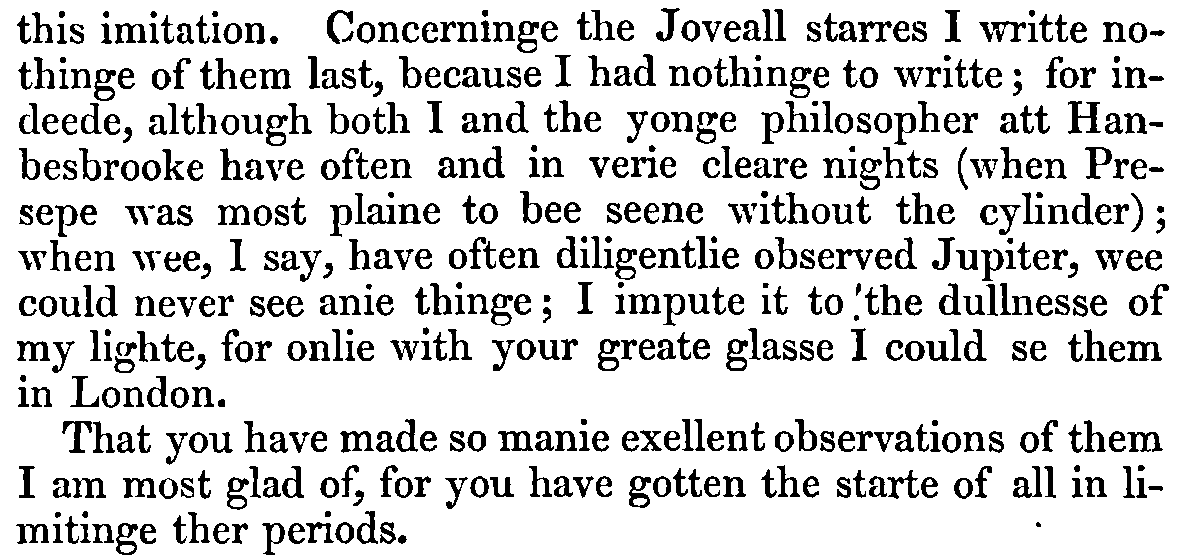
By December 1610, according to Bryn Jones’s historical account, Lower had observed Jupiter’s satellites with Harriot at Syon House. Writing to Harriot on 4 March 1611, Lower explained that his own instrument would not show the moons, though he had seen them with Harriot’s:13
[…] when wee, I say, have often diligentlie observed Jupiter, wee could never see anie thinge; I impute it to the dullnesse of my lighte, for onlie with your greate glasse I could se them in London.17
The letter goes beyond the excitement of seeing them. Lower was following Harriot’s efforts to determine their orbital periods:
That you have made so manie exellent observations of them I am most glad of, for you have gotten the starte of all in limitinge ther periods.17
Notes and sources
William Shakespeare, Cymbeline, 5.4, Folger Shakespeare Library. Source line breaks preserved except for one verse line divided between consecutive excerpts; the speech is presented complete across five passages. Bold emphasis and square-bracketed glosses are editorial. Omissions in Neville’s quotations are marked. Posthumus compares himself with a gout sufferer; he does not say he himself has gout. His captivity is as a supposed Roman prisoner, rather than arrest for debt.↩︎
Henry Neville to Ralph Winwood, 1 November 1604, Edmund Sawyer, ed., Memorials of Affairs of State, II (1725), p.35. Spelling and capitalization modernized.↩︎
Henry Neville to Robert Cecil, undated, endorsed 4 August 1601, Hatfield House, Cecil Papers 87/61; Calendar of the Manuscripts of the Marquess of Salisbury, XI (1906), pp.320–321. Spelling modernized from the manuscript; omissions marked. Chapter 7 gives the fine negotiations and family appeals.↩︎
Patricia Parker, “Cymbeline: Arithmetic, Double-Entry Bookkeeping, Counts, and Accounts,” SEDERI 23 (2013), pp.95–119, especially p.104, note 14, article. Parker discusses the accounting imagery, not a Neville attribution. The speech’s grammar makes the debtors the beneficiaries allowed to thrive after abatement. Edward Dowden, ed., Cymbeline (1903), pp.170–171, also discusses the penitential argument and the legal sense of bonds: edition.↩︎
In a different transaction, Neville sought compensation in January 1609 for his expenditure as ambassador in France: “[…] if I might obtain any thing which would yield me but half that I spent in France, I would hold myself well satisfied […].” He calculates a fraction he would accept, whereas Posthumus describes creditors accepting reduced payments. Henry Neville to Robert Cecil, Earl of Salisbury, 14 January 1609 (1608/9), The National Archives, SP 14/43, ff.29–30. Quotations follow John O’Donnell’s transcription; the continuation has not been fully collated against the manuscript. Revised draft: RBA D/EN/F6/2/3. Mary Anne Everett Green, ed., Calendar of State Papers, Domestic, James I, 1603–1610 (1857), no.22, January 1609. Spelling modernized. Chapter 33 examines the letter’s argument about poverty and reputation. In the same appeal Neville compares himself to the diseased man at Bethesda who needed help to enter the water. The figurative bonds concern service and gratitude, rather than the obligations in the financial schedule. Robert Sidney’s later notice of Neville’s death says he “hath left a great debt behind him”; Robert Sidney to Barbara Gamage Sidney, 22 July 1615, Margaret P. Hannay, Noel J. Kinnamon and Michael G. Brennan, eds., Domestic Politics and Family Absence (Ashgate, 2005), Letter 252 (C81/259; De L’Isle and Dudley V, p.303), publisher record. Sidney’s notice gives no sum or connection with the earlier bonds.↩︎
Boccaccio, Decameron, II.9, Brown University, Decameron Web. Bernabò loses the wager and becomes poor; his life is later declared forfeit, and his wife obtains his pardon after he asks her forgiveness. The developed prison prayer is absent from that tale. This comparison does not claim absence from every proposed source for Cymbeline. Cancellation of bonds also had an established religious use in writing about redemption. Samuel Rowlands, A Terrible Battell Betweene the Two Consumers of the Whole World: Time, and Death (1606), juxtaposes a usurer’s money, bonds and bills with a rich man suffering from gout: EEBO-TCP A11139. This earlier conjunction supplies context, but not Posthumus’s penitential offering of his life. For another Shakespearean use of the cancelled bond, see Macbeth, 3.2.↩︎
Royal Berkshire Archives, D/EN/F6/1/5, unsigned bond-maturity schedule, preserved among Miscellaneous correspondence, of Sir Henry Neville, D/EN/F6/1. The first-person heading and provenance identify Neville as the probable debtor; the hand is not independently authenticated. The nine recorded sums total £1,709. February 1598 is February 1599 in modern year numbering. The schedule does not record later payment or cancellation.↩︎
William Shakespeare, Cymbeline, 5.4, Folger Shakespeare Library. Bold emphasis added. All play quotations in this chapter follow this text.↩︎
Maisano, “Shakespeare’s Last Act,” pp. 402–407 and 420, notes 3 and 51; Martin Butler, ed., Cymbeline (Cambridge University Press, 2005), p. 6, quoted in Maisano’s note 3. Composition and any Christmas 1610–1611 performance are scholarly reconstructions; Forman’s account is undated, within his notes conventionally assigned to 1611; see the manuscript description and images.↩︎
For the astronomical interpretation, Scott Maisano, “Shakespeare’s Last Act: The Starry Messenger and the Galilean Book in Cymbeline,” Configurations 12.3 (2004), pp. 401–434, especially pp. 402–406 and 416–417, DOI. The article appeared on Project MUSE in 2007. Lower’s observation and Neville correspondence are documented separately below.↩︎
John Pitcher, ed., Cymbeline (Penguin, 2005), introduction, p. lxxiii, quoted and discussed in Maisano, p. 406; Peter Usher, “Jupiter and Cymbeline,” Shakespeare Newsletter 53 (2003), pp. 4–10, especially p. 8, discussed there. Pitcher’s and Usher’s positions are cited through Maisano’s published account. Maisano, pp. 416–417, including note 43 citing Pitcher’s commentary, pp. 288–289; his source is Galileo Galilei, Sidereus Nuncius or The Sidereal Messenger, trans. Albert Van Helden (University of Chicago Press, 1989), pp. 31–32. These are interpretations of Shakespeare’s imagery, not endorsements of a Neville attribution. The Folger stage direction specifies Posthumus as the centre of the circling movement. Maisano describes the spirits dancing “about the descending god” (p. 402; cf. p. 433); that is his account of the astronomical analogy, rather than the wording of the stage direction. For a dissenting assessment of the astronomical interpretation and discussion of the scene’s religious and dramatic functions, see C. R. A. Eager, Theophany on the Shakespearean Stage (PhD thesis, University of Leeds, 2020), pp. 131–132, White Rose repository. The play’s tablet is not named as Galileo’s book.↩︎
J. L. Vivian, ed., The Visitations of the County of Cornwall (Exeter, 1887), pp. 268, 299–300 and 459, Killigrew, Lower and Treffry pedigrees; public digitization. These pedigrees make Anne Killigrew and William Lower second cousins once removed, both descended from John Killigrew (d. 1536) and Jane Petit. Anne descends through their son John and his son Sir Henry; William through their daughter Elizabeth, her daughter Agnes Treffry, and Agnes’s son Thomas Lower. This is the relationship supplied by the printed pedigrees, alongside the contemporary letter’s own kinship language.↩︎
Bryn Jones, “Despite the Clouds: A History of Wales and Astronomy,” The Antiquarian Astronomer 8 (2014), pp. 66–86, especially pp. 68–69, journal issue. The December 1610/Syon House placement comes from the historical account; Lower’s March letter itself specifies London and Harriot’s telescope.↩︎
William Lower to Henry Neville, St Winnow, 30 July and 6 November 1608, Royal Berkshire Archives, D/EN/F7, public catalogue. The July letter’s address and closing both use kinship language. The file concerns the execution of Sir Jonathan Trelawny’s will and the wardship of his sons. The quoted passages are from the original July letter; the two letters concern estate business, not astronomy.↩︎
Journals of the House of Commons, vol. 1, 2 April 1604, second scribe, “Restitution of Southampton.” The entry records appointment to the committee, not proof of attendance at its meeting.↩︎
William Lower to Thomas Harriot, 21 June 1610, printed from the holograph in Henry Stevens, Thomas Hariot, the Mathematician, the Philosopher and the Scholar (London, 1900), pp. 116–118, quotation p. 118; public text. Stevens dates the letter 21 June; Lower’s own dateline reads “the longest day of, 1610.” The quotation has been checked against the printed page image. Anna Cetera-Włodarczyk, Jonathan Hope and Jarosław Włodarczyk, “Unsphered, Disorbed, Decentred: Shakespeare’s Astronomical Imagination,” Shakespeare 17.4 (2021), pp. 400–427, especially the section “Shakespeare, Ptolemy, Copernicus and Beyond” and notes 37–38, DOI. Their discussion of Lower cites his letter to Harriot of 21 June 1610; it is separate from the March 1611 observation letter quoted above.↩︎
William Lower to Thomas Harriot, 4 March 1611, printed from British Library, Add. MS 6789, in J. O. Halliwell, ed., A Collection of Letters Illustrative of the Progress of Science in England (London: Historical Society of Science, 1841), pp. 38–40, quotation and image p. 40. Original printed spelling retained; emphasis added. This is a facsimile of the printed edition, not the manuscript.↩︎