An Egyptian messenger comes before Octavius Caesar after Antony’s death, asking what he intends for Cleopatra:
EGYPTIAN
A poor Egyptian yet, the Queen my mistress,
Confined in all she has, her monument,
Of thy intents desires instruction, […]
— Antony and Cleopatra, 5.11
Shakespeare’s principal source, North’s translation of Plutarch, has no Egyptian envoy at this point. Instead, North sends Caesar’s representative Proculeius to Cleopatra directly. Shakespeare adds the queen’s representative approaching Caesar, as well as the phrase “the Queen my mistress.” The phrase does not occur in the searchable text of North’s 1579 translation.2
Reporting his first audience with Henri IV in May 1599, Neville described how he had presented Elizabeth’s letters and explained his appointment:
the Queen my mistress being very willing to continue the good amity, that had been so long since begun and entertained between them […] had sent me to reside about his person as her ordinary ambassador.3
Both Shakespeare’s Egyptian envoy and Neville speak to a foreign ruler as the representative of an absent queen.
Writing in French to Villeroy, the secretary of state, on 6 June 1599, Neville uses the same formula, la royne ma maistresse, while pressing for a satisfactory answer to Elizabeth’s demands.4
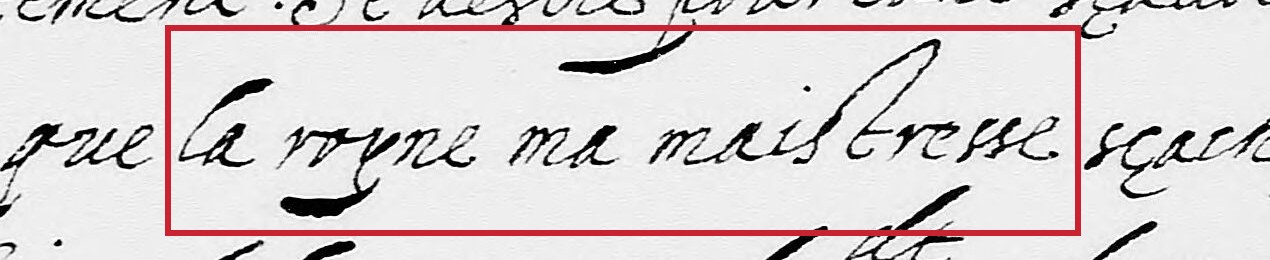
This was habitual language for Neville: the exact phrase occurs twelve times in ten English letters to Cecil between May 1599 and January 1600, discussing alliances, debts, war and obligations between rulers.5
Twelve exact uses and one possessive form.
| Date (all to Robert Cecil) | Wording | Winwood, I |
|---|---|---|
| 15 May 1599 | the Queen my mistress being very willing to continue the good amity | p. 20 |
| 26 May 1599 | the other respect of the Queen my mistress was like to continue | p. 33 |
| 26 May 1599 (separate letter) | the great wrong and ingratitude done therein to the Queen my mistress | p. 36 |
| 6 June 1599 | so would I upon the Queen’s my mistress’s | p. 45 |
| 15 June 1599 | anything else that might concern the Queen my mistress | p. 49 |
| 13 July 1599 | so little respect towards the Queen my mistress | p. 61 |
| 13 July 1599 | want of respect towards the Queen my mistress | p. 61 |
| 28 July 1599 | the money the Queen my mistress had lent the King | p. 79 |
| 7 August 1599 | Whereas the Queen my mistress, by reason of her present war | p. 85 |
| 15 November 1599 | for the interest of the Queen my mistress | p. 129 |
| 15 November 1599 | a due regard of the Queen my mistress | p. 129 |
| 3 January 1599/1600 | against the subjects of the Queen my mistress | p. 141 |
| 26 January 1599/1600 | the Queen my mistress had discharged the part of a true and perfect friend and confederate | p. 148 |
In the survey of 239 dramatic texts dated 1590–1615, the words “queen my mistress” occur in two Shakespeare plays and none of the 201 other entries. Only Antony and Cleopatra uses the full formula “the Queen my mistress.” The other Shakespeare example is Posthumus’s exclamation to Imogen in Cymbeline 1.1:
POSTHUMUS
My queen, my mistress!6
Posthumus addresses his beloved; the Egyptian speaks for his queen. The formula occurs in other printed prose, including accounts of two embassies recorded in Hakluyt. Neville used the language of contemporary diplomacy, and Shakespeare gives that language to Cleopatra’s envoy.7
“Perpetual amity”
The same letter reporting Neville’s first audience contains a second expression used in Antony and Cleopatra. Neville had urged the king to maintain free trade between England and France. He argued that friendship would last longer if it rested on the interests of their subjects as well as the dispositions of their rulers. He therefore asked that trade continue:
in such ample sort as it had been in his predecessors’ times, and according to the treaties of perpetual amity passed between the two crowns.8
In Antony and Cleopatra 2.2, Agrippa proposes a marriage to secure an alliance between Antony and Caesar. Antony should marry Caesar’s sister Octavia:
AGRIPPA
To hold you in perpetual amity,
To make you brothers, and to knit your hearts
With an unslipping knot, take Antony
Octavia to his wife, whose beauty claims
No worse a husband than the best of men;9
North supplies the marriage and its political purpose. Octavia is to be “a good mean to keep good love and amity betwixt her brother and him.” Shakespeare makes that hope “perpetual amity”: the language of a treaty enters a proposal of marriage. No other dramatic text in the 1590–1615 survey uses the phrase.10
The French equivalent also appears in diplomacy and literature. Francis I’s instructions to his ambassador in England in 1533 speak of perpetuelle amitié (perpetual friendship) with the pope; in Marguerite de Navarre’s Heptaméron, lovers promise une amitié perpetuelle (a perpetual friendship).11
Neville invokes treaties binding two crowns; Agrippa proposes to bind rival rulers through Octavia. Both speakers seek a lasting settlement by giving political friendship a durable foundation. The play will expose the fragility of Agrippa’s promise.
“The Queen my mistress” identifies the authority for whom Neville speaks; “perpetual amity” names the relationship he is charged with maintaining. Both occur in his account of his first audience with Henri IV, and both enter Antony and Cleopatra where Shakespeare reshapes North’s narrative. The play’s ancient politics are expressed in language Neville used in conducting his own embassy.
Honour and profit
Overwhelmed by the expense of entertaining English visitors in Paris, Neville told Thomas Windebank in January 1600 what his future motto would be:
And ever hereafter my motto shall be fie upon honour that brings no profit.12
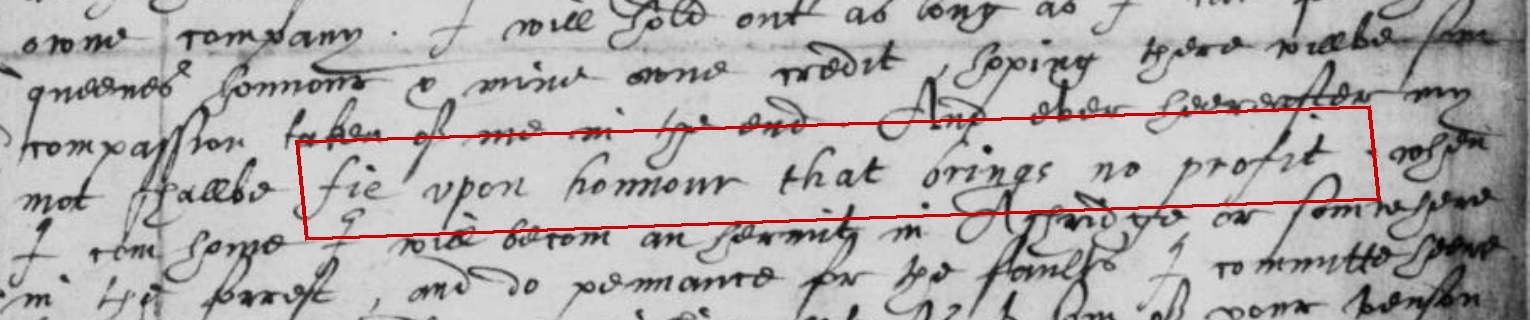
Pompey turns the same opposition into a declaration of principle in Antony and Cleopatra 2.7. His new allies and former enemies are drinking aboard his vessel. Menas proposes cutting the cable and killing them, leaving Pompey master of their territories. Pompey says Menas should have acted without consulting him; now that he knows the plan, he must forbid it:
POMPEY
Ah, this thou shouldst have done
And not have spoke on ’t! In me ’tis villainy;
In thee ’t had been good service. Thou must know
’Tis not my profit that does lead mine honor;
Mine honor, it. Repent that e’er thy tongue
Hath so betrayed thine act. Being done unknown,
I should have found it afterwards well done,
But must condemn it now. Desist and drink.13
The episode is already in North. His Pompey says Menas should have acted without telling him, then declares: “I was never taught to break my faith nor to be counted a traitor.” Shakespeare preserves the compromising admission but gives it a new verbal shape: “profit” must follow “honor.”14
Neville curses honour that costs him money; Pompey insists that honour must govern profit, while admitting he would have welcomed the profitable crime had it been committed without his knowledge. Neville makes a bitter joke of the conflict between public standing and personal advantage; Pompey makes a convenient principle of it.
Notes and sources
William Shakespeare, Antony and Cleopatra, 5.1, Folger Shakespeare Library. Shakespeare quotations preserve the edition’s line breaks. Bold marks the corresponding words.↩︎
Plutarch, The Lives of the Noble Grecians and Romanes, translated by Thomas North (1579), “Antonius,” p.1007, TCP A09802. North sends Proculeius to Cleopatra; Shakespeare adds the Egyptian’s embassy in 5.1 before Caesar sends Proculeius. The earlier joint embassy through Euphronius appears in North, p.1004, and Shakespeare’s 3.12. A search of the complete 1579 TCP transcription, checking original spellings as well as standardized forms, found neither “queen my mistress” nor “my mistress,” and no occurrence of “queen” within 100 words of “mistress.” Variants checked included mistresse, mistres and mystresse. This result concerns the searchable transcription, which contains gaps, rather than every page of every edition.↩︎
Neville to Robert Cecil, Paris, 15 May 1599, Ralph Winwood, Memorials of Affairs of State, ed. Edmund Sawyer, I (1725), p.20. Spelling and capitalization modernized; ellipsis marks an omission. The letter calls this his first audience on p.24. The French king’s “serviteur” courtesy appears on p. 21 and is compared with Twelfth Night 3.1 in Chapter 24.↩︎
Henry Neville to Nicolas de Neufville, seigneur de Villeroy, Paris, 6 June 1599, Bibliothèque nationale de France, Français 15970, ff.101r–102r, phrase at f.102r; manuscript. The quoted French preserves the manuscript spelling. The letter is also printed in Ralph Winwood, Memorials, ed. Edmund Sawyer, I (1725), pp.37–38, with the corresponding phrase on p.38. The French example is additional to the English-language counts below.↩︎
The comparison uses 162 English Neville letters and 239 dramatic entries dated 1590–1615: 38 Shakespeare plays and 201 other works, including masques, entertainments and translations. The Neville occurrences are individually identified in the table through the cited pages of Winwood’s Memorials. Ignoring punctuation and capitalization and allowing period spelling variants such as queene and mistresse, “queen my mistress” returned twelve Neville occurrences in ten letters, two Shakespeare occurrences in two plays, and no other dramatic match. The full “the queen my mistress” occurs only in Antony and Cleopatra among those plays. Including the possessive gives thirteen instances in eleven letters. The dramatic texts are from Pervez Rizvi’s Collocations and N-grams; results describe that dated collection. The table modernizes spelling and follows Winwood, Memorials, I: the second 26 May letter is headed “Of the same date with the former” on p.36; the former begins on p.29. The possessive on p.45 means the Queen my mistress’s place and honour. The 13 July and 15 November entries include Neville’s indirect reports of answers given to him.↩︎
Shakespeare, Cymbeline, 1.1, Folger. Only the opening exclamation of Posthumus’s speech is quoted.↩︎
An EarlyPrint standardized-word search of texts published through 1616 found six occurrences across three records: Amadis of Gaule (1590), A18993; Hakluyt’s Principal Navigations, A02495, dated 1599 in the search catalogue; and Speed’s Theatre of the Empire of Great Britain (1612), A68764. Hakluyt’s three occurrences concern two ambassadors to Russia: Thomas Randolph, in his own account of his 1568 embassy, describes delivering the queen’s message through an interpreter; the account of Sir Jerome Bowes’s 1583 embassy twice gives the phrase in his replies defending Elizabeth’s standing against the emperor’s disparaging comparisons with other rulers. See Randolph’s and Bowes’s accounts.↩︎
Neville to Cecil, 15 May 1599, Winwood, Memorials, I, p.24. Spelling and capitalization modernized. “Intercourse” in the surrounding passage concerns trade between the realms.↩︎
Shakespeare, Antony and Cleopatra, 2.2, Folger.↩︎
North, Lives (1579), “Antonius,” p.984, TCP A09802. Spelling modernized; “&” expanded to “and.” A search of the same 239 dramatic texts dated 1590–1615, from Pervez Rizvi’s Collocations and N-grams, found “perpetual amity” only in Antony and Cleopatra. Amyot’s French version has “bonne paix & certaine amitié entre eulx” (good peace and firm friendship between them), without “perpetual” at this point: Les vies des hommes illustres, VI (1567), p.3420. The English phrase also occurs in Robert Greene’s Pandosto (1588), the principal source for The Winter’s Tale. Its ambassadors welcome a marriage because “those kingdoms which through enmity had long time been dissevered, should now through perpetual amity be united and reconciled” (spelling modernized): TCP A02143, closing reconciliation passage. For its relationship to Shakespeare, see the Folger’s account of the sources of The Winter’s Tale. Greene provides an earlier marriage-alliance use, not evidence that this passage supplied Antony and Cleopatra.↩︎
Francis I, instructions to Jean de Dinteville, Anet, 27 January 1533 (1532 in the document’s dating), BnF, Dupuy 547, ff.188–190; David Potter’s edition of the 1533 correspondence, item 7. The king expresses his desire for perpetual friendship and filial observance towards the pope. Marguerite de Navarre, L’Heptaméron des nouvelles (1559), thirteenth tale, ending; the narrator doubts the lovers’ ability to fulfil their promise. The English translation, The Queen of Navarre’s Tales (1597), TCP A06891, likewise has “perpetuall amity.” French spelling retained; translations supplied here.↩︎
Neville to Thomas Windebank, Paris, 10 January 1599/1600, The National Archives, SP 12/274, f.15; State Papers Online, Gale MC4304580829; TNA record. John O’Donnell’s transcription; spelling modernized, with “mot” rendered as “motto.”↩︎
Shakespeare, Antony and Cleopatra, 2.7, Folger.↩︎
North, Lives (1579), “Antonius,” p.984, TCP A09802. Spelling modernized. North’s account already contains Pompey’s willingness to benefit from an act done without his knowledge. Shakespeare’s explicit honour–profit antithesis distinguishes the wording of his speech.↩︎