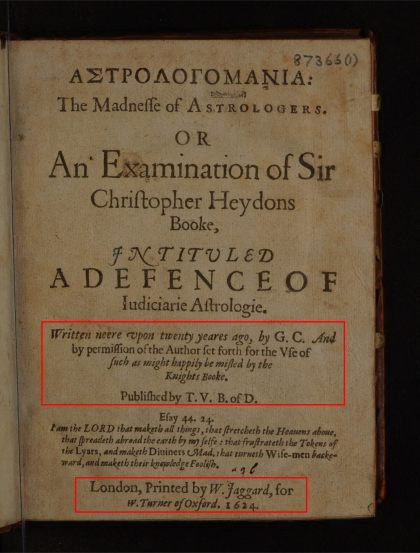
William and Isaac Jaggard’s printing house produced Shakespeare’s First Folio in 1623. The following year, George Carleton’s Astrologomania appeared with the imprint “Printed by W. Jaggard, for W. Turner of Oxford.” Turner was the Oxford bookseller-publisher; the Jaggard shop supplied the printing.1,2 In 1604, John Chamber had named Henry Neville and Henry Savile as executors and directed that Carleton’s book against astrology be printed alongside his own.3
From Chamber’s will to the Jaggard press
The 1624 title page describes the work as:
Written near upon twenty years ago, by G. C. And by permission of the Author set forth […]
Thomas Vicars brought the work to publication. By then Carleton had married Neville’s widow, and Vicars was Carleton’s son-in-law. A publication planned during Neville’s lifetime had resurfaced within his extended family.1,4,5
William Turner registered the book on 18 July 1623 as An Examination of Sir Christopher Heydon’s book entitled “A Defence of Judicial Astrology.” Nearly four months later, on 8 November, Edward Blount and Isaac Jaggard registered Shakespeare’s First Folio.6
In his will, Chamber called Carleton’s work The Arraignment of Astrology. The agreement in author, subject and approximate date makes Astrologomania its likely continuation or revision.3
Carleton defended Chamber against Sir Christopher Heydon, who argued that the stars could predict human actions and fortunes.7
King Lear: blaming the stars
Gloucester blames eclipses for broken family bonds. Edmund, who has just deceived him with a forged letter, ridicules the excuse: people blame heaven for behaviour that is their own. Carleton states the principle directly:
For over a man’s freedom, the Positions of heaven have no power. And it is a most foolish thing, for a man to seek that without him, whose cause is altogether within himself.8
Edmund makes the same point through the circumstances of his birth:
EDMUND […] An admirable
evasion of whoremaster man, to lay his goatish
disposition on the charge of a star! My father
compounded with my mother under the Dragon’s
tail, and my nativity was under Ursa Major, so that it
follows I am rough and lecherous. Fut, I should
have been that I am, had the maidenliest star in the
firmament twinkled on my bastardizing. […]
—King Lear 1.29
The connection becomes more specific when Carleton brings adultery and the birth of children into his argument:
When Adultery is committed and Bastards begotten, it is against the revealed will of God: But he that shall affirm that God hath no will, nor power, nor part in gene[r]ation, shall take away part of his power, and give it to some other thing, and so make more Gods.10
Both discussions connect sexual conduct, birth and responsibility. Their answers differ: Carleton argues that even a child conceived in adultery cannot fall outside God’s power; Edmund denies that the stars made him what he is. Shakespeare gives the dispute a voice inside the family whose conduct is at issue.10
Macbeth: a truth that deceives
The witches’ prediction begins to come true when Macbeth learns that he has been made Thane of Cawdor. That success encourages him to believe their promise of kingship. Banquo warns that truth itself can be the bait:
BANQUO […]
And oftentimes, to win us to our harm,
The instruments of darkness tell us truths,
Win us with honest trifles, to betray ’s
In deepest consequence.—
—Macbeth 1.311
Carleton attacks precisely this reason for trusting predictions. He quotes Heydon’s claim that nothing had made him so “confident in the validity of this Art” as seeing its predictions “fall out true.”12 If that proves astrology trustworthy, Carleton argues, it would prove witchcraft trustworthy too. His example is the prediction made to Saul:
God in his just judgement against the wicked King Saul, did suffer Satan thus to deceive and illude Saul, even by foretelling him a true Event […].13
Vicars makes the argument especially close to Banquo’s wording in his prefatory dedication:
[…] the wizard is never a whit the more to be believed […] The Devil telleth truth sometimes, and yet he is still the Father of Lies; and his Instrument (at haphazard) may light upon a Truth, and yet remain a Liar still.14
Banquo’s “instruments of darkness” and Vicars’s devilish “Instrument” both tell a truth that makes them dangerous to believe. Vicars’s words belong to the 1624 publication; they cannot simply be assigned the earlier date given for Carleton’s treatise.14
Carleton also describes spirits that “make show of obedience” in order to “catch the soul of man in these snares.” Macbeth follows that course, demanding further assurances and trusting promises whose meaning he discovers too late:15
MACBETH […]
And be these juggling fiends no more believed
That palter with us in a double sense,
That keep the word of promise to our ear
And break it to our hope. […]
—Macbeth 5.811
Notes and sources
George Carleton, Astrologomania: The Madnesse of Astrologers (London: W. Jaggard for W. Turner of Oxford, 1624), STC 4630, ESTC S107657, TCP A17971, title page, Wellcome copy; Folger catalogue. Spelling in quotations from Carleton and Vicars has been modernized; wording is otherwise retained. Words divided at line endings are joined. Red rectangles in the illustrations are editorial annotations. G.C. is George Carleton; T.V. is Thomas Vicars, Bachelor of Divinity. The date of composition is the title page’s approximate retrospective statement.↩︎
Folger Shakespeare Library, “The Shakespeare First Folio,” “Who produced the First Folio?”; Carleton’s 1624 title page, cited above. The imprint reads W. Jaggard; it does not settle the division of work between William and Isaac. Eton catalogue, B42024, suggests that Isaac may have finished the printing. The registration entry is examined in the register note below. The printing-house connection does not establish transmission of Shakespeare manuscripts from Neville’s estate.↩︎
John Chamber, will, July 1604, The National Archives, PROB 11/104/339. It names Neville and Savile as executors, directs publication of unprinted works, and identifies Carleton of Mayfield’s Arraignement of Astrologie. See “Back in Public Life.” Agreement in author, subject and approximate date supports continuity with the 1624 work, not identity of every passage or a claim that Neville personally edited the surviving text.↩︎
For Anne Neville’s marriage and Vicars’s patronage address, Bartholomaeus Keckermann, A Manuduction to Theology, translated by Thomas Vicars (1622), sig. A2r, printed dedication. For Vicars’s wife as Bishop Carleton’s daughter, J. H. Cooper, “The Vicars and Parish of Cuckfield in the Seventeenth Century,” Sussex Archaeological Collections 45 (1902), p. 17, monument transcription. The two women named Anne are distinguished in “Thomas Vicars: The Poet Who Shakes a Spear,” which also gives the 1628 Shakespeare passage and Fred Schurink’s identification of it.↩︎
Vicars’s prefatory poem also recalls Carleton’s Heroici characteres, the 1603 book addressed to Neville: “In Authorem & eius Opera,” prefatory leaf, with its marginal title. Thomas Vicars, dedicatory epistle in Carleton, Astrologomania, opening and printed subscription.↩︎
Edward Arber, ed., A Transcript of the Registers of the Company of Stationers of London, vol. IV, p. 64, 18 July 1623: William Turner entered the work under the hands of Doctor Feateley and Master Bill, warden, for sixpence. The descriptive title is modernized here. The entry names neither Carleton, Vicars nor Jaggard and does not use the title Astrologomania; its identification with that book follows the catalogue attribution cited above and agrees with its subject and Turner imprint. The First Folio entry is on p. 69, 8 November 1623, under Blount and Isaac Jaggard, covering those plays not already entered to other stationers. Both entries were checked against scanned pages of Arber’s printed transcript, not the original handwritten register.↩︎
Carleton, Astrologomania, chapter I, p. 1. “Chambers” is the printed form of John Chamber’s name. The book repeatedly defends him against Heydon.↩︎
Carleton, Astrologomania, chapter VIII, p. 75, following the distinction between natural causes and free human action on pp. 73–74.↩︎
Shakespeare, King Lear, 1.2, Folger Shakespeare Library. Ellipses mark excerpts from longer speeches. For the Chamber comparison and the distinction between Edmund’s polemic and the play’s larger treatment, see Phebe Jensen, “Causes in Nature: Popular Astrology in King Lear,” Shakespeare Quarterly 69.4 (2018), 205–227, especially pp. 214–216, publisher’s article, discussed in the Lear chapter. The Carleton comparison developed here is distinct from Jensen’s Chamber finding.↩︎
Carleton, Astrologomania, chapter X, pp. 111–113, quotation p. 112. “Gene[r]ation” corrects the printed “gene-gation,” divided across two lines. He answers Heydon on how forbidden acts can occur under providence; p. 113 expressly retains punishment and God’s freedom from sin.↩︎
Shakespeare, Macbeth, 1.3, 4.1 and 5.8, Folger Shakespeare Library.↩︎
Carleton, Astrologomania, chapter III, p. 20, quoting Heydon, A Defence of Iudiciall Astrologie (1603), p. 195. The quotation here is controlled against Carleton’s printed report of his opponent’s words, not a fresh collation of Heydon’s edition.↩︎
Carleton, Astrologomania, chapter III, pp. 20–22, quotation p. 21. The claim about Satan and Saul is Carleton’s theological account, not an independent assertion about supernatural events.↩︎
Thomas Vicars, dedicatory epistle in Carleton, Astrologomania (1624), third answer to the argument from successful prediction, unnumbered leaf. “Remain” follows the printed page. This prefatory formulation is not assigned the main treatise’s approximate composition date.↩︎
Carleton, Astrologomania, chapter IX, pp. 85–87, quotation p. 86. This passage interprets the claims of Agrippa and distinguishes apparent obedience from the spirits’ entrapment of the enquirer. Vicars also develops this argument in his epistle.↩︎