Jaques turns the world around him into arguments. He divides life into seven ages, distinguishes kinds of melancholy, and asks for the degrees of the lie. That combination of learning and classification suggests a particular, ultimately tragic, figure in Neville’s circle: Henry Cuffe.1,2
Cuffe was Oxford’s Regius Professor of Greek before becoming Essex’s secretary. Henry Savile, Neville’s tutor, had supported his studies and brought him to Merton. Cuffe later approached Neville on Essex’s behalf; their discussions are examined in Chapter 6.3
The strongest connection with Jaques is Cuffe’s The Differences of the Ages of Man’s Life. Printed in 1607, six years after his execution, its title page dates the book to 1600. Neville’s longstanding association with Cuffe provides a possible route of access to the work in manuscript.4,5
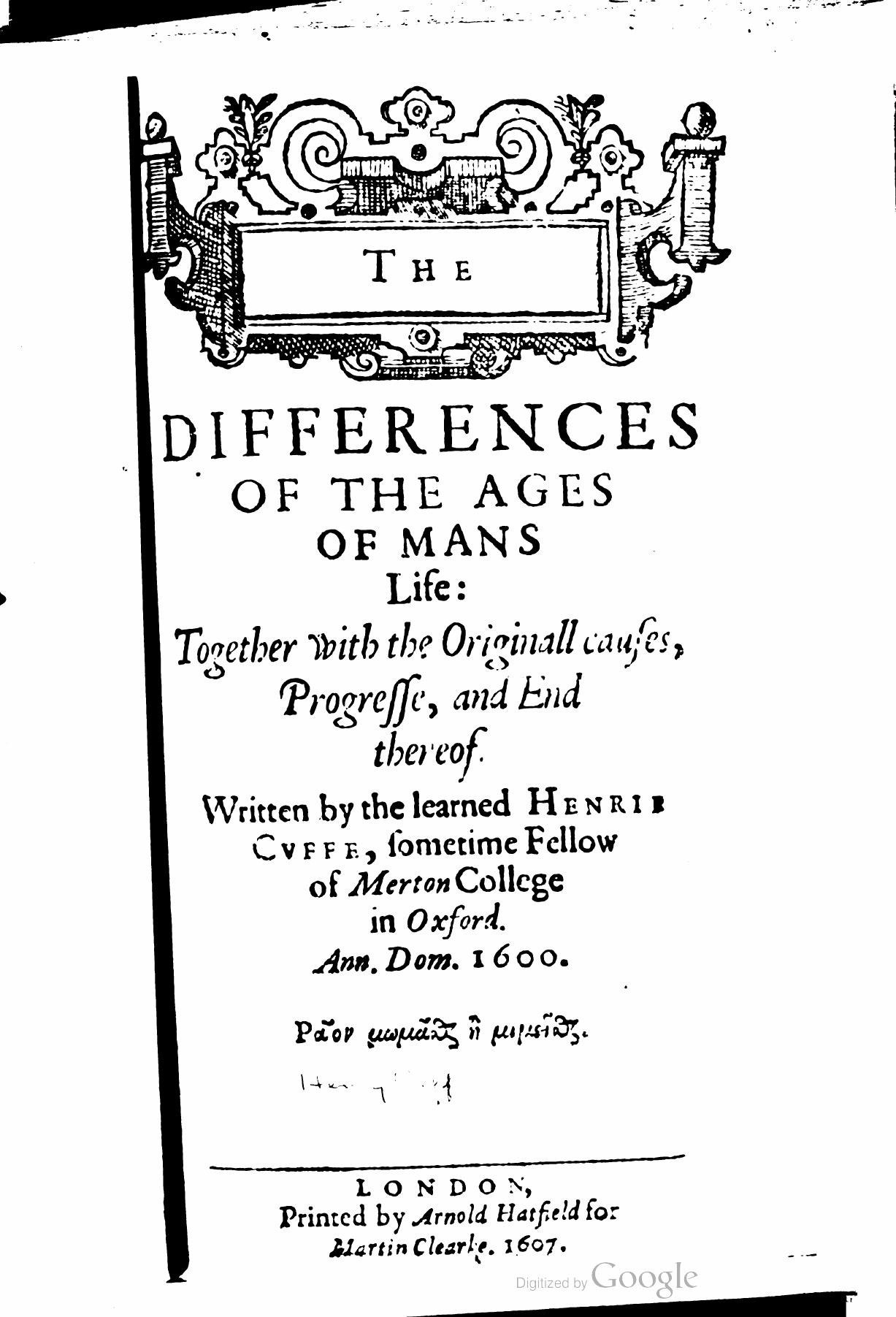
The seven ages, with the sunlight removed
Alan Taylor Bradford’s 1976 study in Shakespeare Quarterly explains how Shakespeare transforms the traditional seven ages of man. Bradford uses Cuffe to set out the planetary scheme: the seven ages follow the seven heavenly bodies, from the Moon to Saturn. At the centre stands the Sun, governing the prime of life. Cuffe describes its effect:
our youthful prime, by the Sun’s lively operation, is lifted up from base delights to a loftier and more man-like resolution and liveliness.4
The planetary scheme, as Cuffe describes it, gives life a flourishing middle, as desire rises into resolution and mature strength. Jaques keeps the number seven but removes that prime:
JAQUES All the world’s a stage,
And all the men and women merely players.
They have their exits and their entrances,
And one man in his time plays many parts,
His acts being seven ages. At first the infant,
Mewling and puking in the nurse’s arms.
Then the whining schoolboy with his satchel
And shining morning face, creeping like snail
Unwillingly to school. And then the lover,
Sighing like furnace, with a woeful ballad
Made to his mistress’ eyebrow. Then a soldier,
Full of strange oaths and bearded like the pard,
Jealous in honor, sudden and quick in quarrel,
Seeking the bubble reputation
Even in the cannon’s mouth. And then the justice,
In fair round belly with good capon lined,
With eyes severe and beard of formal cut,
Full of wise saws and modern instances;
And so he plays his part. The sixth age shifts
Into the lean and slippered pantaloon
With spectacles on nose and pouch on side,
His youthful hose, well saved, a world too wide
For his shrunk shank, and his big manly voice,
Turning again toward childish treble, pipes
And whistles in his sound. Last scene of all,
That ends this strange eventful history,
Is second childishness and mere oblivion,
Sans teeth, sans eyes, sans taste, sans everything.
— As You Like It, 2.7.6
Mars and Jupiter move forward; Saturn’s decay expands into two stages, preserving the total of seven. As Bradford puts it, “Jaques’ cosmos is sunless.”7
|————————————|————————————| | 1. Moon: moist infancy | 1. The mewling, puking infant | | 2. Mercury: play, talk and learning | 2. The schoolboy unwilling to learn | | 3. Venus: blossoming desire | 3. The lover sighing over his mistress | | 4. Sun: the vigorous prime | Omitted | | 5. Mars: courage and combat | Moved to 4: the soldier risking death for reputation | | 6. Jupiter: gravity and steadiness | Moved to 5: the justice displaying his authority | | 7. Saturn: decrepitude | Expanded into 6 and 7: the shrinking pantaloon, then second childishness and oblivion |
Jaques seems to be satirizing Cuffe’s solemn delineation. Mercury’s readiness for learning becomes a child creeping unwillingly to school. Cuffe’s Mars stirs men to “a more venturous boldness in quarrelling combats”; Jaques’s soldier is “sudden and quick in quarrel,” spending that boldness on a reputation as insubstantial as a bubble. Jupiter’s gravity dwindles into a well-fed justice’s solemn appearance and stock sayings.4,7
Shakespeare turns the learned scheme into an ironic character study: Jaques leaves no place for the flourishing prime in which human powers mature into something worth achieving.
“Compounded of many simples”
Jaques’s description of his own melancholy makes the comparison more specific:
JAQUES I have neither the scholar’s melancholy, which
is emulation; nor the musician’s, which is fantastical;
nor the courtier’s, which is proud; nor the
soldier’s, which is ambitious; nor the lawyer’s,
which is politic; nor the lady’s, which is nice; nor
the lover’s, which is all these; but it is a melancholy
of mine own, compounded of many simples, extracted
from many objects, and indeed the sundry
contemplation of my travels, in which my often
rumination wraps me in a most humorous sadness.1
— As You Like It, 4.1.
“Simples” are constituent ingredients. Jaques first separates melancholy into kinds, then describes his own as a mixture, its ingredients “extracted from many objects.” He calls it “the sundry contemplation of my travels” and ends with “a most humorous sadness.” The language of ingredients and humours makes his account of himself sound like an analysis of a substance.8
Cuffe uses the vocabulary of composition to explain the human body. He describes the body before the Fall as:
compounded of the contrary natures of the four elements
He traces natural death to “contrariety in the compound,” then explains that continued life depends on:
the due and just proportionable temperature of the four first qualities, Heat, Cold, Dryness, Moisture.9
Here “temperature” means the balance of the qualities. Cuffe then applies this account to the bodily complexions, including melancholy:
Lastly, melancholy resembling the earth and its qualities, cold and drought, both enemies to life, hasteneth the destruction of the body whereunto it is incident.10
Jaques turns this language of composition into a portrait of his own mind. Cuffe’s melancholy belongs to the body’s mixture; Jaques insists on a melancholy “of mine own,” assembled from the world he observes. His joke is more pointed because he first rejects the scholar’s melancholy, then explains himself in a scholar’s language of ingredients, compounds and kinds.
The scholar’s jokes and categories
Against that background, Jaques’s Greek joke acquires a more personal point. When Amiens sings, Jaques adds a verse with the refrain “Ducdame, ducdame, ducdame.” Asked to explain it, he replies:
AMIENS What’s that “ducdame”?
JAQUES ’Tis a Greek invocation to call fools into a
circle. […]11
— As You Like It, 2.5.
Jaques invents the puzzle and enjoys his companions’ need for an explanation. Beside Cuffe’s Greek professorship and his treatise on human ages, it contributes to the proposed portrait of a learned man making sport of his authority.
Jaques also asks Touchstone to name “the degrees of the lie,” which Touchstone sets out in seven stages. Across age, temperament and conduct, Jaques wants human experience sorted into its constituent kinds.2
Underhand persuasion
Oliver claims he has secretly tried to stop his younger brother Orlando from wrestling with Charles:
OLIVER Charles, I thank thee for thy love to me, which
thou shalt find I will most kindly requite. I had
myself notice of my brother’s purpose herein, and
have by underhand means labored to dissuade him
from it; but he is resolute. […]
— As You Like It, 1.1
Neville reports Henri IV’s private pressure on the Dutch States on 24 September 1599:
the king did underhand dissuade them from peace
Both use “underhand” with “dissuade … from” for private persuasion.12
Among the EEBO-TCP texts searched through 1623, the close construction appears only in Shakespeare’s First Folio. Neville’s dispatch supplies a dated private use in 1599.13
A clause and a voyage
Two further comparisons turn diplomatic language into comedy. In July 1599 Neville wants the treaty to require ships to carry both a flag and a passport. “Copulative” joins the requirements with and; “disjunctive” allows either one:
to make the clause copulative, which is now disjunctive, either to flag or passport.
At the play’s wedding gathering, Touchstone announces:
TOUCHSTONE God ’ild you, sir. I desire you of the like. I
press in here, sir, amongst the rest of the country
copulatives, to swear and to forswear, according as
marriage binds and blood breaks. […]
— As You Like It, 5.4
The word joins conditions in Neville’s treaty discussion and couples in Touchstone’s joke.14
That same July, Neville reports the Dutch fleet “victualled for a year.” Jaques gives Touchstone’s marriage a shorter allowance:
JAQUES […]
[To Touchstone.] And you to wrangling, for thy
loving voyage
Is but for two months victualled.—So to your
pleasures.
[…]
— As You Like It, 5.4
The naval expression becomes a joke about how long a marriage’s supplies will last. “Victualled” occurs in only three of the 239 plays dated 1590–1615 in the collection examined.15
Chapter 17 examines “purlieu” alongside Neville’s dispute over his free chase.
Morley and Neville’s stepmother
The play’s music supplies a household connection. Thomas Morley’s First Booke of Ayres (1600) printed “It was a lover and his lass,” sung by two pages in Act 5, twenty-three years before the play appeared in print.16
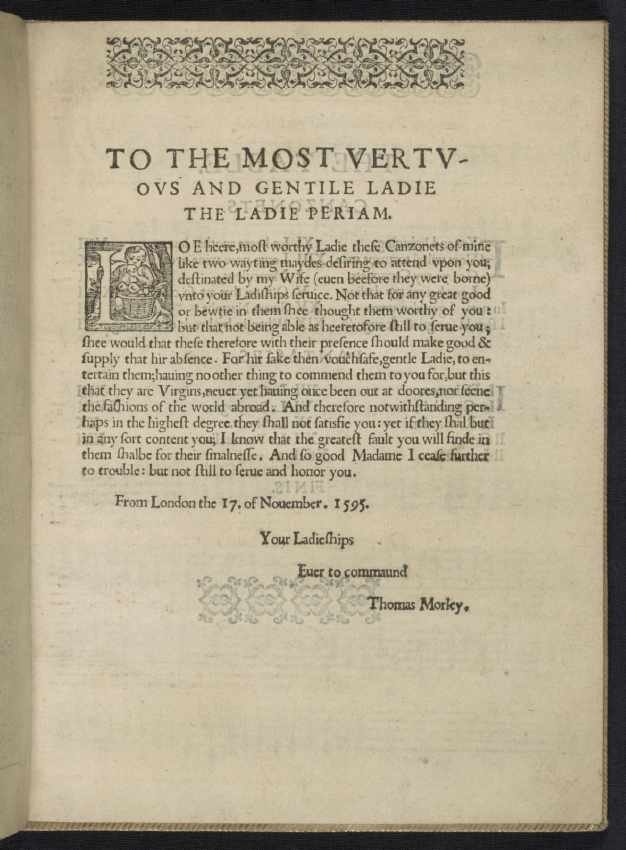
In 1595 Morley had dedicated his First Booke of Canzonets to Two Voyces to Lady Periam—Elizabeth Bacon, Neville’s stepmother and the Lady Nevell of Byrd’s keyboard manuscript, as John Harley identifies her. Morley explains that his wife had formerly served her and had intended these pieces for her before their completion. The canzonets would take her place, “not being able as heretofore still to serve you.”17
Amiens and the journey home
Amiens, the exiled duke’s companion, has a name absent from Lodge’s Rosalynde but present in Neville’s French itinerary. On 14 May 1600 Neville wrote to Cecil from “Between Amiens and Abbeville,” travelling from Paris to Boulogne. He joined the English peace commissioners there on 16 May; Chapter 5 describes the negotiations and maps the route.18
Later that summer, Neville returned from the Boulogne negotiations. He landed at Dover on 2 August, left on the fourth and reached London on the sixth. On 4 August the Stationers’ Register listed As You Like It among four plays “to be staied.” The entry gives no reason for the stay.19
Retreat from court
Neville also imagined exchanging public honour for religious retirement. Writing from Paris in January 1600, he declared that on returning home he would become “an hermit in Ashridge or somewhere in the forest” and “do penance” for his faults. Shakespeare gives As You Like It a comparable ending: Duke Frederick abandons the “pompous court” for a “religious life,” and Jaques resolves to join him. This departure from court has no counterpart in Lodge’s ending, where the usurper dies in battle.20
Notes and sources
Shakespeare, As You Like It, 4.1. The seven listed kinds precede Jaques’s description of his own mixture.↩︎
Cuffe, Differences, pp. 113–121, TCP A19683: definition of age, bodily heat and moisture, and alternative divisions of life. The comparison concerns the procedure of definition and division. Shakespeare, As You Like It, 5.4: Touchstone supplies the degrees of the quarrel at Jaques’s request.↩︎
Sidney Lee, “Cuff, Henry,” Dictionary of National Biography, vol. 13 (1888), biography, on Savile’s support, Cuffe’s Greek professorship, his Essex service and his dealings with Neville during the crisis. The identification of Cuffe as a possible model for Jaques is the argument considered here.↩︎
Henry Cuffe, The Differences of the Ages of Mans Life (London: Arnold Hatfield for Martin Clearke, 1607), title page and p. 121; STC 6103, TCP A19683. Cuffe’s quoted spelling and capitalization are modernized. The title dates the writing to 1600. The editor, R. M., describes the text as a transcript from an original reportedly Cuffe’s own.↩︎
Henry Cuffe, The Differences of the Ages of Man’s Life: Together with the Originall Causes, Progresse, and End Thereof (London: Arnold Hatfield for Martin Clearke, 1607), title page, R.M.’s dedicatory epistle, and the treatise, facsimile, Folger catalogue. The title dates the writing to 1600. R.M. reports a transcript of what he was informed was Cuffe’s original; this is the editor’s account of transmission. The possible route of manuscript access rests on Neville’s longstanding association with Cuffe; R.M.’s dedication does not name Neville as a reader. The title’s 1600 writing date gives no month and does not establish when a manuscript could have reached him, or whether the finished treatise preceded the play.↩︎
Shakespeare, As You Like It, 2.7, Jaques’s seven ages. The planetary interpretation follows Bradford’s argument in the next note; the planets are not named in Jaques’s speech.↩︎
Alan Taylor Bradford, “Jaques’ Distortion of the Seven-Ages Paradigm,” Shakespeare Quarterly 27, no. 2 (Spring 1976), pp. 171–176, especially pp. 173–175 (the “sunless” phrase is on p. 174), JSTOR. It treats Cuffe as an example of the tradition, not as a demonstrated personal model for Jaques; that latter proposal is the argument considered here.↩︎
David and Ben Crystal, Shakespeare’s Words, As You Like It, 4.1, gloss to “simple”, defines the noun in this passage as “ingredient, element, constituent.” The full Folger passage is cited above. “Humorous” invokes the humours and temperament; the comparison concerns that vocabulary, not its rarity. The reading of extraction and compounding as Jaques’s explanatory method is the present comparison.↩︎
Cuffe, The Differences of the Ages of Mans Life (1607), pp. 72–76: the first block quotation is on p. 72, in his account of the original harmony of the body; the second is on p. 76, where bodily life and health depend on the proportion of the four qualities. On p. 75 he identifies “contrariety in the compound” as a cause of natural death. Facsimile; TCP A19683. Cuffe also distinguishes bodily creatures “simple as mixed” on p. 8, in a discussion of the world’s duration. Printed pages 8, 72, 75 and 76 checked against the scan; spelling modernized. This is a comparison of composition and explanatory method: Cuffe does not supply Jaques’s exact phrase “compounded of many simples,” and his account of elemental bodily mixture is distinct from Jaques’s metaphorical mixture of experiences.↩︎
Cuffe, Differences (1607), pp. 97–99, especially p. 98, facsimile, TCP A19683. The passage compares sanguine, choleric, phlegmatic and melancholic constitutions in relation to length of life; it then turns to moderation of the affections. Quotation checked against the printed page; spelling modernized. This supplies a connection in subject and explanatory vocabulary, not Jaques’s exact phrase “compounded of many simples.”↩︎
Shakespeare, As You Like It, 2.5. The play supplies Jaques’s claim that the refrain is Greek, not an independently established Greek meaning. The exchange retains Folger line breaks.↩︎
Neville to Robert Cecil, Paris, 24 September 1599 O.S., Edmund Sawyer, ed., Memorials of Affairs of State, I (London, 1725), pp. 106–108, especially p. 107. Shakespeare, As You Like It 1.1. Neville’s spelling is modernized; Shakespeare follows Folger’s wording and line breaks. The connection allows intervening words; it is not an identical continuous phrase.↩︎
EarlyPrint/EEBO-TCP searches, 5 October 2026: underhand followed within five intervening words by dissuade found only Shakespeare’s First Folio, TCP A11954, among texts printed through 1623. Wider searches checked both orders, up to fifty intervening words, and joined, hyphenated and separated forms, including under hand, vnder hand and variants of dissuade such as disswade and diswade. British History Online’s full-text phrase search for “underhand dissuade” returned just one result: William Davison to Francis Walsingham, 13 January 1579, whose published calendar reads, “I have underhand dissuaded the journey as of little profit.” See Calendar of State Papers Foreign: Elizabeth, vol. 13, ed. Arthur John Butler (1903), no. 512, p. 390 (BHO). The manuscript’s corresponding words, “underhand disswaded,” were checked in State Papers Online, MC4312180517, TNA, SP 83/11, letter beginning at f.55, scan 57. This is an earlier diplomatic use; the search totals describe the collections and queries examined.↩︎
Neville to Cecil, 18 July 1599 O.S., Sawyer I, p. 74; Shakespeare, As You Like It 5.4. Neville’s proposed treaty requirement joins flag and passport rather than allowing either alone.↩︎
Neville to Cecil, Orleans, 13 July 1599 O.S., Sawyer I, pp. 61–66, quotation on p. 66; Shakespeare, As You Like It 5.4. Neville attributes the provisioning report to the Dutch agent. The dramatic count selects the 239 plays dated 1590–1615 in Pervez Rizvi’s Collocations and N-grams, using his published play catalogue and assigned dates. Normalized word forms were searched and spelling variants checked. Four occurrences of victualled occur in three plays: As You Like It, Patient Grissel, TCP A20077, and The Woman’s Prize in the Beaumont–Fletcher collection, TCP A27177. Public TCP comparators read “victualed” and “victual’d”; their contexts concern provisions. This is a count of the selected texts, not a first-use claim or a count of the noun victuals.↩︎
Thomas Morley, The First Booke of Ayres (London: H. Ballard for William Barley, 1600), sigs. B4v–C1r, STC 18115.5; Folger Shakespeare Library, printed song and commentary. Shakespeare, As You Like It, 5.3. The song appeared in print before the play, which was first published in the 1623 Folio.↩︎
Thomas Morley, The First Booke of Canzonets to Two Voyces (London: Thomas Este, 1595), dedication to Lady Periam, dated 17 November 1595, Library of Congress page image. John Harley, ‘My Ladye Nevell Revealed’, Music & Letters 86.1 (2005), 1–15, identifies her as Elizabeth Bacon, formerly Lady Nevell, and connects Morley’s dedication and his wife’s service to her. Morley does not name the place where his wife served. Spelling in the short quotation is modernized.↩︎
Neville to Cecil, 14 May 1600 O.S., Sawyer I, pp. 183–185, heading on p. 183. The heading’s spelling is modernized. Shakespeare, As You Like It 2.1. Thomas Lodge, Rosalynde (1590), ed. David Bevington, Internet Shakespeare Editions. Searches of this edition return neither Amiens nor Amyens. The departure from Paris and the request for instructions appear on p. 184. The commissioners’ dispatch of 20 May 1600 O.S. records the three arrivals from England at noon on 16 May and Neville’s arrival that evening: Sawyer I, p. 188.↩︎
Historical Manuscripts Commission, Calendar of the Manuscripts of the Marquis of Salisbury, X (London, 1904), p. 261, Fane to Cobham, 2 August 1600; p. 268, Neville to Cecil, 6 August 1600. Neville confirms his departure on Monday and arrival in London on the sixth. Stationers’ Company, Liber C, flyleaf, 4 August 1600: the other plays are Henry V, Much Ado About Nothing and Jonson’s Every Man in His Humour. As You Like It first appeared in the 1623 Folio; see the Folger textual introduction.↩︎
Henry Neville to Thomas Windebank, Paris, 10 January 1599/1600, The National Archives, SP 12/274, f. 15, State Papers Online, MC4304580829. Spelling modernized; the relevant manuscript passage was checked against John O’Donnell’s transcription. Neville complains of the expense of entertaining English visitors and of honour that brings no profit before imagining retirement and penance. Shakespeare, As You Like It, 5.4. Thomas Lodge, Rosalynde (1590), modernized edition edited by David Bevington, section 34, paragraphs 540–544: Torismond is slain in battle. The comparison concerns religious withdrawal from public life, rather than an identical phrase or an established borrowing.↩︎
