The Northumberland manuscript is a collection of Elizabethan political and literary writings, now at Alnwick Castle; its fire-damaged outer cover leaf has attracted particular attention. The collection was found among papers at Northumberland House in London in 1867. The cover carries a contents list surrounded and overlaid by names, phrases and pen trials—brief practice marks and scribbles. Its edges are burnt and large portions are missing; much of the surviving writing is faint.1
William Shakespeare, Francis Bacon and the Neville name crowd this one leaf. Shakespeare’s name appears repeatedly, in different forms, beside the titles of Richard II and Richard III. A passage from The Rape of Lucrece is written among the scribbles. Near the top are two entries I read as Nevills, accompanied by the Neville family’s punning motto, Ne vile velis—“wish nothing base.”2
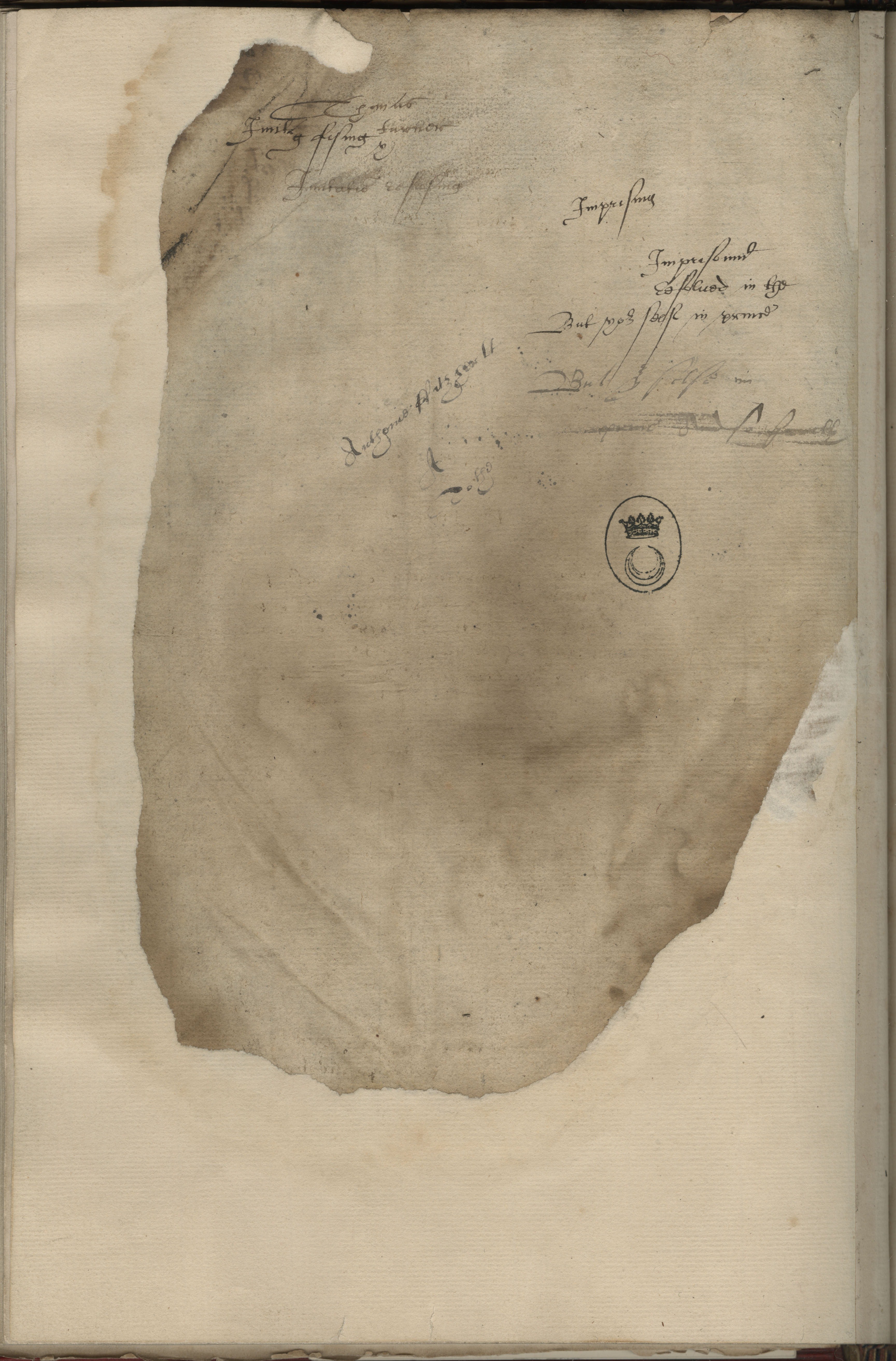
All the names, titles and the Lucrece fragment discussed here appear on the densely written front of the leaf, labelled folio 46r in Folger’s Shakespeare Documented. The reverse, 46v, is mostly blank apart from a few pen trials and a collection stamp. Older descriptions call the opening folio 1 or page i.3
Read the overview through four landmarks: A, the Neville entries and motto near the upper left; B, a cluster of Shakespeare names among the lower pen trials; C, the two Richard titles near the foot of the contents list; and D, the short broken lines from Lucrece lower on the left. The enlarged details below supply the readings; a contents entry is not a surviving manuscript of the named play.3,4,5,6
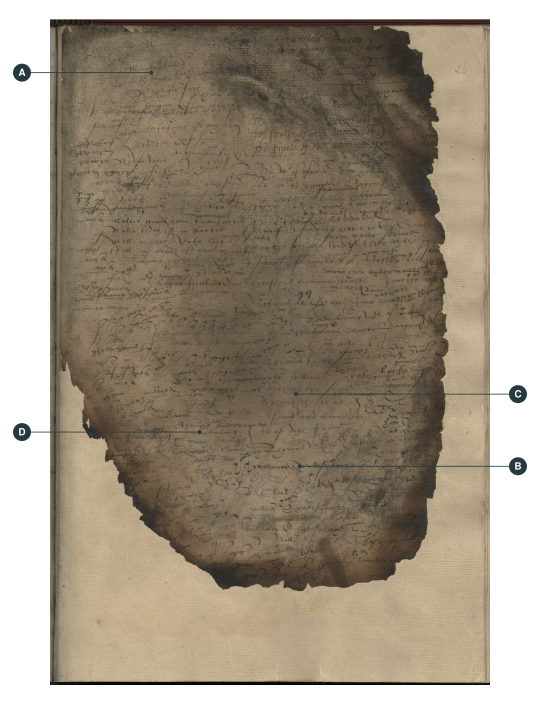
Two “Nevills” and the family motto
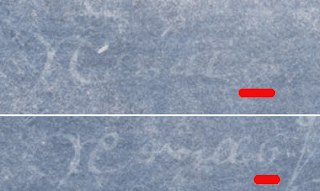
The two surname entries stand in the upper-left part of the recto. I read both as Nevills, with a final s; the upper occurrence is particularly faint. The manuscript’s u/v form can be rendered Neuills. The inverted details reproduced below make the faint strokes easier to distinguish, with red marks beneath the final letters.7
The final s permits a possessive reading—“Nevill’s”—and thus the possibility of an ownership mark. The nearby Ne vile velis makes the family connection explicit. The motto appears twice as well. Frank Burgoyne’s 1904 edition had already recorded two occurrences of the surname, transcribed as Nevill, and proposed Henry Neville as the person for whom the collection was made or to whom it belonged.2
Shakespeare, Bacon and the listed works
The names are not confined to a single heading. William Shakespeare recurs across the page, along with shortened forms and trials of its opening letters. Francis Bacon, Bacon and Baco recur too. They appear among other writing, sometimes crossed by it, and in several orientations.4
Near the foot of the contents list is this sequence:
William Shakespeare
Rychard the second
Rychard the third
Asmund and Cornelia
Ile of doges frmnt
by Thomas Nashe [&] inferior plaiers
The first two titles identify Shakespeare’s Richard II and Richard III. Asmund and Cornelia, also written elsewhere on the page, is a lost play. The next entry describes a fragment of The Isle of Dogs and names Thomas Nashe and “inferior players.” None of these four play texts survives in the volume.5
The list also includes speeches for the Earl of Essex at a tournament, a speech for the Earl of Sussex, and “Orations at Gray’s Inn revels”—entertainments at one of London’s Inns of Court. Other entries name Bacon’s Of Tribute, his essays, Leicester’s Commonwealth, and “Philipp against Monsieur”—Philip Sidney’s letter opposing Elizabeth’s proposed marriage to the French duke of Anjou. Bacon’s writings, Sidney’s letter and part of Leicester’s Commonwealth remain in the collection; the contents list therefore preserves both surviving material and works now absent.8
Political essays and plays in manuscript
The Northumberland collection combines political writings with entries for plays. Both kinds of manuscript also occur in Neville’s family. A manuscript defence of Richard III was dedicated to Neville, with additions attacking the playwrights who had blackened the king’s reputation. His son later supplied the manuscript of A King and No King to its publisher, Thomas Walkley; Zachary Lesser argues that the father had owned it first.9 These connections give the Neville name on the cover a concrete context: political essays and play manuscripts circulated through the family, as Chapters 21 and 52 examine.
A line from Lucrece
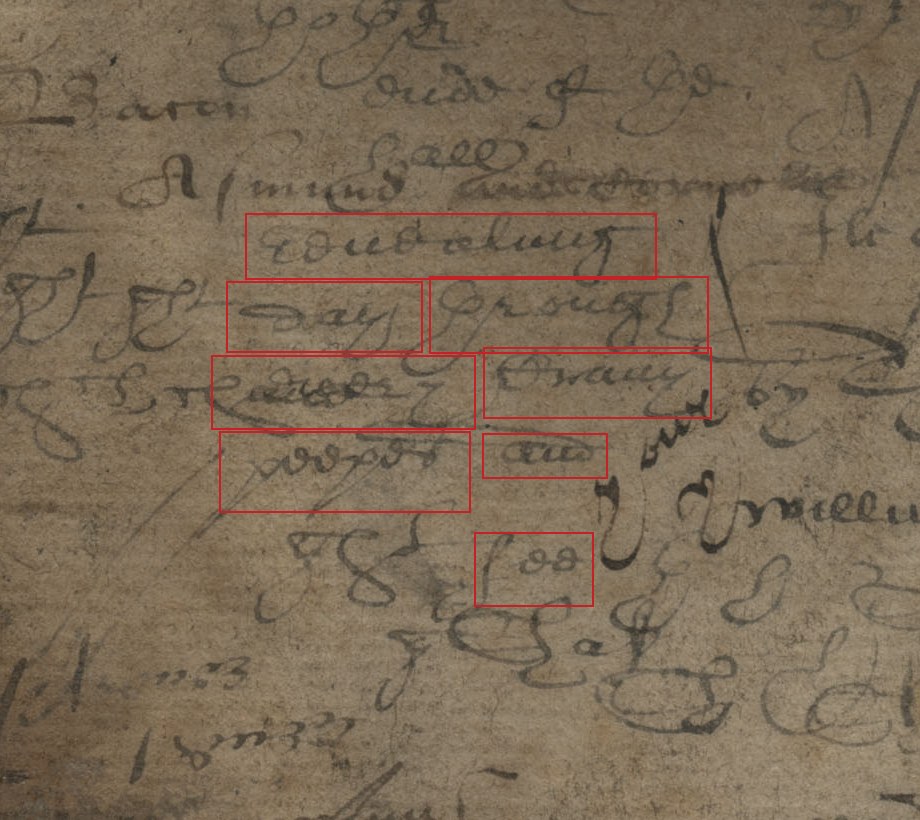
The flyleaf’s version of a line from The Rape of Lucrece differs from the published poem by one conspicuous word. With spelling modernized, the manuscript reads:
Revealing
day through
every cranny
peeps and
see
—Northumberland manuscript, f.46r
Shakespeare’s poem has:
Revealing day through every cranny spies
And seems to point her out where she sits weeping,
—The Rape of Lucrece, lines 1086–1087
The manuscript substitutes “peeps” for “spies”. The fragment continues “and see”; “Shak” is written below. The poem was first published in 1594, placing this literary reference within a few years of the collection’s usual dating, around 1597–1598.6
The page also has Honorificabiletudine, a form of the long Latin word used by Costard in Love’s Labour’s Lost, 5.1: honorificabilitudinitatibus.10
Notes and sources
Burgoyne, pp. ix–x, printing John Bruce’s account of the discovery and the burnt and singed papers. Bruce associated the damage with an earlier fire at Northumberland House.↩︎
Frank J. Burgoyne, ed., Collotype Facsimile & Type Transcript of an Elizabethan Manuscript Preserved at Alnwick Castle, Northumberland (London: Longmans, Green, 1904), pp. xvi–xviii and the “Modern Script Rendering of MS. Folio 1,” digitized edition. For the final-s reading, see Ken Feinstein’s 2019 discussion below. Burgoyne’s ownership suggestion is conjectural; his accompanying genealogy on p. xvi incorrectly treats Elizabeth Bacon, Neville’s stepmother, as his mother. See Chapter 1 for the family relationships.↩︎
Shakespeare Documented, “Shakespeare’s name, plays, and poems included in the Northumberland manuscript”, Alnwick Castle, DNP MS 525, ff.46r–v, c.1598. Peter Beal, Catalogue of English Literary Manuscripts 1450–1700, Alnwick Castle, MS 525, describes the damaged, window-mounted volume and dates it c.1597. The recto/verso labels here follow the modern photographic record.↩︎
Burgoyne, p. xvii and the “Modern Script Rendering” plate, records the repetitions of Shakespeare/William Shakespeare and Baco/Bacon/Francis Bacon, together with initials and abbreviated forms. The photograph shows the overlap and changing orientations.↩︎
Misha Teramura, “Asmund and Cornelia,” Lost Plays Database, updated 9 March 2016, “Historical Records”; Burgoyne, pp. xii–xiii. The displayed list follows Teramura, with the superscript fragment abbreviation placed on the line. The ampersand in brackets is editorial. The list may record texts once included in the collection; the surviving volume does not contain the four plays.↩︎
Burgoyne, p. xvii, preserves the short manuscript lines; Beal, CELM, ShW 5, identifies line 1086 and part of 1087. William Shakespeare, Lucrece, lines 1086–1087, Folger Shakespeare Library. The manuscript quotation is modernized in spelling; its broken lineation is retained. Burgoyne suggested that “see Shak” referred to Shakespeare; CELM instead includes “and see” within the fragment of the poem’s next line.↩︎
Ken Feinstein, “Part 1: Henry Neville, Shakespeare, and the Northumberland Manuscript,” 26 October 2019, identifies the possible final s in both names and illustrates an inverted view. “Nevills” follows that reading; Burgoyne’s published transcription omits the final s. The name details are enlargements of the same photograph, not independent witnesses. Ownership remains an interpretation of the entries.↩︎
Burgoyne, pp. xi–xiii. “Tilt” refers to a tournament; the speeches and revels entries should not all be counted as separate surviving plays. For the surviving Bacon works and Sidney’s letter, see Beal, CELM, MS 525, entries BcF 319, BcF 310, BcF 322 and SiP 182. For the surviving Leicester’s Commonwealth fragment, see Burgoyne, p. 75, and the facsimile plates labelled 63–90. Burgoyne describes a little less than half of the work as surviving. Beal, CELM, LeC 66, likewise records the incomplete copy in Alnwick Castle, MS 525, pp. 63–90.↩︎
British Library, Add MS 29307, dedication of the Encomium of Richard III; William Cornwallis, The Encomium of Richard III, ed. A. N. Kincaid (1977), p. 33, edition record. Thomas Walkley’s dedication to “Sir Henrie Nevill” in A King and No King (1619), sig. A2r, records receipt of the text from its dedicatee, first edition. Zachary Lesser identifies the family context and argues, following Charles Mills Gayley, that the ambassador had originally obtained the manuscript, which later passed to his son: “Mixed Government and Mixed Marriage in A King and No King: Sir Henry Neville Reads Beaumont and Fletcher,” ELH 69.4 (2002), pp. 947–977, at p. 949, DOI.↩︎
Burgoyne, p. xvi, reads “Honorificabiletudine.” Compare Shakespeare, Love’s Labour’s Lost, 5.1. Related forms have a history before Shakespeare; the two spellings are not identical.↩︎