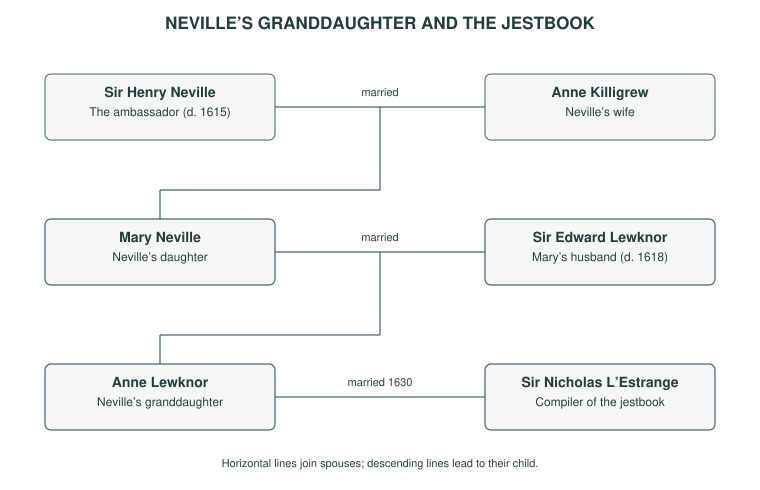
Sir Nicholas L’Estrange (1604–1655) compiled Merry Passages and Jeasts, a handwritten collection of more than six hundred jests. In 1630 he married Anne Lewknor, Henry Neville’s granddaughter; her mother was Mary Neville, the ambassador’s daughter, and her father Sir Edward Lewknor.1
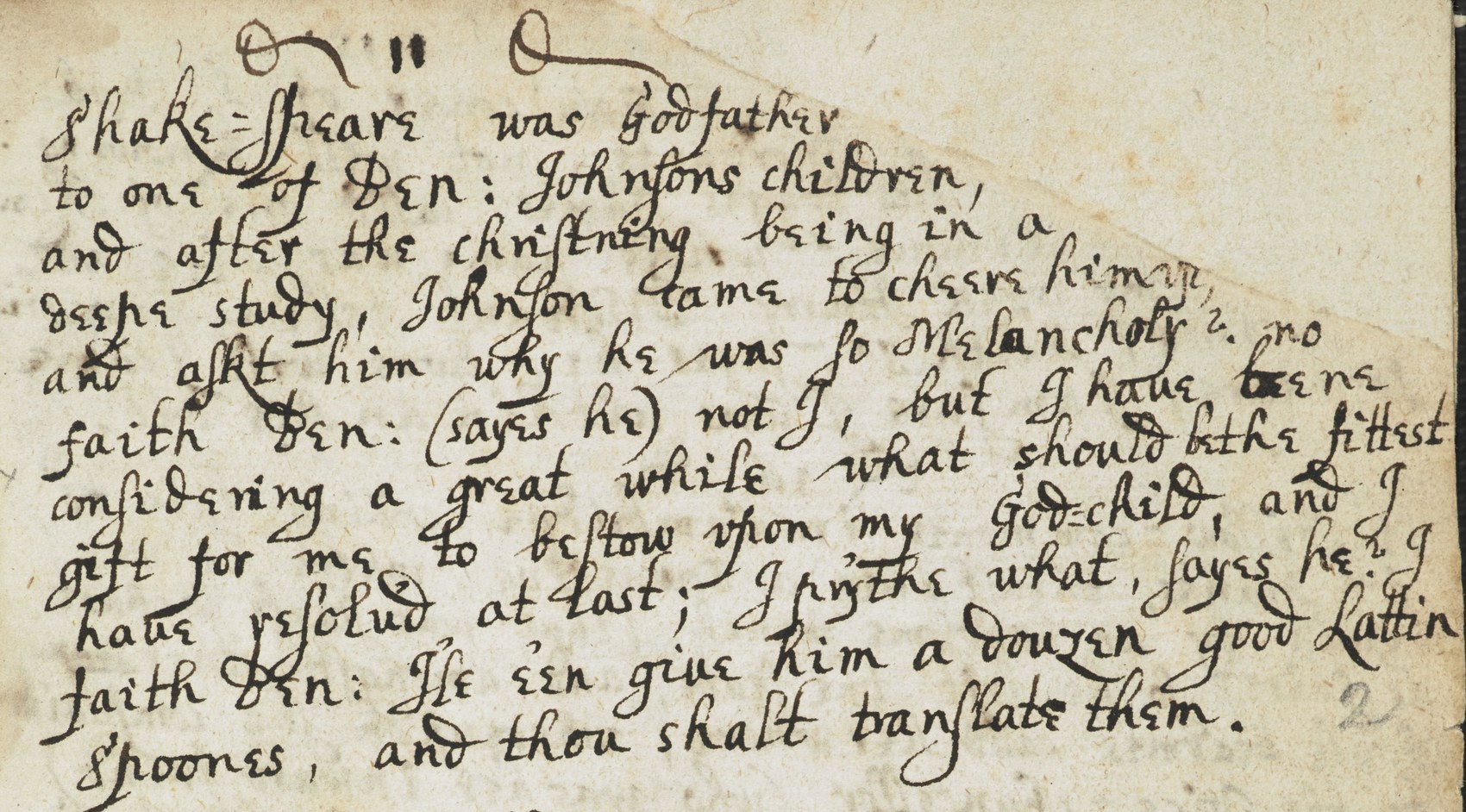
One story in the manuscript, now British Library Harley MS 6395, has Shakespeare offer Ben Jonson a dozen “Latin spoons” for his child, then ask Jonson to “translate” them. The joke turns on Latin sounding like latten, a cheap copper alloy: Jonson would have to turn the spoons into silver. L’Estrange records “Mr Dun” as the source of this Shakespeare jest.2
The manuscript often preserves the name of the informant for each jest. Those source labels let us see Neville’s family participating in the preservation of oral literature. Anne appears as “My wife”; her mother Mary as Lady Lewknor; and her siblings Edward and Catherine as Ned Lewknor and “My Sis. Ka. Lewk.” William Neville also supplied stories. Shakespeare’s remembered wit survives among the things that this household and its wider acquaintance thought worth writing down.
Who compiled the book?
Nicholas belonged to the L’Estrange family of Hunstanton in Norfolk. The family relationships are set out in J. G. Nichols’s notice accompanying William J. Thoms’s 1839 selection from the manuscript. Nichols also cites the marriage settlement of August 1630 and quotes Mary Lewknor’s will, made in 1642. In that will Mary names her eldest daughter, Lady Anne L’Estrange, wife of Sir Nicholas, and leaves her a coach and four coach horses. The sequence from Neville through Mary to Anne is thus supported by a named family relationship, not merely a similarity of surnames.1

Mary’s husband died in 1618, when their children were young. Nicholas’s marriage to Anne brought him into a family whose older generation had lived through Neville’s public career and whose younger generation could transmit stories learned at home. His manuscript consequently contains several layers of time. A jest written down in the middle of the seventeenth century may describe a childhood episode decades earlier. The date of the compilation must not automatically become the date of the incident.
The two principal printed editions also need distinguishing. Thoms’s Anecdotes and Traditions offers a selection, retaining the original L’Estrange numbers alongside its own sequence. H. F. Lippincott’s 1974 edition provides the fuller text. The numbers used in this chapter are the L’Estrange jest numbers, so that a reader can find the same item across witnesses. The manuscript image reproduced below supplies direct visual control for jest 11; the other passages are discussed from the printed editions.3
The “Latin spoons”: Shakespeare and Jonson
Jest 11 presents Shakespeare as godfather to one of Ben Jonson’s children. After the christening, Jonson finds him unusually thoughtful and asks the reason. Shakespeare explains that he has been considering a suitable present. His answer supplies the joke:
I’ faith, Ben, I’ll e’en give him a dozen good Latin spoons, and thou shalt translate them.2

The pun depends on Latin sounding like latten, a term for brass or another copper alloy. Silver spoons were an appropriate christening gift. Shakespeare proposes the cheaper material and leaves Jonson the task of “translation”: changing the metal into silver. A familiar scholarly operation becomes an impossible act of alchemy. The story gives Shakespeare the quick conception and Jonson the labour required to make it valuable.
Its remembered setting is domestic and social. The two writers are connected through a child’s christening rather than a theatrical quarrel. The joke imagines them sharing enough linguistic and literary understanding for its compressed ending to work. Neither the date of the christening nor the identity of the child is supplied by the anecdote. Heather Wolfe’s Folger account presents the manuscript, transcribes the entry and explains the wordplay, making it possible to see exactly what the surviving witness says.2
For the history of Neville’s descendants, the manuscript’s provenance is the point of contact. The story was preserved by the man who married his granddaughter. That is a concrete relationship between the Shakespearean anecdotal tradition and the extended Neville family. The manuscript also tells us something more precise about transmission: this particular story is attributed to “Mr Dun,” rather than to one of the Neville informants.
Could “Mr Dunn” be the poet Donne’s son?
Lippincott renders the source name “Mr Dunn”; Thoms prints “Mr. Dun.” One possibility is John Donne the younger (1604–1662), the poet’s son. He handled his father’s books and papers and helped bring his writings into print. If he were the informant, the story would connect two families engaged in preserving literary memory: the Donnes and the Neville–Lewknor–L’Estrange descendants.4
That identification remains open. The source label contains no first name, office or statement of kinship. There are also “Mr Donne” labels elsewhere in Lippincott’s transcription, including jests 26 and 56. Their presence makes the spelling question worth investigating across the manuscript, but does not prove that the differently written names designate one man. A variant spelling is a possible connection, not a completed identification.5
The Herbert stories
William Neville supplied the dice story about William Herbert in jest 69. The jest is quoted and discussed in Chapter 48. Chapter 52 follows the later patronage and wardship involving the two Herbert brothers. The jestbook records the story’s informant as “Mr Wil: Nevill,” a more explicit Neville source attribution than that attached to the “Latin spoons” anecdote.6
A separate story, jest 535, concerns Philip Herbert and an argument at bowls. It is attributed to Mr Jenkins. The distinction between the brothers and their informants matters: the collection preserves several Herbert stories through different routes.7
Anne Neville, Mary as a child, and Mr Packer
Jest 604 takes us into an older domestic scene. Mr Packer is travelling in a coach with “old Sir Henry Nevill’s Lady.” Lady Lewknor, then a little girl, accompanies them. After a hard frost and snow, the adults describe the thaw as having removed the ice. The child sees a remaining piece and calls Packer’s attention to it. He deliberately misconstrues her hurried words as an indecent expression and repeats that interpretation to her mother.8
The comedy depends on sound: “There ice yet i’ the ditch” becomes, through Packer’s wilful interpretation, “There I shit i’ the ditch.” The jest preserves a little performance of childish innocence and adult teasing within a named family scene.
The people make it particularly valuable here. “Old” Lady Neville is identified in Lippincott’s index as Anne Killigrew, the ambassador’s wife. The child is Mary, later Lady Lewknor and eventually the compiler’s mother-in-law. Lippincott identifies Mr Packer as John Packer, whose service and correspondence were discussed in Chapter 49, although the jest itself supplies only the surname. The History of Parliament places Packer in Neville’s service by 1600, so the 1604 letter discussed in Chapter 49 is not the beginning of that employment. The narrative reaches back behind Nicholas’s marriage to an episode from the childhood of the woman whose daughter he married.
It would be a mistake to classify this simply as a story supplied by Neville’s wife. She is a participant in it; the entry does not give her as its informant. Yet its survival shows how anecdotes could carry household names and remembered childhood scenes into a later generation. The family’s oral history included the ambassador’s wife and secretary as well as more public literary figures.
Women as tellers and makers of wit
Jest 70, another of William Neville’s contributions, preserves an exchange between old Lady Neville and her maid. Seeing a gentleman eating from a dish at the lower end of the table, she asks her attendant whether it is a fool. The maid answers that she thinks so, and that she is certain it was made for one. “Fool” names both a dessert and a foolish person. The maid supplies the punchline, moving the ambiguity from the dish to its intended eater. This small domestic exchange shows the older woman participating in the same play of double meanings that animates the more celebrated literary stories.9
Jest 123 is told by the compiler’s wife Anne. A Lady Neville insists on serving a piece of cheese to a witty young man and praises it extravagantly. After tasting it, he replies that the cheese must be her own, which explains her liking for it, since he would not wish to eat worse. She takes the words as an insult and becomes angry until he explains his meaning. The sentence can sound like a refusal to taste anything worse than this cheese, or a compliment: he desires nothing inferior to it. Lippincott’s index identifies this Lady Neville as Elizabeth Smythe, wife of the Sir Henry Neville who died in 1629. She was the ambassador’s daughter-in-law and later married John Thorowgood, whose place in the household is followed in Chapter 52. She is distinct from Anne Killigrew, the “old” Lady Neville of jests 70 and 604.
Anne’s contribution was not confined to stories about relatives. In jest 121 she supplies the tale of an atheist caught in a storm, who asks God to hear him on the ground that he seldom troubles him. In jest 173 she tells of a severe mother who accidentally whips her son’s visiting Cambridge fellow pupil after he exchanges beds with the son. In jest 175 a minister claims that extra wine helps a man praise God with greater alacrity. These stories range across household discipline, university life, piety and self-excusing speech. Anne was an active source of the collection’s comic variety.10
Her siblings also contributed. Ned Lewknor supplies jest 64, in which an English speaker hears a Latin sentence delivered in a French accent and produces an absurd English rendering built around “veal.” Catherine’s jest 370 gives a hungry man the fear that his own stomach will eat him up. The latter is brief, but its label, “My Sis. Ka. Lewk.,” matters: the compiler records a woman of the Neville-descended family as the person from whom it came.11
These entries make the genealogy more than an introductory ornament. It explains why the source labels recur and how the collection acquired its material. The women of the family were remembered characters, skilled conversational participants and suppliers of stories. Anne’s role is especially clear because “My wife” records the compiler’s immediate relation to his informant.
What the collection preserves
The jestbook combines literary celebrity with household familiarity. Shakespeare and Jonson appear alongside women at dinner, a mischievous secretary in a coach, a gambling Herbert and a mother deceived by university visitors. The collection preserves the forms in which wit travelled: a remembered reply, an ambiguous sound, a borrowed story, a family anecdote and a named attribution.
For Neville’s afterlife, its significance extends beyond a single famous jest. His daughter’s household and his granddaughter’s marriage helped sustain a culture in which stories were exchanged and recorded. Several relatives appear in the record as tellers. The Shakespeare anecdote’s place within that manuscript is therefore part of an identifiable social history, even while its own informant remains unresolved.
The source labels also give us a discipline for reading it. We can distinguish the person in the story from the person who told it, and both from the person who wrote it down. Applied consistently, that distinction brings the Neville family’s actual contribution into clearer view. Their role in preserving seventeenth-century wit is substantial enough to be described in its own terms.
Notes and sources
J. G. Nichols, notice of Sir Nicholas L’Estrange and his contributors, in William J. Thoms, ed., Anecdotes and Traditions, Illustrative of Early English History and Literature (Camden Society, 1839), xv–xvii, xx, public edition. Nichols cites the 25 August 1630 marriage settlement and quotes Mary Lewknor’s 1642 will at xvi. The diagram shows selected descendants, not a complete pedigree. The British Library catalogue dates the compiler 1604–1655 (Harley MS 6395); Nichols and the title of Lippincott’s edition give 1603 for his birth.↩︎
British Library, Harley MS 6395, fol. 2r, jest 11, c.1650; Heather Wolfe, “Shakespeare, Ben Jonson, and the ‘Latin’ spoons in L’Estrange’s jest book”, Shakespeare Documented, Folger Shakespeare Library, updated 23 February 2020. The record supplies the image, transcription, source label and explanation of the pun. The quotation modernizes spelling. British Library image supplied under the Public Domain Mark.↩︎
Thoms, Anecdotes and Traditions, introduction and source list, especially xiii–xx; H. F. Lippincott, ed., “Merry Passages and Jeasts”: A Manuscript Jestbook of Sir Nicholas Le Strange (1603–1655), Salzburg Studies in English Literature, Elizabethan & Renaissance Studies 29 (Salzburg, 1974). The title’s birth date is retained as part of its bibliographical identity. The present chapter does not claim a fresh collation of the whole Harley manuscript.↩︎
Thoms, Anecdotes and Traditions, 2–3, jest 11; Lippincott, Merry Passages, 19, jest 11. Augustus Jessopp, “Donne, John (1604–1662)”, Dictionary of National Biography, for the younger Donne’s custody and publication of his father’s papers. Jessopp does not identify him as this informant.↩︎
Lippincott, Merry Passages, 22, jest 26, and 28, jest 56, both with “Mr Donne” labels. These printed spellings call for comparison with the original manuscript before any identification of the several labels is adopted.↩︎
Lippincott, Merry Passages, 30–31, jest 69, and the person-index entries for Herbert and Neville. The story names “Sir William Herbert”; its identification with the third Earl of Pembroke is the editor’s. The source label is “Mr Wil: Nevill.”↩︎
Thoms, Anecdotes and Traditions, 71–72, selection no. CXXVII, L’Estrange jest 535, source “Mr. Jenkins,” and Nichols’s explanatory note identifying Philip Herbert. The note also corrects chronological embellishments in another version of the earlier affront.↩︎
Lippincott, Merry Passages, 160, jest 604, and the index entry for old Lady Neville. The two expressions are transcribed from the printed edition. Packer’s first name is not supplied in the jest; the person index identifies him as John Packer. Paul Hunneyball, “PACKER, John (c.1572–1649)”, History of Parliament (2010), records his service to Neville by 1600. The anecdote is undated, and the family notice cited above does not establish Mary’s birth date; it therefore does not support a precise year for this childhood scene.↩︎
Lippincott, Merry Passages, 31, jest 70, and 45–46, jest 123, with the distinct index entries for old Lady Neville and Lady Neville, pp. 230–231. The latter identifies Elizabeth, daughter of Sir John Smythe of Ostenhanger and wife of Sir Henry Neville (d.1629). Jest 70 is sourced to William Neville; jest 123 to the compiler’s wife.↩︎
Lippincott, Merry Passages, 45, jest 121, and 60, jests 173 and 175. Each carries “My wife” as its source label. The catalogue of her contributions is larger than the examples discussed here.↩︎
Lippincott, Merry Passages, 29, jest 64, source “Ned. Lewkenor”; Thoms, Anecdotes and Traditions, 51, selection no. LXXXVII, L’Estrange jest 370, source “My Sis. Ka. Lewk.” For the siblings’ relationships, see Nichols’s family notice, xvi–xvii.↩︎