On 2 March 1601, after the failure of Essex’s rebellion, Henry Neville explained why he had objected to an earlier proposal to force access to Elizabeth. Southampton had described the plan to him. Neville’s answer was a maxim from Tacitus:
This was an action of the nature of those which, as Tacitus saith, non laudantur nisi peracta, and would be interpreted by the success.1
The Latin means “they are not praised unless carried through.” The enterprise would acquire its meaning from its outcome: success might vindicate what failure would condemn. About five years before Macbeth, Neville had put that dangerous calculation into words.2

An enterprise judged by its success
Neville drew the maxim from Otho’s speech urging a coup against Galba in Tacitus’s Histories.3 The official account of the Gunpowder trial in 1606 also applied the maxim to the conspirators, showing its renewed public currency.3 His former tutor Henry Savile had translated the passage in 1591:
No delay in that enterprise is to be used, which never is commended, before it be ended.4
The same problem of completion and consequence opens Macbeth’s soliloquy:
MACBETH
If it were done when ’tis done, then ‘twere well
It were done quickly. If th’ assassination
Could trammel up the consequence and catch
With his surcease success, that but this blow
Might be the be-all and the end-all here,
But here, upon this bank and shoal of time,
We’d jump the life to come. But in these cases
We still have judgment here, that we but teach
Bloody instructions, which, being taught, return
To plague th’ inventor. […]
—Macbeth 1.75
Macbeth wants Duncan’s death—his “surcease”—to secure success without releasing further consequences. “Trammel” imagines those consequences caught in a net. He would risk the life to come if he could make the present safe. But almost immediately he recognizes that judgment operates here, in this world: murderous instruction returns to punish its teacher.
Gordon Braden describes the impulse driving Macbeth from one violent act to the next as a “radical fear of incompleteness.”5 Neville asks how success will determine the judgment passed on an enterprise; Macbeth asks whether success can end its consequences. The blow can kill Duncan, but cannot end what the killing sets in motion.
Holinshed supplied Shakespeare with the murder of Duncan and, in the separate story of King Duff, a reluctant killer urged on by his wife, drunken attendants and an attempt to put the blame on others. Donwald already recoils inwardly from the deed. Shakespeare develops that reluctance into the sustained reasoning we hear before the murder, then makes its consequences dominate the rest of the play.6
Lady Macbeth voices the other side of the argument while she waits for her husband to return:
LADY MACBETH
Alack, I am afraid they have awaked,
And ’tis not done. Th’ attempt and not the deed
Confounds us. […]
—Macbeth 2.27
Here the peril lies in an unfinished enterprise. Once Macbeth returns, however, completing it proves to have solved very little. The couple’s immediate problem becomes the manufacture of an acceptable account: who will be blamed, what will be seen, and how they must appear.
The face and the hidden intention
At the end of his declaration, Neville describes learning at court what Essex had done:
[…] when I understood what course the Earl took, and saw the vizard taken from him and his true intents laid open, which he had so disguised before with specious pretences and cloaks of religion and virtue, I detested him and his actions from the bottom of my heart […].8
A vizard is a mask. In Neville’s image, the action exposes the intention that words had hidden.
In Macbeth, the mask has to stay on. Before the banquet at which Banquo’s absence will require explanation, Macbeth tells his wife to be attentive to Banquo, whose murder he is secretly arranging. Their faces must protect the secrets of their hearts:
MACBETH So shall I, love,
And so I pray be you. Let your remembrance
Apply to Banquo; present him eminence
Both with eye and tongue: unsafe the while that we
Must lave our honors in these flattering streams
And make our faces vizards to our hearts,
Disguising what they are.
—Macbeth 3.29
The “vizard” and “disguising” belong together in both passages. Neville describes the moment when Essex’s apparent virtue becomes exposed intention; Macbeth instructs his wife to preserve the separation. Even washing has become deceptive: they must “lave,” or bathe, their honours in flattery. Macbeth keeps the planned murder of Banquo from his wife, as well as from the intended victim.
Blood that might wash away a crime
In the declaration of March 1601, Neville had already asserted that to join an enterprise against Cecil, his relative and benefactor, would “blot my reputation to be false unto him or any man.”8 By July 1602, Neville’s question had changed. He was no longer explaining why an enterprise might fail. He was trying to recover his liberty and repair what its failure had done to him.
On 31 July 1602, Neville asked Cecil to continue his mediation with Elizabeth:
And if there be no other means to wipe away this blot wherewith I am soiled, yet it is possible that if I were at liberty, I might shed so much of my blood, in some place where she hath occasion to use men, as might serve for a laver for the crime which hath made me so ugly in her eye.10
A laver is a vessel or means of washing. Neville imagines his offence as visible dirt: a blot that has made him repulsive to the queen. Future service, even to the shedding of his own blood, might wash it away.
In Macbeth, washing becomes the measure of a crime’s persistence. Macbeth looks at the blood on his hands:
MACBETH
[…]
Will all great Neptune’s ocean wash this blood
Clean from my hand? No, this my hand will rather
The multitudinous seas incarnadine,
Making the green one red.
—Macbeth 2.27
He imagines the whole ocean turning red before his hand can become clean. Lady Macbeth answers him with a brisk assurance:
LADY MACBETH
A little water clears us of this deed.
—Macbeth 2.27
By the sleepwalking scene, she has become unable to finish the washing:
LADY MACBETH […] What, will these hands ne’er be clean? […]
—Macbeth 5.111
The physical stain has gone; the offence remains. Her attendant has watched her rub her hands for a quarter of an hour. What she had promised would clear them of the deed has become the action that continually recalls it.
Neville’s own blood, shed in the queen’s service, might cleanse an offence; the murdered king’s blood makes Macbeth unclean. Both make blood and washing measures of an offence against the monarch. In the letter, restoration remains imaginable. In the tragedy, no amount of power can make the guilty mind accept that the washing is finished.
“Give sorrow words”
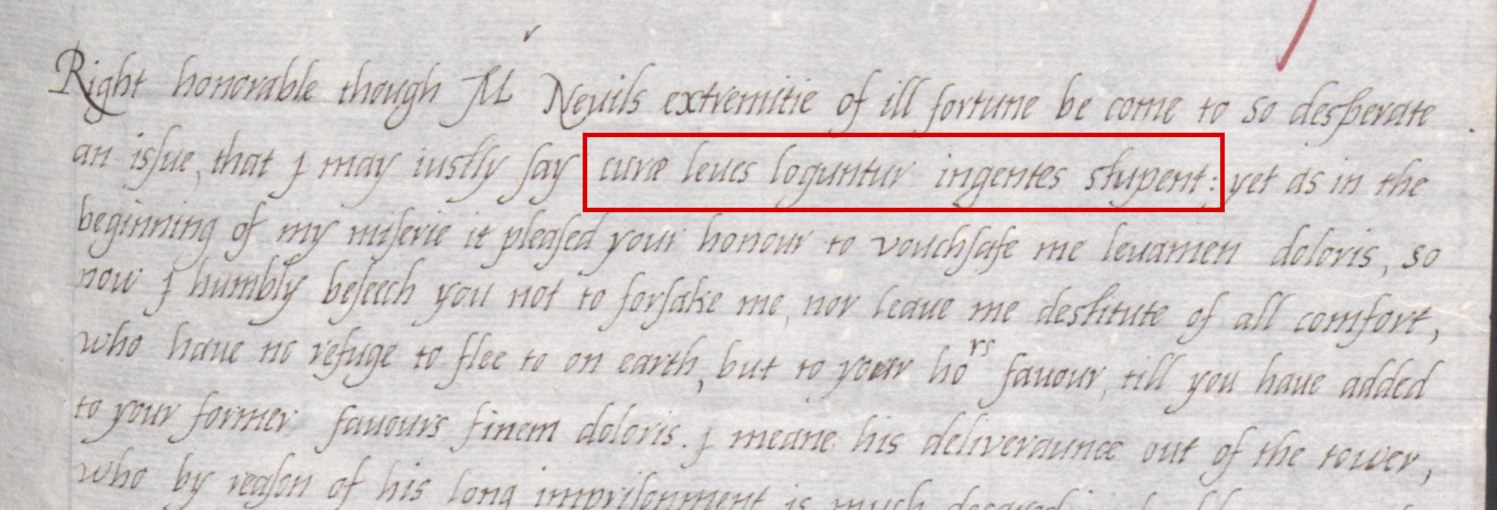
Two months before Neville’s appeal to wash away his offence, his wife had addressed Cecil from within the same family crisis. In a letter endorsed 23 May 1602, Anne Neville pleaded for her husband’s release from the Tower and quoted Seneca’s Phaedra:
Curae leves loquuntur, ingentes stupent.
Lesser troubles speak; great ones are struck dumb.12
Brian Arkins connects this maxim with Malcolm’s words to Macduff, who has just learned that his wife and children have been slaughtered:
MALCOLM
Give sorrow words. The grief that does not speak
Whispers the o’erfraught heart and bids it break.
—Macbeth 4.312
Anne uses Seneca to explain why suffering defeats expression. Malcolm turns that thought into an urgent appeal to speak before suppressed grief destroys the sufferer. A particular classical sentence, independently identified in Shakespearean scholarship, appears in a dated letter from Neville’s wife, written amid the consequences of his political disaster.
The maxim also appears in Florio’s 1603 translation of Montaigne:
Light cares can freely speake,
Great cares heart rather breake.12
Florio’s English supplies the heart and the speak/break rhyme of Malcolm’s speech; Montaigne’s French text already carried the Latin. Anne’s letter shows that maxim being used in Neville’s household under the pressure of his imprisonment, a year before Florio’s English appeared.
Arkins also traces the tragedy’s impossible washing to Seneca: in Phaedra and Hercules Furens, speakers ask what rivers or ocean could cleanse their pollution. The imagery of Neville’s plea thus stands beside a classical tradition that scholars have already recognized in the play.13
Cannons overcharged
The play introduces Macbeth’s prowess through an anachronistic image of artillery. Asked whether a fresh assault dismayed Macbeth and Banquo, the wounded captain describes their answer:
CAPTAIN
[…]
If I say sooth, I must report they were
As cannons overcharged with double cracks,
So they doubly redoubled strokes upon the foe.
[…]
—Macbeth 1.214
The simile brings the artillery of Shakespeare’s own time into eleventh-century Scotland. Holinshed describes the successive assaults and Macbeth and Banquo’s resistance, but the overcharged-cannon comparison is Shakespeare’s addition.15,16 T. McAlindon hears a warning in the captain’s praise: “uncurbed valour might prove self-destructive.”17
Neville’s connection with the technology was practical. He managed the Mayfield furnace and the ordnance business.18 The surviving records include a 1592 export grant to Henry Nevile, esquire, probably the younger Neville, and Abraham James’s letter of 15 November 1595 reporting shipments and stocks of ordnance at Lewes.19,20 Chapter 3 discusses the business; Chapter 17 follows its dependence on woodland and charcoal.
German notarial records give a concrete example of the danger. A certificate dated 21 April 1591 records the testing of English guns in Hamburg on 12 April. One gun “shattered into small pieces”; the gunner thanked Almighty God that nobody had lost his life or otherwise suffered harm. A second certificate, dated 4 September, records another gun bursting during testing. Its endorsement bears the name “Nevill,” although it does not identify the gun’s manufacturer.21
The earlier 2 Henry VI makes the recoil explicit. Queen Margaret warns Suffolk that his curses will turn against him:
QUEEN MARGARET
[…]
Or like an over-charged gun, recoil
And turn the force of them upon thyself.
—2 Henry VI 3.222
The force directed outwards may destroy the person who releases it—the danger Macbeth recognizes when he says that bloody instructions “return / To plague th’ inventor” (Macbeth 1.7).5 The German certificates show the practical danger beside the tragic use McAlindon identifies, although they do not specify that excessive loading caused either failure. The soldier celebrated for destroying the king’s enemies will turn his force upon the king, and ultimately bring destruction upon himself.
Neville also used “overcharged” of Anne’s grief in April 1602, after the loss of one child and the expected loss of another. In 2 Henry VI 3.2 the same word describes both a gun’s excessive charge and the dying Cardinal Beaufort’s burdened soul. These passages connect physical loading and inward strain; Neville’s own use belongs to that emotional sense.23
Gowrie: a Scottish tragedy Neville knew
On 27 February 1600, while ambassador in Paris, Neville wrote to Cecil recommending John Ruthven, third Earl of Gowrie, who was returning to Scotland through England. His recommendation was personal:
And because I know him well, and have had good communication with him, and therein found him to be of very good judgment, and exceedingly well affected both to the common cause of religion, and particularly to her Majesty, and that which may concern her honour and service; I have thought good to recommend him especially unto your Honour.24
Neville had given Gowrie a passport in the most favourable terms he could. He urged Cecil to speak with him about “alterations feared in Scotland.” This was a well-informed young nobleman who Neville thought could be useful to Elizabeth’s government.
On 5 August that year, Gowrie and his brother Alexander were killed in their house at Perth during a visit by James VI. According to the royal account, Alexander had drawn James into a private room and attempted to overpower him; the king’s attendants intervened, killing both brothers. James presented his escape as deliverance from treason. The brothers could no longer answer that accusation, and the account provoked immediate doubt.25
Neville reported the news to Winwood on 28 August. He described the alleged conspiracy and the king’s escape, then separated the relation sent to England from the opinions circulating about it:
This is the relation sent hither of it, which notwithstanding is diversely censured according to men’s divers affections.26
Censured here means judged. Neville knew both the official narrative and its disputed reception. By 2 November he was reporting the punishment of Robert Bruce and other Scottish ministers. Their offence, he wrote, was refusing to declare the brothers’ conspiracy in the form required of them.27
That controversy reached Shakespeare’s company. In a letter of 18 December 1604, John Chamberlain told Winwood that the King’s Men had twice performed a play about the tragedy of Gowrie, drawing large crowds. Some great councillors were displeased. Chamberlain wondered whether the treatment was at fault or whether depicting living princes was considered unsuitable; he expected the play to be forbidden.28
David McInnis, in Shakespeare and Lost Plays, puts this episode back into the company’s repertory: before Macbeth, the King’s Men had dramatized an alleged attempt on James’s life. He argues that the handling of the contested story, rather than simply the appearance of a living king on stage, may have caused the offence.29
McInnis also notes an analogy with Macbeth’s confidence in magical protection. The official pamphlet claimed that a small parchment bag containing magical characters had been found in Gowrie’s pocket. He was said to have relied on it for safety; his mortal wound supposedly began to bleed freely only after it was removed.30 Facing Macduff, Macbeth declares:
MACBETH
[…]
I bear a charmed life, which must not yield
To one of woman born.
—Macbeth 5.830
Holinshed already gives Macbeth the assurance that no man born of woman can kill him. Gowrie’s story supplies a recent Scottish counterpart to that fatal trust in supernatural protection. The landscape itself brings the histories close: Holinshed places Dunsinane in the district of Gowrie, ten miles from Perth, where the brothers died.30
Neville had known and recommended the young earl, then reported the disputed accounts of his death and the punishment of ministers who refused the required declaration. The King’s Men turned the affair into theatre. Its lost text prevents a comparison of wording, but the surviving records connect Neville’s diplomatic correspondence with a Scottish political tragedy in the company’s repertory.
The Macbeth–Banquo prophecy also featured in James’s visit to Oxford in August 1605, during which Neville received an honorary MA. On 27 August, three young men dressed as Sibyls greeted the king with an entertainment invoking the prediction that Macbeth would reign but Banquo’s descendants would be kings. Three days later, on 30 August, Neville was created Master of Arts, alongside William and Philip Herbert. His degree connects him to the royal visit in which this Scottish story was performed for James; whether he witnessed the entertainment remains unknown.31
Success might determine how others judged an enterprise; it could not settle what followed. Neville’s declaration and the Tower letters move from the calculation before the attempt to the damaged reputation and household left after it. Macbeth makes the hope of finality its tragic error. The deed that was meant to settle everything demands another deed, and another:
MACBETH
Things bad begun make strong themselves by ill.
—Macbeth 3.29
Notes and sources
Henry Neville’s declaration, 2 March 1601 (dated 2 March 1600 in the manuscript), The National Archives, SP 12/279, document beginning at fol. 15; State Papers Online manuscript record. Text follows John O’Donnell’s transcription; spelling and punctuation modernized. For an additional printed reference, see Mary Anne Everett Green, ed., Calendar of State Papers, Domestic Series, of the Reign of Elizabeth, 1601–1603 (London, 1870), pp. 5–8, especially p. 7, vol. CCLXXIX, no. 11. The Candlemas conference is Southampton’s account of the proposed court enterprise as reported by Neville, not an account of the march into London on 8 February.↩︎
Macbeth is conventionally dated about 1606. David McInnis, Shakespeare and Lost Plays (Cambridge University Press, 2021), chapter 4, pp. 118–149, especially pp. 119, 135–136, 142, discusses its Jacobean context and Simon Forman’s record of a Globe performance on 20 April 1611. The surviving printed text first appeared in 1623: Barbara A. Mowat and Paul Werstine, “An Introduction to This Text,” Macbeth, Folger Shakespeare Library. An exact composition date and the extent of subsequent adaptation are not settled.↩︎
Tacitus, Histories 1.37–41, especially 1.38: nullus cunctationis locus est in eo consilio quod non potest laudari nisi peractum. Latin and English text, LacusCurtius. Otho urges a coup; Neville cites the maxim while explaining his objection to the proposed court enterprise. The saying also circulated elsewhere: the official account of the Gunpowder trial, A True and Perfect Relation (London, 1606), sig. B2r, applies the plural formulation to the alleged calculations of the conspirators. William Camden also reports Neville’s use of quae non laudantur nisi peracta, recalling that he was present when the confession was read: Annales, 1601, §51, Latin text. Camden’s account was published later; his stated presence concerns the reading of the confession, not the original conversation.↩︎
Tacitus, The Ende of Nero and Beginning of Galba. Fower Bookes of the Histories of Cornelius Tacitus. The Life of Agricola, trans. Henry Savile (Oxford, 1591), Histories, p. 22. Spelling modernized; vocabulary and syntax retained. Neville’s compressed Latin identifies the passage, but does not establish which edition or language he was recalling.↩︎
William Shakespeare, Macbeth 1.7, ed. Barbara A. Mowat and Paul Werstine, Folger Shakespeare Library. All Shakespeare quotations in this chapter follow the Folger text, preserving line breaks; bold emphasis is added. Gordon Braden reads this soliloquy as part of Macbeth’s search for a decisive act that will settle everything, tracing his “radical fear of incompleteness” through the ensuing violence: “Senecan Tragedy and the Renaissance,” Illinois Classical Studies 9.2 (1984), pp. 277–292, especially pp. 287–289. Braden’s comparison is with Seneca. A separate Tacitus–Macbeth parallel is proposed by Herbert W. Benario, “Shakespearean Debt to Tacitus’ Histories,” Notes and Queries 55.2 (2008), pp. 202–205, at p. 204: Cawdor’s dignified death and Tacitus’s judgment of Otho (Histories 2.50.1). The comparison with Otho’s coup maxim in Histories 1.38 developed here is distinct from both.↩︎
Raphael Holinshed, Chronicles, Scottish history, pp. 234–235 (Duff and Donwald) and p. 269 (Duncan and Macbeth), pagination of the 1808 reprint, vol. V. Donwald “abhorred the act greatlie in heart,” but followed his wife’s urging; four servants carried out the murder. Shakespeare combines material from the two narratives. The source already includes reluctance and concealment; the comparison concerns their dramatic elaboration.↩︎
Neville, declaration of 2 March 1601, TNA SP 12/279, cited in note 1: final paragraph for the vizard passage; the preceding discussion of Cecil for “blot my reputation.” Transcription by John O’Donnell. It reads “course,” not “cause,” and retains the clause about disguise, specious pretences and cloaks of religion and virtue. At “with specious pretences,” the manuscript’s abbreviated “with” corrects “which” in the transcription. Spelling and punctuation modernized; ellipses mark omitted text. Additional printed reference: Green’s CSPD 1601–1603, p. 8. The mask is Essex’s; the reputation is Neville’s.↩︎
Macbeth 3.2. The excerpt begins within Macbeth’s sentence; lave means wash or bathe. The following section compares the related washing image in Neville’s 1602 appeal, a separate document.↩︎
Henry Neville to Robert Cecil, 31 July 1602, Hatfield House, Cecil Papers 94/90, holograph. Quotation follows John O’Donnell’s transcription; spelling and punctuation modernized, first person and vocabulary retained. Additional printed reference: Calendar of the Manuscripts of the Most Honourable the Marquess of Salisbury, vol. XII (London, 1910), p. 268. The calendar abridges the passage and converts it to the third person; the quotation here is from Neville’s letter.↩︎
Anne Neville to Robert Cecil, Hatfield House, Cecil Papers 93/72, endorsed 23 May 1602. Latin read from the manuscript; the abbreviated calendar omits it: HMC, Salisbury, XII (1910), p. 164. Seneca, Phaedra 607. Translation here is new. The manuscript uses loquuntur; the Latin Library has the spelling locuntur. Brian Arkins, “Heavy Seneca: his Influence on Shakespeare’s Tragedies”, Classics Ireland 2 (1995), section 7, connects this line with Malcolm’s speech. Shakespeare quotation follows Macbeth 4.3, Folger Shakespeare Library, preserving verse lineation. Arkins establishes the Seneca–Shakespeare comparison, not the connection with Anne. Florio’s 1603 translation of Montaigne, I.2, “Of Sadnesse or Sorrowe,” renders the same maxim: “Light cares can freely speake, / Great cares heart rather breake.” E. K. Chambers records this parallel with Macbeth, crediting Collier: The Tragedy of Macbeth, Warwick Shakespeare (Toronto, 1907), pp. 151–152, note to 4.3.208. The Latin also appears in Montaigne’s French text, I.2, here consulted in the transcription of the 1598 edition. Florio’s English supplies the heart/break image and speak/break rhyme found in Malcolm’s speech. Anne’s May 1602 letter predates that publication; her Latin and Florio’s translation are distinct witnesses to the maxim’s circulation, without establishing the dramatist’s route to it.↩︎
Arkins, “Heavy Seneca,” section 7, comparing Phaedra 715–718 and Hercules Furens 1323–1326 with the washing passages in Macbeth. His argument concerns Senecan influence on Shakespeare; the dated Neville documents provide the additional household comparison made here.↩︎
Macbeth 1.2, Folger Shakespeare Library. David and Ben Crystal, Shakespeare’s Words, “crack”; Samuel Johnson, Miscellaneous Observations on the Tragedy of Macbeth (1745), note III. Johnson rejects Theobald’s proposed repunctuation and defends the cannon’s thunderous sound. Philip Weller’s Macbeth Navigator, note to 1.2.37, glosses “cracks” as charges of gunpowder. These interpretations explain the metaphor without turning it into an exact loading specification.↩︎
Royal Household, “Macbeth (r. 1040–1057)”; Royal Armouries, “The Hundred Years’ War 1337–1453,” sections “Early Artillery” and “Handguns”, dating unequivocal western European records of guns to Florence in 1326. The anachronism lies in the captain’s simile; the passage describes Macbeth and Banquo’s blows, not cannon deployed on their battlefield.↩︎
Holinshed, Scottish history, pp. 265–268, especially p. 268, 1808 reprint, vol. V. The chronicle narrates successive conflicts; Shakespeare compresses the military action and supplies the overcharged-cannon simile.↩︎
T. McAlindon, “Macbeth,” Shakespeare’s Tragic Cosmos (Cambridge University Press, 1991), pp. 197–219, reproduced essay. His discussion of “cannons overcharg’d with double cracks” connects excessive valour with potential self-destruction. The link to Neville’s ordnance business is the present chapter’s comparison.↩︎
Andrew Thrush, “Neville, Sir Henry I (1564–1615), of Billingbear,” The History of Parliament: The House of Commons 1604–1629 (2010), on the Mayfield furnace and the April 1591 monopoly. Chapter 3 distinguishes that reported grant from the separately catalogued 1592 instrument and discusses identification of the younger Neville. For the furnace industry and cast-iron gunfounding, Jeremy Hodgkinson, “The Wealden Iron Industry,” Wealden Iron Research Group (2002). The dated ordnance records are cited in the following notes.↩︎
The National Archives, LR 15/301, grant dated 8 November 1592, Discovery catalogue. The catalogue describes a transcript of the grant to Henry Nevile, esquire, Ludolfe Englested and Giles Devisher. The original instrument has not been collated here; the grantee’s identification with the younger Neville is an inference from the designation and context.↩︎
Abraham James to Henry Neville, 15 November 1595, Royal Berkshire Archives, D/EN/O/23/2; catalogue of the ordnance papers, D/EN/O/23. The letter records two shipped consignments and remaining ordnance at Lewes. It is distinct from the separate account of broken pieces of ordnance in the same bundle.↩︎
The National Archives, PRO 30/50/7, German notarial instruments of 21 April and 4 September 1591, catalogue. The April instrument begins on the leaf numbered 32; the testimony is on the leaf numbered 33: “In kleinen stücken zersprungen” (“shattered into small pieces”) and “daß keiner dabey vmbs Leben oder sonst Zu schaden vnd vmb seine gesundheit gekommen wehre” (that nobody had lost his life, otherwise come to harm, or lost his health). Translation from the manuscript. The September instrument begins on the leaf numbered 36; its endorsement carries “Nevill,” the number 47, a weight figure of 1620 and the date 4 September 1591. That endorsement belongs to the September instrument, not the April no-injury account. The records do not identify overcharging as the cause or name Mayfield as the place of manufacture; the endorsement alone does not establish who made the gun.↩︎
William Shakespeare, 2 Henry VI 3.2, Queen Margaret to Suffolk, Folger Shakespeare Library.↩︎
Henry Neville to Robert Cecil, 3 April 1602, Hatfield House, Cecil Papers 92/99. Manuscript checked against the independent printed abstract in Calendar of the Manuscripts of the Most Hon. the Marquis of Salisbury, XII, pp.95–96. The calendar confirms “overcharged” and the family bereavements; the manuscript gives the fuller account of grief and successive afflictions. This passage paraphrases the letter.↩︎
Neville to Cecil, Paris, 27 February 1599/1600, Ralph Winwood, Memorials of Affairs of State, ed. Edmund Sawyer (London, 1725), vol. I, p. 156. Dates in the narrative begin the year on 1 January; the printed heading is 27 February 1599 O.S. Quotations from Winwood throughout this chapter modernize spelling, capitalization and light punctuation, preserving vocabulary and syntax. Winwood’s spelling is not treated as evidence of manuscript orthography.↩︎
McInnis, Shakespeare and Lost Plays, pp. 120–128, reviewing the royal narrative and its contested reception. His account draws on W. F. Arbuckle’s two-part study of the Gowrie conspiracy in Scottish Historical Review 36 (1957).↩︎
Neville to Winwood, London, 28 August 1600, Winwood, vol. I, pp. 248–250, especially pp. 249–250. The dating is 28 August, not 8 August. The distinction between the reported accusation and differing reactions is Neville’s own.↩︎
Neville to Winwood, 2 November 1600, Winwood, vol. I, pp. 270–272, especially p. 271. Neville reports that Bruce and other ministers were deprived of their charges and banished from Edinburgh and the court because they refused the required declaration.↩︎
John Chamberlain to Ralph Winwood, 18 December 1604, The Letters of John Chamberlain, ed. Norman Egbert McClure (Philadelphia, 1939), vol. I, p. 199, quoted and examined by McInnis, pp. 120, 126–128. The lost play is usually called The Tragedy of Gowrie, but its exact title is uncertain. The letter records two performances and an expected prohibition; no surviving prohibition is established by that expectation.↩︎
McInnis, “Courting Controversy—Shakespeare and the King’s Men,” pp. 118–149, especially pp. 119–128, 135–136, 147. He also proposes, expressly as conjecture, that The Spanish Maze concerned the Copley family and the Bye Plot; this chapter’s argument does not depend on that identification.↩︎
McInnis, pp. 124–125, quoting Gowreis Conspiracie (Edinburgh: Robert Charteris, 1600), sig. C3. For the prophecy already in the chronicle, Holinshed, Scottish history, p. 274; compare Macbeth 5.8. The magical bag and bleeding are claims in the official account, not accepted supernatural events.↩︎
Isaac Wake, Rex Platonicus (Oxford: Joseph Barnes, 1607), title page and pp. 18–19, sigs. C1v–C2r, printed witness. Wake describes the 1605 visit, not an event in the publication year. Andrew Clark, ed., Register of the University of Oxford, II (1571–1622), part I, Introductions (Oxford, 1887), p. 234, explains degrees by creation; pp. 236–237 list the peers and knights created MA on 30 August 1605, including William Herbert, Earl of Pembroke, Philip Herbert, Earl of Montgomery, and Henry Neville. Anthony Wood, Fasti Oxonienses, I, in Athenae Oxonienses, II, ed. Philip Bliss (1815), cols. 315–316, identifies Neville as the former ambassador at Paris, of Billingbear. The degree was by creation, honorary in modern terms, not evidence of a new course of study. The named degree records establish the honour; they do not establish Neville’s attendance at the earlier entertainment. Wake describes a distinct university entertainment, not a performance of Shakespeare’s play.↩︎