Appendix G
Nathan Field’s comedy A Woman Is a Weathercock, staged around 1609–10 and published in 1612, gives an important role to a gentleman called Nevill. He helps a friend marry the woman he loves despite her father’s choice of another husband, disguises himself as a priest, and arranges a performance in which another man appears under his name. His disguises and several Shakespearean echoes invite comparison with Sir Henry Neville’s letters and the plays.
Field was an actor as well as a playwright. His title page records performances before the king at Whitehall and by the Children of the Queen’s Revels at Whitefriars, a London indoor playhouse. The cast list names “Neuill,” the contemporary printed spelling of Nevill, without a first name or title. This appendix uses Nevill for Field’s character and Neville for the historical man.1
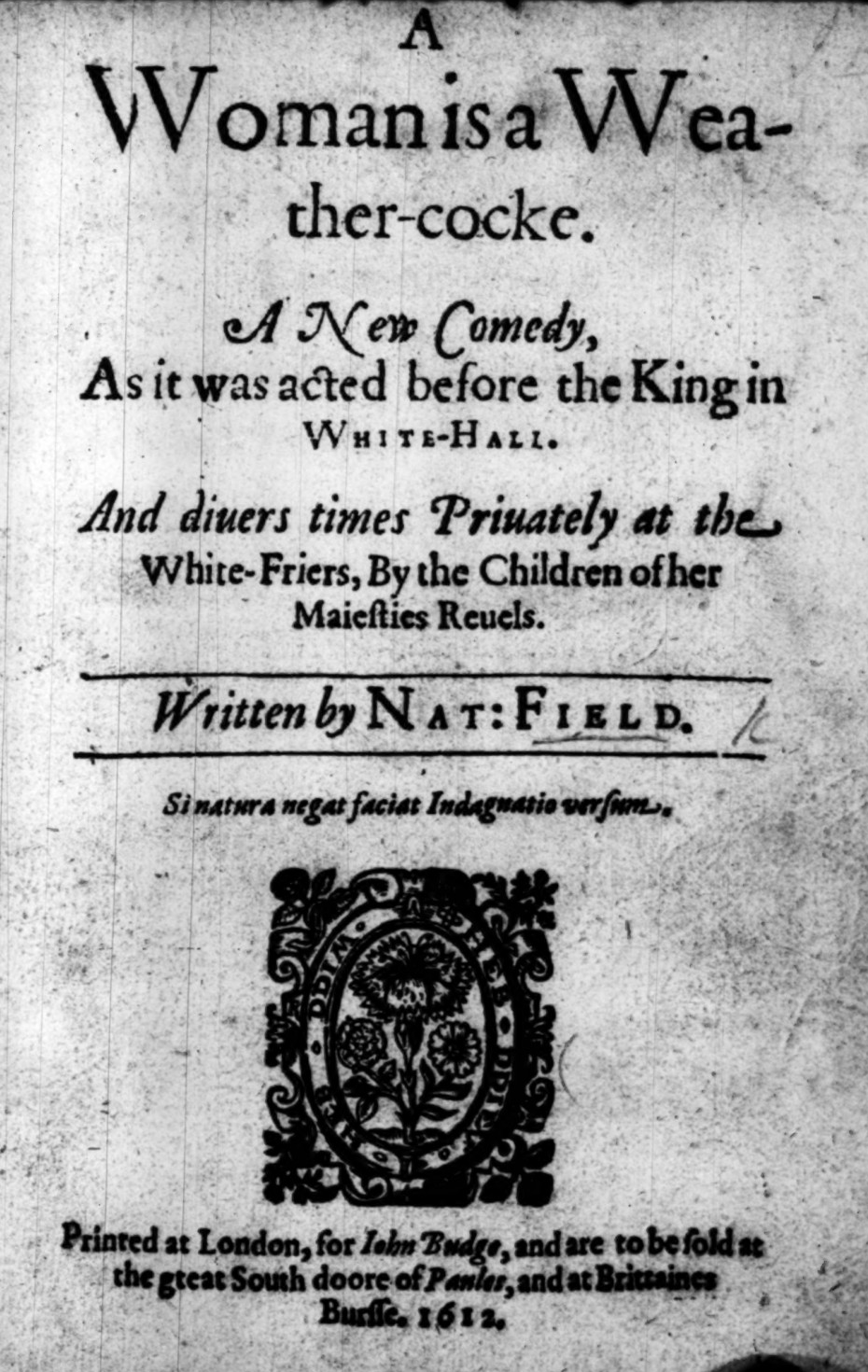
The 1612 title page records performances at Whitehall and Whitefriars and names Nathan Field as the author.
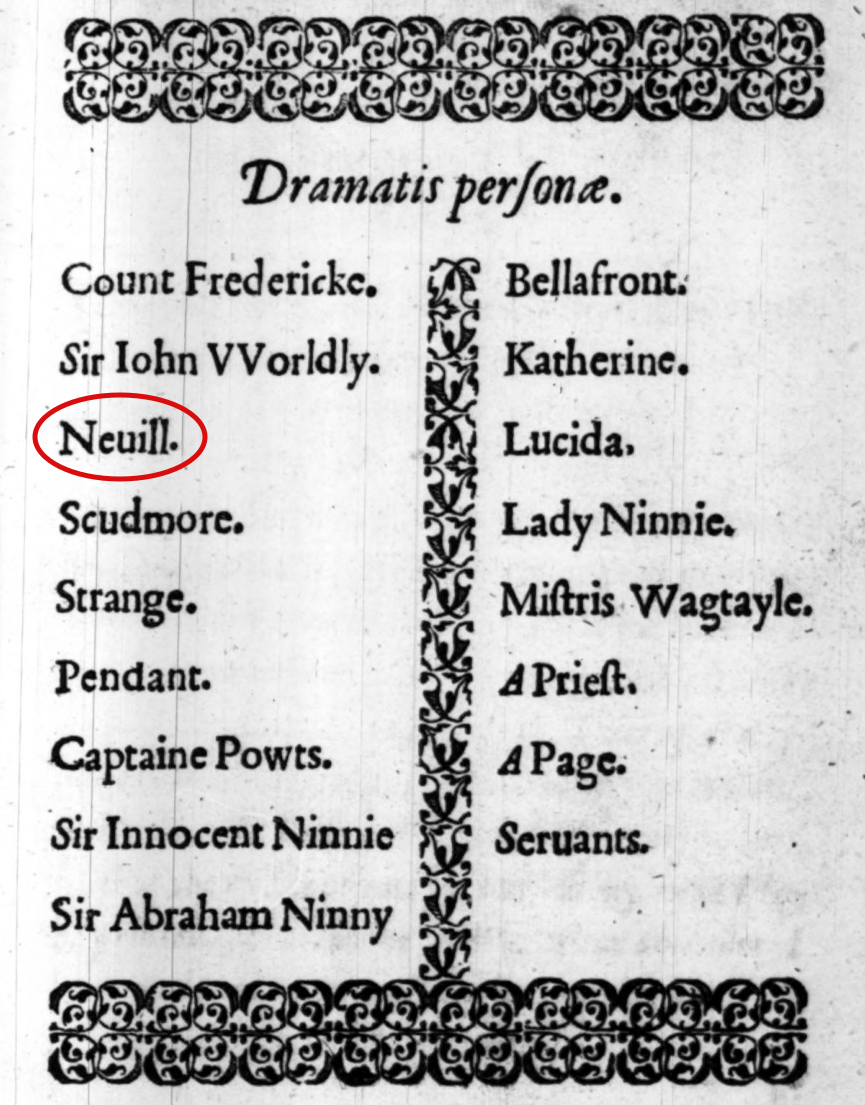
The cast list, sig. A2r, with “Neuill” circled in red (annotation added). Both images are cropped from the original printed edition cited in note 1.
A friend who makes the plot work
Scudmore loves Bellafront, but her father, Sir John Worldly, has arranged for her to marry Count Frederick. Nevill comes to Scudmore with news of the wedding. Scudmore’s distress draws him into an effort to recover Bellafront, and Nevill supplies the practical means.
First, Nevill persuades and pays the intended priest to let him take his place. Wearing the priest’s appearance and clothing, he performs an apparent marriage ceremony. The substitution prevents Bellafront’s marriage to the Count from becoming binding within the play’s resolution. Nevill explains his plan to the theatre audience beforehand; Scudmore and the wedding party do not know who is under the disguise.2
At the wedding masque, a costumed entertainment with dancing, Nevill is expected to lead and dance with Bellafront. He instead exchanges clothes with Scudmore, who has entered disguised as the craftsman supplying the masks. Scudmore takes Nevill’s place in the dance, tells Bellafront who he is, and leaves with her to marry before the real priest. Nevill, now dressed as the craftsman, can leave without attracting the wedding guests’ attention.
Nevill tells Scudmore:
Tonight by promise, I do give a masque,
As to congratulate the bridal day,
In which the Count, Pendant, and the wise knight,
Will be most worthy dancers; sir, you shall
Learn but my part, which I will teach you too,
As nimbly as the usher did teach me,
And follow my further directions.
Scudmore accepts his friend’s control:
I am your property, my enginer.3
“Enginer” means a deviser or contriver. Nevill gives directions; Scudmore learns and performs his part. The stage direction “Change habit” makes the exchange of costumes explicit. During the dance, the wedding guests believe that “young Nevill” is leading, although the dancer is Scudmore. The theatre audience has seen the substitution.
At the end Nevill returns in his priestly disguise. He removes it to reveal a devil’s robe, then removes that too and is recognized. The joke gives a visible form to his argument that forcing Bellafront to marry the wrong man would have been a devilish act under a priest’s cloak. Scudmore and Bellafront are now married, and Scudmore closes his part in the comedy with:
And may all true love have like happy end,
Women forgive me; Men, admire my Friend.4
Nevill’s ingenuity has made the lovers’ marriage possible. He does not, however, direct every intrigue: another character, Strange, separately exposes a slander against Bellafront’s sister Katherine. Field gives more than one character a hand in bringing about the ending.
A priest’s habit: Field, Neville and Shakespeare
Nevill’s assumption of a priest’s role has a particular connection with Sir Henry Neville’s diplomatic work. On 16 September 1599, Neville wrote to Robert Cecil about a prospective agent for a mission to Spain. The man had been a priest, had become Protestant and married, and proposed using his former occupation as cover. Neville explained:
he will take upon him the habit, and for need the function of a priest, which will also give him credit and trust there, and means thereby to do the better service.5
Neville’s agent would wear a priest’s clothes and, when necessary, perform the priest’s duties to secure confidence and access. Field’s Nevill likewise assumes both appearance and function: he takes the priest’s place and performs the wedding ceremony before people who accept his religious authority. The letter concerns an intelligence mission; the comedy turns the same means of gaining trust into a device for managing a marriage.
Nevill’s role also invites comparison with the Duke in Measure for Measure. Before assuming a friar’s disguise, the Duke asks Friar Thomas:
Supply me with the habit, and instruct me
How I may formally in person bear
Like a true friar. More reasons for this action
At our more leisure shall I render you.
Nevill likewise obtains a real priest’s cooperation and assumes his appearance. Both men use religious dress to move through a marriage plot under a concealed identity, directing events while other characters misunderstand who they are. Both disclose their identities in the final settlement. The audience, unlike the people deceived on stage, knows about the disguise beforehand.
Their purposes are different: the Duke investigates his deputy’s conduct and governs Vienna; Nevill helps a friend recover the woman he loves. Field’s counterfeit wedding and masque exchange are his own plot’s particular devices. The comparison concerns the dramatic role of a concealed director who brings about the marriage resolution.6
The same letter is compared with Feste’s impersonation of Sir Topas in Chapter 24. In Twelfth Night, costume and the performance of a religious office again become instruments of deception.7
“Thou hast spoke my heart in twain”
When Nevill first announces Bellafront’s impending marriage, Scudmore answers:
Oh! that this stroke were thunder to my breast,
For Nevill thou hast spoke my heart in twain,
And with the sudden whirlwind of thy breath,
Hast ravished me out of a temperate soil,
And set me under the red burning zone.
The addressed construction, “thou hast … my heart in twain,” closely resembles Gertrude’s words to Hamlet. The second quarto, with a 1604 title page, reads:
O Hamlet thou hast cleft my hart in twaine.8
Field replaces the physical verb “cleft” with “spoke”: Nevill’s announcement itself divides Scudmore’s heart. The line addresses Nevill by name; it is Scudmore’s speech, not Nevill’s. The comparison does not depend on the First Folio’s publication in 1623. The image is already present in the first quarto of Hamlet (1603), which reads “Hamlet, thou cleaues my heart in twaine,” and the closer “thou hast cleft” construction appears in the second quarto.
Field uses the image again later in the comedy. Mistress Wagtail, coached by the Count’s follower Pendant, is flattering Sir Abraham Ninnie:
Oh, thy very name,
Like to a hatchet cleaves my heart in twain.
Here “thy very name” refers to Abraham, not Nevill. The extravagant compliment turns the earlier language of injury into comic courtship.
Shakespearean influence on Field has an established scholarly history. In his 1950 article “Shakespeare and Nathan Field,” William Peery examined both verbal echoes and larger dramatic similarities, including Scudmore’s later confrontation with Bellafront beside Hamlet’s confrontation with Gertrude. Peery also pointed to Field’s explicit recollection, in Amends for Ladies, of the play in which the fat knight Oldcastle explains honour—a reference to the speech now associated with Falstaff in 1 Henry IV.9
Further Shakespearean echoes
Pendant flatters Count Frederick, Bellafront’s intended husband, by imagining Nature falling in love with the man she has made:
Nature herself having made you, fell sick
In love with her own work, and can no more
Make man so lovely, being diseased with love.
Peery compares this with Sonnet 20:
Till Nature as she wrought thee fell a-doting,
In both passages, Nature becomes enamoured of her own creation. Peery presents the resemblance as a possible Shakespearean echo.10 The same flattery speech continues with another Shakespearean phrase:
Oh foot, oh leg, oh hand, oh body, face,
By Jove it is a little man of wax.
In Romeo and Juliet, the Nurse similarly recommends Paris as a husband for Juliet:
A man, young lady—lady, such a man
As all the world—why, he’s a man of wax.
The expression praises a man as perfectly formed, like a wax model. Both passages advertise a desirable bridegroom; Field makes the praise part of Pendant’s extravagant flattery of his employer.11
Later, Pendant finds Sir Abraham occupied with a foolish love poem and remarks, “Oh, this love will undo us all.” The same words occur in Troilus and Cressida, when Helen asks Pandarus to sing:
Let thy song be love. “This love will undo us all.”
The setting strengthens the verbal comparison: Field’s exchange concerns a suitor’s poem and its possible musical setting, while Shakespeare’s concerns a song of love. The wording may also draw on a circulating song or refrain.12
Scudmore’s confrontation with Bellafront supplies another resemblance. Angry at her apparent betrayal, he insists:
I’ll make you sure first: I am come to speak,
And speak I will freely, and to bring back
Your letters, and such things you sent; and then,
I’ll ne’er see those deceiving eyes again.
Katherine, resisting Petruchio’s attempts to silence her in The Taming of the Shrew, says:
Why, sir, I trust I may have leave to speak,
And speak I will. I am no child, no babe.
Both speeches turn the declaration of an intention to speak into an emphatic assertion. The speakers’ positions differ: Katherine demands a hearing, whereas Scudmore has threatened Bellafront.13
Finally, when Pendant coaches Mistress Wagtail to entrap Sir Abraham, he begins, “They say every woman has a springe to catch a woodcock.” A springe is a snare, and the woodcock represents an easily deceived person. In Hamlet, Polonius dismisses Hamlet’s professions of love to Ophelia:
Ay, springes to catch woodcocks. I do know,
Both uses turn courtship into a trap. This expression was proverbial—Field himself introduces it with “They say”—but its presence adds another point of contact with Hamlet in the scene that also contains Wagtail’s “heart in twain” compliment.14
Talent without employment
Nevill also gives a speech about intellectual ability denied an adequate outlet. He begins by judging Scudmore’s behaviour:
How well does Scudmore speak, ill for himself,
Wit’s a disease, that fit employment wants,
Therefore we see, those happiest in best parts,
And under-borne fortunes under their merits,
Grow to a sullen envy, hate, and scorn
Of their superiors; and at last, like winds,
Break forth into rebellious civil wars,
Or private treasons; none so apt for these,
As melancholy wits fettered with need.15
“Wants” means lacks; “parts” are abilities. The speech describes talented people whose circumstances fall short of their merits, and the danger of that frustration turning into resentment or political violence. Scudmore answers that wit governed by discretion can avoid these faults. He then accepts Nevill’s guidance, and Nevill gives his abilities a practical task: learning the part he will perform in the masque.
The political frustration has a point of contact with Sir Henry Neville’s correspondence. Writing to his regular correspondent, the diplomat Ralph Winwood, on 4 June 1606, he complained:
For my own business I am at a stand, if I go not backward. This Parliament hath done me no good, where not only speeches and actions, but countenances, and conversation with men disliked, hath been observed. But in these points I cannot betray my own mind, speed as it will.16
The letter records Neville’s sense of stalled progress and scrutiny of his political associations. Field’s speech concerns unused ability and its consequences.
The name and the evidence
The conjunction is worth recording: a character named Nevill directs a marriage intrigue through disguise and performance; his priestly impersonation uses the means of gaining trust described in Neville’s own diplomatic letter; he is addressed in language closely resembling Hamlet; and he speaks about talent, frustrated advancement and political danger. The play identifies him only as Nevill, “Master Nevill” and “young Nevill.” Nothing in the play directly identifies him as Sir Henry Neville. The possible personal allusion therefore remains a question alongside the directly observable dramatic and verbal correspondences.
Notes and sources
Nathan Field, A Woman Is a Weather-cocke (London: for John Budge, 1612), title page and dramatis personae, sig. A2r; STC 10854, TCP A00725, quarto facsimile and TCP transcription. The scan identifier ends in “1611,” but the title page prints 1612. Field’s quotations below modernize spelling and capitalization; bold emphasis is added. For the performance date and Field’s acting career, see Jean MacIntyre, “Production Resources at the Whitefriars Playhouse, 1609–1612”, Early Modern Literary Studies 2.3 (1996), paragraphs 6–7.↩︎
Field, Weathercock, Act II, sigs. C4v–D1r; the marriage’s resolution is at sig. H4v. Nevill tells the audience that he has obtained the real priest’s cooperation through argument and payment.↩︎
Field, Weathercock, IV.1, sig. G2v; costume exchange, V.1, sig. H3v; “young Nevill,” sig. H4r. “Property” makes Scudmore available for his friend’s purposes; “enginer” describes the deviser of the scheme. The usher is the instructor from whom Nevill learned the dance.↩︎
Field, Weathercock, sigs. H4v–I2v. The closing “my Friend” is unnamed but follows Nevill’s successful assistance to Scudmore. Strange’s exposure of Captain Pouts’s slander provides a separate resolution to Katherine’s story. Alan William John Heaven also reads the closing stage picture as Scudmore applauding Nevill: “‘The soul of lively action’: instructing movement in the comedies of Nathan Field” (PhD thesis, University of York, 2020), p.162.↩︎
Henry Neville to Robert Cecil, 16 September 1599, in Edmund Sawyer, ed., Memorials of Affairs of State, I (London, 1725), pp.102–105, at p.104. Quotation checked against the printed page; spelling and capitalization modernized, emphasis added. The preceding sentence identifies the man as a former priest who had become “of the Religion” and married. Neville describes a proposed appointment, not a completed mission.↩︎
Field, Weathercock, Act II, sigs. C4v–D1r, and the disclosure at sig. H4v; Shakespeare, Measure for Measure, 1.3 and 5.1. Measure for Measure first appeared in print in 1623. The resemblance is between the dramatic arrangements, not evidence that Field read a printed copy before publishing his own play.↩︎
Shakespeare, Twelfth Night, 4.2. Feste assumes the identity of Sir Topas the curate to question Malvolio; Chapter 24 quotes the passage alongside Neville’s letter.↩︎
Field, Weathercock, I.1, sig. B3r, and IV.3, sig. H1r. Shakespeare, Hamlet, second-quarto facsimile, reproduced p.64 (PDF p.65); compare the first-quarto facsimile, PDF p.46. Hamlet’s original spelling is retained, with long s normalized. The first quarto places the remark before the Ghost’s entrance; the second places it after his departure. William Peery, ed., The Plays of Nathan Field (Austin: University of Texas Press, 1950), pp.245 and 262, notes to 1.1.172 and 4.3.51, already compares the first passage with Hamlet and points to Field’s later comic reuse; he also cites Chapman’s The Widow’s Tears.↩︎
William Peery, “Shakespeare and Nathan Field,” Neophilologus 34 (1950), 238–245, especially 241–245, DOI. Peery considers both the similarities and differences between the confrontation scenes and distinguishes convincing comparisons from common expressions. His account establishes prior discussion of Field’s Shakespearean debts; it does not identify Nevill with Sir Henry Neville.↩︎
Field, Weathercock, I.2, Pendant’s praise of the Count; William Peery, “Shakespeare and Nathan Field,” Neophilologus 34 (1950), p.245, comparing Weathercock 1.2.52–53 with Sonnet 20 and proposing a possible conscious or unconscious echo. Shakespeare, Sonnet 20, line 10. Field’s spelling is modernized; both quotations retain their verse lineation.↩︎
Field, Weathercock, I.2, sig. B4v; Shakespeare, Romeo and Juliet, 1.3, Nurse’s recommendation of Paris. Shakespeare quotations in this section follow the Folger text, with its line divisions; bold emphasis is added. Peery, The Plays of Nathan Field (1950), p.246, note to 1.2.77, identifies the Romeo and Juliet parallel and Field’s reuse in Amends for Ladies.↩︎
Field, Weathercock, III.3, sig. F3v; Shakespeare, Troilus and Cressida, 3.1, Helen’s request for a song. Folger encloses “This love will undo us all” in quotation marks. Troilus and Cressida appeared in quarto in 1609.↩︎
Field, Weathercock, III.2, sig. F1r; Shakespeare, The Taming of the Shrew, 4.3. Shrew first survives in print in the 1623 First Folio; any earlier influence on Field would have depended on theatrical or manuscript circulation, rather than that printed edition.↩︎
Field, Weathercock, IV.3, sig. G4v; Shakespeare, Hamlet, 1.3. Field’s quarto spells the word “Sprindge.” The short quotation from Polonius preserves the complete verse line; his explanation continues in the following lines. The same Field scene later gives Wagtail the hatchet-and-heart compliment, sig. H1r. Peery, The Plays of Nathan Field (1950), p.262, note to 4.3.3–4, likewise calls the expression proverbial and compares Hamlet.↩︎
Field, Weathercock, IV.1, sigs. G2r–G2v. The speech has the prefix “Neu.” and names Scudmore in its first line. The speech continues through rustic contentment and the misuse of intellectual gifts before Scudmore replies. The threat of frustrated men turning to violence also appears earlier in the play: Captain Pouts, rejected as Katherine’s suitor, threatens her father, “I will pray for civil wars, to cut thy throat without danger” (Act I). A contemporary treatment of misdirected ability occurs in A sixe-folde politician (1609), attributed to John Melton, chapter III, p.32: its marginal summary reads, “A pregnant wit wanting employment takes hold of naughty courses.”↩︎
Henry Neville to Ralph Winwood, 4 June 1606, Ralph Winwood, Memorials of Affairs of State, ed. Edmund Sawyer, II (1725), p.216. Spelling and capitalization modernized from the printed witness. Neville proceeds to discuss parliamentary business; the letter records frustration within public life rather than complete inactivity.↩︎