Shakespeare’s source books at Billingbear
A catalogue made in 1780 of the library at Neville’s family home, Billingbear, records many books used as sources for Shakespeare’s plays. Cinthio’s Hecatommithi (Venice, 1580) contains the stories behind Othello and Measure for Measure. Boccaccio’s Decameron (Venice, 1555) contains Giletta’s story, adapted in All’s Well That Ends Well, and the wager on a wife’s fidelity behind Cymbeline.1
Surviving volumes allow us to look beyond the catalogue. Some bear Neville’s name; others contain annotations attributed to Neville or his tutor Henry Savile. These books provide evidence of ownership and reading, while the catalogue records the broader family collection after generations of additions.2
The catalogue records Chaucer’s Works (London, 1602): Troilus and Criseyde supplied the lovers’ story in Troilus and Cressida, and the Knight’s Tale supplied the plot of The Two Noble Kinsmen. It also records Saxo Grammaticus’s Danica Historia, or Gesta Danorum (Frankfurt, 1576), the original written source of the Amleth story behind Hamlet.3
Alongside them stands a substantial collection of Roman history: Livy and Dionysius on early Rome, Appian on the civil wars, and Cassius Dio on the Republic and Empire. Together they cover the historical ground of Coriolanus, Julius Caesar and Antony and Cleopatra, and the imperial world reimagined in Titus Andronicus. Neville’s own writing also demonstrates his use of Plutarch, the principal narrative source for several plays.4
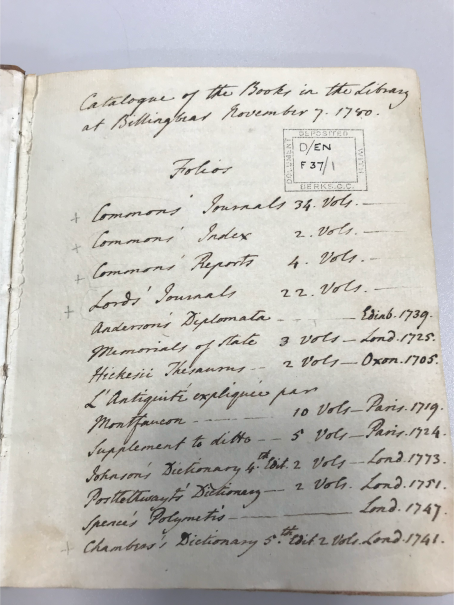
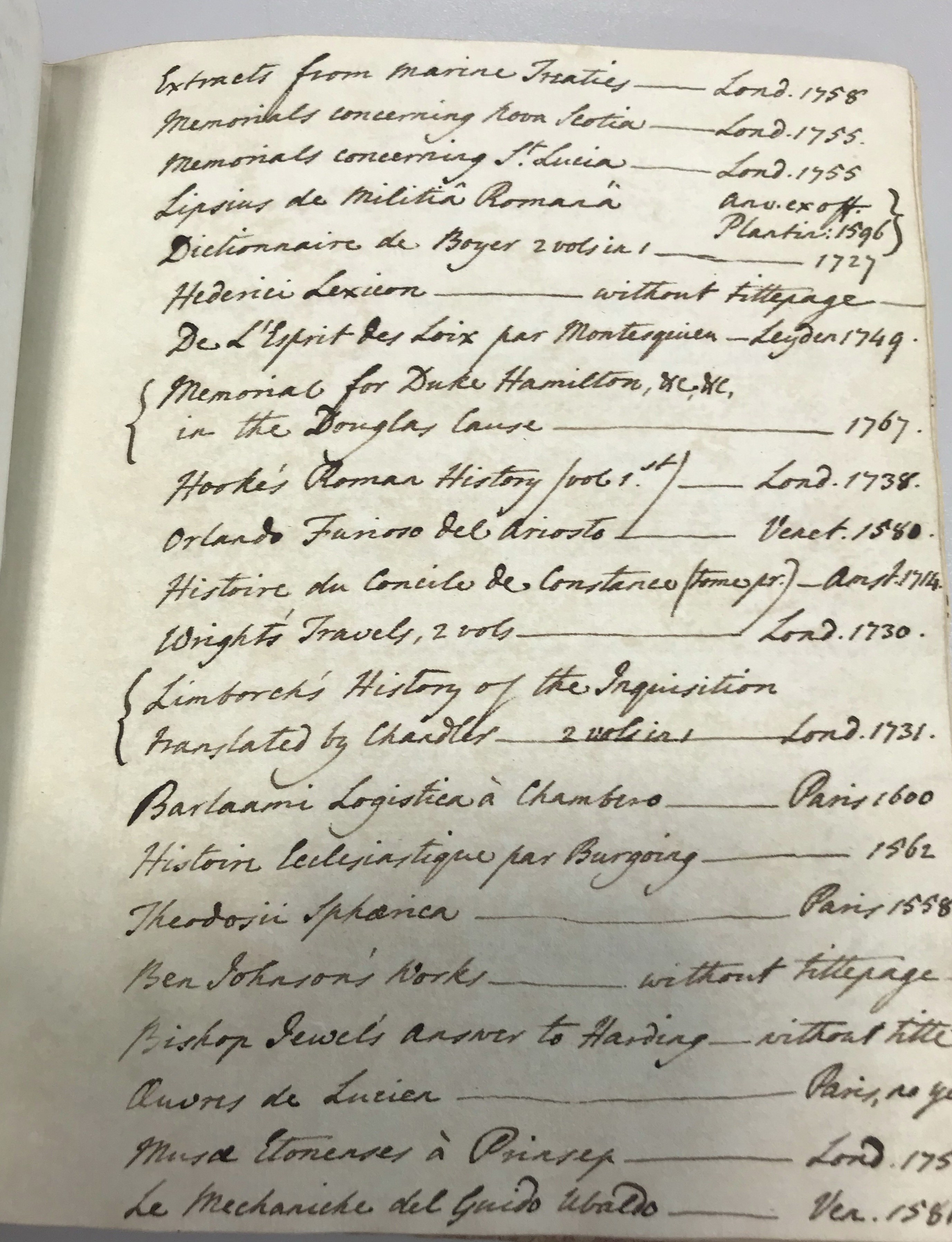
Several catalogued books connect directly with Neville’s own circle. John Chamber’s Latin edition of Barlaam’s Logistica (Paris, 1600) contains preliminary verse addressing Neville by name as ambassador to the French king and praising his gifts of expression. Chapter 47 examines that address in detail. Henry Savile, Neville’s tutor, travelling companion and lifelong friend, edited the Rerum Anglicarum scriptores (London, 1596), a collection of medieval English historians also recorded in the catalogue.5
Richard Carew’s Survey of Cornwall (London, 1602) brings another familiar family onto the shelves. His brother George travelled in Europe with Neville and Savile; his son, also Richard, accompanied Neville to France to learn French. Two further books were translated by Filippo Pigafetta, the traveller and scholar whom Cobham described in 1582 as an acquaintance of the young Neville: Guidobaldo del Monte’s Le Mechaniche (1581) and the Emperor Leo’s treatise on military formations (1586).6
The same editions Savile used
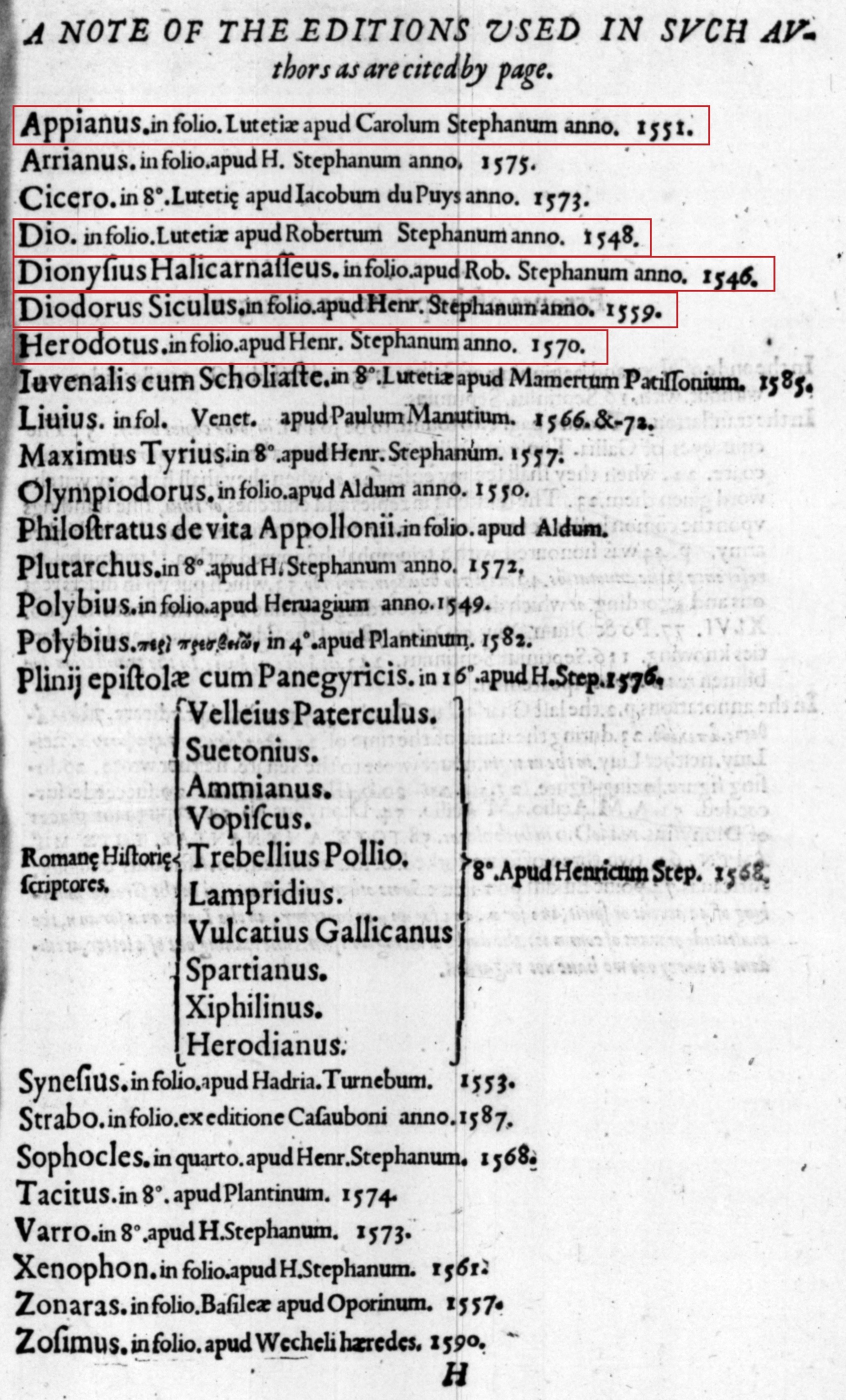
Five Greek historical works in the Billingbear catalogue match editions recorded in five of the twenty-five bibliographic entries Henry Savile listed in his 1591 Tacitus. Savile supplied “A note of the editions used in such authors as are cited by page,” identifying the books behind his page references. Three of these books survive at Audley End with Savile and Neville’s annotations: Appian, Cassius Dio and Dionysius of Halicarnassus.7
| Author | Edition recorded by both Savile and the Billingbear catalogue |
|---|---|
| Appian | Charles Estienne, Paris, 1551 |
| Cassius Dio | Robert Estienne, Paris, 1548 |
| Dionysius of Halicarnassus | Robert Estienne, Paris, 1546 |
| Diodorus Siculus | Henri Estienne, 1559 |
| Herodotus | Henri Estienne, 1570 |
Savile’s Greek in a Neville book
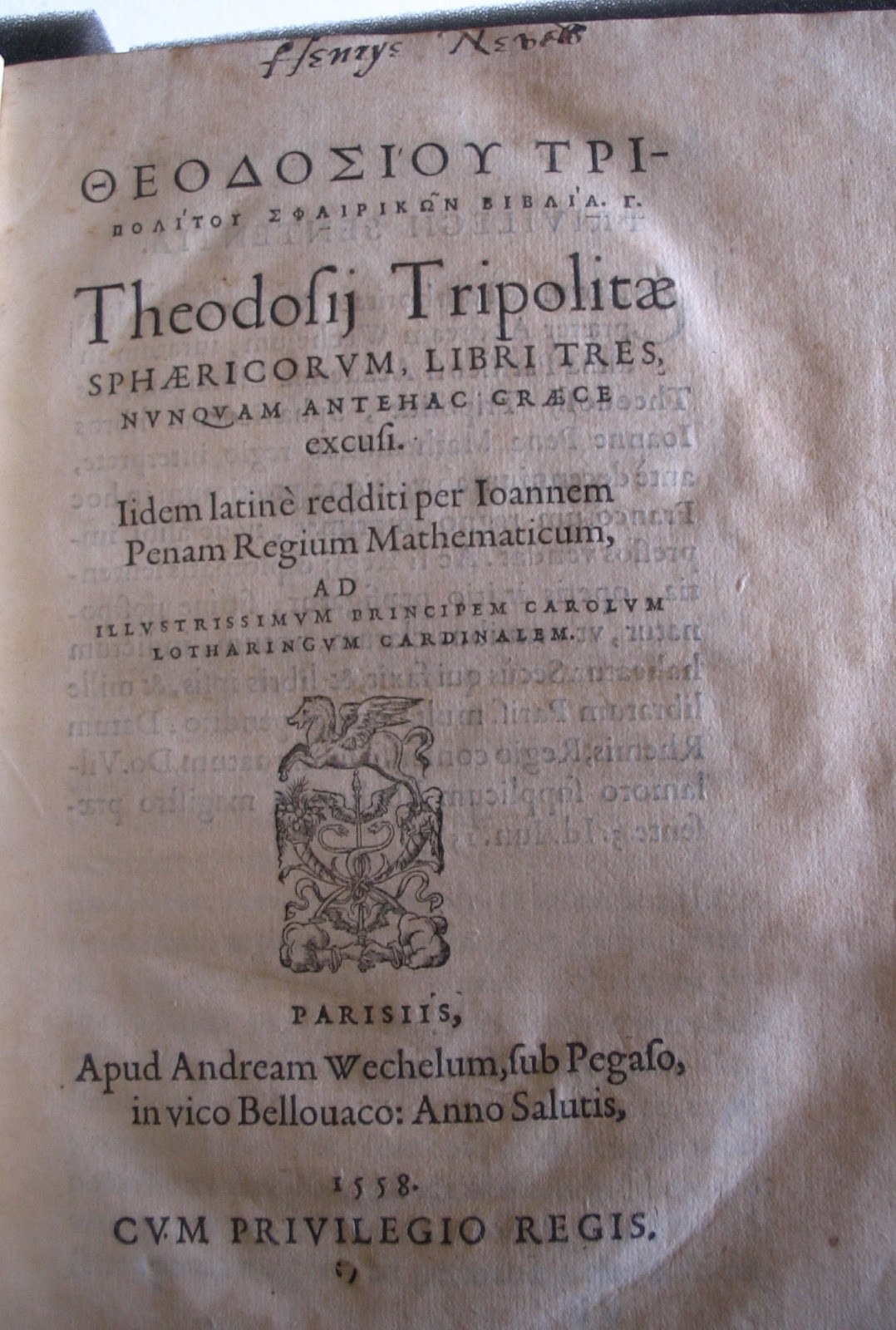
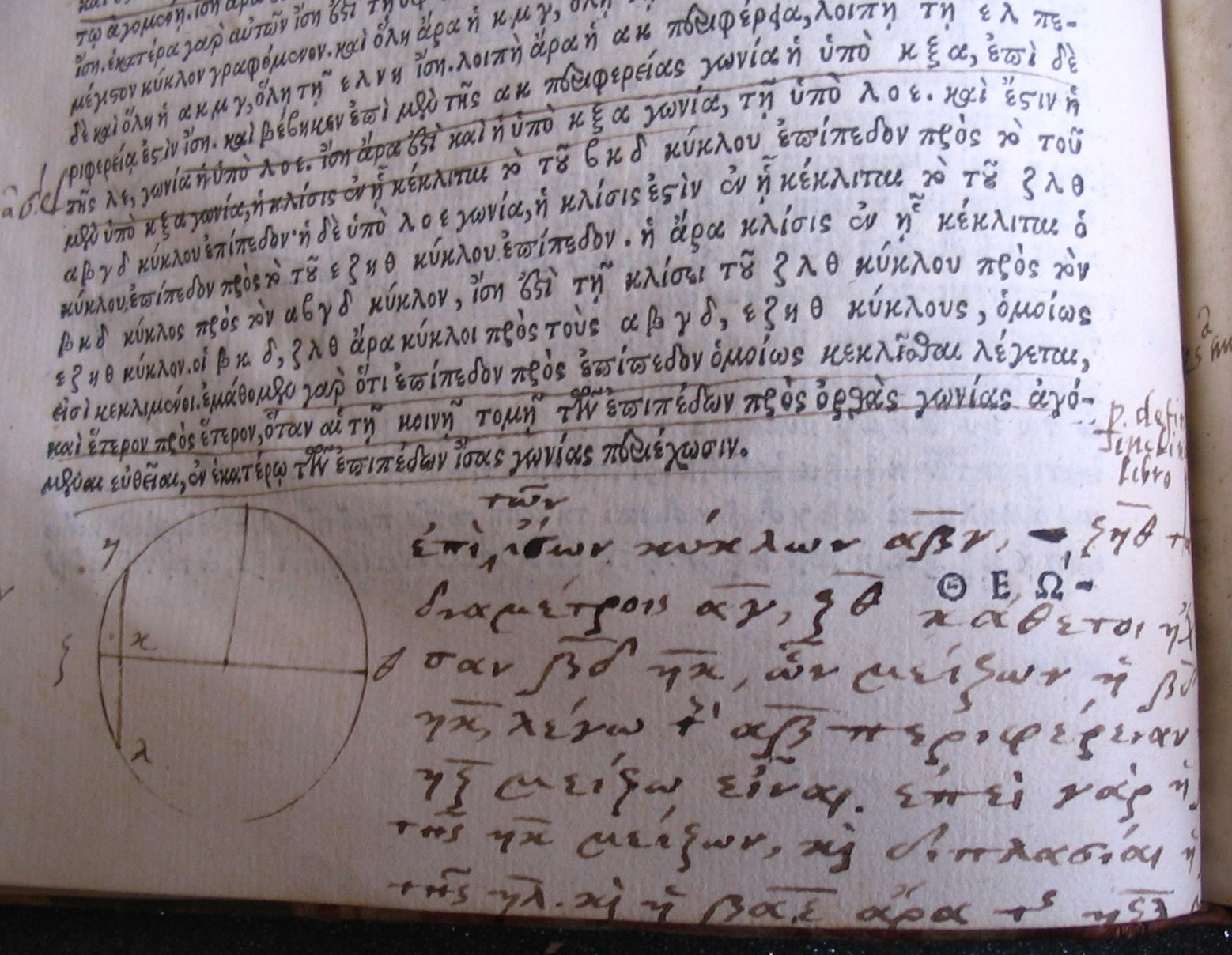
An annotated geometry book provides another direct trace of Savile’s reading. The Audley End copy of Theodosius’s Sphaerics (Paris, 1558), printed in Greek with Jean Pena’s Latin translation, contains Greek annotations in Savile’s hand. A scholar who specializes in Savile’s work has confirmed it.8
The title page bears the name “Henrye Nevell”, probably not in the ambassador’s own hand. It may have been written by someone identifying the owner, or by Neville’s son. The Billingbear catalogue of 1780 lists the same Paris edition of Theodosius.
Savile’s study of Italian
Girolamo Ruscelli’s De’ Commentarii della lingua italiana adds Italian language study to this picture. Published in Venice in 1581, precisely during Neville and Savile’s Italian travels, it is recorded in the Billingbear catalogue and survives at Audley End with extensive notes attributed to Henry Savile. His marginal annotations and underlining concern Italian grammar, including verb formation: evidence of language study alongside the histories, poems and tales.9
The range of the collection
The early books reach well beyond the familiar literary sources. The catalogue records Machiavelli’s Prince (1551), Bodin’s République (1579), Paruta’s Della vita politica (1579), Botero’s Reason of State (1589), and Albergati’s Discorsi politici (1602). Albergati’s title expressly announces its opposition to Bodin and defence of Aristotle. The collection also included Francesco Guicciardini’s History of Italy (Venice, 1580), which survives at Audley End with Neville’s annotations. Published during his continental tour, this edition was newly available when Neville and Savile travelled through Italy in 1581–82.10
The practical books include Giacomo di Grassi’s fencing manual, Ragione di adoprar sicuramente l’arme (Venice, 1570), which explains attack and defence with swords and other weapons, and Carlo Tetti on fortification (1575).10
The catalogue also records the first edition of Copernicus’s De revolutionibus orbium coelestium (Nuremberg, 1543), which sets out a system in which the Earth and the other planets orbit the Sun. William Gilbert’s De magnete (London, 1600) treats magnetism through experiment and argues that the Earth itself is a great magnet, explaining the compass needle’s orientation. These were major works of astronomy and natural philosophy alongside the collection’s literary and historical books.11
The Italian literary sequence is particularly extensive:
| Work | Edition recorded |
|---|---|
| Pulci, Morgante Maggiore | 1551 |
| Brusantino, Angelica innamorata | 1553 |
| Renaldini, Innamoramento di Ruggeretto | Venice, 1554 |
| Boccaccio, Decameron | Venice, Valgrisi, 1555 |
| Tasso, Rinaldo | Venice, 1562 |
| Cinthio, Hecatommithi | Venice, 1580 |
| Ariosto, Orlando Furioso | Venice, 1580 |
| Petrarch, with Gesualdo’s commentary | 1581 |
| Boiardo, Orlando Innamorato | Venice, 1602 |
| Guarini, Pastor Fido | Venice, 160212 |
The 1581 Venetian edition of Petrarch, with Giovanni Andrea Gesualdo’s commentary, survives at Audley End and is explicitly listed in the Billingbear catalogue. Its publication coincides with Neville and Savile’s Italian travels. The copy contains underlining in both Petrarch’s poetry and Gesualdo’s commentary, although the reader responsible has not been identified.10
The surviving Audley End books preserve only part of the early collection recorded at Billingbear. Matching a catalogue entry to a surviving edition is a starting point; the copy’s inscriptions, annotations and history are needed to establish its connection with Neville.13
The 1546 Dionysius survives at Audley End with the annotation examined in Chapters 34 and 39. Neville’s note names Ancus Martius and Tarquinius Collatinus and adds sixty-two years to a chronological calculation. Ancus belongs to the Roman material discussed with Coriolanus; Collatinus is Lucrece’s husband. Chapter 39 reproduces and transcribes the note, examines the Greek passage, and explains why the calculation appears to require Tarquinius Priscus rather than Collatinus. The wording is preserved as written.14
From Bisham to Billingbear and Audley End
Dunstan Roberts identified the signatures of Thomas Hoby, the translator of Castiglione’s Courtier, in two books at Audley End: Renaldini’s Innamoramento di Ruggeretto, Venice 1554, and Boccaccio’s Decameron, Venice 1555. Both also carry Hoby’s motto and an inscription dated 1554. Roberts discusses the discrepancy between that date and the Boccaccio imprint without treating either as a transcription error.15
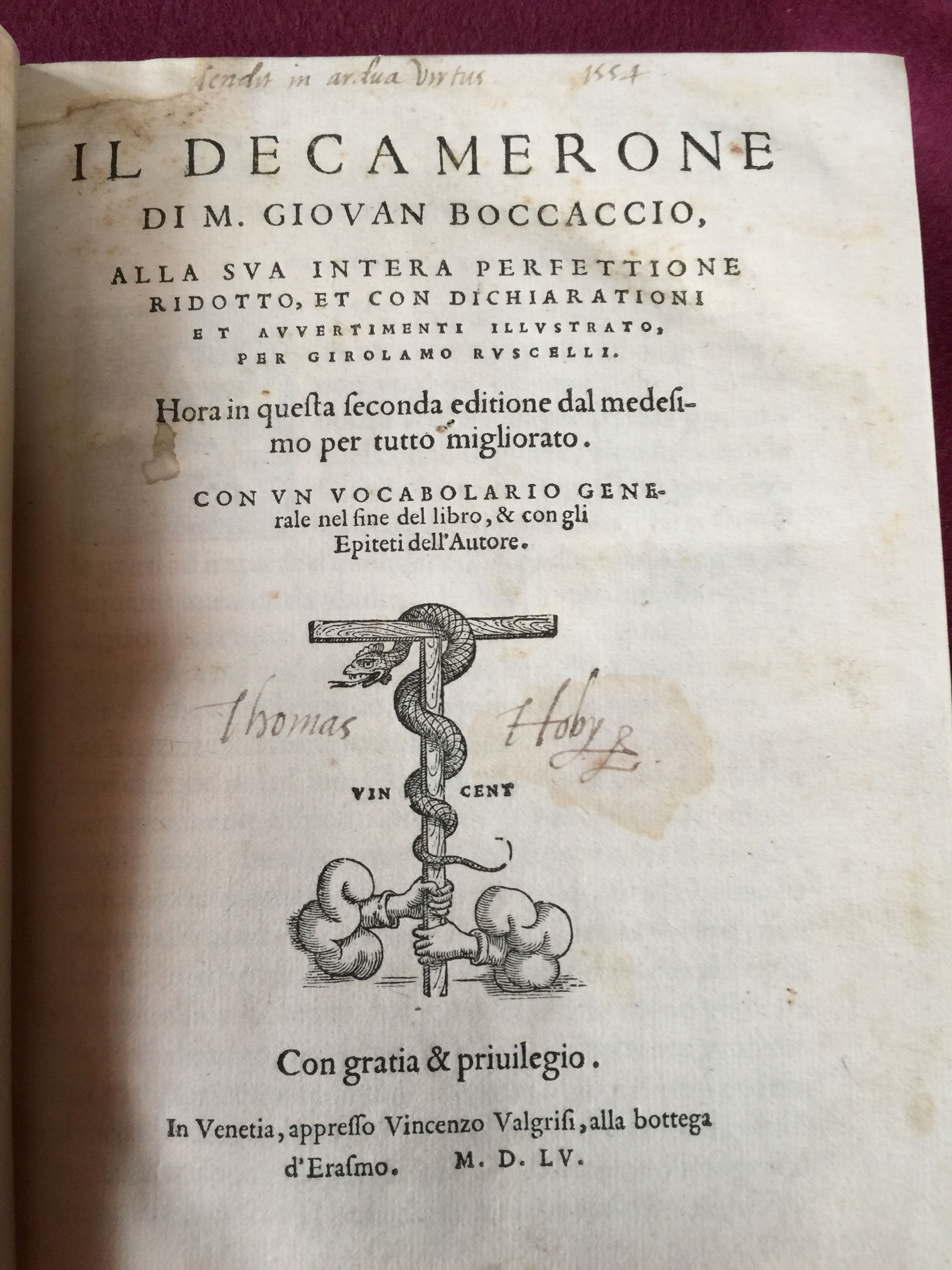
Both editions occur in the 1780 Billingbear catalogue. The Boccaccio appears in the Audley End catalogue of 1834; both appear there in 1877. Roberts therefore proposes that the books reached Billingbear between Hoby’s acquisition of Bisham Abbey in 1558 and the 1780 catalogue, then moved separately to Audley End. The surviving books retain an identifiable history through changes of house and binding.16
The family link between the houses gives that movement its setting. Richard Aldworth Neville began living at Audley End in 1797 and took possession in 1802. Books followed the family from Billingbear, possibly in more than one transfer: the two Hoby volumes first appear in the surviving Audley End catalogues at different dates.17
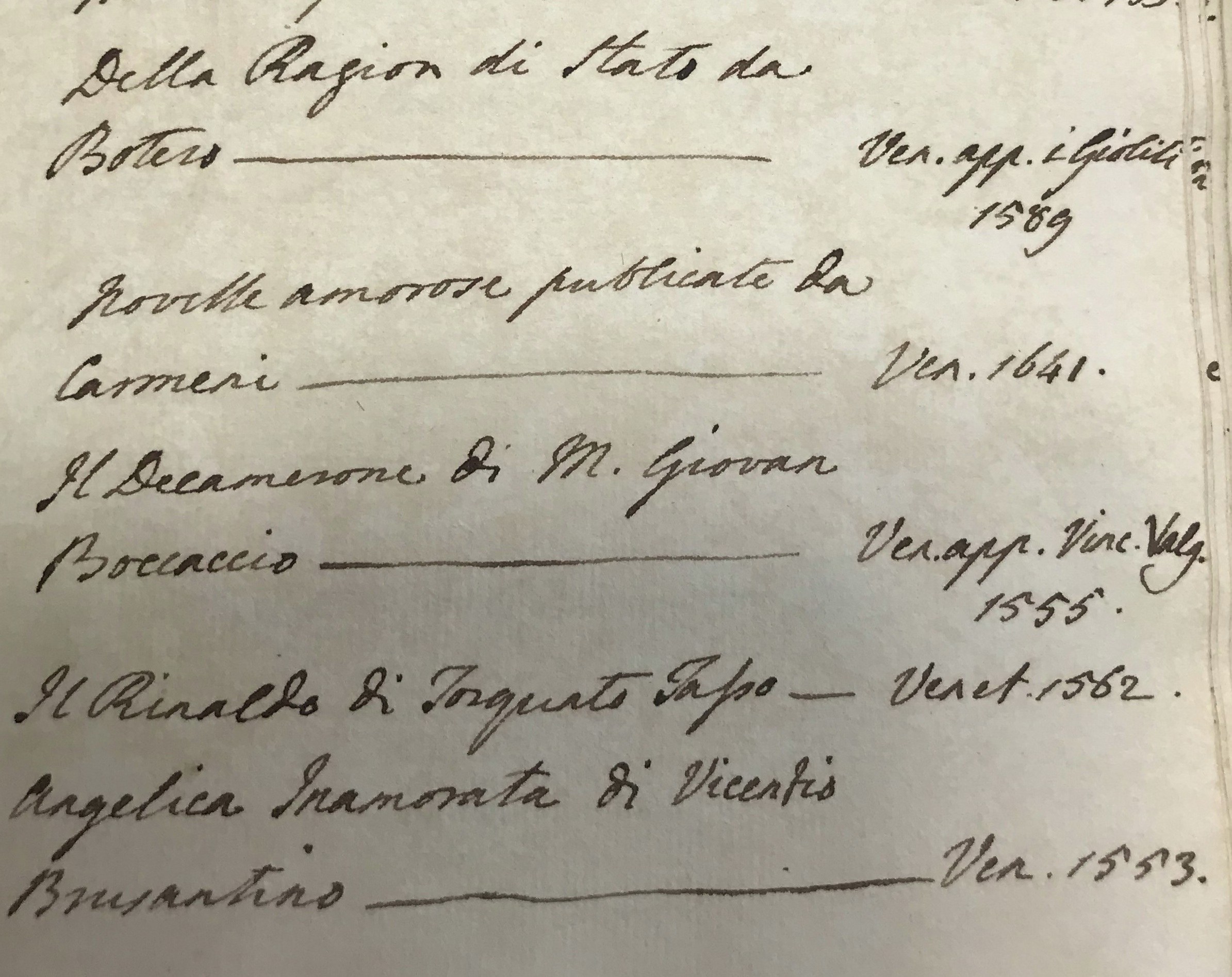
Hoby is their earliest identified owner; their arrival at Billingbear remains undated. Hoby and Neville’s father had met in Padua during the Marian exile, and their Berkshire houses, Bisham and Billingbear, stood about eight miles apart. Roberts places the two books within that documented family acquaintance, without assigning an otherwise unknown date to their transfer.15
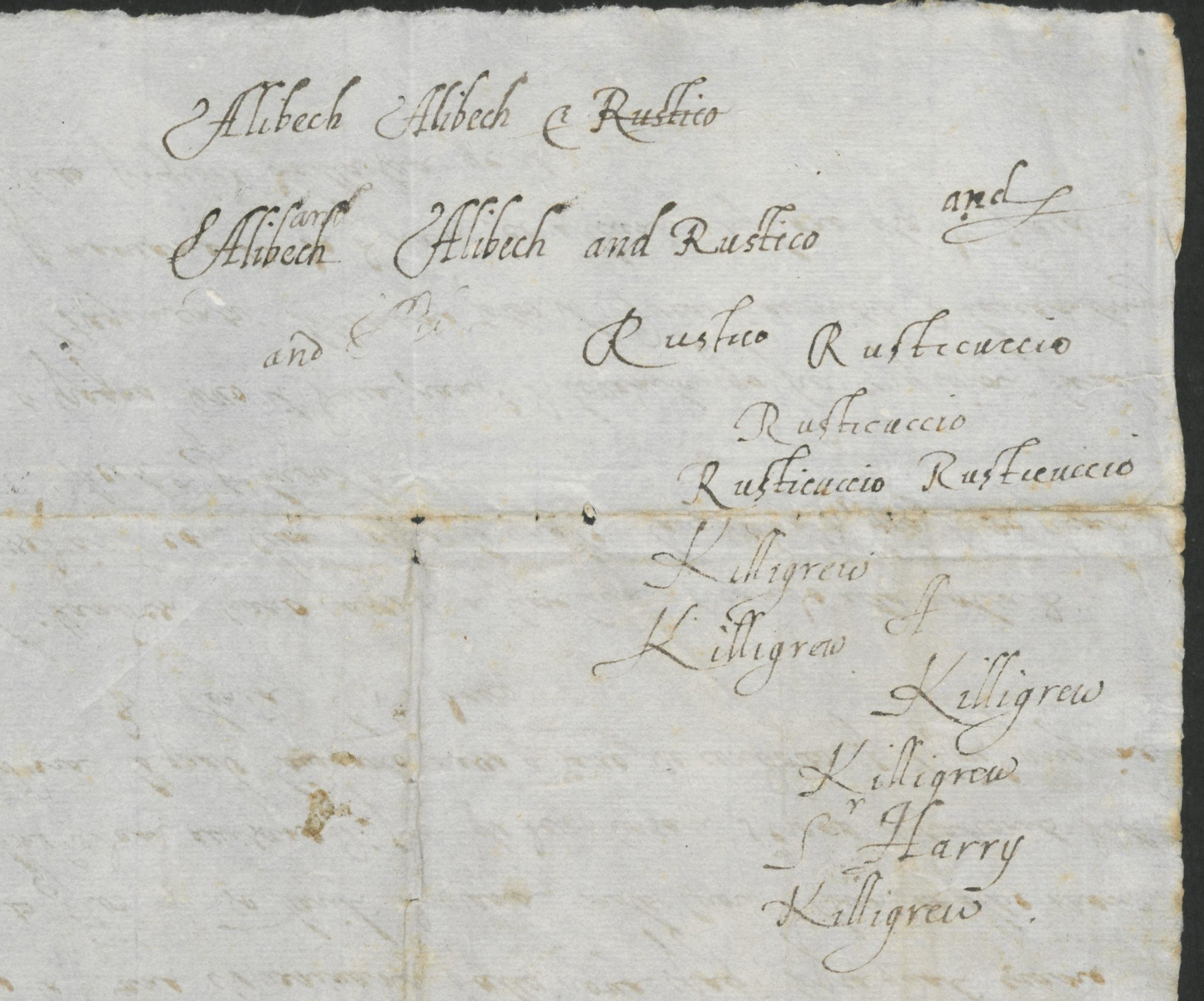
Neville’s familiarity with Boccaccio also left a trace in his papers. On the reverse of Italian newsletter material from 1591, received through Thomas Savile, he wrote “Alibech Alibech & Rustico,” repeating the names and playing with Rustico as “Rusticuccio.” They are the characters in the tenth tale of the third day of the Decameron, immediately after the Giletta story behind All’s Well That Ends Well. The names and Italian wordplay strongly suggest familiarity with the tale in Italian, independently of the later library catalogue.18
The Aldine Pliny
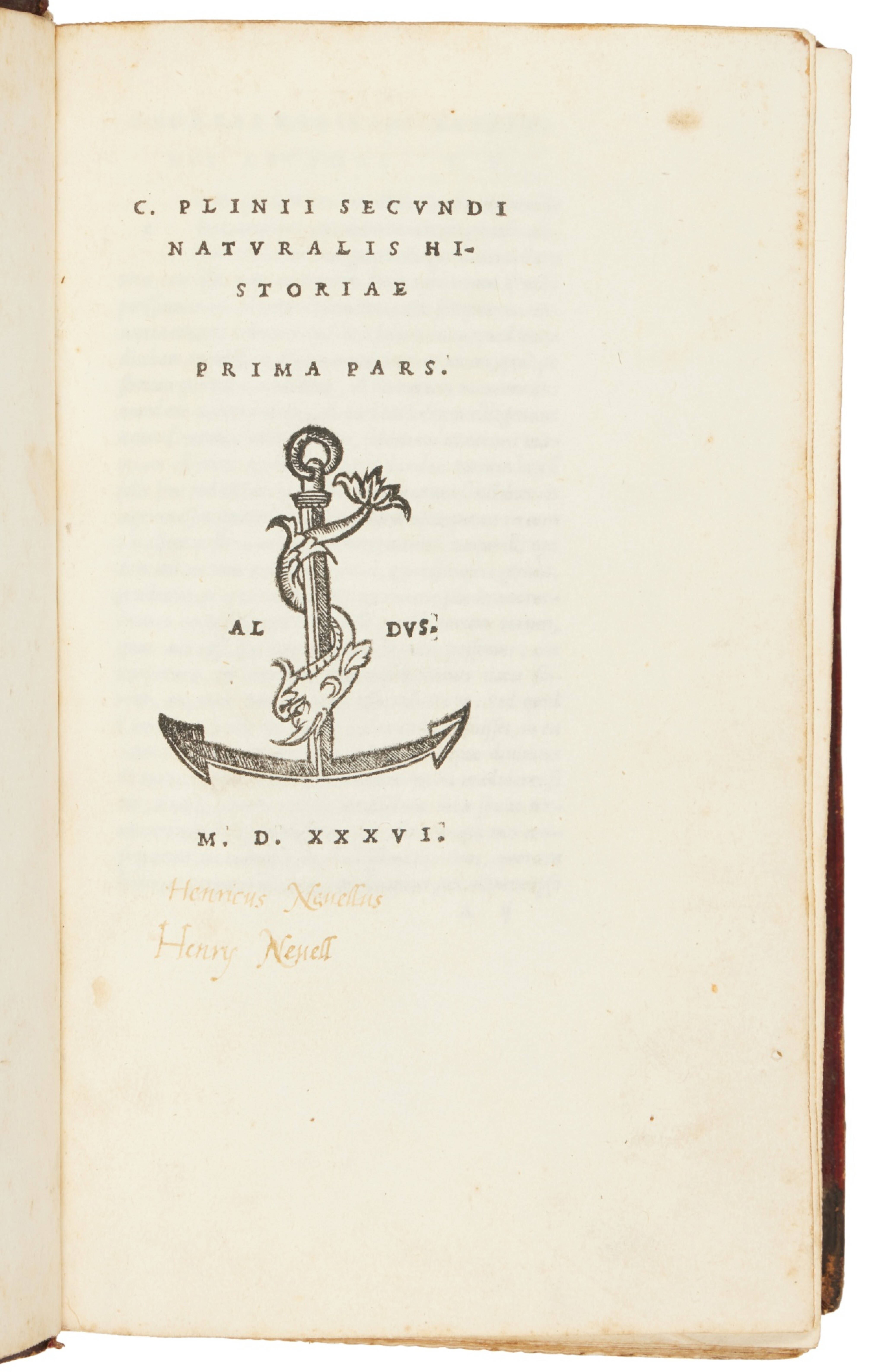
Two volumes of an Aldine Pliny stood in the library at Billingbear. One, according to Lord Braybrooke’s account of 1836, contained the autograph of Henry Neville the ambassador. The third volume was missing until Thomas Dampier, later bishop of Ely, happened upon a large-paper copy at a bookstall. He remembered the incomplete set and presented his find to the owner of Billingbear. When the books were brought together, their distinctive bindings and ornaments matched: the missing volume had come home.19
The set survives. The title page of its first volume, dated 1536, bears Henry Neville’s name twice, in Latin and English, beneath the Aldine anchor and dolphin. Sotheby’s reproduced the page when the three volumes appeared in the Brooker sale in 2025. Braybrooke’s account identifies the owner as the ambassador.20
Neville’s gifts to Merton
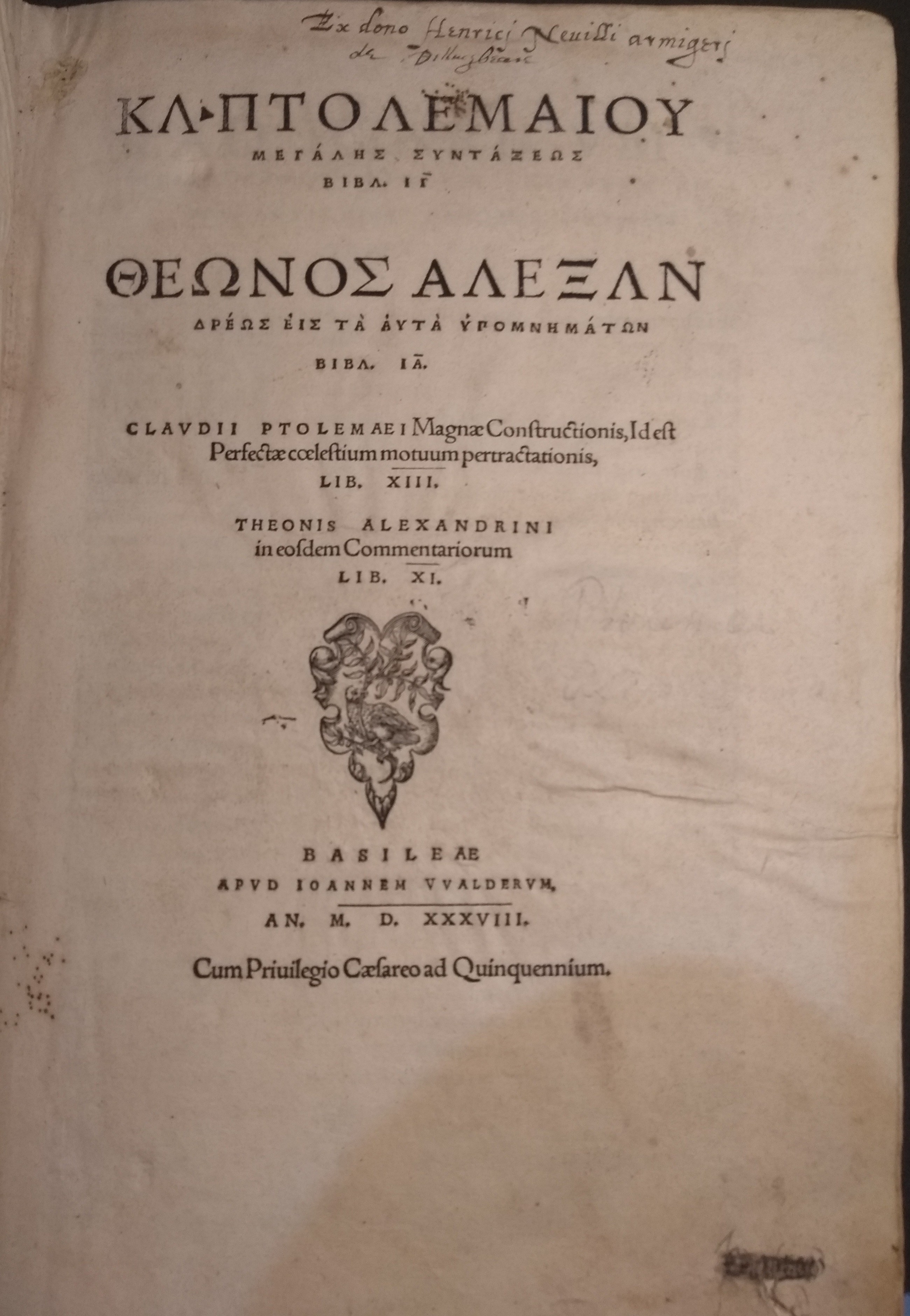
Neville also gave books to Merton College, Oxford. Two surviving volumes bear donor inscriptions naming Henry Neville of Billingbear: Ptolemy’s astronomical treatise, the Almagest, and a volume of Cassius Dio. The Cassius Dio is a copy of the same Paris 1548 edition that survives at Audley End. The Ptolemy is the Greek edition printed at Basel by Johann Walder in 1538, with Theon of Alexandria’s commentary. Its title-page inscription records the gift of “Henry Neville, esquire, of Billingbear.”21
An Italian source at Billingbear
Cinthio’s Hecatommithi is a key Italian source for Othello: in its story, a handkerchief helps turn a Moorish commander against his wife.22 The collection’s Epitia story supplies the corrupt magistrate’s bargain adapted in Measure for Measure.23 The 1580 Billingbear edition aligns with Neville’s travels in Europe; the copy is not at Audley End and has not been located yet.
Holinshed in the family
A surviving 1577 Holinshed’s Chronicles at the University of Kansas bears William Killigrew’s ownership name. The library identified him by comparing the inscriptions with signatures on a 1579 letter and a 1601 deed. William was the uncle of Neville’s wife Anne. Her father, Henry Killigrew, had a separate connection with the enlarged 1587 edition: he was named among those appointed to review it.24
The 1577 book also names both brothers among the participants in the siege of Edinburgh Castle: Henry as Elizabeth’s ambassador and William among the volunteers.24
Notes and sources
D/EN/F37/1, entries for Cinthio’s Hecatommithi (1580) and the Valgrisi Decameron (1555). Cinthio, III.7 and VIII.5; Royal Shakespeare Company, “Othello: Dates and Sources” and “Measure for Measure: Dates and Sources”. Whetstone’s Promos and Cassandra is an intermediary for the latter. Boccaccio, Decameron, III.9 (Giletta) and II.9 (the wager); Senate House Library, “Il Decamerone”. Painter transmits the Giletta story in English; Frederyke of Jennen belongs to the wager story’s wider transmission. The identification of source stories does not require every borrowing to have been made directly from the Italian.↩︎
Royal Berkshire Archives, D/EN/F37/1, Catalogue of the Books in the Library at Billingbear, 7 November 1780, heading and dated entries; repository record. This is a later family-library catalogue, not Neville’s probate inventory. Its separate entry for a Rolli Decameron explicitly marks 1527 as a false date: the Rolli edition is London, 1725, as described by the Morgan Library, PML41119, and Sir John Soane’s Museum, 1347. It must not be counted as a sixteenth-century edition. These records identify the edition, not the present location of the Billingbear copy.↩︎
Royal Berkshire Archives, D/EN/F37/1, Catalogue of the Books in the Library at Billingbear, 7 November 1780, entries “Chaucer’s Works”, London, 1602, and “Saxonis Grammatici Danica Historia”, 1576. For the Chaucerian sources, see Folger Shakespeare Library, “List of sources for Shakespeare’s works”, entries for Troilus and Cressida and The Two Noble Kinsmen. The catalogue does not identify Shakespeare’s particular Chaucer edition. Saxo, Danica Historia (Frankfurt: Andreas Wechel, 1576), pp. 44–47; University of Tartu copy. Saxo is the ultimate narrative source, not necessarily the text consulted directly: Belleforest’s retelling and an earlier play belong to the transmission discussed in David Bevington, “Hamlet: Sources and Analogues”. The 1576 Saxo contains Amleth’s murdered father, his uncle’s marriage to the widow, concealed intelligence, and the journey carrying instructions for the prince’s death. Amleth discovers and alters the instructions, turning the sentence on his companions (pp. 44–47, especially p. 47). Which version Neville read remains unknown. For Oliver Elton’s translation, see Internet Shakespeare Editions.↩︎
D/EN/F37/1, entries under Livy, Dionysius, Appian, Cassius Dio and Tacitus; the editions are discussed below. Dionysius, Roman Antiquities, VIII, treats Coriolanus; Appian’s Civil Wars and Dio’s Roman History cover Caesar and Antony. Titus Andronicus has an invented Roman plot, not a single historical episode reproduced from these authors. Plutarch’s role in Coriolanus, Julius Caesar and Antony and Cleopatra is distinct from this wider historical coverage; Neville’s use of the Life of Demetrius is examined in Chapter 9. The catalogue’s Amyot Plutarch is dated 1627 and its English Lives 1758: neither is presented as Neville’s own edition.↩︎
Savile’s 1596 collection prints William of Malmesbury, Henry of Huntingdon, Roger of Hoveden, Æthelweard and the history attributed to Ingulf, followed by a chronology. Its title announces texts recovered from old manuscripts. In his dedication to Elizabeth, Savile explains that he is making earlier writers available to those who might undertake a national history rather than writing it himself. Thomas Roebuck records that Rowland Whyte bought the collection for Robert Sidney in November 1596; Sidney’s copy survives at the Centre for Renaissance and Reformation Studies in Toronto. The book thus circulated within Savile and Neville’s former travelling circle during the decade of Shakespeare’s history plays. Henry Savile, Rerum Anglicarum Scriptores post Bedam praecipui (London: G. Bishop, R. Newbery and R. Barker, 1596), title page and dedication to Elizabeth, Bavarian State Library copy. The title page supplies 1596; Waszink’s 1598 date is not followed. Thomas Roebuck, “Politics, Patronage and Medieval Scholarship: Henry Savile’s Rerum Anglicarum scriptores post Bedam (1596) in Context”, Erudition and the Republic of Letters 6 (2021), 61–115, especially 62 and n. 2; Elisa Tersigni, “Henry Savile’s Rerum Anglicarum scriptores post Bedam (London, 1596)”, Centre for Renaissance and Reformation Studies, University of Toronto, 23 May 2012, provenance discussion.↩︎
Barlaam, Barlaami Monachi Logistica nunc primum Latinè reddita, & scholiis illustrata à Ioanne Chambero (Paris: Guillaume Auvray, 1600), prefatory verse, address to Henry Neville; Augsburg, Staats- und Stadtbibliothek, 4 Math 43, digitized by the Bayerische Staatsbibliothek, image 8. The address is contemporary evidence of Chamber’s relationship to Neville. The 1780 entry is evidence of later library presence. Royal Berkshire Archives, D/EN/F37/1, entries for Rerum Anglicarum scriptores (London, 1596) and Carew’s Survey of Cornwall (London, 1602). For George Carew’s travels with Neville and Savile, Robert B. Todd, “Henry and Thomas Savile in Italy,” Bibliothèque d’Humanisme et Renaissance 58 (1996), p. 440; for his relationship to Richard, Westminster Abbey, “Sir George Carew”. Richard Carew the younger describes being sent by his father to France with Neville in Samuel Hartlib, The True and Readie Way to Learne the Latine Tongue (1654), pp. 45–49, especially p. 46; EEBO-TCP A42982. For Pigafetta’s acquaintance with Neville, Cobham to Walsingham, 21 August and 17 September 1582, TNA SP 78/8, ff.22 and 43; Calendar of State Papers, Foreign, Elizabeth, XVI, entries 266 and 339. The translator is Filippo, not Marc’Antonio Pigafetta.↩︎
Henry Savile, The ende of Nero and beginning of Galba (1591), “A note of the editions used in such authors as are cited by page,” STC 23642, TCP A13331, Savile’s edition list. Catalogue of the Books in the Library at Billingbear, 7 November 1780, Royal Berkshire Archives, D/EN/F37/1, folio-section leaves headed “Œuvres de Plutarque” and “Edit. Princ. Dionysius Halicarnasseus.” Five of Savile’s 25 edition entries match exactly; the table does not claim that his complete list matches. The 1780 catalogue establishes the editions then held at Billingbear, not that Savile consulted those particular physical copies. The 1548 Dio is distinct from the separately catalogued 1551 Xiphilinus epitome.↩︎
Theodosius, Sphaericorum libri tres, with the Latin translation of Jean Pena (Paris: André Wechel, 1558), Audley End copy. Ken Feinstein, “Part 5: Henry Savile’s Greek Handwriting at Audley End”, 15 December 2019, reproduces the title page, annotation and handwriting comparisons, and reports confirmation by a Savile specialist. The title-page inscription’s hand is expressly left unidentified. For the corresponding edition in the 1780 Billingbear catalogue, see Royal Berkshire Archives, D/EN/F37/1, entry “Theodosii Sphaerica”, Paris, 1558. Neither the inscription nor the catalogue dates Savile’s annotations.↩︎
Girolamo Ruscelli, De’ Commentarii della lingua italiana, seven books (Venice: Damian Zenaro, 1581), title page and Audley End copy, inventory 81035061, including annotated pp. 88 and 247; digitized edition. The identification of Savile’s hand is the author’s, based on photographs of the annotated copy. Royal Berkshire Archives, D/EN/F37/1, Catalogue of the Books in the Library at Billingbear, 7 November 1780, entry “De’ Commentari della Lingua Italiana del Girolamo Ruscelli”, Venice, 1581. For the Italian journey in 1581–82, Robert B. Todd, “Henry and Thomas Savile in Italy,” Bibliothèque d’Humanisme et Renaissance 58 (1996), pp. 439–444, article, and Jonathan Woolfson, Padua and the Tudors: English Students in Italy, 1485–1603 (1998), discussed in Chapter 2. The publication year coincides with their travels; neither the purchase nor the annotations have been independently dated.↩︎
Royal Berkshire Archives, D/EN/F37/1, entries under the named authors and titles. Edition dates and languages refer to the catalogued editions. Albergati, Dei discorsi politici libri cinque (Rome, 1602), title; Audley End inventory 81035076. The dates are catalogue evidence, not acquisition dates. Giacomo di Grassi, Ragione di adoprar sicuramente l’arme si da offesa, come da difesa (Venice: Giordano Ziletti, 1570), title and contents. Royal Berkshire Archives, D/EN/F37/1, entry “Historia d’Italia di Guicciardini”, Venice, 1580. For the surviving Audley End copy and its annotations, see Ken Feinstein, “Part 3: Henry Neville’s Annotations in Guicciardini’s The History of Italy”, 10 December 2019, reproducing the catalogue entry, annotated pages and handwriting comparisons. Petrarch: D/EN/F37/1, entry “Il Petrarca con l’Espositione di Gesualdo — Ven. 1581”; Audley End inventory 81035022. The surviving copy’s title page gives Venice: Alessandro Griffio, 1581; photographed pages show underlining in the verse and Gesualdo’s commentary. Neither the marks nor acquisition of the copy are dated here. For the Italian travels, see Todd, “Henry and Thomas Savile in Italy,” pp. 439–444, cited above.↩︎
Royal Berkshire Archives, D/EN/F37/1, unpaginated catalogue: leaf containing “Chillingworths’ Religion of Protestants” for Copernicus; leaf beginning “Conference between Laud and Fisher” for Gilbert. Nicolaus Copernicus, De revolutionibus orbium coelestium (Nuremberg: Johann Petreius, 1543), Library of Congress copy and description; William Gilbert, De magnete (London: Peter Short, 1600), Smithsonian Libraries copy and description. The catalogue records these editions; it does not establish when they entered the family library.↩︎
Robert Greene’s Pandosto supplies the principal story of The Winter’s Tale. Robert Henke argues that Shakespeare’s reshaping of the prose romance—tragic opening, pastoral middle and comic reconciliation—follows the three-part movement of Italian pastoral tragicomedy, the tradition to which Guarini’s Il pastor fido belongs. Robert Henke, “The Winter’s Tale and Guarinian Dramaturgy,” Comparative Drama 27.2 (1993), opening paragraph, publicly reproduced by the journal. The argument summarized here is stated in that paragraph; it concerns dramatic form, while retaining Greene’s Pandosto as the narrative source. Royal Berkshire Archives, D/EN/F37/1, Catalogue of the Books in the Library at Billingbear, 7 November 1780, entry “Il Pastor Fido del Guarini,” Venice, 1602; repository record. The entry records the later family collection; it does not date the book’s acquisition. The first English translation appeared in the same year, printed by Thomas Creede for Simon Waterson and dedicated to Sir Edward Dymoke, the Queen’s Champion. Samuel Daniel contributed a commendatory sonnet; the translator’s own sonnet calls Dymoke his kinsman, and Waterson’s dedication says the translator had died. Dymoke was the nephew of Frances Dymoke, wife of Thomas Windebank—Neville’s correspondent and trusted family agent. Thus the English edition’s dedication leads to the family of the man to whom Neville wrote the complaint about his crowded table examined in Chapter 33 on Timon of Athens. Battista Guarini, Il Pastor Fido: or The Faithfull Shepheard (London: Thomas Creede for Simon Waterson, 1602), preliminaries: Daniel’s sonnet, the translator’s sonnet and Waterson’s dedication dated 31 December 1601; STC 12415, TCP A02284, public transcription. The translator is unnamed in the book; differing later attributions are not resolved here. Walter C. Metcalfe, ed., The Visitations of the County of Lincoln in 1562–4 (1881), p.42, Dymoke pedigree: Frances is a daughter of the elder Sir Edward Dymoke and sister of Sir Robert, father of the younger Sir Edward. The dedication does not establish a transfer of the book through Windebank to Neville.↩︎
Author’s comparison of D/EN/F37/1 with Audley End collection descriptions. The provisional matches require object-level verification. The earlier 129/57/72 calculation included the Rolli Decameron under its false 1527 date; excluding that 1725 edition yields 128/57/71. Two 1616 entries and the 1618 Fenton Guicciardini are also excluded. No complete revalidation of every edition or earlier ownership is implied. See the Morgan and Soane edition records cited with the catalogue’s false-date Rolli entry. The working comparison identifies 128 catalogue entries dated through 1615: 57 have candidate Audley End matches and 71 remain unmatched. These are entries, not books proved to have belonged personally to Neville; some represent parts of multi-volume works.↩︎
Dionysius of Halicarnassus, Roman Antiquities (Paris: Robert Estienne, 1546), Audley End copy, p.45, at 1.75. Photograph and identification: Ken Feinstein, “Part 8: Henry Neville and Henry Savile Annotations in Roman Antiquities”, 16 October 2020. See Chapter 39 for the complete transcription and comparison with the Greek text; Collatinus is retained with two Ls.↩︎
Dunstan Roberts, “Books Owned by Sir Thomas Hoby (1530–1566),” Transactions of the Cambridge Bibliographical Society 17.1 (2020), 53–66, at 53–55. Audley End inventory numbers 81035068 (Renaldini) and 81035044 (Boccaccio). Roberts describes the title-page signatures, motto, dates and later bindings. The attributions are his published findings.↩︎
Roberts, “Books Owned,” 55–56. He distinguishes the books’ appearances in the 1780, 1834 and 1877 catalogues and proposes the transmission dates. The catalogue sequence does not identify when Henry Neville personally possessed either book.↩︎
Braybrooke, History of Audley End (1836), p.53, distinguishes residence in 1797 from possession in 1802. Roberts, “Books Owned,” pp.55–56, traces the books through the 1780, 1834 and 1877 catalogues; his shorthand “inherited … in 1797” is refined here using Braybrooke’s account. The residence began under a family arrangement; possession followed after the existing life interests ended.↩︎
The National Archives, PRO 30/50/70/2, reverse of Italian newsletter material, 1591; published manuscript images. The names refer to Boccaccio, Decameron, III.10. Giletta’s tale (III.9), discussed in Chapter 29, immediately precedes Alibech and Rustico (III.10). The scribbles identify a tale, not the particular edition Neville read.↩︎
Richard, Lord Braybrooke, The History of Audley End (London, 1836), p.117, digitized edition. Braybrooke places the first two volumes at Billingbear, reports the ambassador’s autograph in one, and recounts Dampier’s recovery of the third. His estimate of the set’s rarity is not used here as a modern census. Dampier was the recipient’s cousin; the identification of the autograph follows Braybrooke’s published account, not a new authentication.↩︎
Sotheby’s, Bibliotheca Brookeriana: A Renaissance Library, The Aldine Collection N–Z (2025), lot 1325, Pliny, Naturalis historiae (Venice, 1535–1536), title-page photograph and provenance. Auction catalogue. The auction catalogue leaves the identification between two Henry Nevilles open; Braybrooke, The History of Audley End (1836), p.117, specifically identifies the ambassador. The photograph establishes the presence of the two names; the historical identification here follows Braybrooke.↩︎
Merton College, Oxford, 32.A.4 (Ptolemy and Theon, Basel: Johann Walder, 1538) and 21.DD.6 (Cassius Dio), title-page donor inscriptions. For the Ptolemy title-page photograph, see Ken Feinstein, “Annotations at Merton College, Oxford,” 26 June 2023, Published photograph. For the Dio, see the Oxford SOLO catalogue, Merton 21.DD.6: Paris, Robert Estienne, 1548, books XXXVI–LVIII. The catalogue transcribes the title-page gift inscription as “Ex do: Henricj Neuillj armigerj militis de Pillingbean.” This is the catalogue’s transcription; the Merton inscription has not been checked here against a photograph.↩︎
Royal Berkshire Archives, D/EN/F37/1, Catalogue of the Books in the Library at Billingbear, 7 November 1780, unpaginated, entry “Hecatommithi, overo Cento Novelle di M. Giovanbattista Giraldi Cinthio,” Venice, 1580; repository record. Cinthio, De gli Hecatommithi (Venice, 1580), third decade, seventh tale. For the narrative relationship, see Cambridge’s introduction to Othello, discussion of Cinthio’s Moor, Ensign, Disdemona, officer and handkerchief. The catalogue entry establishes later family-library presence, not Neville’s purchase or reading of the copy.↩︎
Royal Shakespeare Company, “Measure for Measure: Dates and Sources,” describes Cinthio’s Epitia story and Whetstone’s 1578 English play. Cinthio is the source ancestor; the chapter does not claim that every feature of Shakespeare’s play comes from the Italian tale.↩︎
Karen Severud Cook, “A Holinshed’s Chronicles Provenance Puzzle,” Kenneth Spencer Research Library, University of Kansas, 6 February 2018; 1577 Chronicles, Pryce D11. Cook compares the ownership names with Surrey History Centre 6729/1/56, 3 June 1579, and Kansas MS239:2357, 26 October 1601. Cyndia Susan Clegg, “Censorship,” in The Oxford Handbook of Holinshed’s Chronicles (2013), 43–60, especially 45–46, quotes the Privy Council’s order naming Randolph, H. Killigrew and Hammond. The review concerned the 1587 edition; William’s surviving copy is the 1577 edition. Cook also identifies the list of siege participants on the verso of the Edinburgh map, following p. 1868 in volume 2. The copy’s marginal annotations remain unattributed. Anne’s parentage and her relationship to William are treated in the family chapter.↩︎