Within three months, Neville’s letters name both Orsino and Sebastian. On 15 November 1600, writing from London, he asked whether a prisoner in Venice was the “true Sebastian,” the Portuguese king believed killed in 1578. On 29 January 1601 he reported the visit of Don Virginio Orsino, Duke of Bracciano, to Elizabeth’s court. The correspondence brings together two central names in Twelfth Night and, with Sebastian, the problem of recognizing someone thought dead.1
Scholars have long suggested that Shakespeare named Orsino after the visiting duke. In his 1975 study of Twelfth Night, Robert K. Turner Jr quotes Neville’s letter when discussing the connection. The Sebastian correspondence adds a second name and a related question of identity from the same few months.2,3
The names Shakespeare chose
Barnabe Riche’s “Of Apolonius and Silla” (1581) supplies the shipwrecked woman who disguises herself and serves the man she loves. The Italian comedy Gl’Ingannati (The Deceived) also has a disguised girl and returning brother: Lelia and Fabrizio, with Flaminio as the lover. Neither gives Shakespeare his pairing of Orsino and Sebastian.4,5
Orsino at Elizabeth’s court
Virginio Orsini, Duke of Bracciano, visited Elizabeth’s court during the Christmas season of 1600–01. He was entertained with a comedy on 6 January, Twelfth Night itself; the record does not name the play. Sarah Werner discusses the possible identification with Twelfth Night for the Folger Shakespeare Library.3
Like Shakespeare’s music-loving Orsino, the visiting duke was a musical patron: he employed the composer Luca Marenzio and wrote verse that Giulio Caccini set to music.6
James Leyland supports Leslie Hotson’s proposed date but questions whether the play was built around Orsini’s biography: the short notice of the visit could instead have prompted a name change in a substantially written play. He also connects Shakespeare’s shipwrecked Sebastian with Teixeira’s account of King Sebastian escaping by sea. Together, Leyland argues, the two names could have had particular appeal at Elizabeth’s court.3
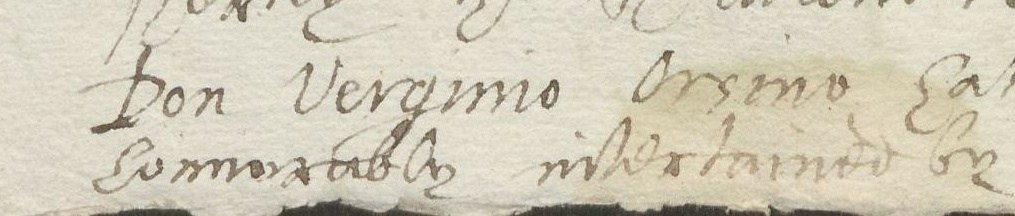
As Leyland notes, Winwood, still in France, had already given Orsino’s party a letter to Neville to help them obtain access to Elizabeth’s court.3 On 29 January 1601 Neville wrote to Winwood:
Don Virginio Orsino has been here, and very graciously and honourably entertained by her Majesty; he is gone hence to the Archduke.7
Neville’s surviving draft, with its deletions and insertions, spells the name Orsino in his own handwriting—the form Shakespeare gives his duke.7
Who was the true Sebastian?
King Sebastian of Portugal died in battle in 1578. A claimant appeared in Venice in 1598, attracting Portuguese supporters and Spanish opposition. Franca Petrucci identifies him as the Calabrian Marco Tullio Catizone. Venice imprisoned him and expelled him in December 1600; his disputed identity had become an international affair.8
José Teixeira, an advocate of the claimant, wrote directly to Neville on 21 October 1600 (31 October New Style). Portuguese witnesses, he said, had identified the prisoner by bodily marks; João de Castro had confirmed the news. He urged Neville to inform Elizabeth. Luís Filipe Silvério Lima discusses the letter in his 2023 study. Teixeira also supplied the main narrative of The Strangest Adventure (1601), translated by the dramatist Anthony Munday.9
On 15 November 1600 Neville asked Winwood to investigate:
We are full of a report, and almost of an opinion, that he which has been so long a prisoner at Venice is now discovered to be the true Sebastian, by many secret tokens upon his body, confirmed out of Portugal by those which knew him both child and man. I pray you inform yourself well of it, and clear us of that point if you may.9
Leyland connects this letter with the bodily marks in the play’s recognition scene.9 Neville was inclined to believe the report but sought confirmation.
Winwood reported the contrary on 13 January 1601: the Venetian judgement was that the man was “an imposture, a Calabrese.” Neville’s reply of the 23rd confirms receipt on the 21st. On 28 January he mentioned Captain Primme’s journey to the “pretended Sebastian”; the next day he reported Orsino’s visit.10
Shakespeare first introduces Sebastian under an assumed name: he tells Antonio that he has called himself Roderigo before revealing his name and family.11 When the twins finally stand together, Antonio, who has mistaken Viola for Sebastian, asks:
ANTONIO
How have you made division of yourself?
An apple cleft in two is not more twin
Than these two creatures. Which is Sebastian?11
— Twelfth Night, 5.1.
Viola names their home, Messaline, and their father, also Sebastian. The twins then test their memories:
VIOLA
My father had a mole upon his brow.SEBASTIAN And so had mine.
VIOLA
And died that day when Viola from her birth
Had numbered thirteen years.SEBASTIAN
O, that record is lively in my soul!
He finished indeed his mortal act
That day that made my sister thirteen years.11
— Twelfth Night, 5.1.
The twins remember their father’s mole and the age they were when he died; Neville’s informants identify marks on the claimant himself. Both accounts connect bodily detail with knowledge reaching back into childhood.
Antonio’s own history brings another diplomatic concern into the recognition scene. He risks arrest in Orsino’s city for a sea fight against the count’s galleys. Others repaid what they took to protect their trade; Antonio refused. Orsino calls him a pirate; Antonio answers as an honourable enemy.12
On 26 September 1599 Neville reported disputes over an English ship taken at Marseille and a French vessel seized by an English royal ship. He defended the latter seizure: the French traders had broken their king’s prohibition on trade with the Catholic League. He presented the English action as service to Henri IV. In both accounts, acts of maritime violence have to be distinguished from legitimate hostility and settled through restitution.13
Extorting reason
One of the strongest verbal links between Neville and Twelfth Night is a shared construction. On 29 June 1599 Neville asked Cecil for documentary support in seeking repayment of France’s debt to Elizabeth:
I humbly pray to have some verification attested under your Honour’s hand, for I hope that with importunity I shall at last extort some reason from these men; and the more I am able to charge them with, the greater present or yearly satisfaction they must in reason offer.14
Olivia uses the same unusual construction:
OLIVIA […]
Do not extort thy reasons from this clause,
For that I woo, thou therefore hast no cause;
But rather reason thus with reason fetter:
Love sought is good, but given unsought is better.15
— Twelfth Night, 3.1.
The unusual feature is the construction itself: Neville’s “extort some reason from” becomes Olivia’s “extort thy reasons from.” Both then return to “reason.” Neville seeks a reasonable settlement; Olivia rejects an argument drawn from her declaration of love.
A search of the EEBO-TCP texts in EarlyPrint found no example of this close construction printed before the First Folio of 1623.16
Neville also uses “extort” for drawing out concealed information. On 26 August 1599, discussing an alleged counterfeit-possession scheme, he wrote to Cecil:
So as if now the bottom of it might be extorted from this Bennet, I think it would be very acceptable to the king.17
Sebastian uses the word in the same sense when he praises Antonio for not pressing him to disclose his identity:
SEBASTIAN […]
a touch of modesty that you will not extort
from me what I am willing to keep in. Therefore it
charges me in manners the rather to express myself.18
— Twelfth Night, 2.1.
New words at the same moment
Neville’s letters of 1599–1600 contain a cluster of words that enter Shakespeare’s surviving plays in Twelfth Night or at about the same time. Several then recur in later Shakespeare plays. The connection is chronological as well as verbal: these words were in Neville’s working vocabulary during the very period in which the plays were being written.19
The table compares eight words across 239 dramatic texts assigned to 1590–1615 in Rizvi’s corpus: 38 Shakespeare plays, including collaborations, and 201 other texts. Each text counts once for a word, including ordinary inflections.20
| In Twelfth Night | Neville’s letters, 1599–1600 | Shakespeare plays containing the word (of 38) | Other dramatic texts (of 201) |
|---|---|---|---|
| “abatement and low price” (1.1) | “abatement of the impositions,” 26 February 160021 | 5: Twelfth Night, Hamlet, King Lear, Cymbeline, The Two Noble Kinsmen | 1 |
| “Here is yet a postscript” (2.5) | “the postscript of your last letter,” 24 April 160022 | 2: Twelfth Night, Hamlet | 0 |
| “I bring no overture” (1.5) | “Gondi’s overture,” 19 May 159923 | 4: Twelfth Night, All’s Well That Ends Well, King Lear, The Winter’s Tale | 3 |
| “an improbable fiction” (3.4) | “both untrue, and utterly improbable,” 29 June 159924 | 1: Twelfth Night | 1 |
| “so implacable” (3.4) | “implacable,” of the pope’s hostility to Elizabeth, 29 July 160025 | 1: Twelfth Night | 2 |
| “your misdemeanors” (2.3) | “such misdemeanors,” reporting Villeroy’s complaint about English attacks on shipping, 2 April 160026 | 1: Twelfth Night | 4 |
| “this clause” (3.1) | “make the clause copulative, which is now disjunctive,” 18 July 159927 | 1: Twelfth Night | 10 |
| “only to exasperate you” (3.2) | “exasperate,” 15 November 1600, in the letter asking about the “true Sebastian”28 | 4: Twelfth Night, Troilus and Cressida, King Lear, Macbeth | 11 |
The concentration is striking. Of the six plays using abatement or abatements, five are Shakespeare’s; both plays using postscript are his. Overture appears in four Shakespeare plays but only three of the much larger group of other plays. Improbable and implacable remain confined to Twelfth Night within Shakespeare and occur in only one and two other plays respectively. These are words Neville was using in correspondence just before or during the play’s composition, some of which Shakespeare would continue to use for years.
French diplomatic business gives this vocabulary a particular setting. Overture and abatement have close French counterparts: Cotgrave’s dictionary of 1611 gives ouverture as a proposal or opening and abbatement as an abatement. Neville uses the English words for a proposed royal marriage and a reduction in duties on English goods—matters at the centre of his French embassy.29 Misdemeanors also belongs to that work: it is Neville’s word when reporting Villeroy’s complaint about English attacks on French shipping.26
A French courtesy
At his first audience with Henri IV, Neville heard a French courtesy that also appears in Twelfth Night. Reporting the conversation to Cecil on 15 May 1599, he records the king saying that, if Elizabeth were a man, he would call himself her perfect friend; since she was a woman, “Je me dirai son serviteur”—“I shall call myself her servant.”
In Twelfth Night 3.1, Sir Andrew greets Viola in French. She answers:
VIOLA Et vous aussi. Votre serviteur!
ANDREW I hope, sir, you are, and I am yours.
— Twelfth Night, 3.1.30
Neville’s “son serviteur” and Viola’s “Votre serviteur” use the same French courtesy.
A priest’s habit and a priest’s function
Feste impersonates Sir Topas the curate to interrogate the confined Malvolio. Maria supplies gown and beard; Feste remarks as he dresses:
FOOL Well, I’ll put it on and I will dissemble myself in
’t, and I would I were the first that ever dissembled
in such a gown. [He puts on gown and beard.] I am
not tall enough to become the function well, nor
lean enough to be thought a good student, but to be
said an honest man and a good housekeeper goes as
fairly as to say a careful man and a great scholar.
The competitors enter.31
— Twelfth Night, 4.2.
On 16 September 1599 Neville reported a proposed agent for Spain who had been a priest before becoming Protestant and marrying. For the mission he would resume his former role:
he will take upon him the habit, and for need the function of a priest, which will also give him credit and trust there, and means thereby to do the better service.32
Both passages distinguish the clothing from the “function”: the work and authority of a priest. Neville’s agent would use that authority to gain trust; Feste uses it to question Malvolio, turning even his sane answers about Pythagoras into grounds for continued confinement.
The costume itself proves unnecessary. Maria tells Feste:
MARIA Thou mightst have done this without thy beard
and gown. He sees thee not.31
— Twelfth Night, 4.2.
In the 26 August 1599 letter quoted earlier, Neville reported a woman induced to feign possession:
the woman that was suborned to counterfeit herself to be possessed with a devil.33
The woman feigns possession; Malvolio’s persecutors impose that diagnosis on a sane man. Both deceptions exploit religious belief, alongside the clerical impersonation described in Neville’s next month’s dispatch.34
Further close parallels appear in Chapter 28, Measure for Measure—religious disguise for intelligence—and Chapter 30, King Lear—counterfeit possession and manipulation.
Notes and sources
Henry Neville to Ralph Winwood, 15 November 1600 and 29 January 1601, in Edmund Sawyer, ed., Memorials of Affairs of State in the Reigns of Q. Elizabeth and K. James I, vol. I (London, 1725), pp. 273–275, 291–292. November letter; January letter. Except where otherwise stated, dates here modernize the year to begin on 1 January, without converting Julian days to Gregorian dates. Quotations from Winwood’s Memorials are modernized in spelling, capitalization and punctuation, with straightforward forms such as “hath” rendered as “has.” Vocabulary, syntax and historical meaning are preserved. Sawyer’s printed edition does not preserve the original manuscripts’ spelling. Bold type throughout marks the terms being compared or discussed.↩︎
Robert K. Turner Jr, “The Text of Twelfth Night,” Shakespeare Quarterly 26, no. 2 (Spring 1975), pp. 128–138, especially p. 134 n. 16. JSTOR. Turner cites Neville’s 29 January letter in discussing the possible significance of Orsini’s visit.↩︎
Sarah Werner, “Twelfth Night”, The Collation, Folger Shakespeare Library, 6 January 2015. Werner discusses the Epiphany entertainment and the possibility of identifying its unnamed comedy with Shakespeare’s play. James Leyland, New Evidence for the First Night of Twelfth Night, 6 January 1601, Knowledge Commons, version 2, deposited 29 March 2026 (PDF copyright 2024), especially PDF pp. 3, 5–6 and 8–9, DOI. Page 3 quotes Winwood’s 4 December 1600 letter referring Orsino’s party to Neville. Leyland supports Hotson’s proposed performance date while questioning his biographical reading of Orsino, and adds the Sebastian connection; the argument concerns topicality and performance dating, not an attribution of authorship to Neville.↩︎
Barnabe Riche, Riche his Farewell to Militarie Profession (1581), “Of Apolonius and Silla,” complete tale; EEBO-TCP A68653. Public text.↩︎
Gl’Ingannati (The Deceived), translated by Thomas Love Peacock (London: Chapman and Hall, 1862), dramatis personae and Act I, especially pp. 16–21. Edition. Peacock combines translation with summarized portions, as his introductory remarks explain; the edition is used here for characters and plot, not as Shakespeare’s English verbal source.↩︎
Valerio Morucci, “Poets and musicians in the Roman-Florentine circle of Virginio Orsini, Duke of Bracciano (1572–1615),” Early Music 43.1 (2015), pp. 53–61, especially p. 55 and p. 60 n. 33, DOI. Marenzio served in Orsini’s household from January 1590 to January 1595; Caccini’s letter of 14 September 1596 discusses setting Orsini’s madrigal for Vittoria Archilei.↩︎
Neville to Winwood, 29 January 1601, Sawyer, Memorials, I, pp. 291–292, quotation p. 292. Printed witness. The letter heading is on p. 291, immediately after a separate letter dated 28 January; the heading reads “29 Jan. 1600.” Turner’s date is correct. Manuscript draft: The National Archives, PRO 30/50/2, fols. 98r–99r, with the Orsino notice at the foot of fol. 98v. The manuscript has deletions and insertions and ends with a closing formula without a signature; attribution is controlled by the corresponding letter printed under Neville’s name. Ken Feinstein reproduced this manuscript detail alongside the printed letter and the First Folio in a Twitter post, 19 November 2019. The draft is in Neville’s own handwriting; the corresponding printed letter independently confirms its identity. The figure uses the original photograph rather than the highlighted social-media crop.↩︎
Franca Petrucci, “Catizone, Marco Tullio”, Dizionario Biografico degli Italiani, vol. 22 (1979), complete entry. This supplies the claimant’s historical background and the Venetian proceedings; Neville’s own reports are quoted separately.↩︎
Neville to Winwood, 15 November 1600, Sawyer, Memorials, I, pp. 273–275, quotation p. 274. Printed witness. For the comparison with Sebastian and the recognition scene, see Leyland, New Evidence, PDF p. 8. The present discussion retains the distinction between marks on the claimant’s body and the twins’ memory of their father’s mole. For Teixeira’s letter to Neville, see Luís Filipe Silvério Lima, “Entre ‘notícias estranhas’ e ‘rumores frescos’: estatutos de veracidade e gêneros documentais na recepção inglesa do caso do Sebastião de Veneza (1598–1603),” Clio: Revista de Pesquisa Histórica 41.2 (2023), 138–171, p. 153 and n. 41, identifying The National Archives, SP 78/44/136, ff. 322r–v. This paragraph follows Lima’s published account, not a new transcription. Its 31 October date is Gregorian (21 October in the English calendar). For Teixeira’s contribution and Munday’s translation, see Misha Teramura, “Sebastian, King of Portugal,” Lost Plays Database, updated 12 May 2021, source discussion.↩︎
Winwood to Neville, 13 January 1601, Sawyer, Memorials, I, pp. 289–290, quotation p. 290; Neville to Winwood, 23 January 1601, p. 290; Neville to Winwood, 28 January 1601, p. 291. Reports and acknowledgement; Primme reference. The printed heading to Winwood’s letter, p. 289, explicitly dates it “Paris, 13 Jan. 1600. O.S.”; it is 13 January 1601 with the year numbered from 1 January, without changing the English calendar day. The acknowledgement establishes receipt on 21 January. It does not establish that Neville commissioned Primme’s journey.↩︎
William Shakespeare, Twelfth Night, 5.1, Folger Shakespeare Library, ed. Barbara A. Mowat and Paul Werstine. Shakespeare quotations throughout preserve Folger wording and line divisions. For Sebastian’s disclosure of his name and account of the shipwreck, see 2.1.↩︎
Shakespeare, Twelfth Night, 3.3 and 5.1, Antonio’s account of repayment and the exchange over piracy.↩︎
Neville to Cecil, 26 September 1599, Sawyer, Memorials, I, pp. 114–115, maritime disputes p. 114. Printed witness. The comparison concerns the conflicting descriptions and settlement of maritime seizure, rather than a shared voyage or identical legal proceeding.↩︎
Neville to Robert Cecil, 29 June 1599, Sawyer, Memorials, I, pp. 53–56, quotation p. 54. Printed witness. The demand for documentation and the discussion of present or annual payment establish the financial sense of “reason.”↩︎
Shakespeare, Twelfth Night, 3.1, Olivia’s speech beginning with her declaration by the roses of the spring. The extract is the final four lines of that speech; the preceding line reads “Nor wit nor reason can my passion hide.”↩︎
EarlyPrint/EEBO-TCP searches, 5 and 14 October 2026, with the comparison restricted to texts printed through 1623. The lemma pattern
[lemma="extort"][]{0,2}[lemma="reason"][lemma="from"]located the construction in Shakespeare’s First Folio (1623), TCP A11954, and no earlier printed witness. Broader searches allowed intervening words, reversed word order and spelling variants, with contexts inspected to distinguish the construction from combinations such as “extorted by reason of” and “extort without all reason.” A later, looser near-parallel—not an exact match—is Josephus, The Famous and Memorable Workes, translated by Thomas Lodge (1602), p. 101, TCP A04680: “extort from them the cause and reason.” The king of Jericho seeks to extract the spies’ explanation by torture. This follows Neville’s 1599 letter and the usual dating of Twelfth Night to around 1601; it does not repeat “reason” in the following sixty words. The first printed witness to Twelfth Night is later than its composition. Results describe the searchable surviving texts, not every historical use. See EarlyPrint’s search documentation.↩︎Neville to Robert Cecil, Paris, 26 August 1599 O.S., Edmund Sawyer, ed., Memorials of Affairs of State, I (London, 1725), pp. 94–95, quotation on p. 95. Spelling and capitalization modernized. Neville reports Bennet’s alleged involvement in a counterfeit-possession scheme and hopes to uncover its politically sensitive implications. The sentence does not specify torture. The letter is also discussed in the King Lear chapter.↩︎
Shakespeare, Twelfth Night, 2.1. Sebastian proceeds voluntarily to give his name and family history. This comparison concerns extracting concealed information; the bounded rarity finding above concerns specifically the construction “extort … reason … from.”↩︎
The chronology in Jonathan Bate and Eric Rasmussen’s RSC Shakespeare resources dates Twelfth Night to 1601, Hamlet to 1600–01, and Troilus and Cressida to 1601–02. The RSC’s account of Hamlet places its writing alongside Twelfth Night. Their order cannot securely establish priority for abatement/abatements or postscript; exasperate also occurs in the approximately contemporary Troilus and Cressida. The remaining five table words first appear in Twelfth Night under this chronology of the surviving plays. This is first use within Shakespeare’s plays, not first use in English.↩︎
Counts calculated from the dramatic texts underlying Pervez Rizvi’s Collocations and N-grams, selecting the 239 records assigned creation years 1590–1615 inclusive in the play catalogue. The 38 Shakespeare records include Pericles and The Two Noble Kinsmen; the other 201 include masques and entertainments as well as plays. Each text counts once per word. Searches include spelling variants, plurals and ordinary verb inflections, but not distinct derivatives such as abate for abatement. Character-name references to Clause in Beggars’ Bush are excluded. For postscript, a separate check included joined, spaced and hyphenated forms, plurals, postscripte, postscrypt, and Latin post scriptum: none added another play in the selected period. The sole other play using abatement is Wit at Several Weapons; improbable occurs in Fortune by Land and Sea, and implacable in Satiromastix and A Woman Is a Weathercock. Dates used to select the sample are the corpus’s assigned dates. Shakespeare passages were checked against the Folger reading texts; the table gives act and scene for each Twelfth Night extract. Counts follow the reading texts: the First Folio’s “Ouerture” in Coriolanus 1.9, TCP A11954, becomes “ovator” in the Folger text; retaining the Folio reading would add a fifth, later Shakespeare play for overture. Distinct derivatives are excluded: implacably occurs in Epicoene and Four Plays in One, while Henry VIII has the verb misdemeaned. The comparison group includes disputed Shakespeare collaborations such as Edward III and Arden of Faversham; the 38-play group is the conventional Folio-plus-two grouping. The date filter follows the database without silently redating texts: notably, it assigns The Staple of News to 1614, although Folger dates its first performance to 1626. Removing that record would reduce the comparison denominator to 200 without changing any of the eight word counts. These are counts from the selected surviving corpus, not an exhaustive census of historical usage.↩︎
Neville to Cecil, 26 February 1600, Sawyer, Memorials, I, p. 155, printed witness. The printed heading gives 26 February 1599 O.S. The letter explicitly connects abatement with charges on English commodities and the Treaty of Blois.↩︎
Neville to Cecil, 24 April 1600 O.S., Sawyer, Memorials, I, pp. 175–176, quotation p. 176; the date is in the heading on p. 175. Shakespeare, Twelfth Night, 2.5, Malvolio reading the letter.↩︎
Neville to Cecil, 19 May 1599, Sawyer, Memorials, I, pp. 26–27, quotation p. 27, printed witness; Shakespeare, Twelfth Night, 1.5.↩︎
Neville to Cecil, 29 June 1599, Sawyer, Memorials, I, pp. 53–54, printed witness. The judgement of the Master of Gray’s reports crosses the page break; the extortion-and-reason sentence occurs later on p. 54.↩︎
Neville to Winwood, 29 July 1600, Sawyer, Memorials, I, pp. 232–233, quotation p. 233, printed witness.↩︎
Neville to Cecil, 2 April 1600 O.S., Sawyer, Memorials, I, pp. 162–165, quotation p. 164; heading and date p. 162. Neville writes that Villeroy said the English made their nation infamous “for such Misdemeanors.” This is Neville’s English account of the conversation, not a quotation of Villeroy’s French. Shakespeare, Twelfth Night, 2.3, Malvolio addressing Toby.↩︎
Neville to Cecil, 18 July 1599, Sawyer, Memorials, I, pp. 73–75, especially p. 74, printed witness. Neville proposes requiring the king’s or admiral’s passport in addition to the other qualification, rather than allowing flag or passport as alternatives.↩︎
Shakespeare, Twelfth Night, 3.2; Neville to Winwood, 15 November 1600, Sawyer, Memorials, I, p. 274, printed witness.↩︎
Randle Cotgrave, A Dictionarie of the French and English Tongues (London: Adam Islip, 1611), s.v. “Ouverture” and “Abbatement”. Cotgrave includes “a motion made” under the former and “an abatement” under the latter. The specific diplomatic applications here are established by Neville’s letters, rather than by the dictionary alone. For French correspondence exchanged in this business, see Neville to Villeroy, 6 and 10 June 1599 N.S., and Villeroy’s reply of 8 June, Sawyer, I, pp. 37–39, 43. Villeroy asks for “temps competent” to enable repayment, p. 39. Misdemeanour has a French-derived base but is not established here as a contemporary French noun; its evidentiary value is its dated use in Neville’s English report.↩︎
Neville to Robert Cecil, Paris, 15 May 1599 O.S., in Edmund Sawyer, ed., Memorials of Affairs of State, I (London, 1725), p. 21. The date is that of the report, not an asserted date for the audience. French spelling is modernized from the printed “Je me diray son Serviteur.” Shakespeare, Twelfth Night, 3.1, Sir Andrew’s greeting and Viola’s response.↩︎
Shakespeare, Twelfth Night, 4.2, Feste’s preparation, interrogation and Maria’s comment on the costume.↩︎
Neville to Cecil, 16 September 1599, Sawyer, Memorials, I, pp. 102–105, quotation and the agent’s background p. 104. Printed witness.↩︎
Neville to Cecil, 26 August 1599, Sawyer, Memorials, I, pp. 94–95, quotation p. 95. Printed witness.↩︎
Shakespeare, Twelfth Night, 3.4 and 4.2, the treatment of Malvolio as possessed and the Sir Topas episode. The resemblance concerns fabricated possession and assumed religious authority; the historical woman and the fictional steward occupy different positions in the deception.↩︎