Henry NevilleReading edition · 0.94.335
Book PDF
Chapter 49

After Neville’s Death

After Henry Neville’s death, his wife Anne and Henry Savile declined the executorship named in his will. The probate court authorized the eldest son to administer the estate on 24 July 1615.1

The forest office after Neville

On 13 July 1615, Chamberlain reported that Sir Ralph Winwood had secured for Neville’s son the keeping of Windsor, Sonning’s stewardship and his other places in or about the forest. The report captures an effort to preserve the offices for the next generation, but the succession was contested. As Andrew Thrush explains, Sonning’s stewardship was granted to Lord Knollys a week later, and Mote Park went to another man in August. The son retained some forest responsibilities, but did not inherit the whole group.2

The later Virginia account

The Virginia Company’s printed declaration of 1620 carries an accounting entry: “Sir Henry Neuill, of Barkshire,” with £37 10s. against the name.3 This preserves a Berkshire Neville interest, five years after the ambassador’s death. It may record his earlier contribution or a continuing family account.

Anne after Neville’s death

The will, dated 30 April 1615, directed that the following should be “equally divided between my wife and eldest son”:

all my goods, chattels, plate, silver vessel, stock of cattle and household stuff whatsoever

Funeral expenses and specified legacies were excepted. Anne could also remain at Billingbear for three months.1

Anne’s life also remained connected with publishing. She married George Carleton, whose poems had been addressed to Neville and whose work on astrology figured in John Chamber’s plans for posthumous publication. In 1622 Thomas Vicars named her among the three patrons of his translation of Keckermann’s A Manuduction to Theology, describing her as the wife of the Bishop of Chichester.4 The printed dedication shows her continuing place among the patrons of books after Neville’s death.

Thomas Vicars and the poet who “shakes a spear”

Thomas Vicars supplies a direct Shakespeare reference from the circle around Neville’s widow. Vicars married Anne Carleton, daughter of Bishop George Carleton; Anne Killigrew Neville, the bishop’s second wife, was therefore his wife’s stepmother. The Cuckfield family monument identifies Vicars’s wife as the bishop’s daughter.5

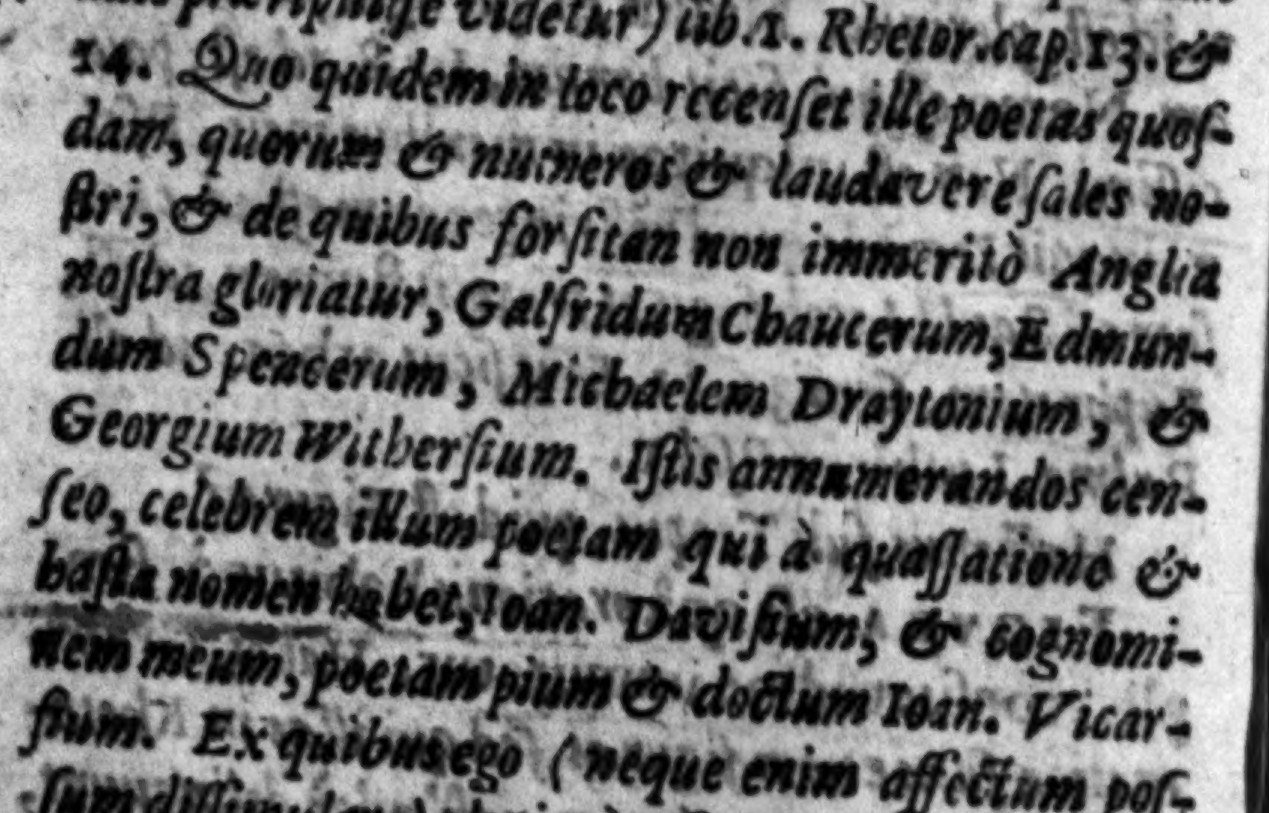
In 1628 Vicars published the third edition of his Latin rhetoric textbook, Manuductio ad artem rhetoricam, first issued in 1621. A discussion of English poets on page 70 repeats a list associated with Charles Butler: Chaucer, Spenser, Drayton and Wither. Vicars then adds a sentence absent from the 1624 edition. Fred Schurink first brought this previously unnoticed Shakespeare reference to scholarly attention in 2006, in “An Unnoticed Early Reference to Shakespeare.”6

Istis annumerandos censeo, celebrem illum poetam qui a quassatione & hasta nomen habet, Ioan. Davisium, & cognominem meum, poetam pium & doctum Ioan. Vicarsium.

In English:

To these I think we should add that famous poet whose name comes from shaking and a spear, John Davies, and my namesake, the devout and learned poet John Vicars.7

Thomas Vicars, Manuductio ad artem rhetoricam, third edition (1628), p. 70, detail. The passage names Shakespeare through “quassatione & hasta” — shaking and a spear — before naming Davies and John Vicars.

The contrast is explicit: Davies and John Vicars receive names, while Shakespeare receives a description of his name. Schurink identifies Davies as most probably John Davies of Hereford, rather than Sir John Davies; the Latin surname alone does not settle the distinction. Vicars also singles Shakespeare out as “famous.” Schurink reads the phrase as a pun that readers were expected to recognize; he considers both the recent First Folio and the continuing popularity of the narrative poems as possible contexts. The passage gives no play title and does not specify which works Vicars had in mind. Dana F. Sutton subsequently published the surrounding Latin discussion and an English translation in The Philological Museum.6

For this book, the conjunction matters: a writer connected by marriage and patronage with Neville’s surviving household praised Shakespeare while avoiding the direct form of his name. That makes the passage relevant to the family’s literary afterlife.

Vicars’s earlier publication of Carleton’s Astrologomania, its Jaggard imprint of 1624 and its comparisons with Lear and Macbeth are examined in “Carleton, Vicars and the Jaggard Press” (Chapter 50).

Books passing through the circle

Library donations show another way in which books moved through this circle and acquired recorded custodians. In 1620 Sir Henry Savile presented the Bodleian with a fourteenth-century Italian manuscript of Sallust’s histories of Catiline and Jugurtha. The catalogue describes drawings, chiefly of soldiers, in several margins. Four years later William Simonson, named “Symondson” in the donation inscription and identified there as a fellow of Merton, gave the library a French manuscript of the memoirs of Nicolas de Neufville, seigneur de Villeroy. Villeroy was a French minister with whom Neville negotiated: in June 1599 Neville met him at Conflans to discuss relations between the two crowns. The manuscript’s two parts cover 1574–89 and 1589–94; the catalogue dates the copy to the first quarter of the seventeenth century and records a “de Neufville” subscription to each part, using Villeroy’s family name.8

Savile died in 1622, before the First Folio appeared. Simonson, the Merton scholar associated with the younger Neville’s education and continental travels, made his gift a year after the Folio.9 The ambassador’s registered will lists “William Simonson” among its witnesses, alongside Savile and Edward Neville.1 These gifts placed historical writing in an institution that recorded it and could preserve it.

Packer’s later book work

John Packer had performed the day-to-day work of correspondence. A contemporary life records his service as Neville’s secretary; his surviving letters carried office business and court news to Winwood. His December 1604 report included preparations for the queen’s masque.10 Such work helps explain how information and papers moved through the household.

Packer’s later career also brought him into the preparation of books. On 7 December 1619 Patrick Young wrote to him about a work by James I, identified by the editor as the king’s Meditation on the Lord’s Prayer. Young had delivered the book to Bishop Andrewes for review and passed it, sealed and with Andrewes’s letter, to Secretary Calvert for dispatch. Acting on Packer’s requests, he had also searched for classical passages. One reference in Suetonius still eluded him, but he had found useful material in Julius Capitolinus and Aelius Spartianus. If Packer thought the research fit to show the king, he could present it and ask what the book’s title should be. Further letters could reach Young at the printer John Bill’s shop in Paul’s Churchyard.11

By 1619, four years after Neville’s death, his former secretary was helping coordinate scholarly research, editorial review and publication.

Notes and sources


  1. Henry Neville, registered will and probate act, 24 July 1615, The National Archives, PROB 11/126/63. The register names Anne and Savile as executors; the act records their renunciation and administration to the son. Quotations modernize spelling. The original-will bundle cited for further collation is TNA PROB 10/323; the registered copy remains a separate witness.↩︎

  2. John Chamberlain to Sir Dudley Carleton, 13 July 1615, in Norman Egbert McClure, ed., The Letters of John Chamberlain, I (Philadelphia: American Philosophical Society, 1939), pp.607–608, public volume record. McClure identifies the secretary as Sir Ralph Winwood and the son as Neville’s eldest, Sir Henry. Chamberlain’s keeping of Windsor is not silently expanded into a precise patent title. This is a contemporary report of procurement, not inspection of the underlying grants. For the subsequent contest and grants to others, see Andrew Thrush, “Neville, Sir Henry III (1588–1629)”, History of Parliament: The House of Commons 1604–1629 (2010), biography and notes 18–20. Thrush dates the Sonning grant to 20 July 1615 and the Mote grant to August.↩︎

  3. A Declaration of the State of the Colonie and Affaires in Virginia (1620), reproduced in Susan Myra Kingsbury, ed., The Records of the Virginia Company of London, III (Washington, 1933), p. 330. The same accounting list records Christopher Brooke, £50 (p. 318); Dudley Digges, £37 10s. (p. 322); Montgomery, £40 (p. 329); Pembroke, £400 (p. 331); Southampton, £350, and Edwin Sandys, £212 10s. (p. 333); and William Strachey, £25 (p. 334). These are entries in a 1620 list, not dates of individual payments or proof that the listed people acted together. Smith’s 1624 repetition belongs to the same list tradition and should not be counted as a second independent subscription record. A separate bill of complaint dated 28 April 1613 describes Sir Henry Nevile as of an unnamed place in Kent and alleges a £75 promise in November 1610: Kingsbury, III, p. 43. It is not assigned here to the ambassador. The following answer, p. 44, is Sir George Huntley’s, not Neville’s. Thrush’s biography of Sir Henry Neville III lists Virginia membership by 1620, but note 9 cites this same Kingsbury p. 330 entry; it is a scholarly identification, not a second independent account.↩︎

  4. Chamberlain to Dudley Carleton, 30 October 1619, Calendar of State Papers, Domestic, James I, 1619–1623, p.88; John Chamber’s will, The National Archives, PROB 11/104/339; Keckermann, A Manuduction to Theology, translated by Thomas Vicars (1622), sig. A2r, printed dedication. Its other patrons are Anne Fetiplace and Mabel Blenerhasset. For Carleton’s poems, see Heroici characteres. Ad illustrissimum equitem Henricum Nevillum (Oxford: Joseph Barnes, 1603), title and opening poem, sigs. A2r–A3r.↩︎

  5. J. H. Cooper, “The Vicars and Parish of Cuckfield in the Seventeenth Century,” Sussex Archaeological Collections 45 (1902), p. 17, transcribing the Guy Carleton monument, which calls Vicars’s wife Anne the daughter of Bishop Carleton. For Neville’s widow as dedicatee, see the 1622 dedication cited above. Anne Carleton and Anne Killigrew Neville Carleton are distinct women.↩︎

  6. Fred Schurink, “An Unnoticed Early Reference to Shakespeare”, Notes and Queries 53.1 (March 2006), 72–75. Schurink identifies the addition in 1628, discusses the name-pun and possible reception contexts, and distinguishes John Davies of Hereford from Sir John Davies. Dana F. Sutton, ed., The Philological Museum, introduction, Latin text, and translation, supplies the surrounding discussion, pp. 70–72, and credits Schurink’s discovery.↩︎

  7. Thomas Vicars, Manuductio ad artem rhetoricam, third edition (London, 1628), p. 70, facsimile. Latin checked against the printed page; long s, u/v and accents normalized. English translation supplied here. The figure is a detail of the page, not an image of Schurink’s article.↩︎

  8. Falconer Madan and H. H. E. Craster, A Summary Catalogue of Western Manuscripts in the Bodleian Library, II, part I (Oxford, 1922), nos.2193 and2198, pp.253,255: public edition. Sallust is MS. Auct. F.5.8; Villeroy is MS. Bodl.235, iii +209 leaves. The catalogue’s report of the subscriptions does not establish that they are Villeroy’s autographs. For Neville’s negotiations with him, Neville to Cecil, 29 June 1599 O.S., Sawyer, Memorials, I, pp.53–54, describing the meeting at Conflans.↩︎

  9. F. Madan and H. H. E. Craster, A Summary Catalogue of Western Manuscripts in the Bodleian Library, II.1 (1922), pp. 253, 255, entries 2193 and 2198: MS. Auct. F. 5. 8 and MS. Bodl. 235. For the identification: Joseph Foster, Alumni Oxonienses, 1500–1714, IV (1892), p. 1357; Calendar of State Papers, Domestic, James I, 1603–1610, p. 371, licence of 24 September 1607; Royal Berkshire Archives, D/EN/F6/2/4, Simondes to Neville, Paris, 24 November [1608]. The letter’s year is supplied from its reported events. The registered will is a scribal copy, not his autograph signature.↩︎

  10. Packer to Winwood, 12 December 1604, Ralph Winwood, Memorials of Affairs of State, ed. Edmund Sawyer, II (1725), pp. 39–40. For secretaryship: Historical Manuscripts Commission, The Manuscripts of the Marquess of Abergavenny, Lord Braye, G. F. Luttrell, Esq., &c. (1892), p. 174, summary of “Life and character of Mr. John Packer,” dated 9 February 1648/9.↩︎

  11. Patrick Young to John Packer, 7 December 1619, in Samuel Rawson Gardiner, ed., The Fortescue Papers, Camden Society, new series I (1871), pp.108–109, no.LXVIII: public volume. The editor identifies the book and Bishop Andrewes in the notes. Young first took the king’s letter and book to Andrewes; Andrewes returned the book sealed with his own letter to the king enclosed. The request about showing the research paper to the king is conditional on Packer’s judgment. The episode concerns James I’s book and supplies no evidence of a Shakespeare manuscript passing through Packer’s hands.↩︎

Note

Search the book

Inspect the document