Robert Cecil wanted Henry Neville to keep watch on a young man in Paris: Aurelian Townshend. In spring 1600 Cecil asked Neville to arrange Townshend’s lodging, control his expenses, and report on his conduct.
[…] hearken whether he use any riotous life or disorder, and certify me, to the intent that I may guess whether he be fit to be near my son.1
Polonius gives Reynaldo a strikingly similar task: deliver money and notes to his son Laertes in Paris, but first inquire into the young man’s behavior:
POLONIUS […]
Inquire me first what Danskers are in Paris;
And how, and who, what means, and where they keep,
What company, at what expense; and finding
By this encompassment and drift of question
That they do know my son, come you more nearer
Than your particular demands will touch it.2
— Hamlet, 2.1
“Danskers” means Danes. Both inquiries concern lodging, company, money and conduct in Paris. Cecil is assessing a prospective servant for his son; Polonius is watching his own son.
Neville carried out the commission. On 24 April 1600, he told Cecil:
I will be careful also to look into his conversation, so to make some judgment of him whether he be fit for that employment that your Honor designs him for.3
“Conversation” here means conduct.
Three days later, on 27 April 1600, Neville explained how he would obtain information about disputed precedence at the last Franco-Spanish treaty. The chancellor was the only commissioner available to question:
Directly sure I shall not, but I will do the best I can by oblique means.4
In the same scene, Polonius gives Reynaldo the corresponding maxim:
POLONIUS […]
By indirections find directions out.
— Hamlet, 2.1
Neville’s diplomatic inquiry and Polonius’s domestic surveillance share a method: an indirect approach may reveal what a direct question will not.
Polonius’s habits have long invited comparison with Robert Cecil’s father, William Cecil, Lord Burghley. The comparison includes Polonius’s advice to Laertes and Burghley’s precepts for Robert, especially their warnings against borrowing. The letter to Neville brings the parallel into the next generation of the Cecil family.5
Claudius and Laertes
Elsewhere, Hamlet turns the language of negotiation into pressure on an individual. Writing to Cecil from Paris on 15 June 1599, Neville considered what England and France should do if the United Provinces refused to join a peace with Spain. One possibility was to use the two monarchs’ authority to compel their acceptance:
either by their common authority to over-rule them to accept the peace, or otherwise, by common means to maintain them
In Hamlet, Claudius asks Laertes to submit to his guidance. Laertes agrees on condition that the king does not force him into a reconciliation:
KING […]
Will you be ruled by me?LAERTES Ay, my lord,
So you will not o’errule me to a peace.— Hamlet, 4.7
Both use “overrule” for imposing an unwanted peace: on the Dutch in Neville’s letter, on Laertes in the play.6
In February 1604 Neville thanked Ralph Winwood for remembering him. Plague in his household had disrupted his correspondence, but he wanted his friend to put him to use:
how willing I would be to make it appear more than in words, if in your absence you would make any use of me.
Later in the same scene in Hamlet, Claudius uses the same expression when pressing Laertes to prove his love for his dead father:
KING […]
Hamlet comes back; what would you undertake
To show yourself indeed your father’s son
More than in words?
— Hamlet, 4.7
Laertes offers to cut Hamlet’s throat in church. Claudius turns the demand for affection proved in action into a demand for murder.7
The wording is uncommon in the surveyed drama: only Hamlet uses it among 239 plays dated 1590–1615. The comparison joins the same words to the same test: affection must become action. Neville offers to demonstrate his love through service; Claudius presses Laertes to demonstrate his through revenge. The phrase appears in the second quarto (1604/5), though not in the corresponding scene of the first (1603).8
The cast of brazen cannon
On 19 November 1599, Neville reported from Paris that Henri IV had ordered cannon to be cast and tested and, separately, for arms to be purchased:
hath taken order for the casting of 50 or 60 pieces here in the arsenal, whereof 30 are already cast and tried; he hath also appointed great store of arms to be bought in sundry towns as I am informed
Near the beginning of Hamlet, Marcellus asks why Denmark is preparing for war:
MARCELLUS […]
And why such daily cast of brazen cannon
And foreign mart for implements of war,
Why such impress of shipwrights, whose sore task
Does not divide the Sunday from the week.
What might be toward that this sweaty haste
Doth make the night joint laborer with the day?
Who is ’t that can inform me?
— Hamlet, 1.1
Both passages move from casting cannon to buying arms. Marcellus’s “cast,” the First Folio reading, names the manufacturing operation Neville reports. The arms markets differ: Marcellus specifies foreign purchases; Henri was buying weapons from towns he might also wish to disarm.9
On 9 May 1600, Neville sent Cecil another report from Paris, this time about Denmark’s naval preparations. The news had reached him through the ambassador of Württemberg, whose informant was in Hamburg:
The King of Denmark makes very great preparation by sea, which gives occasion of much discourse, no man seeing any apparent cause for it. […] I thought it my duty to relate what I heard of it, considering his demeanor the last summer toward our fishermen, and the northern jealousies.
The “northern jealousies” suggest mutual suspicion among the northern powers. Neville reports Denmark preparing its fleet without an apparent explanation; this parallels Marcellus’s question about why Denmark is preparing for war (Hamlet, 1.1).10
Artillery, testing and plots
Two images are particularly close to the danger recorded in a German certificate of gun testing preserved among Neville’s papers.
Claudius wants a second means of killing Hamlet in case his first scheme fails:
KING […]
’Twere better not assayed. Therefore this project
Should have a back or second that might hold
If this did blast in proof. Soft, let me see.
— Hamlet, 4.7
“Blast in proof” means burst during testing.11 This is the very failure recorded in a German notarial certificate among Neville’s papers. Dated 4 September 1591, it describes a gun brought from England breaking into pieces during testing in Hamburg; its endorsement bears “Nevill.” Neville’s Paris report cited above describes guns “cast and tried,” and the certificate records what could happen when a gun failed that trial. Claudius imagines his scheme as a weapon that might destroy itself when put to the test.12
Hamlet gives a related danger to the plot sending him to England. He intends to turn the scheme against the men carrying the sealed letters:
HAMLET […]
For ’tis the sport to have the enginer
Hoist with his own petard; and ’t shall go hard
But I will delve one yard below their mines
And blow them at the moon. O, ’tis most sweet
When in one line two crafts directly meet.
— Hamlet, 3.4
The petard is a siege explosive: its engineer is blown upwards by his own charge. Hamlet will dig beneath his opponents’ mines and turn their work against them. Both passages give intrigue the danger of a destructive device failing or turning upon its user. The German certificate supplies a concrete example of the practical hazard behind these images.13
Other artillery references run through the play: royal drinking salutes from the “great cannon” (1.2), the duel’s “ordnance fire” and the final command to “bid the soldiers shoot” (5.2).14 Scandal becomes “poisoned shot” aimed like a “cannon to his blank”—its target (4.1); accumulated troubles strike like a “murd’ring piece,” a gun scattering small shot (4.5).15,11 Even Osric’s sword-hangers prompt Hamlet’s joke about carrying “a cannon by our sides” (5.2).11
Two Danish names
When Claudius welcomes Hamlet’s old companions, he names them together:
KING
Welcome, dear Rosencrantz and Guildenstern.
— Hamlet, 2.2
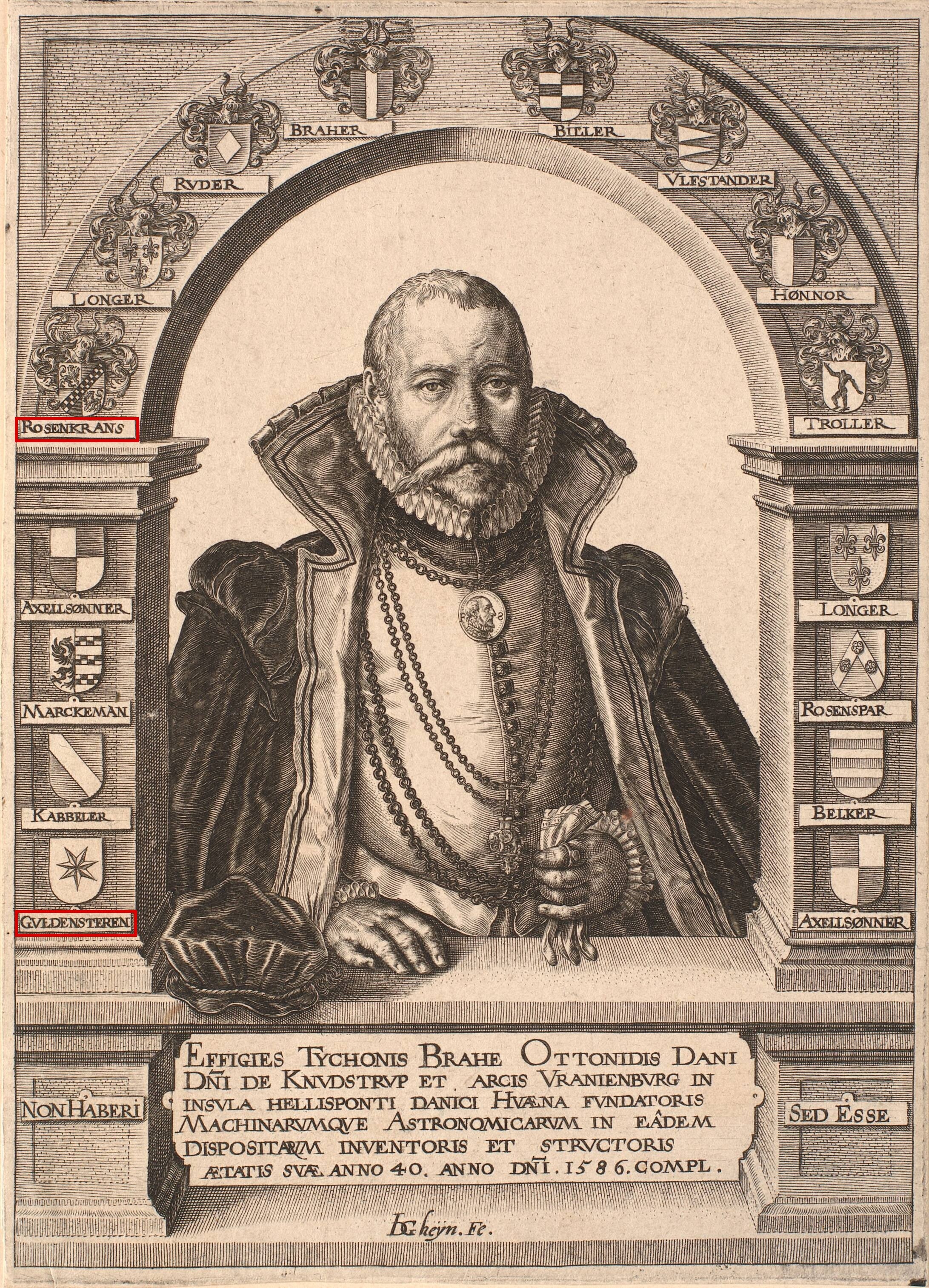
The corresponding Danish family names appear among the sixteen ancestral names on Jacques de Gheyn’s engraved portrait of the astronomer Tycho Brahe. “ROSENKRANS” is on the left side of the arch; “GVLDENSTEREN” is at the foot of the left column. The shields display Tycho’s ancestry.16
The portrait has a route into Neville’s circle through Thomas Savile, the younger brother of his tutor Henry. Italian newsletters addressed to Thomas in 1591 survive among Neville’s papers, as discussed in Chapter 27. On his European tour of 1588–1591, Thomas followed his brother’s earlier route, visiting Dudith and Pinelli, whom Henry Savile and Neville had met on their own travels.
On 1 December 1590, Tycho wrote to Thomas that he had enclosed four copies of his likeness, recently engraved in copper at Amsterdam. He wanted English poets to compose an epigram on the portrait and his work, suggesting Daniel Rogers as a contributor. These were images intended for literary circulation. The documented recipient was Thomas; the letter places the portraits within Neville’s scholarly network, without establishing that Neville saw one.17
Neville’s family library supplies another Danish connection. The later Billingbear catalogue lists the 1576 Frankfurt edition of Saxo Grammaticus’s Gesta Danorum, whose account of Amleth is the ultimate source of the Hamlet story. That edition and its place in the library are discussed in Chapter 10.18
Deer, keepers and the hunt
Neville describes a deer hunt that took him away from a guest waiting at home. In a letter to Windebank of c. 1607, he apologizes for abandoning him and for his household’s poor hospitality:
My hope was to have killed our deer in time to have returned to you to dinner. But when I saw he had carried us out as far as Cramborne, and that it was not possible for me to come back in time, I thought it as good to stay out his death, presuming of their discretion at home, not to have stayed your dinner for me.
Neville stayed with the hunt; his servants kept Windebank waiting. He closes by hoping the visit had done his guest no other harm than “the loss of your dinner.”19
In Hamlet and the Vision of Darkness (2017), Rhodri Lewis follows the play’s sustained language of hunting: deer and hounds, snares, nets and falconry.
After Claudius breaks off the play within the play, Hamlet sings:
HAMLET
Why, let the strucken deer go weep,
The hart ungalled play.
For some must watch, while some must sleep:
Thus runs the world away.
— Hamlet, 3.2
Lewis emphasizes the distinction between the wounded deer and the hart: Hamlet demotes Claudius within the hierarchy of hunted animals, refusing him the fully regal status of a hart. Hamlet believes he has wounded his quarry and can now track him down.
Hamlet is also the quarry. When Guildenstern questions him, he asks: “why do you go about to recover the wind of me, as if you would drive me into a toil?” (Hamlet, 3.2). Lewis explains the technical precision: a toil is a hunting net, and getting upwind allows the quarry to smell the approaching hunter and flee into the waiting net. Hamlet describes political manipulation through the practical workings of a hunt.20
Neville’s letter catches him in the chase, unwilling to leave before the deer is killed. Lewis’s reading shows how Hamlet makes that world of pursuit, quarry and capture a language for life at court.
Conscience and reputation
After Essex’s failed rising in February 1601, Neville had to explain his dealings with the earl’s circle. In his confession of 2 March 1601, he described Henry Cuffe’s approaches and a meeting at Drury House where a plan to enter the queen’s court and seize Essex’s enemies had been discussed. He acknowledged knowing about the proposals but insisted that he had refused to become an actor in them. The distinction mattered: knowledge of a conspiracy could be made to look like consent to it.21
A mind examining itself
Neville’s separate defence, printed as Sir Henry Nevill’s Case, opens by acknowledging an offence while appealing to his inward knowledge of his loyalty:
[…] yet my own soul witnessing to herself, that it was ever loyal and faithful to her Majesty, and consequently abhorring more than death, the imputation of that fault, and loathsome crime of falsehood and treason […]
— Henry Neville, Sir Henry Nevill’s Case22
He asks that his actions be read with the circumstances that reveal his intentions.
Hamlet likewise calls his soul “herself” when describing his choice of Horatio:
HAMLET […]
Since my dear soul was mistress of her choice
And could of men distinguish, her election
Hath sealed thee for herself. For thou hast been
[…]
— Hamlet, 3.2
Both passages make the soul a judge of personal allegiance: Neville’s soul witnesses to his loyalty, while Hamlet’s chooses Horatio and seals that choice for herself.
The central question is why Neville failed to expose the plot. Neville rejects one explanation after another: malice against the state, a wish that the attempt should succeed, personal devotion to Essex. His sentences become questions: “for who had more interest therein than I?” and “for who could have more disliked it than I?”
His explanation comes in two parts. He had hoped that the weak, unfinished project would collapse when its authors recovered their reason. But he also admits a more personal cause:
partly upon an imbecility and weakness of my own nature, (if so it be to be termed), which could not resolve to become an accuser
Even while naming his weakness, he questions the name he has given it. He recoils from accusing a man of Essex’s standing, then concedes that public duty should have outweighed his fear of private disgrace. The defence moves through denial, inquiry, explanation and reluctant self-reproach.22
Hamlet’s encounter with Fortinbras’s army produces the same kind of argument with himself. Other men act; he tries to determine what has stopped him:
HAMLET […]
[…] Now whether it be
Bestial oblivion or some craven scruple
Of thinking too precisely on th’ event
(A thought which, quartered, hath but one part wisdom
And ever three parts coward), I do not know
Why yet I live to say “This thing’s to do,”
[…]
— Hamlet, 4.4
Both men weigh reasons for inaction and interrupt their explanations to judge their own character. Neville questions whether his reluctance deserves the name of weakness; Hamlet divides his scruple into one part wisdom and three parts cowardice. Neville was explaining why he had not denounced a conspiracy; Hamlet is reproaching himself for delaying revenge. The Case gives us Neville writing in precisely this questioning, divided, self-accusing register.23
One idea in two words
The same documents also permit a comparison of verbal technique. Hendiadys expresses one idea through two terms joined by “and.” Shakespeare used it very unevenly. In his 1981 study “Hendiadys and Hamlet,” George T. Wright counted sixty-six examples in Hamlet, more than twice his total for any other play. “Youth and observation” (Hamlet, 1.5) means youthful observation; “the heat and flame of thy distemper” (Hamlet, 3.4) means a hot flame.24
The comparison can be extended by distinguishing kinds of writing.25 A study undertaken for this book found eight secure or probable examples in 168 letters containing 131,988 words. The Confession, the Case and the Advice Touching the Holding of a Parliament contain another eight in just 6,981 words: about 0.6 against 11.5 per 10,000 words.26
In other words, Neville’s ordinary correspondence, including the diplomatic letters, used hendiadys sparingly; his extended defences and political arguments used it much more densely. The contrast points to a choice of register: he draws on the technique when it suits his purpose, just as Shakespeare varies its use between plays.
In the March confession, Cuffe breaks out into “words of heat and impatience”—impatient heat. In the Case, Neville answers the objection that a visit to Essex might have begun “a friendship and inwardness with him”: an intimate friendship. He denies that anything passed beyond general compliments. The Advice describes James’s breach with Parliament as “full of distaste and acrimony”—bitter distaste—and closes by defending “the honest purpose and sincerity of my heart”: sincere purpose.26
A wounded name
On 22 April 1601, writing from Chelsea, Neville asked Cecil to withhold his declaration—probably the March confession. It had been collected before he could include the circumstances that explained his conduct. He feared the judgment that an incomplete account would invite:
So as if it should be published in that naked sort as it is set down, it would be to my infinite disadvantage, and lay me open to the censure of every common person, even for that whereof I am not guilty. Therefore chiefly I desire it may not be published; or if that must needs be […] I humbly desire that I may be permitted to revise it and to add some circumstances which I have either by word or writing already declared unto your Honours, that so the world may know the best of me as well as the worst.27
At the end of Hamlet, the prince appeals to Horatio, fearing what account will survive him:
HAMLET […]
O God, Horatio, what a wounded name,
Things standing thus unknown, shall I leave behind me!
[…]
— Hamlet, 5.2
He begs Horatio to live and tell his story. Neville worried that his account could contain true statements yet leave its readers with a false judgment. Hamlet needs a surviving witness to supply what his actions alone cannot explain.28
Notes and sources
Robert Cecil to Henry Neville, undated in the printed heading, Edmund Sawyer, ed., Memorials of Affairs of State, I (London, 1725), pp.166–167, request on p.167. The letter turns from diplomatic negotiations to Townshend’s accommodation, expenditure, religious observance and fitness to attend Cecil’s son. The boy described as Anne Neville’s cousin is Cecil’s son, not Townshend. Neville’s reply of 24 April supplies the chronological anchor; an exact date for Cecil’s request is not inferred from its position in the volume. Quotations from Sawyer modernize spelling and capitalization, without treating the printed spelling as autograph evidence.↩︎
Shakespeare, Hamlet, 2.1, Polonius’s instructions to Reynaldo. This compares the arrangement and concerns, not a distinctive shared phrase. The subsequent invented allegations belong to Polonius’s method and are not in Cecil’s request.↩︎
Neville to Robert Cecil, Paris, 24 April 1600, Sawyer, Memorials, I, pp.175–176, Townshend paragraph on p.175. The reply confirms receipt, placement with a minister, ten crowns a month for lodging and diet, and responsibility for further provision and assessment. “Conversation” denotes behavior or manner of life. It does not report that Townshend actually committed misconduct.↩︎
Neville to Robert Cecil, Paris, 27 April 1600, Edmund Sawyer, ed., Memorials of Affairs of State, I (London, 1725), pp.177–178, quoted paragraph on p.178. Spelling modernized. Shakespeare, Hamlet, 2.1. This is a separate diplomatic inquiry, not part of Cecil’s instructions about Townshend.↩︎
Tricia A. McElroy and Jason Powell, “Copying Fatherly Advice,” in A Manuscript Miscellany, Folger Institute, NEH summer institute (2005), PDF, pp.46–47, especially PDF p.47. Their discussion of Folger MS V.a.381 records the proposed identification of Polonius with Burghley and compares the fifth precept with Polonius’s advice against borrowing. They refer readers to Josephine Waters Bennett, “Characterization in Polonius’ Advice to Laertes,” Shakespeare Quarterly 4.1 (1953), pp.3–9, and G. K. Hunter’s response, “Isocrates’ Precepts and Polonius’ Character,” 8.4 (1957), pp.501–506. These articles are identified through McElroy and Powell, not independently consulted here. The proposed character model is an interpretation; “By indirections find directions out” is not identified here as a quotation from Burghley’s precepts.↩︎
Henry Neville to Robert Cecil, Paris, 15 June 1599, Edmund Sawyer, ed., Memorials of Affairs of State, I (London, 1725), p. 47, checked against the printed page; spelling and capitalization modernized. Shakespeare, Hamlet, 4.7, Folger text and lineation. The second quarto reads “I my Lord, so you will not ore rule me to a peace”: British Library Garrick copy, facsimile page 80, image checked. The First Folio transcription reads “If so you’l not o’rerule me to a peace,” TLN 3070. The small textual differences leave the construction intact. Neville follows “over-rule them” with the infinitive “to accept the peace”; Laertes follows “o’errule me” with “to a peace.” The comparison concerns a shared verb, object and outcome, with different grammatical complements; no claim of uniqueness is made.↩︎
Neville to Ralph Winwood, London, 16 February 1603/4 O.S., Sawyer II, p. 17. The year is 1604 in modern numbering; Sawyer prints 1603. Shakespeare, Hamlet, 4.7. Spelling and capitalization are modernized.↩︎
An earlier example of the same contrast occurs in Thomas Hoby, trans., The Courtyer of Count Baldessar Castilio (London, 1561), sig. Kk4r, page image; TCP A18135. Q2 passage in the Huntington copy, 69305. Shakespeare Census records Q2 copies with 1604 and 1605 title dates as the second edition. For Q1’s different scene see QLNs 1845 onwards. Searches include than/then and normalized spelling variants. Play counts describe the searched collection, not all surviving drama.↩︎
Neville to Cecil, Paris, 19 November 1599, Sawyer I, p. 132. Spelling and capitalization are modernized. Shakespeare, Hamlet, 1.1; compare Q1, TCP A11959, with the First Folio, TCP A11954. Q2’s “cost” is recorded in the Internet Shakespeare Editions transcription. The Folio reads cast, while Q1 and Q2 read cost; the comparison concerns both the manufacture of cannon and the purchase of arms. A search across 527 dramatic-text records, checking cast and inflected forms near artillery terms, found few examples of the manufacture sense. Controls include Dekker and Webster’s Northward Ho (printed 1607), an ordnance-casting metaphor, TCP A20098; Davenant’s The Cruel Brother (printed 1630), a patent for casting ordnance, TCP A19876; and Marmion’s Holland’s Leaguer (printed 1632), a gun-recasting sexual metaphor, TCP A07025. These support rarity, not uniqueness; the search concerns the artillery-manufacture sense, not every use of cast for moulding metal. The proximity search is not an exhaustive semantic census. For Neville’s Mayfield foundry, see Chapters 3–9.↩︎
Neville to Robert Cecil, Paris, 9 May 1600, Edmund Sawyer, ed., Memorials of Affairs of State, I (London, 1725), p.183. The dateline appears on p.179. Spelling and capitalization are modernized. The report passes from a Hamburg informant through the Württemberg ambassador to Neville; it is not Neville’s eyewitness account. Shakespeare, Hamlet, 1.1, Marcellus’s question about shipwrights and unexplained preparations, present in Q2 and F1. Christian IV ruled both Denmark and Norway; the comparison concerns unexplained military preparations, not a contemporary war between those kingdoms. Related reports in Winwood include Cecil’s statement to Neville that “Denmark hath used us very ill,” I, p.72, and his announcement of a planned Anglo-Danish conference at Emden, I, p.167. These establish contemporary friction involving Denmark but do not identify the particular “jealousies” Neville meant. For Christian IV’s 1599 northern voyage and disputes with England and Sweden, see the University Library of Tromsø, “Christian IV’s Northern Voyage in 1599”.↩︎
Shakespeare, Hamlet, 4.5, 4.7 and 5.2, Folger Shakespeare Library. For the technical glosses, see Philip Weller, Hamlet Navigator, notes to 4.5.95 (a cannon loaded with small shot) and 4.7.154 (blowing up while being tried). “Blast in proof” makes failure under testing an image for the possible failure of the murder scheme.↩︎
The National Archives, PRO 30/50/7, German notarial instrument dated 4 September 1591, beginning on the leaf numbered 36; catalogue. The testimony records an English gun breaking into pieces during testing in Hamburg. Its endorsement carries “Nevill,” the number 47, a weight figure of 1620 and the September date. This is a comparison of the recorded failure with the image “blast in proof,” not an English phrase found in the German document. The endorsement does not identify the gun’s manufacturer. The separate April certificate’s account of a burst gun and the absence of injuries is discussed with these records in Chapter 31, “Macbeth: The Deed and Its Consequences.”↩︎
Shakespeare, Hamlet, 3.4, Folger Shakespeare Library. This passage is present in the second quarto (1604/5) and absent from the Folio. It joins the petard image to military mining; it is not evidence that Neville manufactured these devices.↩︎
Shakespeare, Hamlet, 1.2 and 5.2, Folger Shakespeare Library: Claudius’s drinking salutes, the duel and the final stage direction; also 1.4, where the direction calls for two cannon shots.↩︎
Shakespeare, Hamlet, 4.1, Folger Shakespeare Library. The quoted passage follows Folger’s wording and lineation.↩︎
Jacques de Gheyn II, Tycho Brahe, Statens Museum for Kunst, KKSgb7575, museum dating 1588–1590; public-domain image. Shakespeare, Hamlet, 2.2. The inscription gives Tycho’s age and 1586; it is not by itself the impression’s printing date. SMK’s catalogue explains its early dating by reference to a portrait reportedly present in Giovanni Magini’s copy of Tycho’s 1588 book by 1590; that copy has not been independently inspected here. Other museums date their impressions differently, and the four copies in the letter have not been matched to a surviving impression.↩︎
Tycho Brahe to Thomas Savile, 1 December 1590, ed. Peter Zeeberg, Tekstnet, postscript; also J. L. E. Dreyer, ed., Tychonis Brahe Dani Opera Omnia, VII (Copenhagen, 1924), pp.283–285, especially p.285. The scholarly edition identifies British Library Harley MS 6995, item 40; the published text controls this summary. For Thomas as Henry Savile’s younger brother, Mordechai Feingold, The Mathematicians’ Apprenticeship: Science, Universities and Society in England, 1560–1640 (Cambridge University Press, 1984), pp.130–131. The addressee is Thomas, not Henry or Neville; dispatch and an invitation to poets are explicit, fulfilment is not. For the 1591 newsletters, see The National Archives, PRO 30/50/70/2, catalogue, in Neville’s additional diplomatic correspondence, and Chapter 27. The catalogue identifies Thomas Savell as recipient; the packet’s preservation among Neville’s papers supports the transmission route. Robert B. Todd, “Henry and Thomas Savile in Italy”, Bibliothèque d’Humanisme et Renaissance 58.2 (1996), pp.439–444, especially 442–444, dates Thomas’s tour to 1588–1591 and distinguishes it from Henry’s earlier journey with Neville. Todd explicitly corrects the claim that the brothers travelled together: p.440 n.7 states that Henry was not accompanied by his brother, against Maccagni and Derenzini, “Libri Apollonii,” p.682. Thomas’s departure on 4 June 1588 and his following of Henry’s route are discussed on p.442; his Italian contacts and return to England by the end of 1591 on pp.443–444.↩︎
Billingbear library catalogue, Royal Berkshire Archives, D/EN/F37/1; see Chapter 10. The 1576 Wechel edition is available in the University of Tartu’s digitized copy, with the Amleth narrative at pp.44–47. The later catalogue establishes the edition’s presence in the family library, not the date on which Henry Neville acquired or read it.↩︎
Henry Neville to [Sir Thomas Windebank], c. 1607, The National Archives, SP 14/36, f.20, State Papers Online, Gale document MC4323586678. Transcription by John O’Donnell; spelling modernized, with the manuscript’s place-name “Cramborne” retained (the calendar prints “Cranborne”). Mary Anne Everett Green, ed., Calendar of State Papers, Domestic Series, of the Reign of James I, 1603–1610 (London, 1857), p.456, item 17, calendars the same deer-and-dinner episode under 1608 and supplies the recipient in brackets. The letter is undated; c. 1607 is an editorial approximation. The later endorsement, 15 September 1608, conflicts with Sir Thomas Windebank’s death on 24 October 1607 (see Dictionary of National Biography, “Windebank, Francis”). The recipient’s forename is supplied editorially.↩︎
Rhodri Lewis, “Hamlet, Hunting, and the Nature of Things”, chapter 2 of Hamlet and the Vision of Darkness (Princeton University Press, 2017), pp.43–111, especially pp.62–63 on wind and the toil, and pp.71–73 on the play scene and deer song. Lewis interprets the play’s hunting language; the comparison with Neville’s records is made here. Shakespeare, Hamlet, 3.2. The wind-and-toil question occurs in Q2 and F1 and is absent from Q1’s shorter recorder exchange. The deer song occurs in all three witnesses: Q1 begins “Then let the stricken deer” and has “laugh” and “weep” where Q2 and F1 have “watch” and “sleep.” Modern wording follows Folger. Neville’s letter documents his following a deer hunt to the kill; it does not describe this particular netting technique.↩︎
Henry Neville to Lords Egerton, Buckhurst, Nottingham and Secretary Cecil, 2 March 1600 Old Style (1601 in modern year numbering), The National Archives, SP 12/279, f.15, beginning “Right honourable, my duty and conscience binding me”; transcription by John O’Donnell. This confession is distinct from the shorter Sir Henry Nevill’s Case printed in Sawyer I, pp.302–304.↩︎
Henry Neville, Sir Henry Nevill’s Case, Edmund Sawyer, ed., Memorials of Affairs of State, I (London, 1725), pp.302–304, especially pp.303–304 for the self-questioning and inability to become an accuser. Spelling and capitalization modernized. The undated defence concerns the Essex conspiracy of 1601; the running year 1600 is Old Style. It refers back to an earlier declaration and is not that declaration. Sawyer says he found the paper, in Neville’s hand, among Winwood’s papers; his suggestion that Neville sent it to Winwood is explicitly tentative. Shakespeare, Hamlet, 3.2.67–69, quoted in Folger’s modern wording and lineation. For the three witnesses compare Q1, QLNs 1252–1262, Q2, and F1, TLNs 1914–1916. Q1 moves from Hamlet’s rejection of flattery to his instructions about observing the king, without the soul’s choice of Horatio. Q2 and F1 both contain the feminine personification. Q2 reads “her choice”; the Folio reads “my choice,” retaining “her election” and “herself.” These lines are absent from Q1 (1603), present in Q2 (1604/5) and F1 (1623). Absence from Q1 does not itself date the composition of the passage.↩︎
Shakespeare, Hamlet, 4.4, the soliloquy after the encounter with Fortinbras’s captain. Folger wording and line breaks retained; the quotation begins within the speech and stops before “Sith I have cause, and will, and strength, and means / To do ’t.” This soliloquy survives in Q2 and is absent from the First Folio: see Folger’s textual notes, 4.4.10–69.↩︎
George T. Wright, “Hendiadys and Hamlet”, PMLA 96.2 (March 1981), pp.168–193, especially pp.173, 182 and the lists at pp.185–191. His sixty-six is a count in a modern edited text, not a count in each early witness; classification involves interpretation. The quoted phrases occur in Q2 and the Folio. Q1 has “That ever youth, or else observance noted” in place of “youth and observation” and does not give Gertrude the “heat and flame” lines. Shakespeare, Hamlet, 1.5 and 3.4.↩︎
For the earlier Neville comparison, see John Casson, “Reflections on ‘The Annotated Amleth: Belleforest in the British Library’: The Identity of the Annotator,” Electronic British Library Journal (2017), article 11, pp.1–3, at p.2 and n.9. Casson explicitly directs readers to chapter 10 of Mark Bradbeer and John Casson, Sir Henry Neville, Alias William Shakespeare: Authorship Evidence in the History Plays (Jefferson, NC: McFarland, 2015), for hendiadys in Neville’s letters and 1601 deposition. The earlier book is credited here through Casson’s published reference. For Shakespeare’s distribution, see the discussion of Wright, “Hendiadys and Hamlet,” above.↩︎
Neville’s confession, 2 March 1601, The National Archives, SP 12/279, f.15 and following leaves, transcription by John O’Donnell; “heate and impacience” modernized. Sir Henry Nevill’s Case, Sawyer I, p.303. “Friendship and inwardness” concerns Essex, not Cuffe. These are proposed readings of the paired expressions, not a claim that every doublet is hendiadys or that the figure is unique to Neville. Neville, Advice Touching the Holding of a Parliament, Samuel Rawson Gardiner, History of England from the Accession of James I to the Disgrace of Chief-Justice Coke, II (London, 1863), Appendix V, pp.389–394, p.389 for “distaste and acrimony” and p.394 for “purpose and sincerity”. The author’s comparative study, undertaken for this book, examined 168 letters containing 131,988 words and the three extended documents containing 6,981 words. It identified three secure and five probable cases in the letters, against four secure and four probable cases in the documents: about 0.6 versus 11.5 cases per 10,000 words when probable examples are included. These figures describe that study’s sample and interpretive classifications. Its 168 letters and 138,969 words overall differ from the enlarged collection described in Chapter 11; the rates have not been recalculated from the enlarged collection. Ordinary political and diplomatic letters by other writers supplied controls; Neville’s letter rate was not elevated against them. The contrast made here is between Neville’s own kinds of writing, not a claim that this distribution is unique to him.↩︎
Neville to Robert Cecil, Chelsea, 22 April 1601, Hatfield House Archives, Cecil Papers 86/1, autograph letter, pp. 1–2; spelling and punctuation modernized. Also printed in Historical Manuscripts Commission, Calendar of the Manuscripts of the Marquis of Salisbury, XI (Dublin, 1906), pp. 175–176, quotation and request on p. 176, Hatfield reference 86.1. The calendar describes a two-page holograph. Neville’s explanation of the haste and omissions is his own account. The declaration was to be carried to the Tower; the letter itself is dated Chelsea. The April letter does not date the declaration it asks Cecil to withhold: identification with the long March confession is probable, not explicit. This confession is distinct from the shorter Sir Henry Nevill’s Case printed in Sawyer I, pp.302–304.↩︎
For Othello’s related final appeal about how his deeds will be reported, see Chapter 27. Shakespeare, Hamlet, 5.2, Hamlet’s appeal to Horatio. Shakespeare quotations follow Folger’s wording, with verse lines preserved and omissions marked; display wraps within a verse line are joined. Editorial variant brackets and pronunciation accents are omitted; substantive readings are identified in the relevant notes.↩︎