William and Philip Herbert, the First Folio’s dedicatees, were sons of Mary Sidney Herbert. Her brother Robert Sidney had travelled with Neville; Mary and Robert’s father, Sir Henry Sidney, had been a friend of Neville’s father.1
On 17 November 1612, Robert Naunton reported that Neville had brought William Herbert, Earl of Pembroke, together with Robert Carr, Viscount Rochester, the king’s favourite. Neville attended the meeting; Naunton praised his “noble and Christian intermise”—his intervention.2 Their quarrel appears to have involved rivalry over the office of Master of the Horse, against a background of strained relations between Pembroke and Carr’s adviser, Sir Thomas Overbury.3
In his own undated letter to Ralph Winwood, Neville reports arranging a “full reconciliation” between Pembroke and “my Lord,” tentatively identified as Rochester. He calls Pembroke a “noble, wise and worthy gentleman.” He urged Winwood to write to Pembroke and offered to deliver the letter “with mine own hands.”4,5
Neville and Pembroke also acted together when James imprisoned Sir Thomas Overbury in April 1613 for refusing a diplomatic appointment. Overbury was Rochester’s adviser. John Packer reported that Pembroke and Neville visited Rochester that evening and again the following morning:
But that evening my Lord of Pembroke and Sir Henry Neville were with him, and so were again this morning; who have given him so good advice, that if he follows it, as I hope he will, all will be well with him, and no hurt to his friend.6
In clandestine letters from the Tower to Carr, Overbury refers to Neville and Pembroke under the code names Similis and Niger. They also served together on the Virginia Company’s resident council in England.7,8
Pembroke appears even in the Neville family’s remembered conversation. A story attributed to Neville’s son William describes Herbert catching a fellow gambler swearing to a throw that their false dice could not produce: the dice had no four. Sir Nicholas L’Estrange, who married Neville’s granddaughter, preserved the story in his jestbook.9
The relationship continued after Neville’s death. Pembroke probably helped Neville’s son Henry become MP for Wilton in 1621. In 1629 he received the wardship of Neville’s grandson Richard. Chapter 53 provides more details.10
Pembroke’s own poetry also connects him with Shakespeare. In a verse exchange with Benjamin Rudyerd, he writes, “Love is not love, but given free”: true love expects nothing in return. Rudyerd answers that love depends on being returned. Sonnet 116 uses the same phrase—“Love is not love”—and rejects love that changes when the beloved changes. It describes a love that remains constant despite the loss of youth and beauty, lasting “even to the edge of doom.” Mary Ellen Lamb proposes that the sonnet responds to this poetic debate.11
Dudley defended Neville; Leonard praised Shakespeare
Leonard Digges contributed a poem to the First Folio. His brother Dudley defended Neville in Parliament. On 14 May 1614, during the Commons’ debate over Neville’s advice to the king, he defended Neville’s right to offer unsolicited counsel:
a private man might go and move the King for the good of the country, uncalled12
Dudley invoked his father Thomas’s example: proposals offered to Elizabeth I without being asked had not prevented him from serving in Parliament.
Dudley’s signed examination during the Overbury investigation records a more personal exchange. He recalled telling Neville that he feared Rochester wanted to be rid of Overbury. Neville and Sir Robert Mansell replied with information from Overbury himself.13
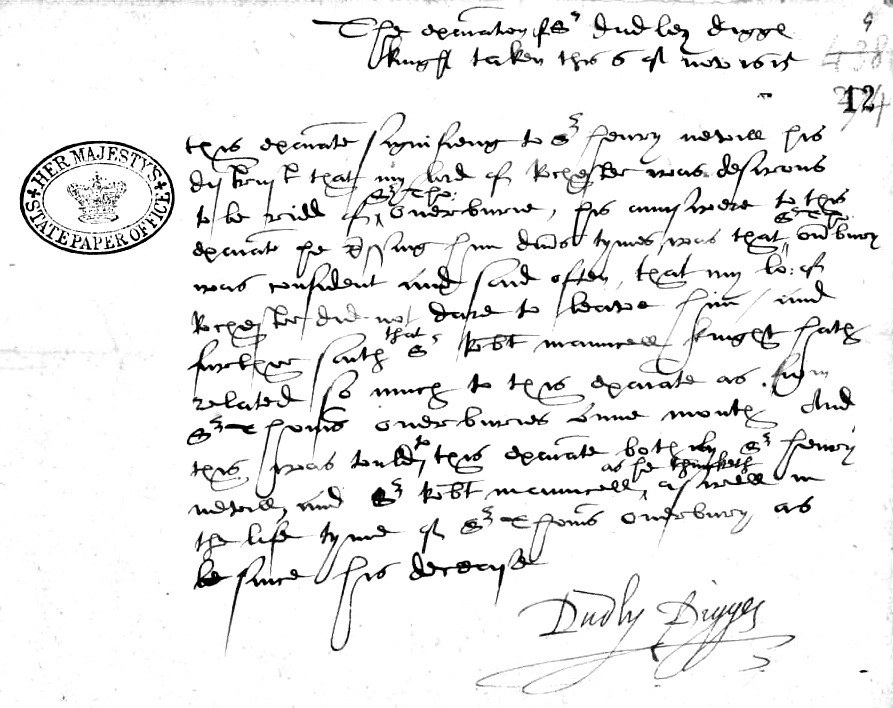
Dudley Digges’s signed examination, 6 November 1615, recalling conversations with Neville before his death. The National Archives, SP 14/83, f.12.
Dudley also wrote the last two discourses in Foure Paradoxes (1604). The fourth discusses Coriolanus and the conflict between Rome’s people and nobility. Kenneth Muir proposed the work as a source for Shakespeare’s Coriolanus; Andrew Hadfield develops the comparison, discussed in Chapter 34.13
In a note assigned to about 1613, Leonard compared Lope de Vega’s reputation with that of “our Will Shakespeare.” In 1622 Edward Blount published his translation of Gerardo the Unfortunate Spaniard, dedicated to Pembroke and Montgomery. A year later, Leonard’s signed poem, Blount’s name and the same two dedicatees appeared together in the First Folio.14
Thomas Russell links the families
Thomas Russell, whom Shakespeare appointed an overseer of his will in 1616, had two connections with these families. He was the Digges brothers’ stepfather. He was also the maternal half-brother of Sir Henry Berkeley, who married Neville’s daughter Elizabeth.15,16,17
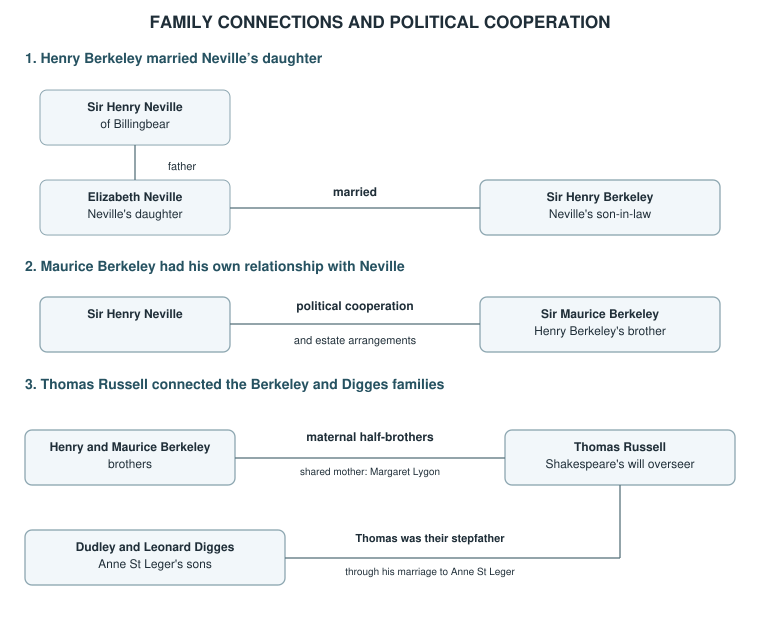
Henry Berkeley’s brother Maurice was Neville’s political associate as well as a family connection. In November 1612 he welcomed Robert Phelips’s plan to approach Neville, assuring him that Neville would appreciate his support. Maurice also held property under Neville’s estate arrangements, and his wife Elizabeth Killigrew was the first cousin of Neville’s wife Anne.18,19,17
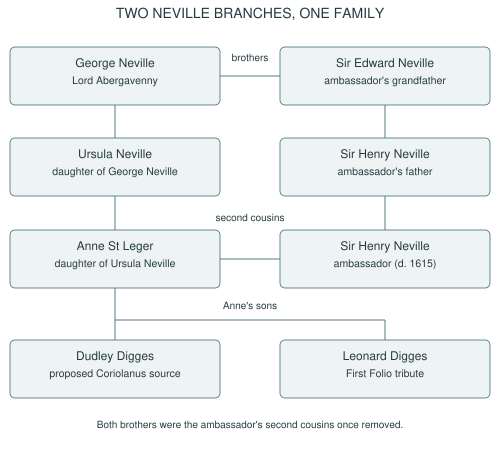
The Digges brothers had a separate blood relationship with Neville: they were his second cousins once removed. Their mother, Anne St Leger, was Neville’s second cousin.20
Another Folio poet: Hugh Holland
Hugh Holland, another contributor to the First Folio, also appears in the Convivium Philosophicum, probably dating from 1611. The poem names him among a company including Donne, Hoskyns and a Sir Henry Neville. Zachary Lesser identifies that Neville as the Billingbear diplomat; Chapter 45 examines the identification.21
A Windebank family copy
Thomas Windebank corresponded with both Henry and Anne Neville; his son Francis later became secretary of state. A surviving First Folio, now in the State Library of New South Wales, bears the inscription “Elizabeth Windebank Her Book” at the end of Hamlet. Elizabeth may have been Francis’s daughter, or Elizabeth Parkhurst, who married his grandson, also named Francis. Neither identification is established, and whether the book passed through the secretary’s hands remains unknown. The same volume also contains an inscription signed “Tho: Hurst” at the end of Antony and Cleopatra; Thomas Hurst’s identity remains unknown.22
Notes and sources
In 1605 Pembroke wrote on behalf of Neville’s secretary John Packer to Sir Thomas Lake, supporting a request to improve Packer’s livelihood. The calendar says sciatica prevented Packer from taking another course to improve his living; it does not specify the appointment or benefit sought. John Packer to Sir Thomas Lake, Billingbear (“Pillingbeare”), 25 February 1604/5, The National Archives, SP 14/12, f.210, State Papers Online MC4323583159; Mary Anne Everett Green, ed., Calendar of State Papers, Domestic, James I, 1603–1610 (1857), p.199, item92, calendar. These particulars are controlled by the calendar and manuscript; the more difficult opening clause is not quoted. Margaret P. Hannay, “Mary Sidney Herbert, Countess of Pembroke (1561–1621)” (2000), The Sidney Homepage, University of Cambridge, supplies the sibling relationships and her sons’ identities. For the two sons as dedicatees of the 1623 First Folio, see Folger First Folio 24.↩︎
Robert Naunton to Ralph Winwood, Holborn, 17 November 1612, in Jackie Watson, Epistolary Courtiership and Dramatic Letters: Thomas Overbury and the Jacobean Playhouse (2024), letter31, pp.92–94, at p.93, DOI. Watson prints the letter from HMC, Buccleuch and Queensberry, I (1899), p.118. “Intermise” means intervention. This is a distinct document from Neville’s undated letter below; for the possibility that both describe the same reconciliation, see the reconciliation-date note below.↩︎
Jackie Watson, Epistolary Courtiership and Dramatic Letters: Thomas Overbury and the Jacobean Playhouse (2024), chapter 2, letter 20, pp.83–84 and note 87; letter 23, p.85, chapter. Watson identifies a dispute over the mastership of the horse and suggests that it may explain the “jarring” reported by George Calvert to Sir Thomas Edmondes on 1 August 1612. Calvert reports the Pembroke–Rochester quarrel as news he could not confirm, while stating that Overbury and Pembroke had “been long jarring.” Naunton’s reconciliation report does not specify the cause; the connection with the office remains a scholarly suggestion.↩︎
Henry Neville to Ralph Winwood, undated, Buccleuch and Queensberry MSS, Winwood Papers, transcribed by John O’Donnell; spelling modernized and abbreviations expanded; square brackets retain supplied readings. HMC, Report on the Manuscripts of the Duke of Buccleuch and Queensberry, I (1899), 131–132, provisionally dates the holograph ‘[1613, April?]’ and tentatively identifies ‘my Lord’ as Rochester. Emphasis added. The fuller passage praises Pembroke for clearing himself of unjust imputations, forgiving injuries and promising cooperation in religion and the state. Neville asks Winwood not to neglect him through a mistaken estimate of his worth.↩︎
HMC, Report on the Manuscripts of the Duke of Buccleuch and Queensberry, I (1899), p. xiii, read with pp. 118 and 131–132, public volume. The introduction expressly questions the date inferred from the letter’s position in the volume and directs comparison with Naunton’s report of 17 November 1612.↩︎
John Packer to Ralph Winwood, London, 22 April 1613, in Ralph Winwood, Memorials of Affairs of State, ed. Edmund Sawyer, III (1725), pp.447–448, especially p.448. Spelling modernized; emphasis added. “Him” is Rochester; “his friend” is Overbury. The two visits took place on 21 and 22 April. Packer first reports: “Yesterday about six of the clock my Lord Chancellor and my Lord of Pembroke were employed by the king to speak with Sir Thomas Overbury, and to make him an offer of an ambassage into the Low Countries or France, which he would.” Overbury pleaded “want of language” and ill health and said “he would not leave his country for any preferment in the world.” James then ordered his imprisonment.↩︎
Jackie Watson, Epistolary Courtiership and Dramatic Letters: Thomas Overbury and the Jacobean Playhouse (2024), 133–134 (recipient, precautions and code names), 153 (instruction), DOI. The Tower letters cited here are addressed to Robert Carr, Viscount Rochester. In letter 41, Overbury instructs him to check the seals, write “darkly and shortly,” and keep the messenger from being seen with his usual servant. These precautions establish the clandestine character of the correspondence. Quotations follow Watson’s transcription with modernized spelling. Overbury’s instruction reads: “Do you and Similis set Niger upon this.” The correspondence concerns negotiations surrounding Neville’s bid for the secretaryship, with Pembroke and Southampton among the participants. See Chapter 9 and Appendix C; Thomas’s letters should be distinguished from the later recollections of his father, Sir Nicholas Overbury.↩︎
Second Virginia Charter, 23 May 1609, in Samuel M. Bemiss, ed., The Three Charters of the Virginia Company of London (1957), Second Charter, resident-council clause beginning “And further wee establishe and ordaine”. The council also included Dudley Digges and Christopher Brooke. Philip Herbert belonged to the wider company membership, not this resident-council list.↩︎
H. F. Lippincott, ed., “Merry Passages and Jeasts”: A Manuscript Jestbook of Sir Nicholas Le Strange (1603–1655) (Salzburg, 1974), 30–31, jest 69, source “Mr Wil: Nevill”; person index, 219, Herbert entry, and 231, Neville entry. Quotation follows the printed edition. Lippincott identifies Sir William Herbert as the third Earl of Pembroke; the story itself supplies no date. For the compiler’s marriage and genealogy, see Chapter 55. The disputed throws are five and four against six and five. Herbert offers a thousand if the other man can find a four on the dice; the narrator explains that they were false, “without a 4.” The offer is conditional, not a payment. The story supplies no date or independent confirmation of the incident; its source label records its transmission through Neville’s family. See Chapter 55.↩︎
John K. Gruenfelder, Influence in Early Stuart Elections, 1604–1640 (Ohio State University Press, 1981), p.125 and p.170 n.5, publisher repository, describes the 1621 Wilton by-election as probably reflecting Pembroke’s influence. Andrew Thrush, “NEVILLE, Sir Henry III (1588–1629),” History of Parliament (2010), treats the identification of the MP as the ambassador’s son as probable; see Chapter 53. Calendar of State Papers, Domestic, Charles I, 1629–1631, 86, 3 November 1629; Hull History Centre, Barnard papers, U DDBA/4/98, draft quitclaim marked “Sealed 25 Jun 1637,” catalogue, p.24; John P. Ferris, “THOROWGOOD, John (1588–1657),” History of Parliament. Statements follow the calendar, catalogue and biography.↩︎
Mary Ellen Lamb, “‘Love is not love’: Shakespeare’s Sonnet 116, Pembroke, and the Inns of Court,” Shakespeare Quarterly 70.2, pp. 101–128, especially pp. 110–115 and 120–124, article. Pembroke’s lyric and Benjamin Rudyerd’s reply are printed on p. 111; the Shakespeare quotations are from Sonnet 116, lines 2 and 12. Lamb proposes that the sonnet responds to the exchange but also considers the reverse direction of influence (p. 121).↩︎
Maija Jansson, ed., Proceedings in Parliament 1614 (House of Commons), Memoirs of the American Philosophical Society 172 (Philadelphia: American Philosophical Society, 1988), p. 246, debate of 14 May 1614. The printed page records Sir Dudley Digges’s speech immediately after Mr Hoskins’s defence of the king’s use of his subjects’ counsel and before Sir Robert Mansell’s proposal to clear Neville of being an undertaker. Digges cites his father’s unsolicited proposals to Elizabeth I as a precedent. The quotation follows the printed parliamentary report; “uncalled” means without being summoned.↩︎
Calendar of State Papers, Domestic, James I, 1611–1618, 325, item 9, 6 November 1615; underlying examination, The National Archives, SP 14/83, f.12. The manuscript abbreviates the name as “Sir Robt Mansell,” expanded here as Sir Robert Mansell. The printed calendar instead gives “Sir Thos. Mansell.” The conversation preceded Neville’s death; 6 November is the examination date. For Dudley’s contribution, see Thomas and Dudley Digges, Foure Paradoxes (1604), fourth paradox, p. 104, TCP A20463; Andrew Hadfield, “Shakespeare and the Digges Brothers,” Reformation 25.1 (2020), 2–17, especially 13–17, DOI. The source relationship is a scholarly proposal; Dudley’s discussion of Coriolanus is explicit.↩︎
Leonard Digges’s note, Balliol College, 30 a 152, Shakespeare Documented; Gerardo the Unfortunate Spaniard (1622), title and dedication, facsimile; First Folio, poem signed L. Digges. The flyleaf note has no written date; c.1613 is the assigned date. The dedication to Gerardo calls Digges a stranger; this is a printed self-description, not proof that he had never met the dedicatees.↩︎
W. P. W. Phillimore, ed., The Visitation of the County of Worcester Made in the Year 1569 (1888), p.119, Russell pedigree; Visitation of England and Wales, XXX, pp.155–156. The published Worcester pedigree includes later continuations. William Shakespeare’s will, 25 March 1616, names Thomas Russell, esquire, and Francis Collins as overseers: The National Archives, PROB 1/4, Shakespeare Documented. This Thomas Russell of Rushock/Alderminster was the half-uncle of Sir Thomas Russell of Strensham (1577–1632), whose father John belonged to the elder Sir Thomas’s other marriage. See also S. M. Thorpe, “RUSSELL, Thomas (1577–1632)”, History of Parliament (1981). Their closeness in age does not make them the same person. Margaret Lygon, mother of Thomas Russell and the Berkeley brothers, married first Sir Thomas Russell of Strensham (d.1574), then Sir Henry Berkeley of Bruton (d.1601). Thomas belonged to the first marriage; Henry and Maurice Berkeley to the second.↩︎
Phillimore, Visitation of Worcester, p.119, records Thomas Russell’s marriage to Anne, widow of Thomas Digges and daughter of Sir Warham St Leger. See also “Digges, Leonard (1588–1635),” Oxford Dictionary of National Biography, DOI, and Andrew Hadfield, “Shakespeare and the Digges Brothers” (2020), DOI. Anne St Leger married Russell after the death of the brothers’ father, the mathematician Thomas Digges. The documented family links do not themselves establish a transfer of literary manuscripts.↩︎
Somerset Heritage Centre, DD/WR/2, copy of the postnuptial settlement of Sir Henry Berkeley the younger and Elizabeth, daughter of Sir Henry Neville, 1609, catalogue; Visitation of England and Wales, XXX, pp.155–156, Berkeley pedigree. The pedigree dates the settlement 12 February 1609/10 (1610 in modern year numbering), whereas the catalogue gives 1609. The original settlement has not been inspected to resolve this discrepancy. For Maurice’s marriage and the Killigrew connection, see also “BERKELEY, Sir Maurice (c.1577–1617),” History of Parliament, biography.↩︎
Maurice Berkeley to Robert Phelips, 12 November 1612, Somerset Heritage Centre, DD/PH/219/59; quoted in Clayton Roberts and Owen Duncan, “The Parliamentary Undertaking of 1614,” English Historical Review 93 (1978), p.488 and n.2, article. Bracketed expansions follow the published transcription. Berkeley writes: “I like well of your purpose of treating with Sir H[enry] N[eville] and I do assure myself it will be grateful to him to see such as you are so well affected.” Phelips’s father had been Speaker of the Commons.↩︎
Royal Berkshire Archives, D/EN/F6/1/19, estate abstract headed “A feoffment dated 30. Aprilis 1615,” Bury Farm entry; catalogue of the containing file, D/EN/F6/1. The recorded indenture is dated “20. May . 7 Jac:” (20 May 1609). Quotations from the manuscript, spelling modernized; emphasis added. Maurice occurs in the Bury Farm group, distinct from the abstract’s first list of feoffees. The Bury Farm group also includes Robert Killigrew, William Barlas, Henry Savile and Edward Neville.↩︎
“St. Leger, Sir Warham,” Dictionary of National Biography, L (1897), p.168, text; The Complete Peerage, I, p.35, Abergavenny pedigree. The cousin degrees are calculated from these pedigrees. The brothers’ maternal grandmother Ursula Neville was a daughter of George Neville, Lord Abergavenny; George’s brother Sir Edward Neville was the ambassador’s grandfather.↩︎
Zachary Lesser, “Mixed Government and Mixed Marriage in A King and No King: Sir Henry Neville Reads Beaumont and Fletcher,” ELH 69.4 (2002), pp. 947–77, at p. 972 n. 13, article. Colin Burrow, “Holland, Hugh (1563–1633)”, Oxford Dictionary of National Biography (2004), on the reciprocal commendations in Pancharis and Sejanus, the Coryate verses, the Mitre company and the First Folio contribution. For the signed Folio poem and the manuscript company, see the facsimiles and sources in Chapter 45.↩︎
State Library of New South Wales, First Folio (1623), SAFE/RB/Y1/1; First Folios project, copy description, and Ken Feinstein, “Francis Windebank’s First Folio?”, 17 May 2021, reproducing the inscription. The inscription is visible, but the suggested identification and earlier transmission are unresolved. For the Windebank family and local estate succession, see Victoria County History, Berkshire, vol. 3, “Parishes: Hurst”. Anne Neville’s letters to Thomas Windebank are TNA SP 12/279, ff. 30 and 32, 6 and 11 March 1601. The First Folios description suggests the secretary’s daughter; Feinstein’s post proposes Elizabeth Parkhurst, the wife of his grandson. These are alternative possibilities, not established identifications.↩︎