When the Sea Venture was wrecked on Bermuda in July 1609, Henry Neville belonged to the council governing the expedition’s sponsor, the Virginia Company. The survivors’ accounts became important sources for The Tempest. One of them, William Strachey’s True Reportory, remained unprinted until 1625—fourteen years after the play’s first recorded performance. That makes Neville’s position directly relevant to a familiar question about the play: how did its author obtain the shipwreck narrative?1,2,3
His name already appears in the scholarship on that question. Arthur F. Kinney quotes Geoffrey Bullough’s suggestion that company contacts, including “perhaps Sir Henry Neville,” might have supplied Shakespeare with Strachey’s account.4 For the argument of this book, that is a striking starting point: Neville has been proposed as a possible intermediary for material used by the dramatist.
A report for the company
The charter of 23 May 1609 names “Sir Henry Nevil” among both the company’s incorporated members and its council resident in England. This council could appoint and replace colonial governors and issue instructions governing Virginia and the voyages to and from it. Neville’s appointment preceded the wreck by two months.5
The Sea Venture carried Sir Thomas Gates, the colony’s lieutenant governor. After the storm, its passengers spent months on Bermuda, built vessels and reached Virginia in May 1610. Strachey, one of the survivors, dated his longer account 15 July 1610. Gates left for England five days later, carrying Strachey’s accounts of the colony and shipwreck. They concerned the very enterprise for whose direction Neville’s council was responsible.2
Strachey had contributed a poem to Jonson’s Sejanus (1605), published by Thomas Thorpe, who would publish Shakespeare’s Sonnets four years later.2
Some of this news became public quickly. Sylvester Jourdain’s Discovery of the Barmudas and the company’s True Declaration of the Estate of the Colonie in Virginia appeared in 1610. Strachey’s longer narrative took a different route: it appears to have circulated among people connected with the company before Samuel Purchas printed it in 1625. The Tempest was performed at court on 1 November 1611. The important distinction is between the printed news available to any reader and the fuller manuscript account available through a more restricted circle.2,3
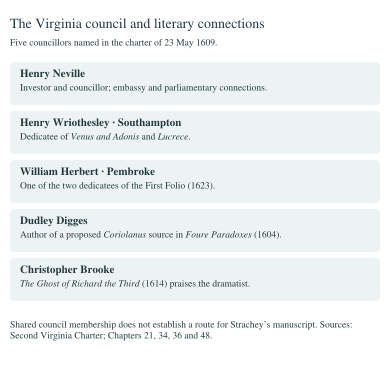
Bullough’s suggested contacts include Southampton, Pembroke, Dudley Digges and Christopher Brooke: men from Neville’s own circle. All four sat on the same Virginia Company council as Neville, and their associations with him extended into literary gatherings, Parliament and court politics.5,4
These were personal connections as well as fellow council memberships. Brooke appears with Neville in the Mitre company; Dudley Digges defended him in Parliament; Southampton supported his bid for the secretaryship; and Neville helped reconcile Pembroke with Rochester. Chapters 9, 45 and 49 examine these relationships.6,7,8,9
Several of these associates also have prominent places in Shakespeare’s literary history: Southampton received the dedications of the narrative poems, Pembroke would be a dedicatee of the First Folio, and Brooke praised the dramatist who brought Richard III to the stage.10,9
The fire on the rigging
Strachey’s account contains a detail far more particular than a storm at sea. During the storm, Sir George Somers saw a small light moving about the rigging:
A little round light, like a faint star, trembling, and streaming along with a sparkling blaze, half the height upon the mainmast, and shooting sometimes from shroud to shroud […] running sometimes along the mainyard to the very end, and then returning.11
Strachey calls it sea-fire. Ariel, the spirit carrying out Prospero’s commands, describes moving about the ship as fire and deliberately terrifying its passengers:
ARIEL […]
I boarded the King’s ship; now on the beak,
Now in the waist, the deck, in every cabin,
I flamed amazement. Sometimes I’d divide
And burn in many places. On the topmast,
The yards, and bowsprit would I flame distinctly,
Then meet and join. […]
— The Tempest, 1.2
The resemblance lies in the movement: a light runs about the upper parts of a storm-tossed ship, appearing at different points in its rigging. Shakespeare makes the sailors’ alarming sight into Ariel’s controlled performance. The spirit can describe from within what a survivor could only watch from below.
Strachey also records the safe landing of everyone aboard—about 150 men, women and children. Prospero asks Ariel directly about the passengers’ safety:
PROSPERO
But are they, Ariel, safe?ARIEL Not a hair perished.
On their sustaining garments not a blemish,
But fresher than before; and, as thou bad’st me,
In troops I have dispersed them ’bout the isle.
— The Tempest, 1.2
The shared survival belongs to the wreck story generally; it does not by itself identify Strachey as the source. The moving sea-fire supplies the more distinctive comparison. Together they show how a frightening deliverance could become a dramatic illusion: the audience sees apparent catastrophe before learning that the storm has been managed and its victims protected.11
Who commands after the wreck?
The survivors’ escape did not settle their obligations. Strachey reports that Stephen Hopkins argued that Gates’s authority had ended with the shipwreck:
Since the authority ceased when the wreck was committed, and with it, they were all then freed from the government of any man […].12
Hopkins wanted to remain on Bermuda rather than proceed to Virginia. His argument attacked the expedition’s chain of command: if the voyage had failed, why should the passengers still obey a governor appointed for another place? Gates sentenced him to death. Intercession by Strachey and others secured his pardon. For the council in England, the issue was practical as well as constitutional. The survivors had to build their ships and continue to the colony; their willingness to obey mattered to the enterprise’s survival.
The Tempest begins by putting authority under similar pressure. A king and his courtiers obstruct sailors fighting a storm. The Boatswain tells Gonzalo:
BOATSWAIN […] You are
a councillor; if you can command these elements
to silence, and work the peace of the present, we
will not hand a rope more. Use your authority. If
you cannot, give thanks you have lived so long, and
make yourself ready in your cabin for the mischance
of the hour, if it so hap. […]
— The Tempest, 1.1
The immediate question is who can save the ship. On the island, it becomes who may rule. Caliban proposes replacing Prospero with Stephano:
CALIBAN
Thou shalt be lord of it, and I’ll serve thee.
— The Tempest, 3.2
Hopkins sought release from the governor’s authority; Caliban offers his service to a new master. Their proposals differ, but both expose the instability of command when a stranded company imagines a new life on an island. Shakespeare turns the problem into comedy as the drunken Stephano entertains kingship and threatens punishment for mutiny. The people challenging one ruler promptly begin imitating another.13
Strachey’s narrative combines extraordinary deliverance with arguments over obedience, work, punishment and pardon. Those questions fell within the responsibilities of the council to which Neville belonged. They also give The Tempest much of its action after the waters become calm.
Bermuda and Naples
Shakespeare does not simply put the survivors of the Sea Venture on stage. The royal party is returning from a wedding at Tunis to Naples, and Ariel reports that the other ships are on the Mediterranean. Bermuda enters through the spirit’s recollection of an earlier errand:
ARIEL […]
[…] In the deep nook, where once
Thou called’st me up at midnight to fetch dew
From the still-vexed Bermoothes, there she’s hid;
— The Tempest, 1.214
The play’s European politics also have a counterpart in Neville’s diplomatic dispatches. On 26 May 1599, Neville reported Henri IV’s account of a quarrel over the kingdom of Naples:
That there was a quarrel grown between the Pope and the Spanish King about the cense and homage of the kingdom of Naples, which being not performed nor tendered since the death of the late king, the Pope had sent to seize upon the revenue of the kingdom, and the viceroy had imprisoned his commissaries; whereupon the Pope had excommunicated him […].15
The cense was the payment or tribute associated with Naples’s obligation to the papacy. Homage acknowledged political subordination. Neville’s report shows what happened when these obligations were withheld: the Pope tried to seize revenues, the viceroy imprisoned his agents, and excommunication followed.
Tribute and homage are also the terms of the political injury at the centre of The Tempest. Antonio has obtained Naples’s assistance in overthrowing his brother Prospero by sacrificing Milan’s independence. Prospero describes the agreement:
PROSPERO […]
So dry he was for sway, wi’ th’ King of Naples
To give him annual tribute, do him homage,
Subject his coronet to his crown, and bend
The dukedom, yet unbowed—alas, poor Milan!—
To most ignoble stooping.
— The Tempest, 1.2
In Neville’s report Naples owes payment and homage to the Pope; in the play Milan promises them to Naples. Shakespeare uses the same political instruments in a different relationship. Antonio gains personal power by making the state he wants to govern dependent on a greater ruler. Prospero’s loss is therefore larger than his expulsion: his brother has traded away the dukedom’s standing to buy its throne.
The reversal also invites a Protestant reading. The Bee Hive of the Romish Church (1579) mocked the homage owed by Naples to the Pope, accompanied by a white horse and thousands of ducats. In The Tempest, Naples itself demands tribute and homage from Milan, and Prospero condemns the bargain as “most ignoble stooping.” The kingdom that acknowledges Rome as its superior becomes the instrument of another state’s humiliation. That possible irony accords with Neville’s Protestant political outlook and his work with Winwood, Southampton and Pembroke.16
Notes and sources
James I, Second Charter of Virginia, 23 May 1609, incorporated members and resident council. Natalie Zacek, “William Strachey (1572–1621)”, Encyclopedia Virginia, for the June 1609 departure, July storm, Bermuda survival and later account. The charter records appointment, not attendance.↩︎
Zacek, “William Strachey”, sections on Virginia and Strachey’s writings. The article identifies two versions, dates the longer one 15 July 1610, reports Gates’s departure on 20 July and describes probable company-connected circulation. The first printed version appeared in Purchas in 1625. Ben Jonson, Seianus his Fall (London: G. Eld for Thomas Thorpe, 1605), title page and sig. A3r, original printing, for Strachey’s signed poem; Folger Shakespeare Library, Shakespeare’s Sonnets, for Thorpe’s 1609 edition.↩︎
Royal Shakespeare Company, “Dates and sources: The Tempest”, for the recorded performance, probable composition period and the two printed 1610 accounts. Its parenthetical dating of Strachey’s publication to 1623 is an error: 1623 is the First Folio’s date; Strachey’s account was printed in 1625, as the Purchas edition cited for the Hopkins episode confirms.↩︎
Arthur F. Kinney, “Revisiting The Tempest”, Modern Philology 93, no. 2 (November 1995): 161–177, especially pp. 165–167. At p.166 Kinney quotes Geoffrey Bullough, Narrative and Dramatic Sources of Shakespeare, VIII, p.239, naming “perhaps Sir Henry Neville”; the quotation is cited through Kinney’s page, not a fresh reading of Bullough’s volume. Kinney finds the suggested chain of transmission tenuous. Kinney’s wider argument expands the play’s cultural context beyond the Strachey narrative. He does not endorse a Neville authorship attribution.↩︎
Tom Cain, “John Donne and the Ideology of Colonization”, English Literary Renaissance 31, no. 3 (Autumn 2001): 440–476, p. 443, identifies Neville among members of the first council (1606–1607), in his discussion of company investors. Second Charter of Virginia, paragraphs beginning “AND forasmuch as the good and prosperous Success,” “AND further, We ESTABLISH and ORDAIN” and “AND further, of our special Grace.” These distinguish the council resident in England from government in Virginia. The resident council includes Pembroke; Montgomery appears in the wider incorporated list but not in this council list.↩︎
For the Convivium, see “At the Mitre” and Andrew Clark, ed., Brief Lives, II (Oxford, 1898), pp. 50–53, public text; Zachary Lesser, “Mixed Government and Mixed Marriage in A King and No King: Sir Henry Neville Reads Beaumont and Fletcher,” ELH 69.4 (2002), pp. 947–977, at p. 972 n. 13, article, supports the identification of the Neville in the company as the Billingbear diplomat. Owen Lowe Duncan, Jr., The Political Career of Sir Henry Neville: An Elizabethan Gentleman at the Court of James I (Ohio State University PhD, 1974), pp. 226–228, especially p. 227, dissertation, groups Brooke and Neville among parliamentary opposition figures.↩︎
Andrew Thrush, “Digges, Sir Dudley (1583–1639), of Chilham Castle, Kent”, History of Parliament: The House of Commons 1604–1629 (2010), discussion of the undertaking controversy and Digges’s intervention of 14 May 1614, citing Maija Jansson, ed., Proceedings in Parliament, 1614 (House of Commons), p. 246. Digges argued that a private man could approach the king unbidden for the good of the country.↩︎
Southampton to Winwood, 6 August 1613, Ralph Winwood, Memorials of Affairs of State, ed. Edmund Sawyer (London, 1725), III, p. 475; Jackie Watson, Epistolary Courtiership and Dramatic Letters: Thomas Overbury and the Jacobean Playhouse (Edinburgh University Press, 2024), chapter 2, chapter, on the secretaryship campaign and associated correspondence. Historical Manuscripts Commission, Report on the Manuscripts of the Duke of Buccleuch and Queensberry, I (1899), pp. 131–132, calendar entry, for Neville’s reconciliation and offer of personal delivery; the calendar tentatively dates the letter to April 1613. These later records document the personal and political associations discussed here. Neville also offered to deliver Winwood’s letter to Pembroke personally.↩︎
Christopher Brooke, The Ghost of Richard the Third (London: George Eld for Laurence Lisle, 1614), sig. D2r; Dudley Digges, examination, 6 November 1615, The National Archives, SP 14/83, f.12. The respective images, transcriptions and fuller discussion appear in Chapters 21 and 49. Digges’s signed examination of 1615 recalls conversations with Neville about Rochester and Overbury. These later records document their personal contact; they do not record the transmission of Strachey’s narrative.↩︎
Shakespeare, Venus and Adonis, dedication, and Lucrece, dedication. Folger Shakespeare Library, “Folger First Folio 24”, identifies the Folio’s dedicatees as William Herbert, Earl of Pembroke, and Philip Herbert, Earl of Montgomery. These publication relationships are separate from proof of manuscript transmission.↩︎
William Strachey, A true reportory of the wracke, and redemption of Sir Thomas Gates Knight, in Samuel Purchas, Purchas his Pilgrimes (London, 1625), IV, p. 1737, transcription and page images, Virginia Humanities. Spelling and punctuation modernized in Strachey. Shakespeare, The Tempest, 1.2, Folger Shakespeare Library. Strachey’s survivors work to save themselves; Ariel’s account describes a controlled magical ordeal. The comparison concerns the moving light and survival, not an identity of every detail.↩︎
William Strachey, A true reportory of the wracke, and redemption of Sir Thomas Gates Knight, in Samuel Purchas, Hakluytus posthumus, or Purchas his Pilgrimes (London, 1625), IV, pp. 1743–1745, especially p. 1744; Virginia Humanities transcription and page-image links. The Hopkins episode is Strachey’s report of the argument, sentence and intercession, not an independently preserved trial transcript.↩︎
Shakespeare, The Tempest, 1.1 and 3.2. Strachey, “Conspiracies on Bermuda”, p. 1744. The comparison concerns challenges to authority, not an identification of Hopkins with a particular character.↩︎
Neville had encountered the island’s name in diplomatic news long before the wreck. Writing to Cecil on 12 March 1600, he reported Spanish letters describing a vessel that had reached Seville and left the Indian fleet “on this side of a place called Bermuda.” The dispatch places Atlantic shipping news among the matters Neville was following during his embassy. Shakespeare, The Tempest, 1.2. The quotation preserves Folger’s line breaks; omissions are marked. The same scene supplies Naples and the Mediterranean setting; 2.1 supplies the wedding at Tunis from which the party is returning. Neville to Cecil, 12 March 1599/1600, in Ralph Winwood, Memorials of Affairs of State, ed. Edmund Sawyer (London, 1725), I, p. 158. The printed dateline gives 1599 under the English year beginning on 25 March; the year is modernized to 1600 in the text.↩︎
Henry Neville to Robert Cecil, 26 May 1599, reliable fair-hand copy, The National Archives, PRO 30/50/2, leaf numbered 123; compared with Winwood, Memorials, I, p. 30. Spelling and punctuation modernized and abbreviations expanded from the manuscript copy; the continuation after the excommunication is omitted. Shakespeare, The Tempest, 1.2, Prospero’s account of Antonio’s agreement with Naples.↩︎
Philips van Marnix van St Aldegonde, The Bee Hive of the Romish Church, trans. George Gilpin (London, 1579), part II, chapter 10, on papal supremacy, TCP A07026, public transcription. The passage describes the yearly homage of the kings of Sicily and Naples to the Pope, their acknowledgment of him as chief lord, and the presentation of a white horse and money. Shakespeare, The Tempest, 1.2. For Neville and Winwood’s efforts to form a Protestant opposition to Thomas Lake and the associated Southampton–Pembroke grouping, see Jackie Watson, Epistolary Courtiership and Dramatic Letters: Thomas Overbury and the Jacobean Playhouse (Edinburgh University Press, 2024), chapter 2, pp. 68–69, chapter. The Protestant reading of the dramatic reversal is proposed here.↩︎