A manuscript names Sir Henry Neville among the company of a “Philosophical Banquet” at the Mitre Tavern, alongside John Donne, Christopher Brooke, John Hoskyns, Henry Goodyere and Hugh Holland. Holland would later contribute one of the poems introducing Shakespeare’s First Folio. The gathering, commemorated in the comic Latin Convivium Philosophicum, is usually dated to 2 September 1611.12
Zachary Lesser identifies the Neville named here as the Billingbear diplomat, pointing to his parliamentary associations with other men in the company. He calls the evidence for identifying him instead as the Abergavenny cousin of the same name “scanty.”3
The company at the Mitre
The poem, traditionally attributed to John Hoskyns, turns the invitation into a mock summons. Its opening promises food and jokes; “convented” means gathered together. A contemporary English version begins:4
Whosoever is contented
That a number be convented
Enough but not too many;
The Miter is the place decreed,
For witty jests and cleanly feed,
The betterest of any.5
The roll call turns names into jokes: Brooke becomes a torrent, Donne “John Made,” and Goodyere a good year. Anyone who fails to appear faces a fine of forty pence.5
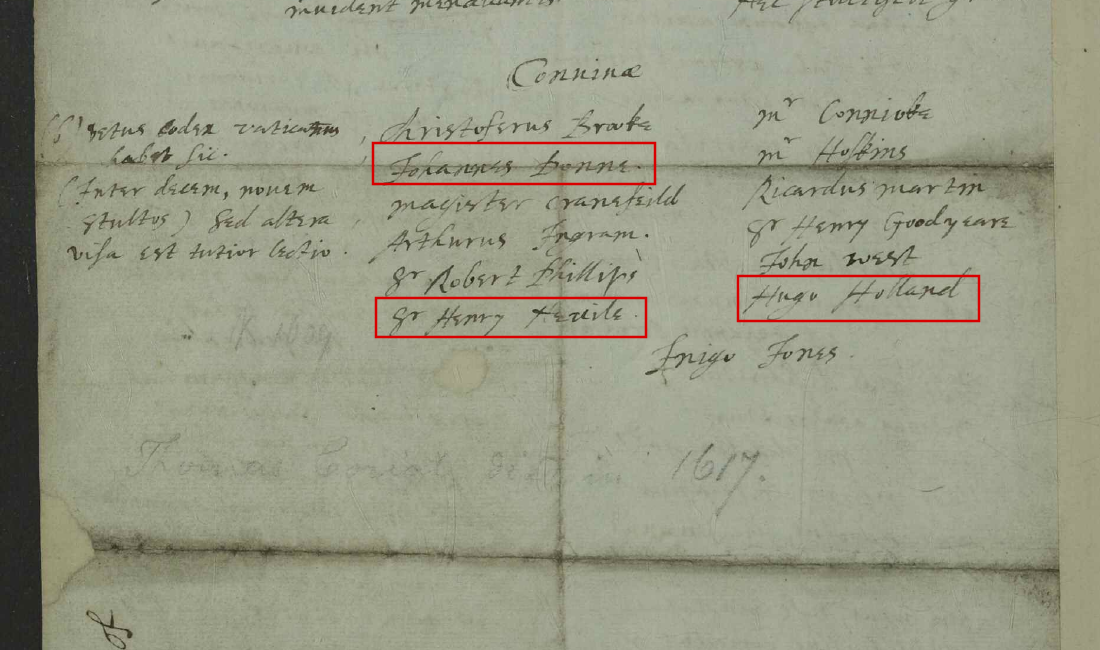
The State Papers copy has an appended list headed Conuiua. Normalizing the names, the thirteen men listed are:
| Named company | Named company |
|---|---|
| Christopher Brooke | John Hoskyns |
| John Donne | Richard Martin |
| Lionel Cranfield | Sir Henry Goodyere |
| Arthur Ingram | John West |
| Sir Robert Phelips | Hugh Holland |
| Sir Henry Neville | Inigo Jones |
| Richard Connock |
Thomas Coryate, the traveller whose Crudities appeared in 1611, supplies a fourteenth figure in the verse, although he is absent from the appended list.1
Donne, Brooke and Goodyere belonged to a close literary friendship. Brooke, a lawyer and poet, had been Donne’s friend since their days at Lincoln’s Inn. Goodyere corresponded regularly with Donne, lent him books, helped him financially and read his work.6
Inigo Jones, the architect, worked with Ben Jonson on court masques, designing their scenery and costumes. Their collaboration began with The Masque of Blackness in 1605.7
Hoskyns and Neville in Parliament
Hoskyns and Richard Martin were lawyers and parliamentarians as well as literary men. Both sat with Neville in the Parliament of 1604. On 14 May 1610, Martin moved to add Neville to a Commons committee concerning ambassadors’ children.8
Neville’s literary associations overlapped with his parliamentary work. In February 1610, he was appointed alongside Richard Martin, John Hoskyns and Christopher Brooke to consider John Cowell’s The Interpreter, a legal dictionary that argued the king could alter or suspend a particular law he judged harmful to the commonwealth. The committee also included Sir Maurice Berkeley, Neville’s political associate and estate trustee; James Whitelocke, his close friend; and Sir George Carew, his former travelling companion and a fellow diplomat. The appointments placed Neville’s literary and political associates together in a parliamentary dispute over royal power.9
Hoskyns also spoke in the 1614 parliamentary debate over Neville’s advice to the king. He defended the king’s right to consult his subjects and use their understanding. Otherwise, the king might as well be “a king of horses as men”: he could command their bodies and goods but make no use of their “wits and discretions.”10
The joke on Neville’s name
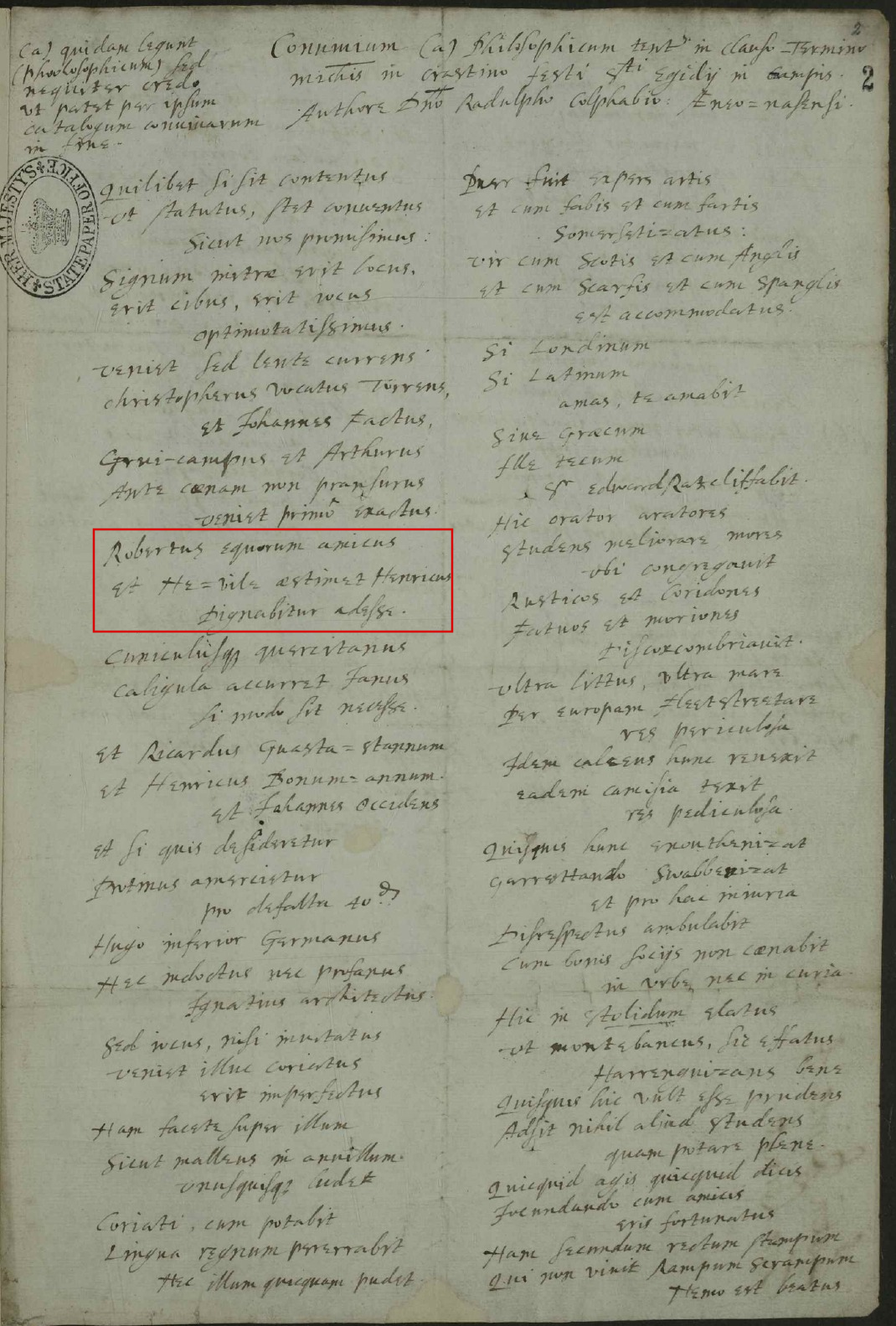
Neville’s place in the roll call is particularly suggestive:
Robertus Equorum amicus,
Ne vile aestimet Henricus
Dignabitur adesse,
The English version renders the middle line “Ne let Sir Henry count it vile.” The surname is broken into Ne-vile, while aestimet introduces the act of esteeming. Clark identifies the joke as an allusion to the family motto, “Ne vile velis.” Chapter 41 examines the conjunction with Sonnet 121’s “vile esteemed.”5
Hugh Holland: from convivial verse to the First Folio
Hugh Holland supplied a direct connection with the First Folio. He had already exchanged commendatory verse with Ben Jonson: Jonson contributed to Holland’s Pancharis in 1603, and Holland to Jonson’s Sejanus in 1605. Holland also contributed verse to Coryate’s Crudities.11
His literary friendships also continued beyond the occasion. An engraved memorial portrait of Richard Martin, dated 1620, carries a joint dedication by Christopher Brooke, John Hoskyns and Hugh Holland to Lionel Cranfield. Holland supplied verses mourning Martin and arranged for the engraving. Five names from the Convivium recur here: Martin himself, Brooke, Hoskyns, Holland and Cranfield.12
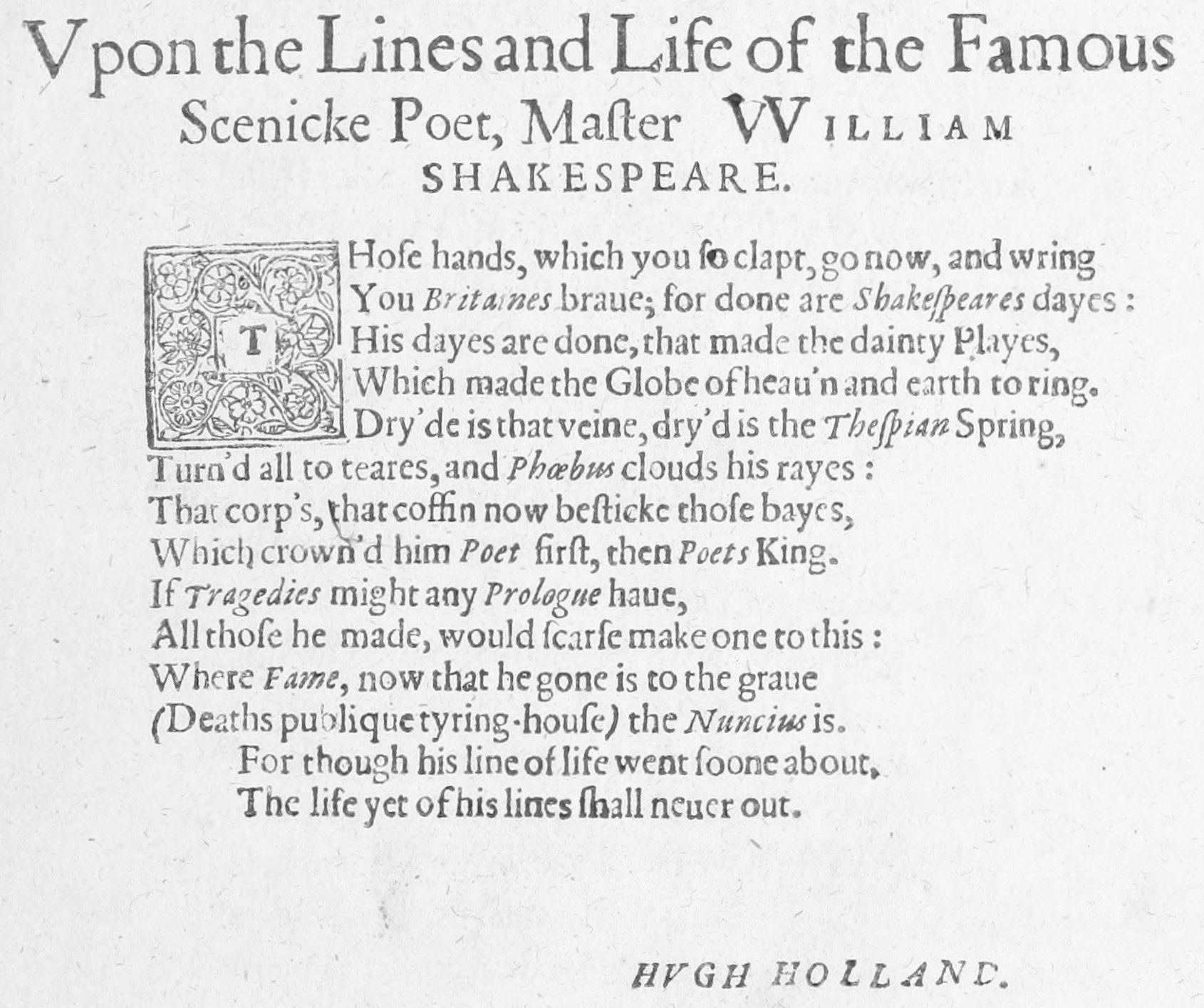
In the First Folio of 1623, Holland’s signed poem is headed “Upon the Lines and Life of the Famous Scenicke Poet, Master William Shakespeare.” Its opening turns the audience’s applause into mourning:
Those hands, which you so clapped, go now, and wring,
You Britains brave; for done are Shakespeare’s days:
His days are done, that made the dainty plays,
Which made the Globe of heaven and earth to ring.13
The closing couplet promises survival through writing:
For though his line of life went soon about,
The life yet of his lines shall never out.13
The Mitre list brings together Donne’s friends, Neville’s parliamentary associates, Jonson’s masque designer and a poet whose tribute would introduce the First Folio.
Notes and sources
The National Archives, SP 14/66, f. 2r–v, Convivium Philosophicum, State Papers Online, MC4323680944; Catalogue of English Literary Manuscripts, HoJ 267. The appended names are on f. 2v. Names in the table are normalized identifications, not a diplomatic transcription.↩︎
Andrew Clark, ed., Brief Lives, II (Oxford, 1898), pp. 50–53, text, prints the heading specifying the day after St Giles’s feast (1 September), hence 2 September. Julian T. S. Neuhauser, “Sirenaicks, Guilds and a New Coryate Manuscript,” Review of English Studies 74.313 (2023), pp. 31–46, at p. 34 and n. 15, DOI, follows I. A. Shapiro’s dating to 1611. The year is a scholarly dating, not treated here as an independently verified date in the manuscript’s hand.↩︎
Zachary Lesser, “Mixed Government and Mixed Marriage in A King and No King: Sir Henry Neville Reads Beaumont and Fletcher,” ELH 69.4 (2002), pp. 947–77, at p. 972 n. 13, article. Lesser expressly supports the Billingbear identification against I. A. Shapiro, “The ‘Mermaid Club’,” Modern Language Review 45.1 (1950), pp. 6–17, at p. 8, article, who assumes the Abergavenny cousin because he contributed to Coryate’s Crudities. Lesser’s references to parliamentary associates support his argument. Annabel Patterson discusses the difficulty of distinguishing the cousins in “All Donne,” in Soliciting Interpretation, ed. Elizabeth D. Harvey and Katharine Eisaman Maus (Chicago, 1990), pp. 37–67, at p. 62; that discussion is cited by Tom Cain, “Donne and the Prince d’Amour,” John Donne Journal 14 (1995), pp. 83–111, n. 37, text, who regards Berkshire Neville as “marginally more likely.” The list supplies no residence or office that conclusively distinguishes the two men.↩︎
Neuhauser, “Sirenaicks, Guilds and a New Coryate Manuscript”, pp. 34–43, especially pp. 35–38 on sociability, pp. 39–43 on guild-like practices and pp. 42–43 on Bodleian MS Don. c. 54 and the Whitaker attribution. Neither Shakespeare nor Jonson is named in the Mitre company. A later portion of the poem is attributed to “Whittakers,” identified by Neuhauser as almost certainly Laurence Whitaker; the traditional Hoskyns attribution need not cover every stanza.↩︎
Clark, Brief Lives, II, pp. 50–53, prints the Latin and a contemporary English version; spelling in the English extracts is lightly modernized. Neuhauser, p. 34 n. 15, identifies the translator as John Reinolds and directs readers to British Library, Harley MS 4931, ff. 18r–19r. The Latin quotations follow Clark rather than claiming a fresh diplomatic transcription of SP 14/66. The attribution to Hoskyns is explicit in the heading of the Madan manuscript used by Clark. Clark’s note 186 identifies the Neville family motto. For the attribution to “Doctore Rudolpho Colfabio”, see Neuhauser, p. 42 n. 73.↩︎
Michelle O’Callaghan, “‘Talking Politics’: Tyranny, Parliament, and Christopher Brooke’s The Ghost of Richard the Third (1614),” The Historical Journal 41 (1998), pp. 97–120, at pp. 102–103, article, on Brooke’s friendship with Donne; “Goodyer, Sir Henry (1571–1627)”, History of Parliament: The House of Commons 1604–1629 (2010), on his correspondence with Donne, loans of books, financial help and responses to Donne’s writing.↩︎
David Lindley, introduction to Ben Jonson, The Masque of Blackness (1605), The Cambridge Edition of the Works of Ben Jonson, opening paragraphs, on the first collaboration, Jones’s scenic design and surviving costume designs.↩︎
Journals of the House of Commons, I (1802), p. 428, 14 May 1610, “Ambassadors Children”; Andrew Thrush, “Neville, Sir Henry I (1564–1615), of Billingbear”, History of Parliament: The House of Commons 1604–1629 (2010), n. 71, identifies the diplomat. The journal records the appointment on Martin’s motion. Alastair Bellany and Andrew McRae, eds., Early Stuart Libels (2005), “The Censure of the Parliament Fart,” C1iv, notes 11 and 27, identifies Martin and Hoskyns as members of the 1604 Parliament.↩︎
Journals of the House of Commons, I (1802), p. 400, 27 February 1610 (modern year numbering), names the members of the Cowell subcommittee; Neville is named again among those preparing for the next day’s conference on p. 407, 7 March. John Cowell, The Interpreter (Cambridge: John Legate, 1607), s.v. “King (Rex),” EEBO-TCP A19476, argues for alteration or suspension of a particular law harmful to the public estate. Andrew Thrush, “Neville, Sir Henry I”, discussion of the 1610 committees and n. 73, and the later paragraph on parliamentary connections, confirms Neville’s committee work and Berkeley’s trusteeship; Paul Hunneyball, “Carew, Sir George II”, confirms Carew’s appointment and earlier travels with Neville and Savile. This is the diplomat who died in 1612, not the future earl of Totnes. James Whitelocke, Liber Famelicus, ed. John Bruce (1858), p. 46, describes his friendship with Neville. These are committee appointments, not a record of each man’s attendance or individual opinion.↩︎
Maija Jansson, ed., Proceedings in Parliament, 1614 (House of Commons) (Philadelphia, 1988), p. 246. The parliamentary report places Hoskyns’s intervention among speeches discussing Neville’s paper. Hoskyns defends consultation and the use of subjects’ judgement; the explicit motion to clear Neville recorded later on the page is Sir Robert Mansell’s.↩︎
Colin Burrow, “Holland, Hugh (1563–1633)”, Oxford Dictionary of National Biography (2004), on the reciprocal commendations in Pancharis and Sejanus, the Coryate verses, the Mitre company and the First Folio contribution.↩︎
Clark, Brief Lives, II, pp. 49–50, note V, transcribes the dedication of the 1620 engraved portrait, naming Brooke, Hoskyns and Holland as dedicators and Cranfield as recipient, followed by Holland’s memorial verses. The engraving is associated with Bodleian MS Aubrey 8, f. 17; Clark’s printed transcription is the witness used here.↩︎
William Shakespeare, Mr. William Shakespeares Comedies, Histories, & Tragedies (London, 1623), preliminary poem signed “HVGH HOLLAND,” Boston Public Library copy, Barton G.174.1, scan n17. English spelling is modernized in the quotations; the image preserves the original printing. Holland’s signed contribution establishes his participation in the Folio’s commemorative preliminaries, not an editorial role in collecting the plays.↩︎