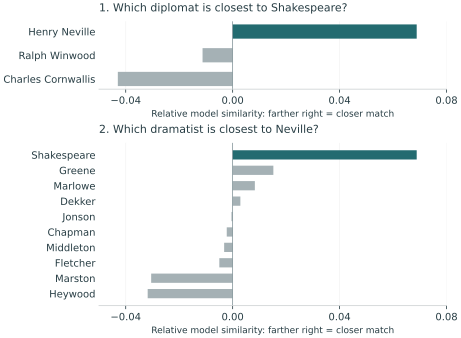
Figure 1. Two distinct comparisons, using the same matched samples. Above: each diplomat’s average similarity to Shakespeare. Below: Neville’s average similarity to each dramatist. Each writer is measured relative to the other two diplomats; negative scores do not mean an absence of shared language. The Shakespeare bar has the same value in both panels.
Henry Neville’s embassy letters to Cecil resemble Shakespeare’s plays more strongly than the letters to Cecil of Ralph Winwood or Sir Charles Cornwallis do. That result holds in all thirty matched comparisons of letters to Robert Cecil, later Earl of Salisbury, drawn from the same printed edition. The distinction matters because these are fellow diplomatic writers, not authors chosen from unrelated kinds of prose.
When Neville’s writing is compared with the plays of ten dramatists, Shakespeare is the closest match in twenty-nine of thirty samples. The study thus finds both a stronger Shakespeare affinity for Neville than for the two other diplomats, and a stronger affinity with Shakespeare than with the other dramatists.1
Which individual plays are closest?
Eleven of the twenty closest plays are Shakespeare’s. That is a striking concentration: Shakespeare accounts for only 36 of the 255 plays—about 14% of the field—but 55% of the top twenty. His share among the closest matches is therefore nearly four times his share of the collection.
Among his works, Romeo and Juliet, 1 Henry VI and Hamlet lead, followed by Antony and Cleopatra, Coriolanus and King John.
The ranking compares all 255 play samples individually, using the same thirty matched letter samples as Figure 1; the table shows the twenty highest. The two highest scores belong to the older King Leir and A Woman Is a Weathercock. The former is distinct from Shakespeare’s King Lear.2
| Rank | Play | Relative similarity |
|---|---|---|
| 1 | The True Chronicle of King Leir | 0.04138 |
| 2 | A Woman Is a Weathercock | 0.03794 |
| 3 | The Three Lords and Three Ladies of London | 0.03334 |
| 4 | Romeo and Juliet | 0.03068 |
| 5 | The Maid’s Tragedy | 0.02805 |
| 6 | 1 Henry VI | 0.02737 |
| 7 | Hamlet | 0.02668 |
| 8 | Antony and Cleopatra | 0.02666 |
| 9 | Volpone | 0.02624 |
| 10 | Coriolanus | 0.02502 |
| 11 | King John | 0.02450 |
| 12 | Julius Caesar | 0.02341 |
| 13 | Henry V | 0.02307 |
| 14 | Twelfth Night | 0.02287 |
| 15 | The Jew of Malta | 0.02019 |
| 16 | More Dissemblers Besides Women | 0.02000 |
| 17 | Henry VIII | 0.01932 |
| 18 | 1 Henry IV | 0.01860 |
| 19 | The Love of David and Fair Bathsheba | 0.01752 |
| 20 | Michaelmas Term | 0.01749 |
Table 1. The twenty highest average individual-play similarities to Neville, out of 255 plays. Neville is measured relative to Winwood and Cornwallis: high scores indicate shared features that distinguish his letters from theirs. Bold titles identify Shakespeare plays, including collaborations.
Why these comparisons matter
Ralph Winwood had served as Neville’s secretary during his embassy in France and subsequently pursued his own diplomatic career. Sir Charles Cornwallis was ambassador to Spain from 1605 to 1609. All three worked in a world of political reporting, negotiation and service to the Crown. Their letters offer a demanding comparison: a resemblance arising merely from the broad language of diplomacy might be expected to appear in the other diplomats too.3
Neville’s similarity to Shakespeare exceeds both comparators in all thirty source-matched samples. The comparison gives each man the same amount of writing, so Neville’s advantage in these tests cannot be explained simply by giving the computer more of his letters. Matching the edition and recipient also reduces differences in source and audience.4
The second question asks whether Neville’s resemblance is particularly to Shakespeare. The computer compares his writing with Shakespeare, Jonson, Heywood, Middleton, Dekker, Greene, Chapman, Fletcher, Marston and Marlowe. Shakespeare comes first for Neville in twenty-nine of thirty samples.5 Across the samples, the average scores point elsewhere for the other diplomats: Winwood’s closest dramatist is Heywood, Cornwallis’s Middleton.
How the comparison works
Take a word such as reason. The computer gathers the words near each occurrence in Neville’s letters and builds a numerical description of those surroundings. Repeating this across hundreds of words produces a profile of his vocabulary in use. The same procedure creates profiles for the other correspondents and for the plays. The test compares these profiles, rather than searching only for identical phrases.
The numerical descriptions use vectors: lists of numbers learned from patterns of word use. Here, Word2Vec was trained on early modern plays and texts from Early English Books Online (EEBO), through EarlyPrint, selected for 1590–1615. Words used in similar surroundings tend to acquire similar vectors. Each word’s vector stays fixed after training, but combining the vectors of different surrounding words produces different descriptions of context. The relationships measured therefore come from period language.6
The model measures each correspondent’s contexts relative to those of the other two. Patterns learned from 255 play samples then relate these differences to the ten dramatist groups.7
Checking the method against known authors
The method can be checked against writers whose authorship is already established. Give it their letters, prose, poetry or masques and ask which dramatist’s plays are closest: does it identify the correct author? It does so for eight of the nine control collections retained here. The table shows where each collection’s own author ranks among the ten dramatists; first place is a successful match.
| Author | Writing tested | Own author’s rank |
|---|---|---|
| Original controls | ||
| William Shakespeare | Poems | 1st |
| Ben Jonson | Letters | 2nd |
| Thomas Heywood | Prose | 1st |
| Thomas Middleton | Prose | 1st |
| Thomas Dekker | Prose | 1st |
| Robert Greene | Prose | 1st |
| Additional controls | ||
| George Chapman | Poems | 1st |
| John Marston | Satires | 1st |
| Ben Jonson | Masques and poems | 1st |
Shakespeare’s poems correctly select his plays, as do the prose collections of Heywood, Middleton, Dekker and Greene. Chapman’s poems, Marston’s satires and Jonson’s combined masques and poems also identify their own authors. The exception is Jonson’s letters, which place him second.
These results show that the method can recover known authorship across different kinds of writing. Five of the six original collections match correctly; all three additional collections retained here do so without having helped select the settings.8
The result extends through Neville’s writing
The broader letter collections give the same result. At 50,000 analysis tokens per writer, Neville exceeds both diplomats in Shakespeare similarity, and Shakespeare leads his dramatist ranking, in all thirty samples. His embassy letters alone also select Shakespeare in all thirty equal-size samples. Neither confinement letters nor the separate Advice, Confession and Case are needed for that match.9
A wider comparison places Neville alongside twenty-one letter-writers and tests each against all ten dramatist groups. Neville–Shakespeare is the strongest of the resulting 220 pairings under the selected model. This gives the three-diplomat comparison a broader setting: Neville’s leading position is not confined to a field of three. This wider comparison uses the broader letter collections.10
Its place in the authorship case
The finding gives the case for Neville a further quantitative basis: his letters stand closer to Shakespeare than those of two fellow diplomats, and Shakespeare stands closer to Neville than the other nine dramatists. Equal amounts of writing preserve both results. This extends the evidence beyond individual verbal parallels to a pattern across his correspondence.
Further research must establish how much of this pattern reflects authorship rather than finer differences in subject, register or editorial transmission. The model’s settings, the composition of the letter collections and the construction of dramatist profiles matter. Shared vocabulary and subject matter can contribute to the affinity; the result does not by itself establish a distinctive signature of sentence structure. The next step is an independently fixed comparison with similarly matched material and known-author controls.11
Notes and sources
Each sample takes 500 interior analysis tokens from thirty letters per writer, all from Sawyer’s 1725 edition and addressed to Cecil/Salisbury. The bars average model cosine similarities across thirty overlapping samples. These are two questions about the same profiles, not independent confirmations.↩︎
This breaks down the same calculation as Figure 1, rather than supplying an independent test. Scores average thirty overlapping samples; individual sample rankings vary. Each play contributes its central 10,000 analysis tokens, or its whole text if shorter. Dramatist labels help determine which topic directions are removed. The nearly fourfold concentration is descriptive, not a chance probability. A broader comparison using 50,000 tokens per writer gives seven Shakespeare plays in its top twenty; this table controls the printed edition and recipient more closely.↩︎
Winwood: History of Parliament, Sir Ralph Winwood. Cornwallis: British Library, Add MS 39853, catalogue description and articles 13 and 15. This establishes their diplomatic setting, not identical subjects, dates or editorial treatment.↩︎
The source is Edmund Sawyer’s three-volume edition of Winwood’s Memorials of Affairs of State (London, 1725). The matched pool contains 61 Neville, 111 Winwood and 43 Cornwallis letters. Samples use thirty distinct eligible letters per writer and leave at least 100 analysis tokens untouched at either end. Dates, postings and volumes are not identical. Suspect Cornwallis units were withheld and a confirmed Winwood editorial footnote removed.↩︎
Each dramatist is represented by a normalized combined profile. Its score depends on the number and coherence of the plays combined; Shakespeare has 36 plays and Greene six. Simply averaging individual-play similarities also places Shakespeare first overall and in 21 of the thirty samples. The direct comparison of diplomats uses the same Shakespeare profile for all three.↩︎
Training selects plays by creation year and EarlyPrint texts by database date. The context window contains two eligible words on either side after filtering; these need not be the four immediately adjacent words in the original text.↩︎
Of the 255 play samples used to fit the representation, 144 belong to the ten scored dramatist groups. The three-writer model centres each correspondent on the other two and retains seven axes per target after removing fifteen topic directions. The wider comparison has a different reference set.↩︎
The original six helped select the settings, so their results are calibration rather than independent validation. There are nine retained collections from eight authors, with Jonson represented twice. The experiment also included translations of Ovid and Lucan attributed to Marlowe; that collection is excluded from this summary because of concerns about attribution and the inclusion of another writer’s prefatory material. The excluded collection ranked Marlowe seventh; the complete ten-collection test therefore yielded eight first-place matches. The combined Jonson collection includes dramatic masques; it is not wholly non-dramatic. The controls use genre-appropriate reference groups and are not matched for text length.↩︎
The broader collections contain 165 Neville, 154 Winwood and 99 Cornwallis letter units. The diplomatic core contains 89 Neville letters, defined by date and official recipient. These equal-token comparisons use broader source and recipient coverage than the matched samples in Figure 1.↩︎
The strict within-letter interaction score is 0.09726, first of 220. This differs from Figure 1’s similarity scores. The strongest pairing does not mean that Neville is the only correspondent whose closest dramatist is Shakespeare.↩︎
The same plays help fit the representation and provide its benchmarks; samples overlap and settings were selected partly using known-author controls. Foreign-language passages in the letters are retained. Rankings and sample frequencies are not authorship probabilities; normalization remains incomplete.↩︎