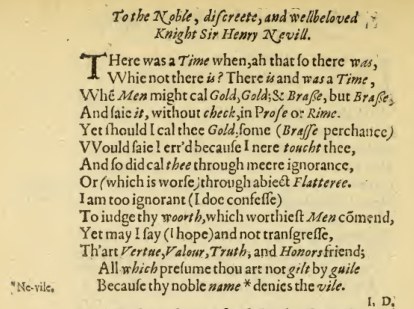
Beside a poem addressed to Sir Henry Nevill in John Davies’s Microcosmos (1603), a printed note in the margin supplied a defence in two syllables: “Ne-vile.” Davies’s closing lines made the moral claim in the name explicit:
All which presume thou art not gilt by guile,
Because thy noble name denies the vile.
The heading calls its addressee “the Noble, discreet, and wellbeloved Knight Sir Henry Nevill.” The marginal gloss shows that the surname joke was being made in print during Neville’s lifetime.1
An honest man, however he seemed
From the Tower, Neville had asked Cecil to separate the appearance created by his disgrace from his judgment of the man. On 9 July 1601 he wrote:
I have received great comfort … for the hope … that your honour doth not in your private judgment condemn me to have been so wicked and disloyal, as my folly and misfortune together have made me to seem.2
He admitted folly. What he resisted was its conversion into a complete account of his character. One title mattered more than the rest:
Whatsoever other opinion I have deserved to lose, that you will vouchsafe still to hold me an honest man. For that is the highest title that I aspire unto.2
Sonnet 121 makes the distinction between conduct and hostile reputation with greater defiance:
Sonnet 121
‘Tis better to be vile than vile esteemed,
When not to be receives reproach of being,
And the just pleasure lost, which is so deemed
Not by our feeling but by others’ seeing.
For why should others’ false adulterate eyes
Give salutation to my sportive blood?
Or on my frailties why are frailer spies,
Which in their wills count bad what I think good?
No, I am that I am; and they that level
At my abuses reckon up their own.
I may be straight though they themselves be bevel;
By their rank thoughts my deeds must not be shown,
Unless this general evil they maintain:
All men are bad and in their badness reign.3
To receive the reproach without committing the vice charged is to suffer other people’s judgment in place of one’s own experience. The poem acknowledges frailties while refusing the accusers’ right to define them. Its “sportive blood” gives those frailties an amorous setting; Neville’s offence was political. The correspondence lies in the shape of the defence: admit a fault, refuse the hostile identity built upon it. Neville asks Cecil to preserve that distinction; the speaker answers his hostile judges, “I am that I am.”
The contrast with the preceding sonnet makes the point sharper. Sonnet 120 ends by making each person’s fault the ground for forgiving the other:
Sonnet 120, lines 13–14
But that your trespass now becomes a fee;
Mine ransoms yours, and yours must ransom me.4
Sonnet 121 changes the tribunal. Its outsiders turn their own “rank thoughts” into an account of someone else’s deeds. Admitting an error, in Neville’s petitions as in this contrast between the poems, need not mean accepting every accusation built upon it. His attempts to withhold or revise his declaration are examined in Chapter 6. His fear of “the censure of every common person” and the “worst interpretation” of his errors gives the poetic conflict a documented personal urgency.5,6
A name in the rhyme
The accusers level their charges at a speaker who may be straight while they are bevel, or crooked. Both words rhyme with Neville. Two lines after bevel, the 1609 quarto prints “this general euill.”3
Shakespeare uses bevel only here in the plays and poems checked. A search of EEBO texts dated 1500–1615, allowing for spelling variants and inspecting verse-line endings, found no other independent example of the level/bevel rhyme. Its two hits were witnesses of this same sonnet.3 The unusual rhyme occurs inside a defence against being falsely judged vile—the very charge Davies makes Neville’s name deny.
The family joke before and after 1609
The dated witnesses show how the name-play and the language of esteeming gather around the sonnet’s publication:
| Date | Witness | Name-play or verbal connection |
|---|---|---|
| 1603 | Davies, Microcosmos | A poem addressed to Sir Henry Nevill ends with the printed marginal gloss “Ne-vile.”1 |
| 1606 / 1607 | Owen, Epigrammatum libri tres | Books I–III first appeared in 1606; the Neville motto epigram is checked here in the 1607 third edition. Its addressee is the Abergavenny cousin.7 |
| 1609 | Shakespeare’s Sonnets | Sonnet 121 sets being vile against being “vile esteemed”; publication does not date its composition.8 |
| Probably 1611 | Convivium Philosophicum | “Ne vile aestimet Henricus” combines the surname joke with esteeming. The likely gathering date is 2 September 1611.9 |
| 1619 | John Vicars’s translation of Owen | The named Neville epigram uses “base esteem” and “deem,” after the Sonnets were in print.7,10 |
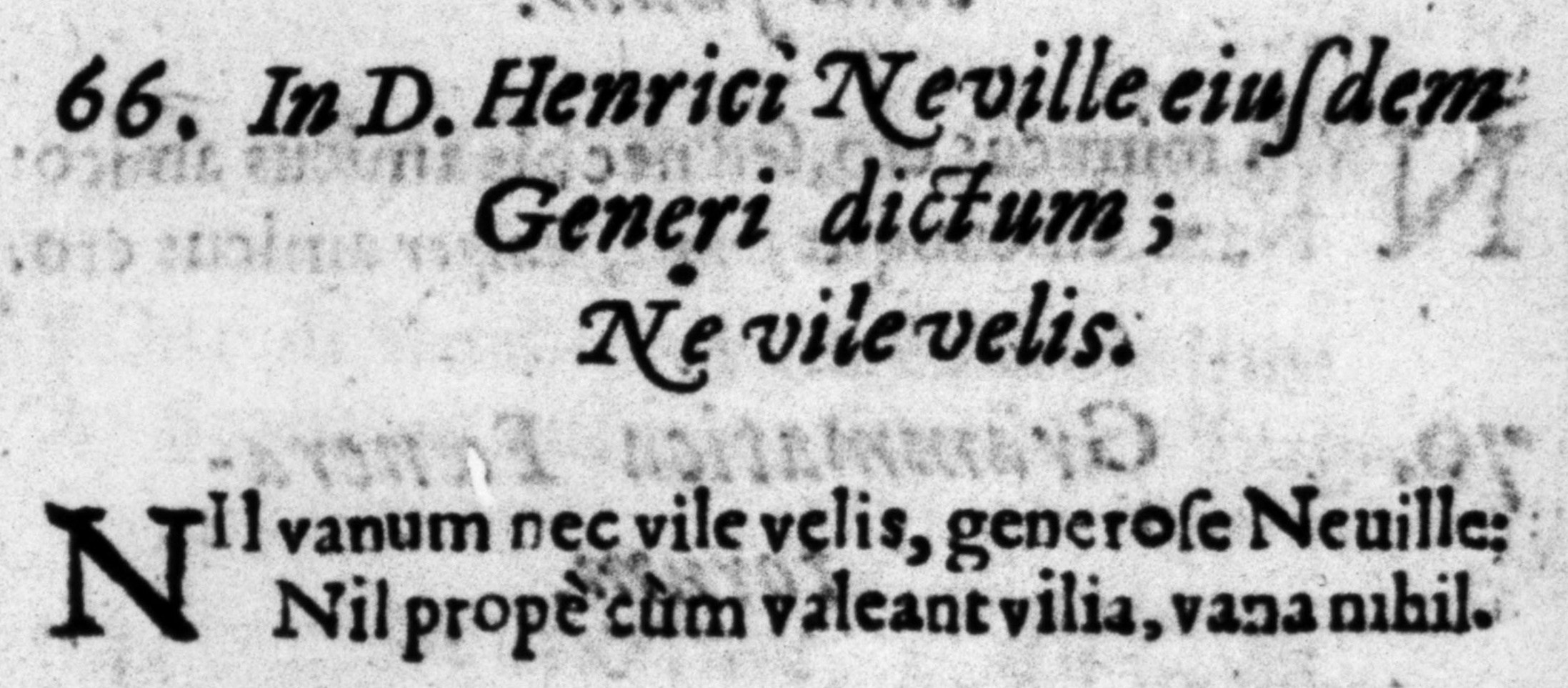
John Owen used the motto Ne vile velis—“Wish for nothing vile”—for Henry Neville of Abergavenny, the ambassador’s cousin. The epigram follows that of the Earl of Dorset, whose daughter Mary Sackville he had married. The third edition of 1607 prints:
Nil vanum nec vile velis, generose Neville:
Nil prope cum valeant vilia, vana nihil.
“Wish for nothing vain or base, noble Neville, since base things are worth almost nothing, vain things nothing.” The joke belongs to the family name; the addressee here is the cousin.7
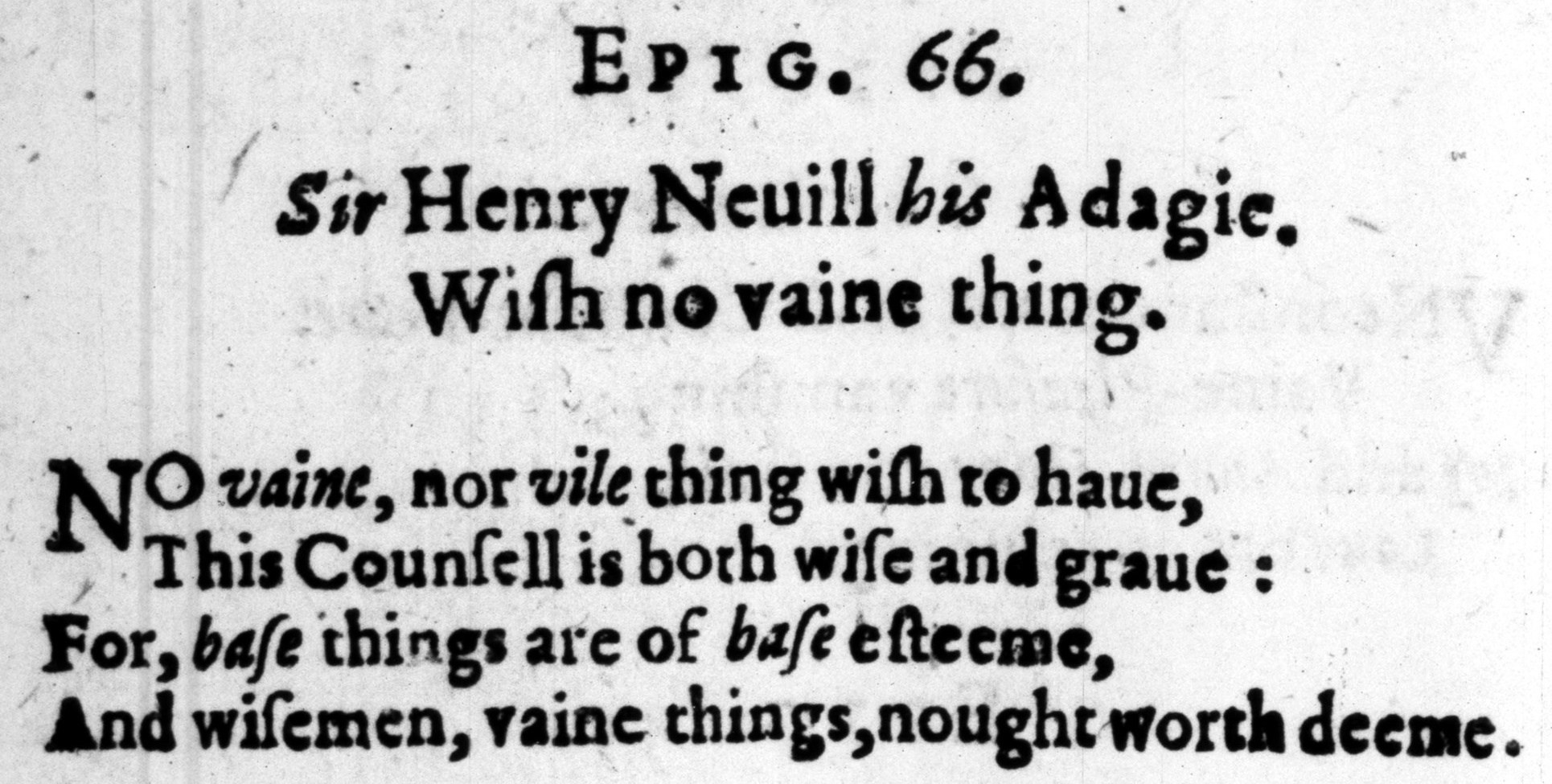
John Vicars’s 1619 translation gives it a more particular resemblance to Sonnet 121:
No vain, nor vile thing wish to have,
This counsel is both wise and grave:
For, base things are of base esteem,
And wise men, vain things, nought worth deem.7
Sonnet 121, lines 1–3
’Tis better to be vile than vile esteemed,
When not to be receives reproach of being,
And the just pleasure lost, which is so deemed3
“Base … base esteem” repeats the structure of “vile … vile esteemed,” with deem following in rhyme. Vicars also keeps vile in his opening line. His English is later than the 1609 Sonnets; Owen’s Latin is attested before them in the 1607 edition. The sequence matters: a printed family pun precedes the sonnet’s publication, while the English verbal resemblance is a later parallel.10
The Convivium Philosophicum (Philosophical Banquet), discussed in Chapter 45 and probably associated with a gathering on 2 September 1611, brings vile and esteeming together inside the surname joke:
Robertus Equorum amicus,
Ne vile aestimet Henricus
Dignabitur adesse,
“Ne vile aestimet Henricus” pairs vile with aestimet, “let him esteem.” The contemporary English translation printed by Andrew Clark keeps the name-play:
Sir Robert Horse-lover the while
Ne let Sir Henry count it vile
Will come with gentle speed;9
A manuscript’s appended guest list names “Sr Henry Neville,” without distinguishing the diplomat from the cousin. The combination is specific: the family pun Ne vile is completed by aestimet, the act of esteeming. It could be a deliberate recollection of “vile esteemed.” In the Latin Henry does the judging, whereas the sonnet’s speaker is judged; the shared words perform different actions.9
Apparent and true
The poets’ puns give the name a moral meaning. Neville’s 1599 portrait presents integrity through a different medium: an astronomical device. Above the inscription identifying him as ambassador to France appear a geometrical diagram and a line of Greek.
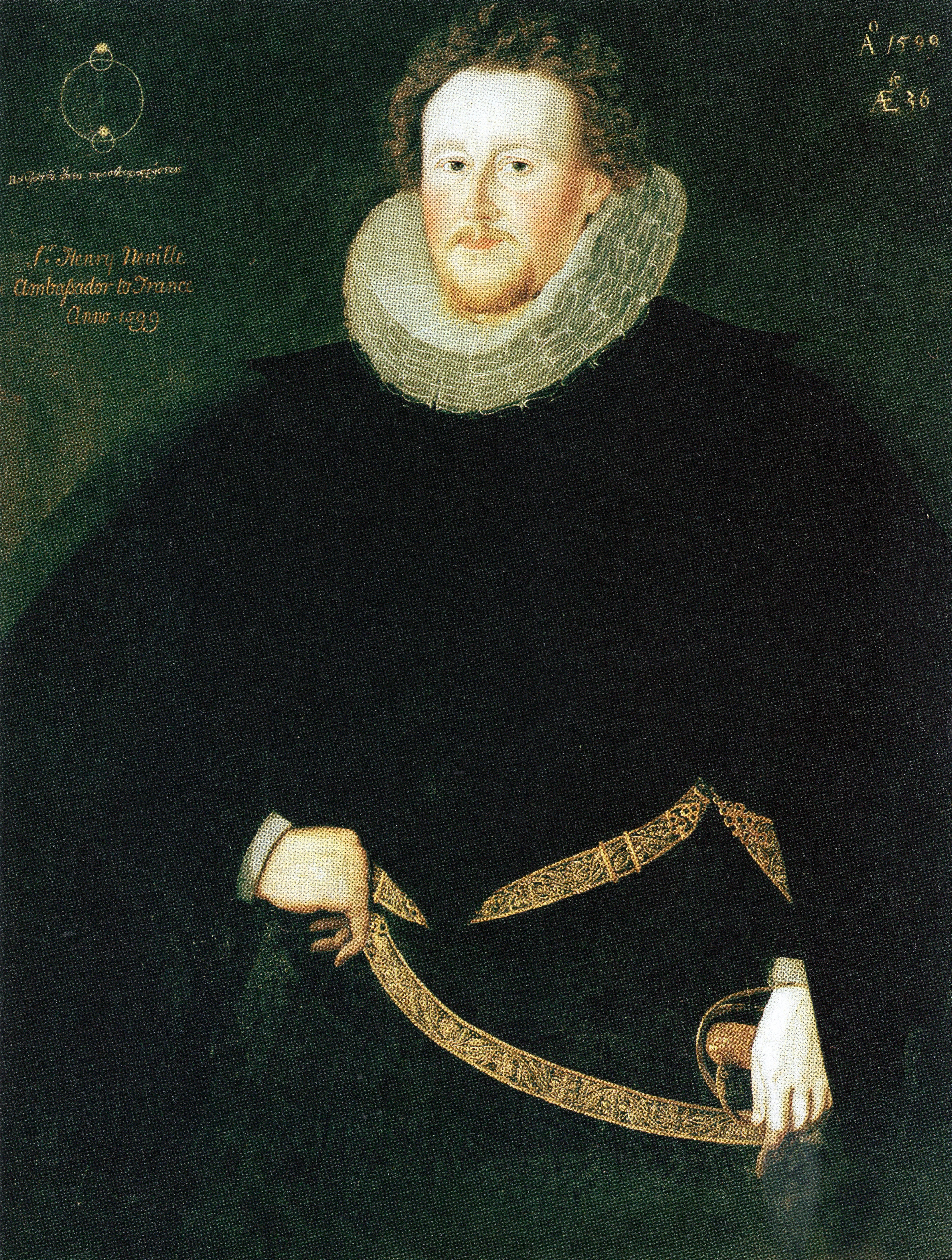
An unnamed specialist’s reading of the Greek inscription, published in 2021, is “Absolutely without prosthaphaeresis”—without the correction between a heavenly body’s mean and true position.11
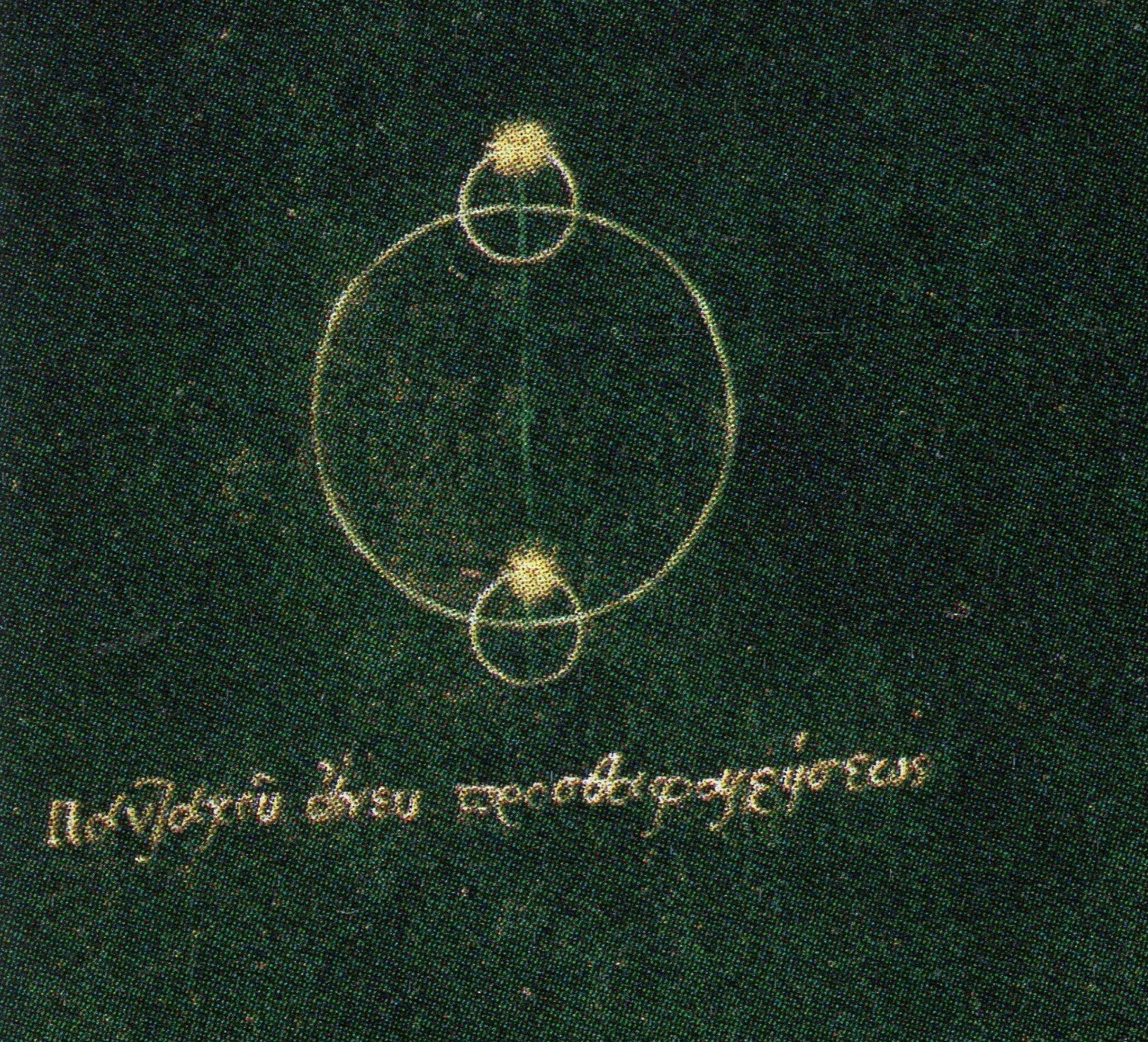
The specialist interprets the device as requiring no correction between Neville’s apparent and true self; the GrECI catalogue also connects it to Ne vile velis. At the two positions shown—apogee and perigee in the Ptolemaic solar model—the mean and true directions coincide. The portrait claims agreement between appearance and character. Sonnet 121 protests against viewers who make the speaker appear crooked. One represents integrity as a coincidence of positions; the other challenges the eyes that misrepresent it.
Base things and the judging crowd
The title-page epigraph of Venus and Adonis (1593) begins Vilia miretur vulgus—“Let the crowd admire base things.” Chapter 39 sets out James Leyland’s proposed connection with Ne vile velis, including the Latin forms linking vilia with vile. The epigraph puts the crowd’s taste for base things against the poet’s own ambition. Sonnet 121 challenges the crowd’s moral judgment instead: who gets to decide whether a man is vile? The proposed motto connection gives this earlier declaration a place beside the sonnet’s defence of character.

Venus and Adonis (1593), title-page epigraph (detail); the box marks Vilia. Bodleian Libraries, Arch. G. e. 31 (2). Image © Bodleian Libraries, Oxford, 2015; Shakespeare Documented.
A name defended or concealed
The vile word-family occurs in only two of the 154 sonnets, twice in one line in each: “vile world with vilest worms” in 71, and “vile than vile esteemed” in 121.8 Both place a life under the power of other people’s judgments. They answer that danger differently.
Sonnet 71
No longer mourn for me when I am dead
Than you shall hear the surly sullen bell
Give warning to the world that I am fled
From this vile world with vilest worms to dwell.
Nay, if you read this line, remember not
The hand that writ it, for I love you so
That I in your sweet thoughts would be forgot,
If thinking on me then should make you woe.
O, if, I say, you look upon this verse
When I, perhaps, compounded am with clay,
Do not so much as my poor name rehearse,
But let your love even with my life decay,
Lest the wise world should look into your moan
And mock you with me after I am gone.8
The poem moves from the bell’s public announcement to the private act of reading. A line of verse can bring back the writer’s hand and name. He asks the beloved to suppress precisely those acts of recognition: “remember not,” “do not so much as my poor name rehearse.”
The last couplet explains what recognition could cost. The world will look into the survivor’s mourning and mock both people. Death does not end the danger of association; the dead man’s name can still hurt someone he loves. Sonnet 72 carries that danger into the act of praising him:
Sonnet 72, lines 9–14
O, lest your true love may seem false in this,
That you for love speak well of me untrue,
My name be buried where my body is
And live no more to shame nor me nor you.
For I am shamed by that which I bring forth,
And so should you, to love things nothing worth.12
Praise itself can misrepresent the person it means to honour. Sonnet 127 objects to “Sland’ring creation with a false esteem.” Sonnet 130 ends by affirming love while rejecting false description:13
And yet, by heaven, I think my love as rare
As any she belied with false compare.13
The speaker can love the woman without inventing her perfection. That gives Sonnet 121’s protest a further counterpart: a person may be misrepresented by flattering comparison as well as hostile judgment.
In Sonnet 72, the friend’s praise can expose both of them to shame. In 71 and 72, love therefore asks for a buried name; in 121, the speaker refuses to let other people’s thoughts determine his deeds. The alternatives are concealment and defiance.
The rare level/bevel rhyme occurs in a defence against being “vile esteemed.” Davies had already made Neville’s name carry that defence: “thy noble name denies the vile.”
Notes and sources
John Davies of Hereford, Microcosmos (Oxford, 1603), concluding address “To the Noble, discreet, and wellbeloved Knight Sir Henry Nevill,” page image, EEBO-TCP A19903. Spelling modernized in the quotations; the image retains the printed spelling. The heading names Sir Henry Nevill without an estate or office; its identification with the diplomat is the reading adopted here, not additional wording in the heading.↩︎
Neville to Cecil, from the Tower, 9 July 1601; manuscript, with Calendar of the Manuscripts of the Marquess of Salisbury, XI (1906), pp. 273–275 as independent text control. Spelling and light punctuation modernized.↩︎
Shakespeare, Sonnet 121, quoted in full; lines 9–14 supply the rhyme and spelling comparison. A whole-word check of the Folger reading texts for the 38 plays, the 154 Sonnets, Venus and Adonis, Lucrece, and The Phoenix and Turtle finds bevel only in Sonnet 121, line 11. The broader EarlyPrint search covered EEBO witnesses dated 1500–1615 inclusive, searching level/leuel/levell/leuell and bevel/beuel/bevell/beuell and inspecting encoded verse-line endings and surrounding rhyme contexts. It found the pairing in A12043 and A12044, two witnesses of the Sonnets. A separate 1615 multilingual passage in A08077 pairs bevell with well, not level. This is a finding within the dated, searchable corpus and its verse encoding, not a claim about every surviving or lost poem. Ken Feinstein’s 14 May 2019 discussion connects the rhyme to Neville’s surname. The 1609 quarto has leuell (line 9), beuel (line 11), and euill (line 13); the surname comparison retains the original u in both euill and Neuill. See the old-spelling edition, Sonnet 121, lines 9–14, ed. Hardy M. Cook and Ian Lancashire. Evil occurs within line 13; the closing end-rhyme is maintain/reign.↩︎
Shakespeare, Sonnet 120, lines 13–14, Folger text. The reciprocal forgiveness in the couplet is contrasted with the public accusation in Sonnet 121; their printed order does not date their composition.↩︎
Neville to Cecil, Chelsea, 22 April 1601, Hatfield House, Cecil Papers 86/1; also Calendar, XI, pp. 175–176. For Chelsea custody and controlled visits, see Nottingham and Cecil to Zachary Lock, March 1601, TNA PRO 30/50/4, manuscript leaf numbered 7, authorizing Lady Neville to visit privately.↩︎
Neville to Cecil, 7 January 1603 (1602 in the letter’s year reckoning), Cecil Papers 91/35; also Calendar, XII (1910), pp. 589–590.↩︎
John Owen, Epigrammatum libri tres, third edition (London: Humfrey Lownes for Simon Waterson, 1607), II.66, STC 18986, Latin page image, n58. Latin u/v and accents normalized; literal translation supplied here. The preceding Dorset heading explains eiusdem generi, “his son-in-law.” John Vicars, trans., Epigrams of that most witty and worthy epigrammatist Mr. John Owen (1619), epigram 66, STC 18993, English page image, n25; EEBO-TCP A08687. English spelling modernized. Ken Feinstein, “Shakespeare’s Sonnet 121, John Vicars, and Vile Things”, 28 July 2019, identifies the comparison and distinguishes the Abergavenny addressee. For the first publication of Books I–III in 1606, see the Philological Museum edition, Introduction, §2. The illustrated witness is the 1607 third edition; the specific epigram has not yet been collated against a first-edition copy.↩︎
Shakespeare, Sonnet 71 and Sonnet 121, Folger Shakespeare Library. A whole-word, case-insensitive check of the 154 numbered Folger sonnets for vile and vilest gives four occurrences, confined to these two lines. This is a statement about distribution within the sequence, not the rarity of the words in English. The 1609 quarto prints vildest in Sonnet 71; the reading text here follows Folger’s vilest.↩︎
Convivium Philosophicum, attributed to John Hoskyns; Latin and contemporary English translation by John Reinolds in John Aubrey, Brief Lives, ed. Andrew Clark, II (Oxford, 1898), pp. 50–53 (text). Clark’s note expressly identifies the Neville family motto. Manuscript: TNA SP 14/66, f. 2r–v, CELM HoJ 267, State Papers Online MC4323680944, catalogued as 2 September 1611. The manuscript images confirm the pun and the appended name; the quotation follows Clark’s edition rather than silently assimilating manuscript variants. The unqualified “Sir Henry Neville” does not distinguish Billingbear from the Abergavenny cousin; the family-motto evidence holds for either. The represented company is not by itself proof that every named guest attended. For the dating, see I. A. Shapiro, “The ‘Mermaid Club’”, Modern Language Review 45.1 (1950), 6–17, at p. 7 and nn. 1–3: the poem specifies 2 September without a year, and Shapiro argues for 1611 as the most likely year. Julian T. S. Neuhauser, “Sirenaicks, Guilds and a New Coryate Manuscript”, Review of English Studies 74.313 (2023), 31–46, at p. 34 and n. 15, retains “likely in 1611,” citing Shapiro. The possible allusion to Sonnet 121 is proposed here, not attributed to either scholar. “Robertus Equorum amicus” (“Sir Robert Horse-lover”) names Sir Robert Phelips. On 12 November 1612 Sir Maurice Berkeley wrote to Phelips approving his proposed consultation with Neville: “I like well of your purpose of treating with Sir H[enry] N[eville].” Clayton Roberts and Owen Duncan, “The Parliamentary Undertaking of 1614”, English Historical Review 93 (1978), 481–498, at p. 488 and n. 2, quoting Somerset DD/PH/219/59. This records a planned approach, not confirmation of a completed meeting.↩︎
Vicars also uses the rhyme in “A Good-man,” epigram 87 in the first sequence (n14), and “To the Reader, of himselfe,” epigram 168 (n18). The comparison here concerns the repeated synonymous adjective with esteem and the Neville motto context, not a unique rhyme. The 1619 translation is a later parallel, not a proposed source for the 1609 quarto; Owen’s epigram is confirmed in the 1607 third edition, while its presence in the 1606 first edition has not been checked.↩︎
GrECI/MUSEU-HUB, “Portrait of Sir Henry Neville”, image 042_Id_17, dates the oil-on-wood portrait to 1599, locates it at Audley End in Lord Braybrooke’s collection, and tentatively attributes it to Marcus Geeraerts the Younger. Its description reads the Greek as “Absolutely without correction” and expressly connects the device to Ne vile velis. Ken Feinstein, “The Greek Inscription on Henry Neville’s Portrait: Solved!”, 9 July 2021, publishes an anonymous specialist’s translation and astronomical explanation. The exact diplomatic Greek is not supplied here. Astronomical prosthaphaeresis is distinct from the later computational technique of that name. The motto connection is an interpretation of the emblem, not Latin words painted on the panel. Portrait reproduction.↩︎
Shakespeare, Sonnet 72, lines 9–14, Folger text. The printed sequence’s development of public reputation is not a chronology of the poems’ composition.↩︎
Shakespeare, Sonnet 127, line 12, and Sonnet 130, lines 13–14, Folger Shakespeare Library. The comparison concerns false description in praise and accusation; it does not identify the poems’ addressees.↩︎
