His defence
In custody, Neville had to defend his loyalty while admitting that he had concealed a dangerous scheme. His written defence, printed as Sir Henry Nevill’s Case, turns on that distinction. Appendix M gives the full text:
Although I mean not to justify myself altogether from blame, but do freely and willingly acknowledge an offence, and submit myself to her Majesty’s mercy; yet my own soul witnessing to herself, that it was ever loyal and faithful to her Majesty, and consequently abhorring more than death, the imputation of that fault, and loathsome crime of falsehood and treason; I do only desire, that my fault may not be barely or nakedly censured, but examined together with all the circumstances that did accompany it […]1
He maintained that he had been solicited rather than initiating the plan, had objected to it and promised no participation, and was preparing to return to France. The conspirators had neither consulted him further nor summoned him on the day of the rising. He objected particularly to Essex’s confession:
How unequally (that I may not say uncharitably) my Lord dealt with me in his confession; wherein he delivered matters to charge me, but nothing to discharge me, although both alike known unto him […]2
Yet he could not explain away his silence. He had hoped the scheme would dissolve and recoiled from accusing a man whose standing before the catastrophe was very different from his reputation afterwards. Essex should be considered “not as he has been found since, but as he was reputed.” As in his appeal to Tacitus in Chapter 6, Neville asks that his conduct be judged by what he could know before the rising, rather than by hindsight. Neville nevertheless admitted that public duty should have prevailed over his fear of private disgrace.3
Letters and appeals
Neville wrote many letters to Robert Cecil during his confinement in the Tower. Alongside requests for help with his fine and release, he wrote about his damaged reputation, his family’s suffering, and his despair. Chapters 40–43 return to these letters and compare their language with the Sonnets.
Anne Neville continued to petition Cecil, her first cousin. In a letter assigned to about June 1601, she explained that sickness prevented her from coming herself; her father’s age and weakness limited his help, and her uncle was absent. She had heard that the Queen was showing grace even to those involved in open action, and hoped that Neville’s offence would be judged less serious:
But howsoever, if he may but taste of the same favour that they have had, and be restored shortly unto me and his poor children, though we live poorly together all our time, I shall think myself happy […].
She asked Cecil to remember the affection of “my good lady your mother towards us, who I am sure, if she were living, would join her request unto my suit.” Mildred Cecil was Anne’s aunt: Anne invoked Mildred’s memory to press Cecil to act.4
A fine of £10,000 exceeded his depleted resources. Explaining his position to Cecil in July 1601, Neville reported losing a yearly £350 payment from the ordnance patent as well as his offices. He had already sold £4,000 of land to meet embassy costs and debts.
On 9 July 1601, he asked Cecil to preserve one judgment of him:
Whatsoever other opinion I have deserved to lose, that you will vouchsafe still to hold me an honest man. For that is the highest title that I aspire unto.5
The same letter also asked permission for Anne to visit and discuss their estate and his suit.
On 12 July 1601 the Privy Council instructed the Lieutenant of the Tower to allow Anne “free access” to her husband at convenient times. It also permitted two or three other visitors a day to confer about his business. The order expressly connected these consultations with his estate and the means of satisfying the fine.6
On 25 July he pleaded for his wife and children:
I beseech your honour therefore even for God’s sake to take compassion upon my poor wife and children, and let not my folly be their utter overthrow. I wish the whole punishment might light upon myself, for I only have deserved it, and they are innocent.7
In a letter endorsed 4 August 1601, he described what continued royal displeasure meant to him:
Unless I be so happy as to obtain some mitigation of that indignation which is kindled in her against me, I shall account my life but a burden unto me, and hope to be eased of it ere it be long.8
Savile appeals to Cecil
Henry Cuffe, Savile’s protégé and Neville’s close friend, left £500 in his will to Neville or his children and asked his forgiveness as a distressed friend. He had visited Savile’s Westminster lodging on 5 February 1601. This connection likely helps explain the suspicion that fell on Savile after the rising. On the morning of the rising Savile went to court; his servant was subsequently questioned and his study at Eton searched, but he was not implicated in treason. In January 1602 he was sufficiently trusted by Elizabeth and Cecil to act for Neville in negotiations for his release.9
In appeals assigned to 1601, Savile had also asked Cecil to help protect Neville’s income. A dispute over tithes—produce owed from agricultural land—had made possession almost worthless: local pressure could prevent the corn from being carried away, stored, threshed or sold. Neville, under the queen’s displeasure, needed the benefit of what was his.10
In negotiations over the original £10,000 fine, Neville raised his offer from £4,000 to £5,000 in March 1602. The Queen initially rejected his proposed payment terms; by 3 April she had accepted the £5,000 offer, but the required security was still disputed. The agreed sum is not a record of the amount ultimately paid, which remains uncertain. Nor did agreement bring immediate freedom: Anne was still petitioning for his release in May, and he remained confined until the change of reign in 1603.11,12,13,14
Anne’s appeal for release
Neville’s letter of 3 April 1602, which reported agreement over the fine, ended with his fear for Anne:
[…] in respect of my poor wife, whose state I do much fear, as being overcharged with grief and sorrow, besides my troubles, with the late loss of one of her children, and the likelihood to lose another. These afflictions coming one upon another, I doubt will much endanger her weak body and mind […].15
In her letter endorsed 23 May 1602, Anne asked Cecil to follow the levamen doloris (relief from grief) he had already given her with finem doloris (an end to grief). The letter opens with a quotation from Seneca about grief silencing speech, discussed in Chapter 31. Anne made clear what would end her grief:
I mean his deliverance out of the Tower, who by reason of his long imprisonment is much decayed in health. I can bear the loss of anything, so I lose not him.13
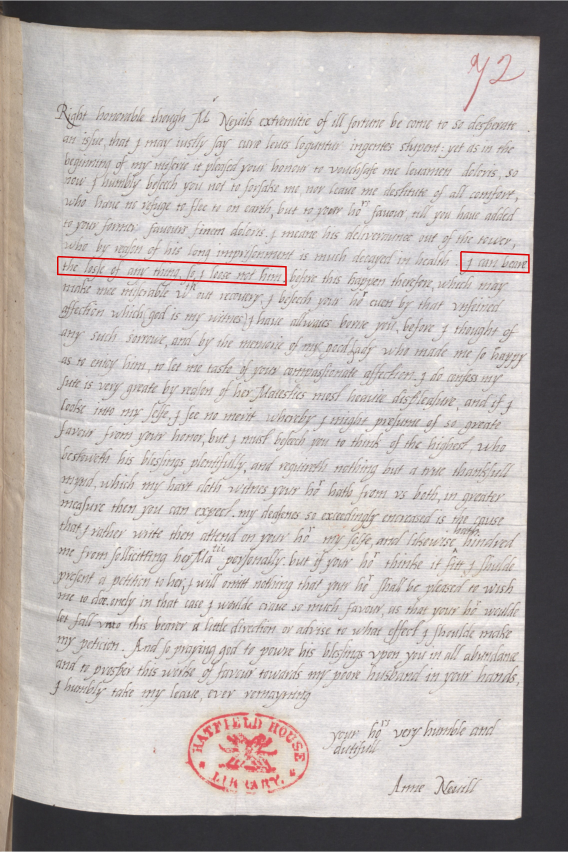
Anne explained that her greatly increased deafness had kept her from attending Cecil and from approaching the Queen personally. She nevertheless offered to petition Elizabeth:
But if your honour think it fit I should present a petition to her, I will omit nothing that your honour shall be pleased to wish me to do.
She asked him to give the bearer “a little direction or advice to what effect I should make my petition”—guidance on what it should say.13
“Wipe away this blot”
Neville’s plea to remain an “honest man” made his good name central to the appeal for release. On 31 July 1602 he imagined recovering it through further service, even at the cost of his life:
And if there be no other means to wipe away this blot wherewith I am soiled, yet it is possible that if I were at liberty, I might shed so much of my blood, in some place where she hath occasion to use men, as might serve for a laver for the crime which hath made me so ugly in her eye.16
A laver is a means of washing. The disgrace has marked both the man and the Queen’s view of him; blood shed in her service might cleanse it. This develops the “blot my reputation” of his declaration into an image of shame, service and repair. Chapters 31 and 43 examine the corresponding language of washing and staining in Macbeth and the Sonnets.
On 7 January 1603 Neville was still thanking Cecil that neither his errors nor the suggestions of “malignant spirits,” ready to put the “worst interpretation” on them, had destroyed Cecil’s favour.17
Managing Billingbear from the Tower
Confinement did not stop Neville attending to the daily business of Billingbear. In a memorandum in his own hand, docketed 3 February 1602/3, he lists work on the gallery, windows, timber and stone, the little parlour’s panelling and a bridge.18 He measures rooms and calculates how much fabric is needed for their hangings.19 Alongside these improvements come the running needs of the estate: sheep and oxen, wheat and malt, hay and fodder, fuel, poultry, brewing supplies and wine from Abingdon. He reminds himself to prepare the ponds and provide hangings for the rooms.20
Release in April 1603
The change of reign brought release. Writing to Dudley Carleton on 12 April 1603, John Chamberlain set the news amid the widespread hopes of royal favour—even among poets:
The tenth of this month the Earl of Southampton and Sir Henry Nevill were delivered out of the Tower by a warrant from the King. These bountiful beginnings raise all men’s spirits and put them in great hopes, insomuch that not only Protestants, but papists and puritans, and the very poets with their idle pamphlets promise themselves great part in his favour: so that to satisfy or please all, hic labor hoc opus est [here is the labour, here is the task]: and would be more than a man’s work.14
Notes and sources
‘Sir Henry Nevill’s Case’, Winwood, Memorials, I, pp. 302–304. Sawyer’s note on p. 302 describes the document found among Winwood’s papers as entirely in Neville’s hand. That is the editor’s testimony; the printed edition supplies the quotations here. It does not print an exact day of composition. The Case is distinct from Neville’s earlier declaration.↩︎
Winwood, Memorials, I, pp. 302–303, the narrative and numbered circumstances. These are Neville’s arguments about his conduct.↩︎
Winwood, Memorials, I, pp. 303–304, concealment, Essex’s former reputation, public duty, and the final appeal to service. The ending is quoted and summarized from the printed witness.↩︎
Anne Neville to Sir Robert Cecil, undated, endorsed 1601 and calendared to about June, Cecil Papers 183/117; HMC, Salisbury, XI, p. 259. The month remains an editorial approximation. Exact quotations follow the manuscript, with spelling and punctuation modernized; the calendar abridges the appeal and omits the absent uncle and the invocation of Cecil’s mother.↩︎
Neville to Cecil, Tower, 9 July 1601, Cecil Papers 86/146, in HMC, Calendar of the Manuscripts of the Marquis of Salisbury, XI (1906), pp. 273–275, printed letter. The financial details follow the printed letter; the “honest man” passage follows the manuscript, with spelling modernized. The £350 annual patent payment and £4,000 land-sale proceeds are Neville’s own account. The letter ends by asking permission for Anne to visit and discuss their estate and his suit. Anne’s 24 March 1601 appeal reports hearing that Cuffe cleared Neville at his death: Cecil Papers 77/90, HMC, Salisbury, XI, p. 145. Chapter 6 examines that report; it is not an independent record of Cuffe’s final words. Neville’s July letter does not independently establish the legal mechanism by which the patent payment began.↩︎
Acts of the Privy Council of England, New Series, XXXII (1601–1604), p. 64, order of 12 July 1601 to Sir John Peyton: printed edition. The order grants permission; it is not a register of actual visits.↩︎
Neville to Cecil, from the Tower, 25 July 1601, Hatfield House, Cecil Papers 87/20. Quotation from the manuscript, spelling modernized; also HMC, Calendar of the Manuscripts of the Marquess of Salisbury, XI (1906), p. 300.↩︎
Neville to Cecil, undated, endorsed 4 August 1601, Hatfield House, Cecil Papers 87/61. Quotation from the manuscript, spelling modernized; also HMC, Calendar of the Manuscripts of the Marquess of Salisbury, XI (1906), pp. 320–321.↩︎
Alexandra Gajda, “Henry Savile and the Elizabethan Court,” Erudition and the Republic of Letters 6 (2021), pp. 32–60, at pp. 34 and 58, nn. 104–105, DOI. Gajda identifies Cuffe as Savile’s protégé and documents his visit, the search and the questioning. The connection’s role in arousing suspicion is an inference; the content of their conversation is unknown. Neville’s letter to Cecil of 6 January 1602, Cecil Papers 84/45, documents Savile’s intervention. Cuffe’s will leaves £500 to Neville or his children and asks his forgiveness as a distressed friend: John Bruce, ed., Correspondence of King James VI of Scotland with Sir Robert Cecil and Others in England (Camden Society, 1861), Appendix VII, pp. 91–92, printed from Hatfield MSS, vol. LXXXIV, no. 1.↩︎
Calendar of the Manuscripts of the Marquess of Salisbury Preserved at Hatfield House, XI (London: HMSO, 1906), 564, item 90.156, and 570, item 139.213. The first is calendared as a holograph, undated and endorsed 1601; the second is undated and unsigned, endorsed “Mr. Savill,” and assigned [1601?]. This account follows the printed calendar.↩︎
Andrew Thrush, “NEVILLE, Sir Henry I (1564–1615), of Billingbear”, The History of Parliament: The House of Commons 1604–1629, ed. Andrew Thrush and John P. Ferris (2010), family, constituency and office lists, and biography. For the successive payment proposals, Neville to Cecil, 11 and 20 March and 3 April 1602, HMC, Salisbury Manuscripts, XII (1910), pp. 72, 80 and 95–96. The April letter reports acceptance of the sum while disputing the demand for sureties.↩︎
Thrush, Neville biography, confinement and fine, notes 34–37. The sum agreed is distinguished from the amount actually paid.↩︎
Anne Neville to Sir Robert Cecil, Hatfield House, Cecil Papers 93/72; calendared in HMC, Calendar of the Manuscripts of the Marquess of Salisbury, XII (1910), p. 164. The letter has no dateline on its recto; the calendar reports the endorsement “23 May, 1602.” Quotations and Latin phrases follow the manuscript, with spelling and punctuation modernized. The calendar summarizes the release request, both spouses’ health difficulties and the proposed petition to the Queen, but omits the Latin.↩︎
Chamberlain to Dudley Carleton, 12 April 1603, in Norman Egbert McClure, ed., The Letters of John Chamberlain, I (Philadelphia, 1939), letter 63, pp. 191–192 (quotation p. 192; spelling modernized). A government letter of 10 April independently confirms their release. See the public edition. Compare Calendar of State Papers, Domestic, James I, 1603–1610, ed. Mary Anne Everett Green (London, 1857), p. 2, no. 18, 10 April 1603.↩︎
Henry Neville to Robert Cecil, 3 April 1602, Hatfield House, Cecil Papers 92/99, concluding paragraph. Quotation from the manuscript, with spelling and punctuation modernized; ampersands expanded. “I doubt” means “I fear.” The printed calendar abridges the passage: HMC, Calendar of the Manuscripts of the Marquess of Salisbury, XII (1910), pp. 95–96. Neither child is named in this passage; the second loss is anticipated, not confirmed.↩︎
Henry Neville to Robert Cecil, 31 July 1602, Hatfield House, Cecil Papers 94/90, holograph; quotation follows John O’Donnell’s transcription, with spelling and punctuation modernized, as in Chapter 31. The printed calendar abridges and changes the passage to the third person: Calendar of the Manuscripts of the Most Honourable the Marquess of Salisbury, XII (London, 1910), p. 268. The first-person quotation is from the letter, not a conversion of that abstract.↩︎
Neville to Cecil, 7 January 1603 (1602 in the letter’s year reckoning), Cecil Papers 91/35; Calendar, XII (1910), pp. 589–590.↩︎
Royal Berkshire Archives, D/EN/F45/1 (catalogued with D/EN/F45/2), “Remembrances,” by Sir Henry Neville in his own handwriting, earlier memorandum docketed 3 February 1602 Old Style, here expressed as 1603. Public catalogue. Short extracts modernize spelling. The sheets also carry a March 1602 heading; the docket dates the memorandum, not necessarily every individual entry. Intended alterations are not proof of their completion.↩︎
Same memorandum, chamber measurements and calculations for wall hangings.↩︎
Same memorandum, provisioning and estate business: livestock, grain, fuel, poultry, brewing supplies, Abingdon wine and the ponds.↩︎