Henry Neville’s tutor and lifelong friend, Henry Savile, helped establish the career of John Hales, a Greek scholar remembered for an extraordinary judgement of Shakespeare. Hales became a fellow of Merton in 1605, while Savile was warden, and helped edit Savile’s Chrysostom edition. Savile explicitly credited a textual conjecture by Hales in the Admonitio prepared for the edition.12
On 24 May 1613, Savile secured Hales’s admission as a fellow of Eton, about nine miles as the crow flies from Neville’s home at Billingbear.1
Hales’s judgement of Shakespeare
In Of Dramatick Poesie, published in 1668, twelve years after Hales’s death, John Dryden reported:
The consideration of this made Mr. Hales of Eaton say, That there was no subject of which any Poet ever writ, but he would produce it much better treated of in Shakespeare.3
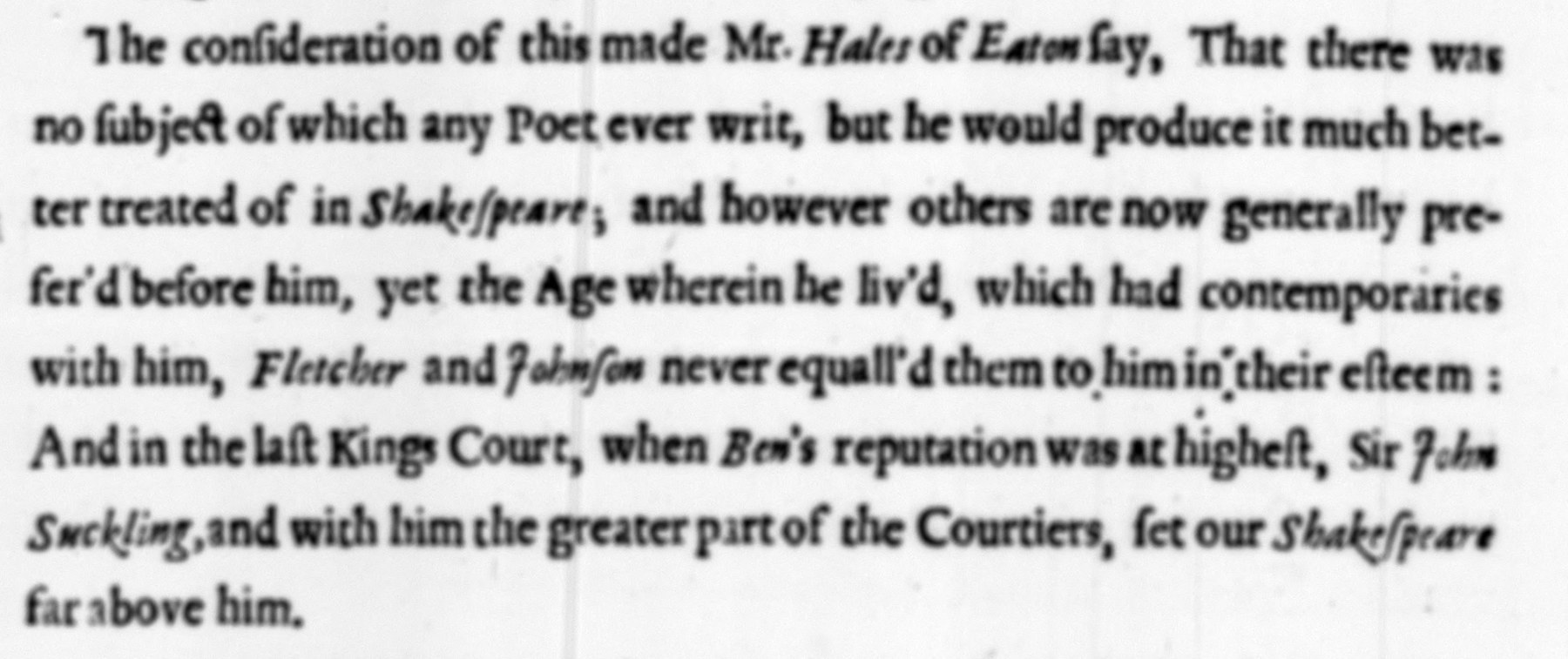
In Dryden’s account, Hales claimed he could find a passage in Shakespeare that treated any subject better than another poet had done. Dryden places it immediately after acknowledging Shakespeare’s unevenness and his ability to rise to great occasions. He then recalls the preference of Suckling and other courtiers for Shakespeare over Jonson. Hales supplies the authority of a learned reader alongside that courtly admiration.
Sir John Suckling, the poet and playwright whom Van Dyck painted holding Shakespeare’s First Folio, was a friend of Hales.4 His verse invitation to Hales appeared in Fragmenta aurea, his collected writings published posthumously in London in 1646. He urges Hales to leave his studies and come to London, where a coach will carry him to “the sweat of learned Jonson’s brain” and “gentle Shakespeare’s easier strain.” For eighteenpence, Hales can sit as “the lord and judge of all fresh wit.”5
Hales’s scholarly work helps explain the weight Dryden placed on his judgement. Alongside his Greek teaching and editorial work, he recorded books and benefactions for the Bodleian and delivered a funeral oration for Bodley in 1613. He was also remembered for conversation and learning that ranged beyond theology into history, mathematics and natural knowledge.67
Daniel Blank places Hales’s admiration within a university culture already engaging with Shakespeare during his lifetime.8 The Cambridge Parnassus plays joke about Shakespeare’s reputation; Oxford’s Narcissus (1602) borrows from his plays.91011
Later writers turned Dryden’s report into a perhaps fictional scene. In 1694 Charles Gildon described judges preferring Shakespeare to the ancients in Hales’s Eton chamber. Rowe’s 1709 account instead has Hales defending Shakespeare against Jonson: if Shakespeare had not read the ancients, at least he had not stolen from them.
In 1710 Gildon merged the accounts. Freehafer argues that Jonson’s condition after his stroke makes the later Eton scene implausible. Dryden’s earlier report gives no date, setting or assembled company.12
The Books and People Around Hales
A booklist of about 1624, written by Hales and probably recording his collection, shows the breadth of learning behind his judgement. William Poole identifies approximately 750 entries, including substantial holdings in mathematics and astronomy alongside classical and theological works.131415
Shakespeare is absent, along with several other major English writers. Poole suggests that modern English literature may have occupied separate shelves. The list therefore cannot tell us the full extent of Hales’s literary reading, and its unidentified “Tragical histories” cannot confidently be counted as Shakespeare.16
Hales probably helped introduce John Milton, the future author of Paradise Lost, to Sir Henry Wotton at Eton in 1638; Milton may also have used Hales’s library.17 Milton’s admiration for Shakespeare had already appeared in print: his poem in the 1632 Second Folio hailed him as “Dear son of Memory, great heir of Fame.” His surviving First Folio reveals the close study behind that admiration. Claire M. L. Bourne and Jason Scott-Warren identify Milton’s handwriting in the copy now at the Free Library of Philadelphia, where he compared Hamlet and Romeo and Juliet with separate editions, corrected readings and marked hundreds of passages. His annotations brought to Shakespeare the same habits of textual scholarship that he applied to Greek and Italian authors.18
Notes and sources
Nancy E. Scott, “The Ever Memorable Mr. John Hales”, Harvard Theological Review 10.3 (1917), 245–271, especially 248–250; Daniel Blank, “‘Our Fellow Shakespeare’: A Contemporary Classic in the Early Modern University”, Review of English Studies 71.301 (2020), 652–669, especially 655. Basil Greenslade, “Hales, John (1584–1656), scholar”, Oxford Dictionary of National Biography, published 23 September 2004, version of 21 May 2009, confirms his close involvement in the Chrysostom project. For Neville’s relationship with Savile, see Chapters 2, 6 and 50. Greenslade dates admission to Eton to 24 May 1613, distinguishing it from Hales’s final withdrawal from Oxford pursuits by 1619; the precise date of his first physical residence is not separately established here. The approximate nine-mile straight-line distance is calculated from Michael Ford’s Country Houses in Berkshire, which places the demolished Tudor Billingbear Park house at SU 830 723, and Historic England, Eton College, list entry 1290278, SU 96715 77868. It is not historical road mileage.↩︎
Jean-Louis Quantin, “Historical Criticism, Confessional Controversy, and Self-Censorship: Henry Savile and the Lives of John Chrysostom”, Erudition and the Republic of Letters 6 (2021), 138–223, especially 197–198 and note 214, citing Savile’s Admonitio, sig. Ppp3r. This printed material was intended for insertion among the notes to volume 8 but was withheld from general circulation; see Quantin, 144–145 and note 25. Hales’s conjecture concerned the identity of Palladius; it depended on a defective Latin translation and was subsequently corrected. Its relevance here is his identifiable editorial contribution.↩︎
John Dryden, Of Dramatick Poesie, an Essay (London, 1668), p. 48, first-edition page. Quotation retains the printed spelling, with long s normalized; emphasis added. The figure reproduces the relevant paragraph. The printed witness gives page 48; Freehafer cites page 47. Dryden reports Hales’s judgement without dating its utterance.↩︎
A. Hamilton Thompson, ed., The Works of Sir John Suckling in Prose and Verse (London: George Routledge & Sons, 1910), Introduction, on his friendship with Hales. The Frick Collection, “John Suckling”, identifies the book in Van Dyck’s portrait as Shakespeare’s First Folio and suggests a sitting in 1638. The connection to Neville here runs through Hales and Savile; no direct acquaintance between Suckling and Neville is asserted.↩︎
John Suckling, Fragmenta aurea (1658), poem beginning “Sir, whether these lines do find you out,” original theatre passage, spelling modernized. The identification of the recipient as Hales follows A. Hamilton Thompson, ed., The Works of Sir John Suckling in Prose and Verse (London: George Routledge & Sons, 1910), pp. 27–28 and the corresponding note; see also Freehafer, “Shakespeare, the Ancients, and Hales of Eton,” p. 67. The poem invites a visit; it does not record one. The poem is also present in the 1646 first edition, published in London for Humphrey Moseley: EEBO-TCP A61943, poem beginning “Sir, Whether these lines do find you out”; electronic text. The 1646 text and imprint were checked alongside the 1658 page image; the recipient’s identification follows Thompson, rather than an explicit name in the early poem’s heading.↩︎
Blank, “‘Our Fellow Shakespeare’,” 655 and its notes on Hales’s Bodleian work and Bodley’s funeral. William Poole, “Analysing a Private Library, with a Shelflist Attributable to John Hales of Eton, c.1624”, in Edward Jones, ed., A Concise Companion to the Study of Manuscripts, Printed Books, and the Production of Early Modern Texts (Wiley, 2015), 41–65, especially 57, also discusses Hales’s work on the benefactors’ register.↩︎
Scott, “Ever Memorable,” 245–247, 250–268, for the character of his writings, intellectual interests and remembered conversation. For the later Rowe anecdote, see Freehafer’s analysis cited above.↩︎
Blank, “‘Our Fellow Shakespeare’,” 652–655, 668–669. References use the final journal pagination, rather than the advance-publication pagination.
Greek and Latin authors remained the formal educational models; Hales himself imitated Horace in a Latin poem associated with Christian IV’s visit in 1606 (656–658). Bodley’s restrictive attitude towards vernacular playbooks coexisted with the Bodleian’s acquisition of a First Folio shortly after publication (658–660).↩︎
Blank, “‘Our Fellow Shakespeare’,” 661–664, especially the analysis of Gullio, Venus and Adonis, and the Alexander–Homer analogy. The anonymous plays are evidence of academic representation and reception. The Gullio passage is also preserved in Bodleian MS Rawl. D. 398, transcribed in Shakespeare Documented, “Pilgrimage to Parnassus and Return from Parnassus”.↩︎
Blank, “‘Our Fellow Shakespeare’,” 661–662, discussing The Second Part of the Return from Parnassus, IV.iii. The “our fellow Shakespeare” speech is assigned to Kempe in the dramatic text; the actors are characters written by the academic dramatist.↩︎
Blank, “‘Our Fellow Shakespeare’,” 665–667, on Narcissus, its 1602 Oxford performance, verbal parallels with 1 Henry IV and theatrical debts to A Midsummer Night’s Dream. Primary text: Narcissus, a Twelfe Night Merriment, ed. Margaret L. Lee (London: David Nutt, 1893), lines 494–511, complete text.↩︎
John Freehafer, “Shakespeare, the Ancients, and Hales of Eton”, Shakespeare Quarterly 23.1 (1972), 63–68, especially 64–68, examining Charles Gildon, Miscellaneous Letters and Essays (1694), 85–86, and Nicholas Rowe, “Some Account of the Life, &c. of Mr. William Shakespear,” in The Works of Mr. William Shakespear (London, 1709), vol. 1, xiv. For Gildon’s 1710 conflation, see Freehafer, 67–68. Compare Blank, “‘Our Fellow Shakespeare’,” 668–669, for the relation between the anecdote and the broader reception history. Gildon’s 1694 account, pp. 85–86, names Falkland and Suckling, qualifies his recollection of Dryden’s story and asks for a more accurate account. Rowe’s company includes Suckling, Jonson, Davenant and Endymion Porter. Freehafer also notes that Falkland was Jonson’s admirer and patron.↩︎
Poole, “Analysing a Private Library,” 52–54: Eton College Archives 62/55, physical arrangement, dating and number of entries. The present account relies on Poole’s examination, not a new inspection of the manuscript.
The list follows the 1621 audit accounts in Eton College Archives 62/55; its latest identified publication dates from 1624. Six rows of folios and nine of smaller books, with space for additions and no valuations, suggest a working shelflist rather than a probate inventory. Some entries cover several volumes or texts.↩︎
Poole, “Analysing a Private Library,” 54–58. His comparison of possible owners and identification of the writing establish a strong attribution to Hales, not absolute certainty of ownership.
Poole considers the college library and the collections of Savile and Thomas Murray as alternatives. Recorded gifts, including one to the writer’s brother, support his attribution to Hales.↩︎
Poole, “Analysing a Private Library,” 53–56, for subject range, Kepler and Savile’s works. The list includes medicine, law, geography, travel and theological controversy, nine works identified by Poole as Kepler’s, and Savile’s editions of Chrysostom, English historical writers and Bradwardine.↩︎
Poole, “Analysing a Private Library,” 58; compare Blank, “‘Our Fellow Shakespeare’,” 655–656. Poole leaves “Tragical histories” unidentified: it might refer to plays or a Mirror for Magistrates-type prose work. Separate shelving is Poole’s proposed explanation, not a surviving second catalogue. Chaucer, Spenser, Daniel, Jonson and Sidney are absent alongside Shakespeare. Montaigne, Drayton’s Poly-Olbion and the English translation of Alemán’s The Rogue are present.↩︎
William Poole, “‘The Armes of Studious Retirement’? Milton’s Scholarship, 1632–1641”, in Edward Jones, ed., Young Milton: The Emerging Author, 1620–1642 (Oxford University Press, 2013), 21–47. Poole describes Hales’s mediation as almost certain and Milton’s access to his library as a possibility. Henry Wotton’s letter to Milton, 13 April 1638, printed in Milton’s Poems (1645), p. 71, sig. E4r, refers to “Mr. H.” and “your said learned Friend”; original printed letter. The letter does not expand the name or explicitly describe Hales’s mediation; that identification and inference follow Poole.↩︎
Claire M. L. Bourne and Jason Scott-Warren, “‘thy unvalued Booke’: John Milton’s Copy of the Shakespeare First Folio”, Milton Quarterly 56.1–2 (2022), 1–85, especially sections 1–4. The poem appeared anonymously in the Second Folio (1632), sig. πA2r, and was reprinted in Milton’s Poems (1645) as “On Shakespear. 1630.” Quotation spelling modernized. The authors distinguish a small number of annotations in other hands.↩︎