A manuscript passed down through the Neville family appears to preserve a text that influenced several works of Shakespeare. This copy of John Lydgate’s Fall of Princes, formerly at Audley End and now at Yale, belonged to Mary Dudley Sidney and subsequently, likely, to Henry Neville’s mother, Elizabeth Gresham. It contains two accounts of Lucrece’s rape and death. Lydgate’s treatment brings together several of the arguments Shakespeare develops in Lucrece (1594): that force cannot make an innocent woman guilty, that suicide punishes the wrong person, and that a prince’s power should protect women. Elsewhere, a short stretch of the manuscript brings together further comparisons with three plays and a sonnet. A stanza introducing Lydgate’s story also combines the image of overpowering sunlight with four of Shakespeare’s rhyme words.1
Mary Dudley Sidney’s book
The manuscript belonged to Mary Dudley Sidney, Sir Philip Sidney’s mother, whose ownership inscription is discussed in Chapter 18.2
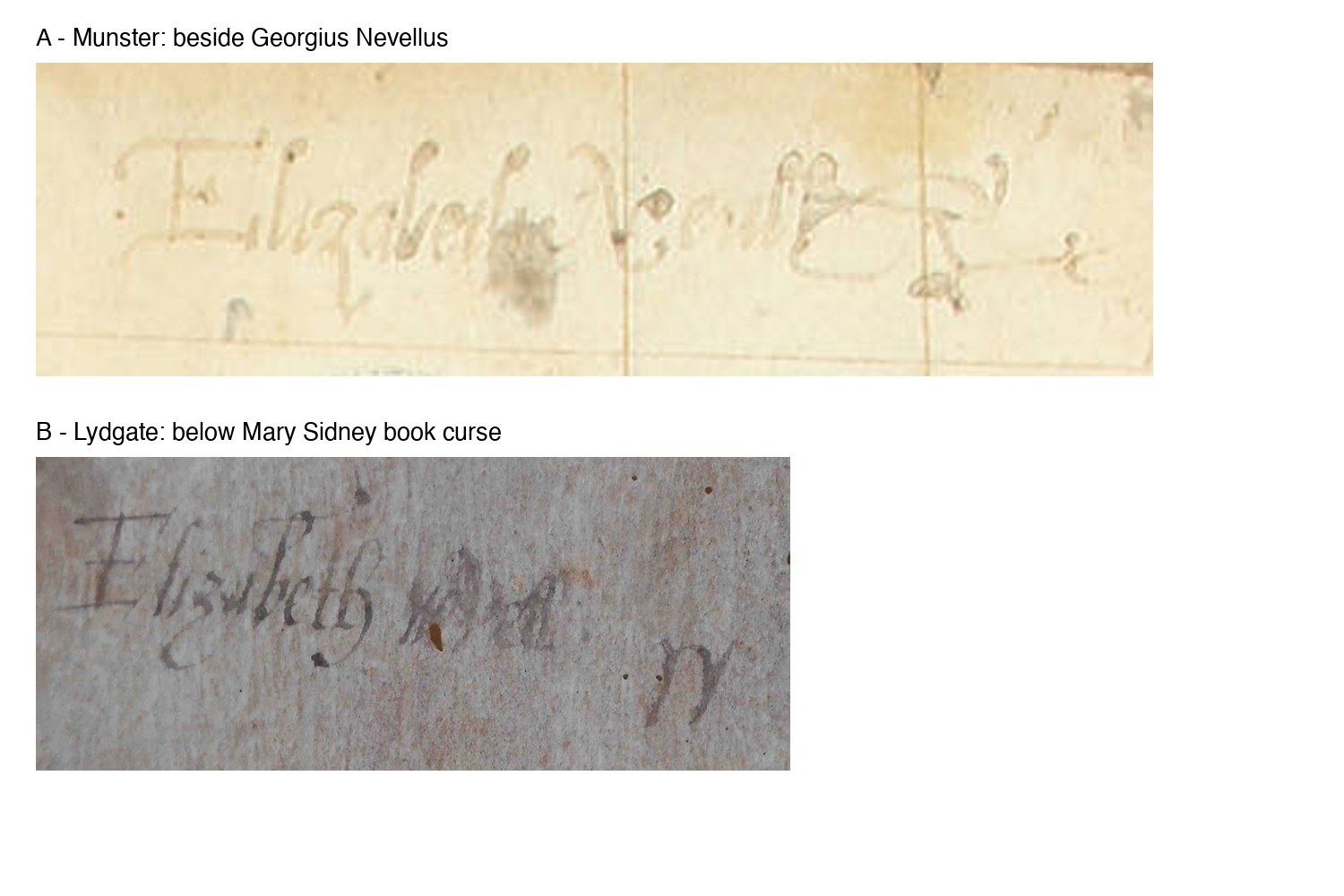
Below Mary’s inscription is another, perhaps reading “Elizabeth Nevell.” Its handwriting resembles an Elizabeth inscription in Sebastian Münster’s La cosmographie universelle (1552), sold by Reiss & Sohn in October 2025. That printed book helps connect the Lydgate manuscript with another Neville book photographed at Audley End: a French edition of Antonio de Guevara’s L’Orloge des Princes. Both the Guevara and the Münster bear the Latin ownership formula “Georgius Nevellus me possidet”—“George Neville owns me.”
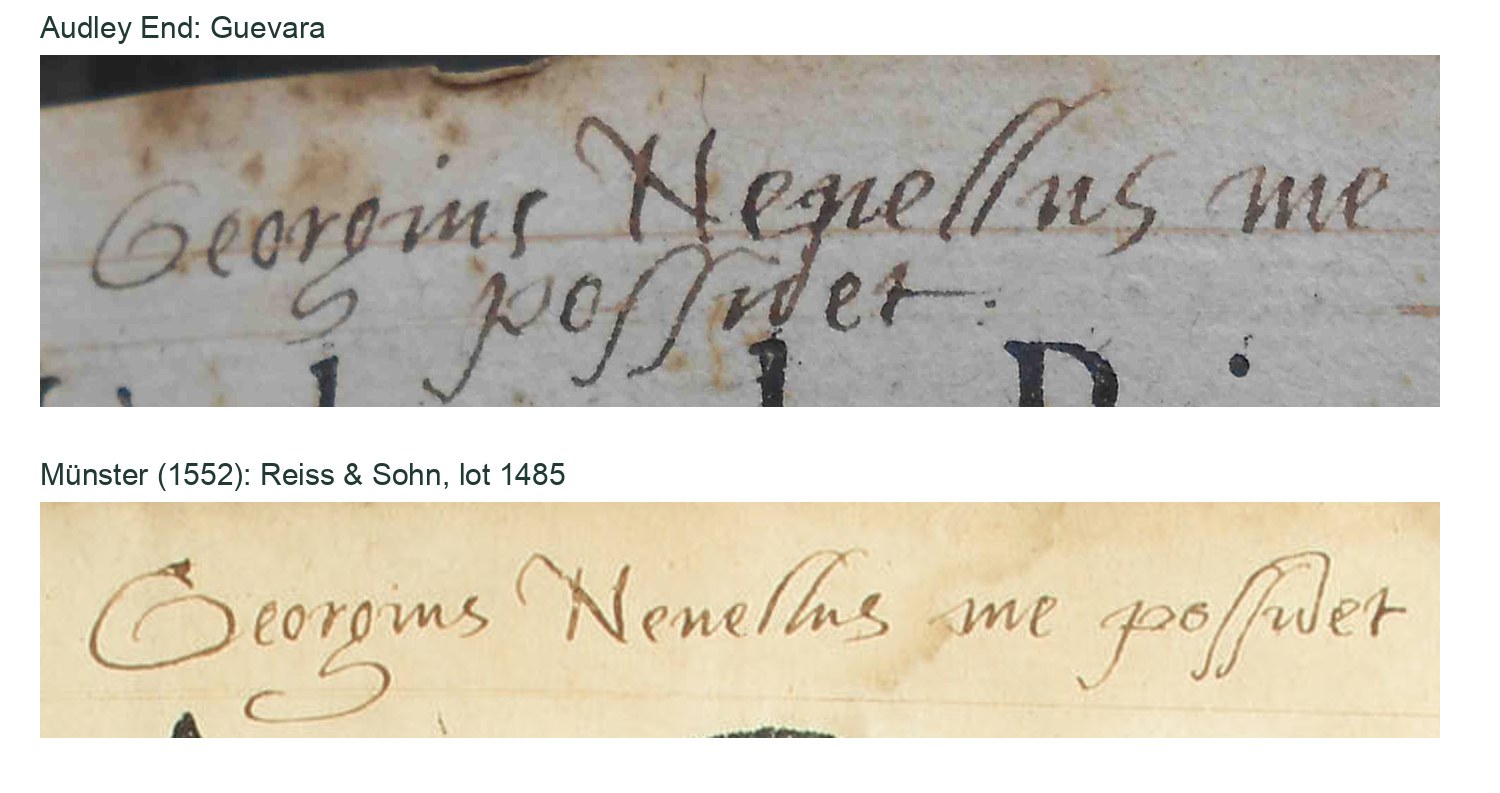
The Münster also records Henry Neville’s gift of the book in 1620 to John Smith, perhaps the cousin of his wife, Elizabeth Smythe. The donor was probably the ambassador’s son Henry: the ambassador had died in 1615. The connection therefore rests on two comparisons: the George Neville inscriptions link the Münster with the Audley End Guevara, while the Elizabeth inscriptions link it with the Lydgate manuscript. The Elizabeth inscription likely belongs to Neville’s mother, Elizabeth Gresham: his stepmother Elizabeth Bacon’s surviving signature looks markedly different.3

The Lydgate manuscript left Audley End and was sold at Christie’s in London on 11 July 2018, as lot 50. Yale purchased it at that sale using the James Marshall and Marie-Louise Osborn Fund. It is now Beinecke MS 1222, and Yale has made the manuscript available online in full.4
Sunlight and rhyme
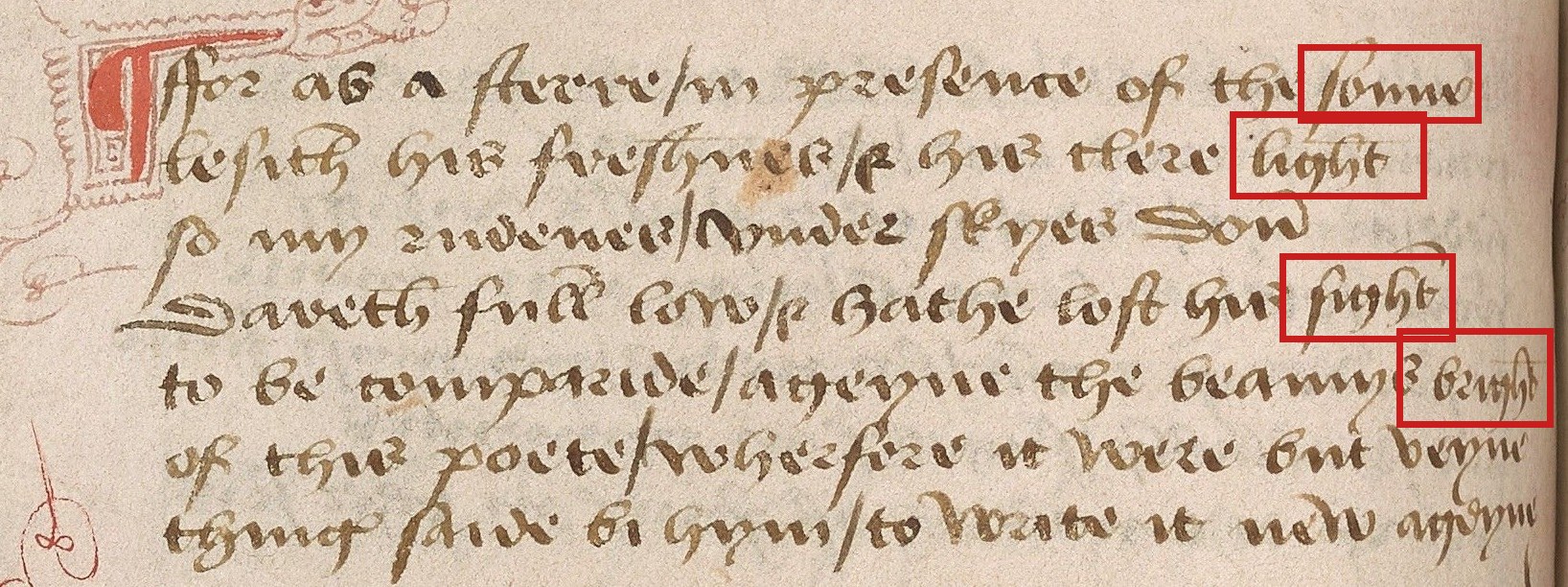
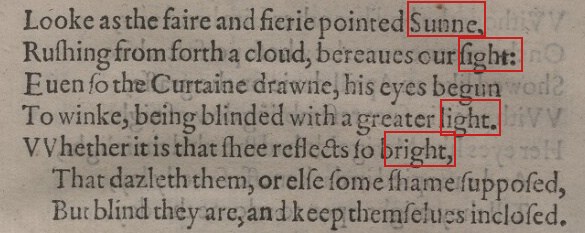
The following stanza concludes Lydgate’s introduction to his Lucrece story. He compares his own poetry with Chaucer’s earlier telling: a star loses its light beside the sun. In Shakespeare’s Lucrece, Tarquin draws back the curtain and is dazzled by her beauty. Both passages combine the image of overwhelming light with the same four rhyme words: “sun,” “light,” “sight” and “bright.”
| Lydgate | Shakespeare |
|---|---|
| For as a star in presence of the sun | Look as the fair and fiery-pointed sun, |
| Loseth his freshness and his clear light, | Rushing from forth a cloud, bereaves our sight; |
| So my rudeness under skies dun | Even so, the curtain drawn, his eyes begun |
| Dareth full low and hath lost his sight, | To wink, being blinded with a greater light. |
| To be compared against the beams bright | Whether it is that she reflects so bright |
The first, second, fourth and fifth lines share their rhyme words, with “light” and “sight” changing places. Both poems use rhyme royal, the seven-line stanza inherited from Chaucer and widely used for tragic complaint.5
Honour and the loss of life
Lydgate describes Lucrece’s belief that her reputation matters more than her survival:
Better was to die than to live in shame,
And less wicked, to put in jeopardy
Her mortal body than her good fame.
When honour dieth, farewell a man’s name!
Shakespeare gives her the same conflict, expressed as a bequest:
“My honor I’ll bequeath unto the knife
That wounds my body so dishonored.
’Tis honor to deprive dishonored life;
The one will live, the other being dead.
So of shame’s ashes shall my fame be bred,
For in my death I murder shameful scorn;
My shame so dead, mine honor is new born.
In both poems, Lucrece imagines saving her name by sacrificing her body. The objection follows in another voice: her death leaves the offender unpunished.6
“To spare a tyrant and slay an innocent”
Lydgate retells Lucrece’s story twice. The first account includes a debate between Lucrece and her husband about whether she should kill herself after Tarquin’s assault. It draws on the Italian humanist Coluccio Salutati, whom Lydgate names. John Roe has suggested that Lydgate provided Shakespeare with a route to Salutati’s treatment of the story.7
In Lydgate, Collatinus tells Lucrece:
To slay thyself or do thy sides bleed,
Certes, Lucrece, thou hast full little need;
It were great wrong by all our judgment
To spare a tyrant and slay an innocent.
Shakespeare gives the corresponding argument to Brutus after Lucrece’s death, as he urges Collatine to turn his grief against Tarquin:
Is it revenge to give thyself a blow
For his foul act by whom thy fair wife bleeds?
Such childish humor from weak minds proceeds.
Thy wretched wife mistook the matter so
To slay herself, that should have slain her foe.
Both passages turn on the same reversal: the innocent person suffers the punishment that belongs to the offender. Lydgate’s husband tries to prevent the death; Shakespeare’s Brutus uses it to demand revenge.8
The body and the mind
Collatinus also separates the force used against Lucrece’s body from her inward consent:
He might thy body by force well oppress
By sleighty ways that he had sought;
But well wot I, for all his sturdiness,
He might never have mastery of thy thought.
The body yielded, the heart yielded him nought.
Ye were twain, thou feeble and he right strong,
Thy truth afforced, he worker of the wrong.
In Shakespeare, Lucrece first describes the same imbalance of strength:
“Mine enemy was strong, my poor self weak,
And far the weaker with so strong a fear.
In the next stanza she insists that force has not won her consent:
“O, teach me how to make mine own excuse,
Or, at the least, this refuge let me find:
Though my gross blood be stained with this abuse,
Immaculate and spotless is my mind;
That was not forced, that never was inclined
To accessory yieldings, but still pure
Doth in her poisoned closet yet endure.”
Both passages join physical weakness to an undefeated inward self. Lydgate’s “heart” corresponds to Shakespeare’s “mind”: neither has consented to what force has done to the body. This distinction also appears in Painter’s retelling of Livy, but Lydgate gives it an extended poetic treatment within the husband’s appeal to save Lucrece’s life.9
The duty of a knight
In Lydgate’s second account, Lucrece herself measures Tarquin’s conduct against the protection a prince and knight owes to women:
A king’s son should of duty
Be to women wall and protection,
Preserve and keep them in all surety,
That no man should, of no presumption,
Do them no wrong nor oppression,
Rather die than see them suffer unright,
Advertising the office of a knight.
Shakespeare’s Lucrece challenges Tarquin on the duties of his office before the assault:
Draw not thy sword to guard iniquity,
For it was lent thee all that brood to kill.
Thy princely office how canst thou fulfill
When, patterned by thy fault, foul Sin may say
He learned to sin, and thou didst teach the way.
Afterward, she invokes that same obligation when she asks the men around her to swear revenge:
“But ere I name him, you fair lords,” quoth she,
Speaking to those that came with Collatine,
“Shall plight your honorable faiths to me
With swift pursuit to venge this wrong of mine,
For ’tis a meritorious fair design
To chase injustice with revengeful arms.
Knights, by their oaths, should right poor ladies’ harms.”
The connection extends from the prince’s misuse of his office to the knight’s duty to protect women. Shakespeare’s Lucrece first confronts Tarquin with his princely office, then calls upon the other men to avenge her wrong.10
Three passages within four pages
The comparisons extend beyond Lucrece. Four consecutive pages of this manuscript contain passages to set beside Richard II, Sonnet 94, 3 Henry VI and A Midsummer Night’s Dream: flowers among weeds, tiger-hearted cruelty to a child, and Cupid’s blindness explained as a failure of judgment. The last two occur in Canace’s letter to her brother, which includes her protest against their father’s cruelty. The illustrations show how closely these passages stand together in the book.11
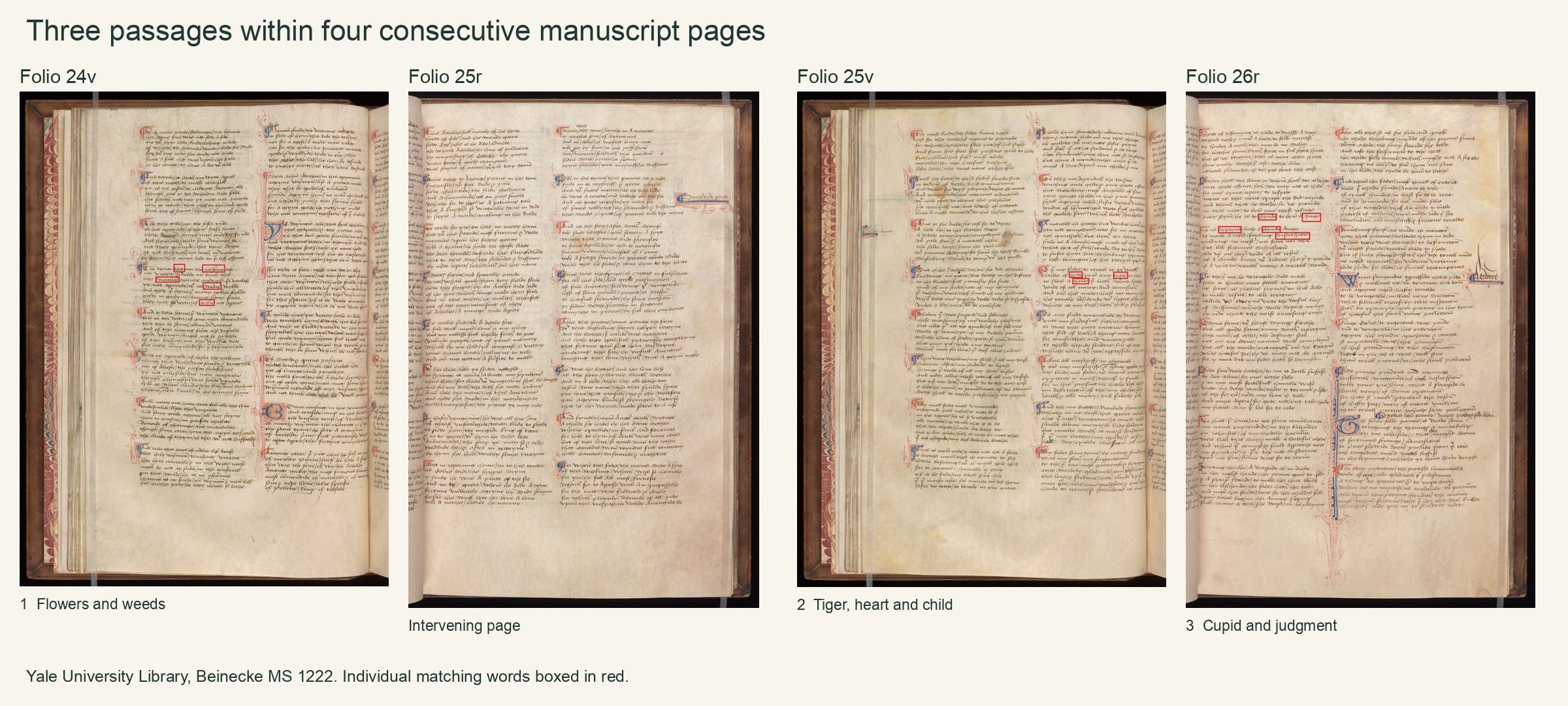
1. Flowers and weeds
Lydgate defends good women against condemnation for the faults of others. His comparison begins:
The white lily nor the wholesome rose
Nor violets spread on banks thick,
Their sweetness which outward they unclose
Is not impaired with no weeds wick
Even where briars grow among flowers, he continues:
They may the virtue of herbs not impair.
In Richard II, the gardener’s servant describes England through the same garden vocabulary:
When our sea-walled garden, the whole land,
Is full of weeds, her fairest flowers choked up,
Her fruit trees all unpruned, her hedges ruined,
Her knots disordered, and her wholesome herbs
Swarming with caterpillars?
Sonnet 94 brings together the lily, sweetness and weeds:
For sweetest things turn sourest by their deeds;
Lilies that fester smell far worse than weeds.
The arguments differ. Lydgate’s good flowers retain their virtue among weeds; Shakespeare’s garden suffers neglect, and his sonnet considers a flower’s own corruption. The shared group of images serves different judgments about goodness and decay.12
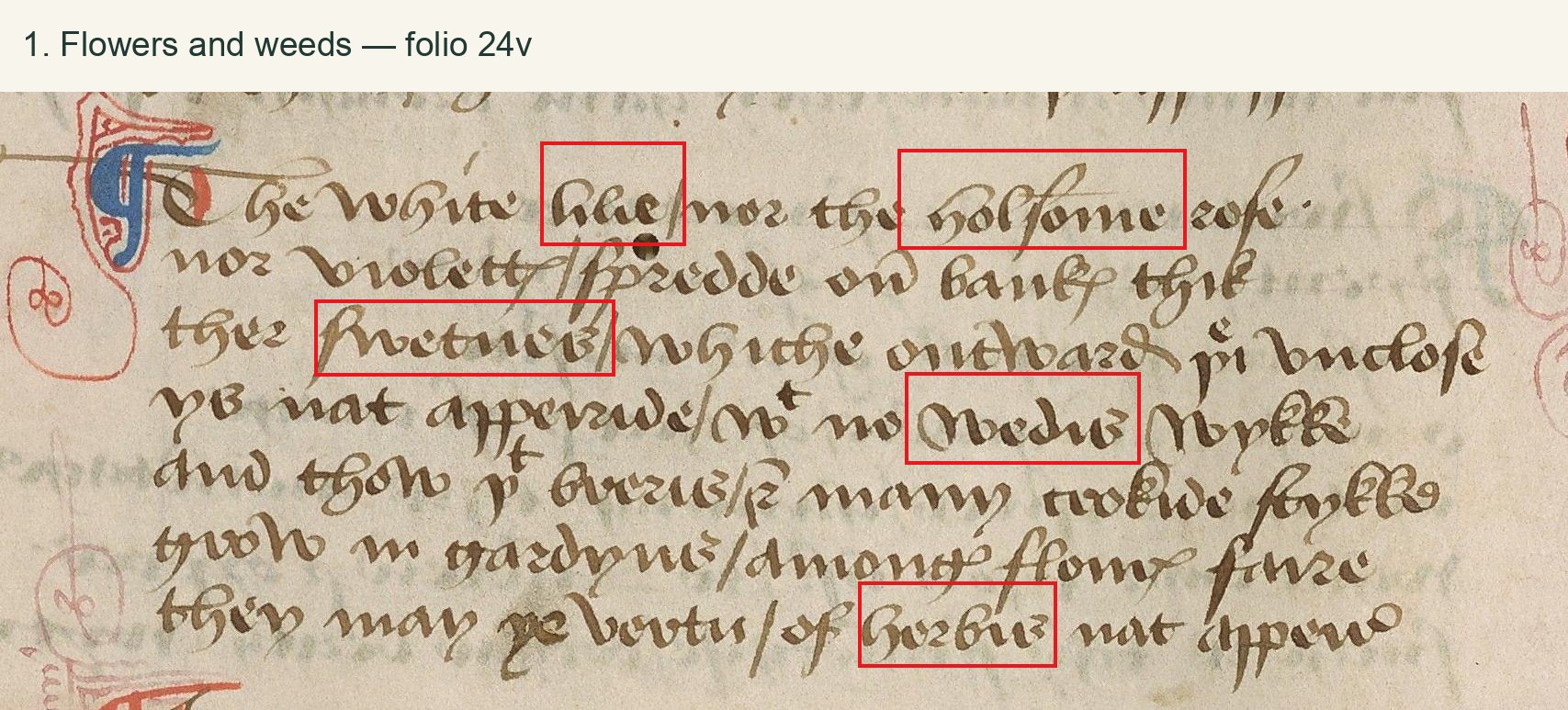
- Flowers and weeds: enlarged detail of folio 24v, left column. Yale University Library, Beinecke MS 1222.
2. A tiger’s heart and a child’s death
Canace addresses the father who has condemned her infant:
O thou my father, too cruel is thy wreche,
Harder of heart than any tiger or lion,
To slay a child that lieth without speech,
Void of all mercy and remission,
And on his mother hast no compassion,
His youth considered, with lips soft as silk,
Which at my breast lieth and sucketh milk.
In 3 Henry VI, York condemns Margaret after the killing of his son Rutland:
O, tiger’s heart wrapped in a woman’s hide,
How couldst thou drain the lifeblood of the child
To bid the father wipe his eyes withal,
And yet be seen to bear a woman’s face?
Both speeches connect a tiger-like heart with pitiless cruelty to a child and the suffering of a parent. Lydgate’s Canace appeals to her own father; Shakespeare’s father denounces a woman who mocks him with his son’s blood.13
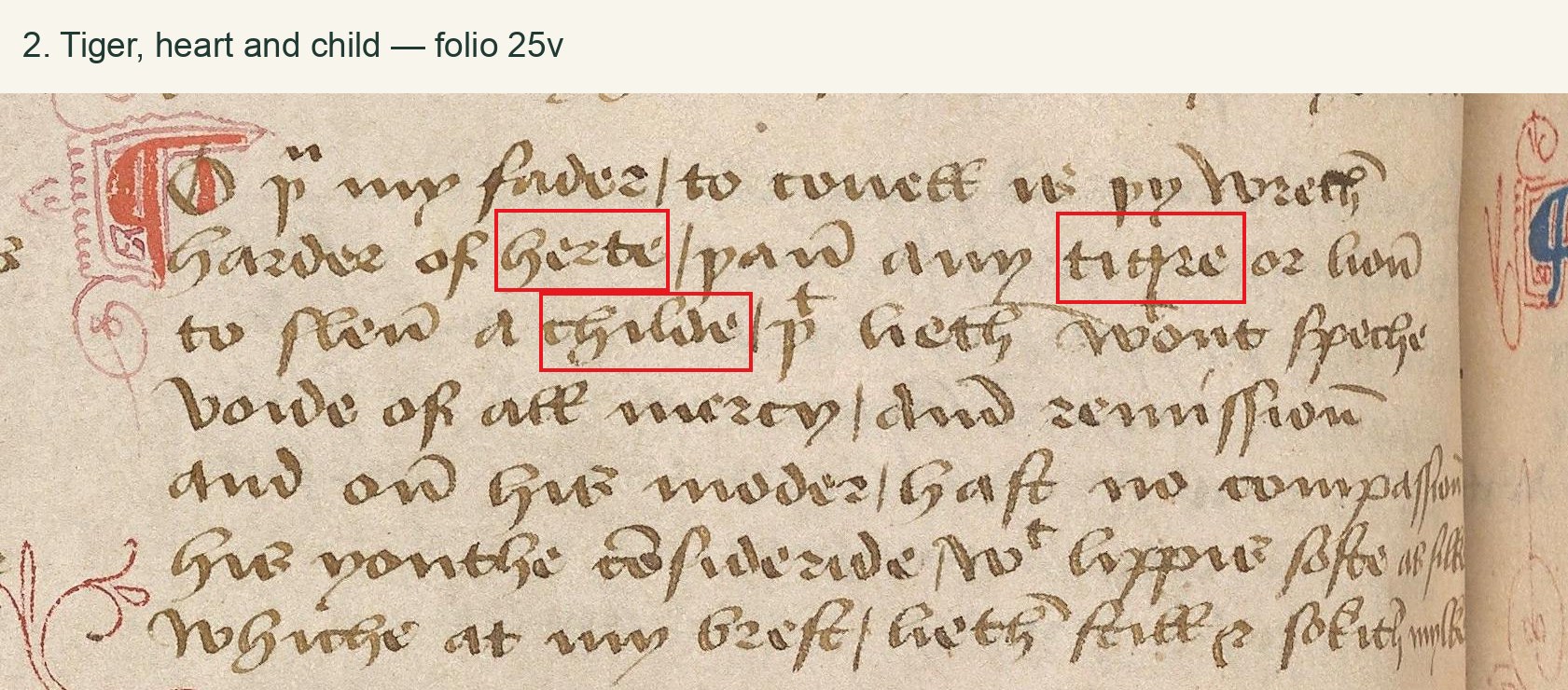
- Tiger, heart and child: enlarged detail of folio 25v, right column. Yale University Library, Beinecke MS 1222.
3. Cupid’s blindness and judgment
On the next page Canace turns to Cupid, who is unfit to judge:
Poets say he is blind to be a judge.
He is depaint like a blind archer,
To mark aright failing discretion
The passage goes on to describe him acting “void of all reason.” In A Midsummer Night’s Dream, Helena makes the same connection between Cupid’s painted blindness and his inability to judge:
Love looks not with the eyes but with the mind;
And therefore is winged Cupid painted blind.
Nor hath Love’s mind of any judgment taste.
Blind Cupid was a familiar image. Both passages describe Cupid as painted blind and explain that blindness through his lack of judgment: Lydgate’s judge lacks discretion and reason; Helena’s Cupid has no taste of judgment.14
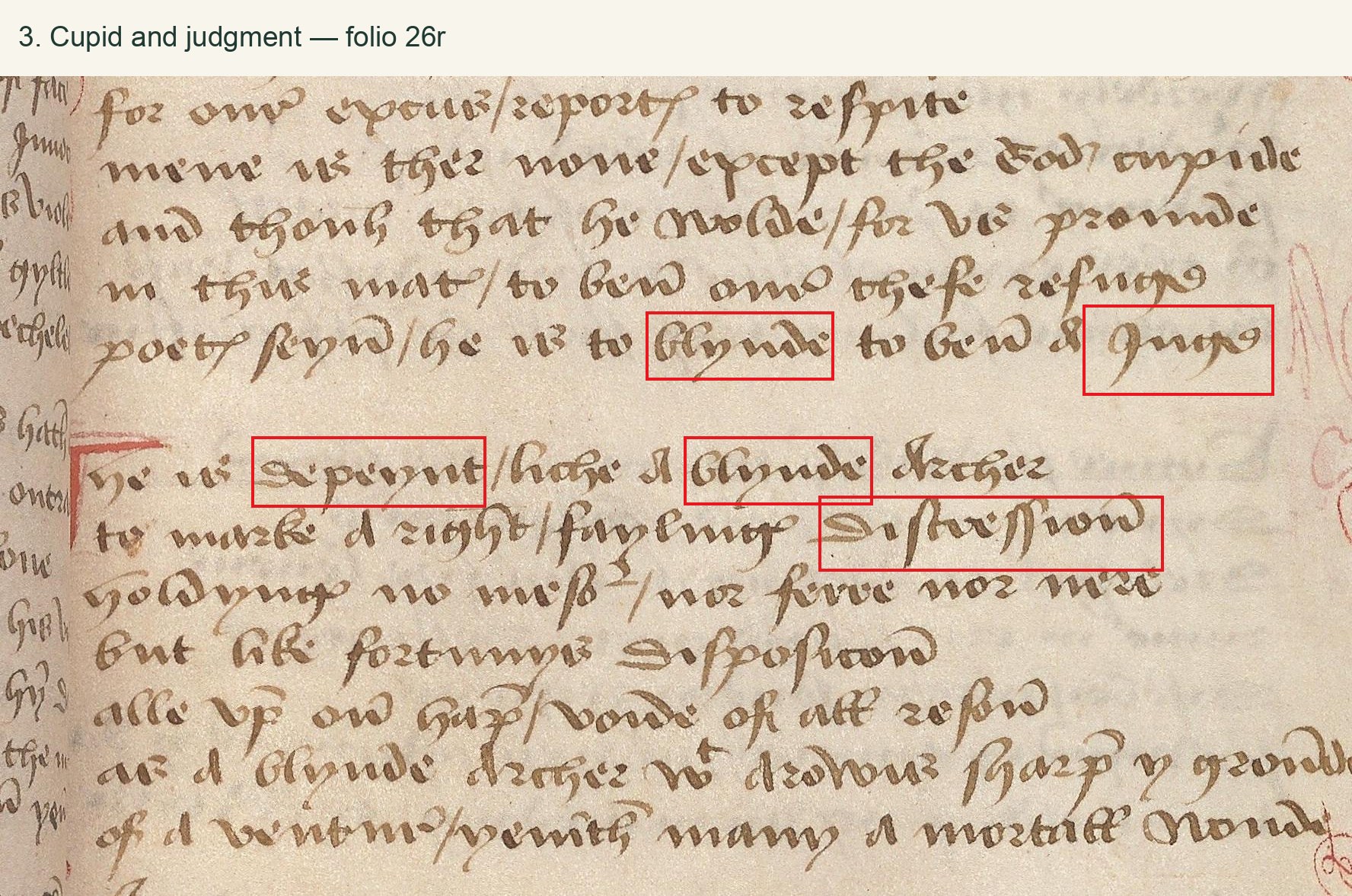
- Cupid and judgment: enlarged detail of folio 26r, left column. Yale University Library, Beinecke MS 1222.
The older language of the poem
Lucrece also uses older poetic forms found throughout Lydgate. When the maid begins to weep with her mistress, Shakespeare writes:
Even so the maid with swelling drops gan wet
Her circled eyne, enforced by sympathy
“Gan” means began; “eyne” means eyes. Neither word is at the end of its line, so their use here does not supply a rhyme.15
Elsewhere, the 1594 text describes a figure in the painting of Troy as “all boln & red”—swollen or puffed out. The same word family appears in the Audley End manuscript as “bolnyng,” in an account of pregnancy. This is a connection with the language of the wider book, outside its Lucrece stories.16
Notes and sources
Yale, Beinecke Rare Book and Manuscript Library, MS 1222, Fall of Princes, c.1450, formerly Audley End: catalogue and complete digitization. The manuscript contains the passages compared here. The Lucrece comparisons follow Henry Bergen’s edition, Lydgate’s Fall of Princes (Washington: Carnegie Institution, 1923), with spelling modernized but older vocabulary retained. Bold emphasis is added. The later section “Three passages within four pages” quotes the Wayland printed text identified in the first note to that section, with spelling modernized. Neither set is presented as a diplomatic transcription of this particular manuscript. Except where the 1594 text is explicitly identified, Shakespeare quotations and line numbers follow the Folger edition of Lucrece.↩︎
MS 1222, preliminary leaf [ii]v, Yale image 16655103; Christie’s, 11 July 2018, lot 50. Mary Dudley Sidney was the wife of Sir Henry Sidney and mother of Philip Sidney and Mary Sidney Herbert, Countess of Pembroke. Her husband’s friendship with Neville’s father is explicit in his letter to Robert Sidney of 28 October 1580: “There can be no greater love than of long time hath been, and yet is, between Sir Harry Neville and me, and so will continue till our lives end. Love you those we have done, and do.” Arthur Collins, ed., Letters and Memorials of State (London, 1746), I, p.271; Robert Shephard and Noel J. Kinnamon, “The Sidney Family Correspondence during Robert Sidney’s Continental Tour, 1579–1581,” Sidney Journal 25.1–2 (2007), 43–66, p.50, identifying the letter as Penshurst Papers Z53/26. Spelling modernized. See Michael G. Brennan, “Sidney Family Chronology,” The Ashgate Research Companion to the Sidneys, 1500–1700, I (2015), p.xxxi, author’s deposited text.↩︎
Münster, La cosmographie universelle (Basel: Heinrich Petri, 1552), Reiss & Sohn, auctions 226–227, lot 1485, October 2025. Its title page bears “Georgius Nevellus me possidet” and records a gift from Henry Neville to John Smith in 1620. The date points to the ambassador’s son Henry (d.1629), rather than the ambassador himself, who died in 1615. A comparable George Neville inscription appears in the Audley End copy of Guevara’s L’orloge des Princes, catalogued as 1552, object 81034866, photographed by John Casson. These two books provide the wider context for comparing the Elizabeth inscriptions. Elizabeth Bacon’s signed name, “Elizabeth periam,” in her letter of 4 November 1604 (Royal Berkshire Archives, D/EN/F44/1–4) looks markedly different from the book inscriptions: its capital E is rounded and its lettering more compact. This weighs against identifying her as their writer, although a single later signature does not conclusively exclude her. She was the ambassador’s stepmother; his mother was Elizabeth Gresham (Mark Greengrass, “Neville, Sir Henry,” ODNB). The ambassador’s daughter Elizabeth is another possible owner. The identification with Elizabeth Gresham is an inference from the family provenance and the contrast with Elizabeth Bacon’s signature, not a match against a securely identified autograph of Elizabeth Gresham. Neither Elizabeth entry is independently dated.↩︎
Yale University Library, John Lydgate, Fall of Princes, Beinecke MS 1222, acquisition record: “Purchased from Christie’s (London sale, 2018 July 11, lot 50), on the James Marshall and Marie-Louise Osborn Fund, 2018”; Christie’s sale catalogue, lot 50. The sale and acquisition records establish the modern transfer; the proposed identification of the Elizabeth inscription rests on the comparison of the inscriptions, not the auction catalogue’s attribution.↩︎
Lydgate, II.995–99, Bergen p.227, page image; Shakespeare, Lucrece, 372–76. “Dareth” means lies concealed or cowers; “rudeness” describes the poet’s supposed lack of refinement. The manuscript stanza is on Beinecke MS 1222, f.30v, image 16655168. The Shakespeare image reproduces Lucrece (London: Richard Field for John Harrison, 1594), sig. D2r, Bodleian Library, Arch. G d.41(1). Both stanzas were checked on these images. No claim of an exhaustive search for the rhyme group is made. Rhyme royal has the pattern ababbcc; the table gives the first five lines of each stanza.↩︎
Lydgate, II.1045–48, Bergen p.228, page image; Shakespeare, Lucrece, 1184–90. Spelling is modernized; Bergen’s “lasse wikke” is rendered “less wicked,” meaning the lesser evil in Lucrece’s reasoning. Her husband opposes that reasoning in the ensuing debate. Shakespeare’s rebuke comes from Brutus after her death (1823–27), rather than immediately after the quoted stanza. The comparison concerns the competing arguments within each poem, not an identical order of speeches.↩︎
Lydgate, II.1009–10, explicitly names “Collucyus” and his “declamacioun.” John Roe, “Pleasing the Wiser Sort: Problems of Ethics and Genre in Lucrece and Hamlet,” The Cambridge Quarterly 23 (1994), 99–119, p.119 n.30: “The chances are fair that Shakespeare would have encountered Salutati through Lydgate.” Article. The note concerns the literary transmission, not the ownership or use of MS 1222. Lydgate’s text was also available in printed editions.↩︎
Lydgate, II.1187–90, Bergen p.232, page image; Shakespeare, Lucrece, 1823–27. Compare Augustine, City of God, I.19, on the punishment of the innocent Lucretia and the guilty Tarquin: text. The moral argument belongs to a wider tradition; the comparison here is with its formulation in Lydgate’s verse.↩︎
Lydgate, II.1163–69, Bergen p.232; corresponding manuscript passage on MS 1222, f.31r, Yale image. “Sleighty” means crafty; “wot” means know; “afforced” means subjected to force. Shakespeare, Lucrece, 1646–47 and 1653–59. The contrast of a weak woman and strong attacker occurs within Lydgate’s quoted stanza and immediately before Shakespeare’s declaration of inward innocence. The treatments are not identical throughout: Lydgate’s Book II Lucrece later speaks of a “manner constrained lust” (II.1282–88), whereas Shakespeare’s Lucrece denies inward inclination; this is part of Lydgate’s debate, not an unqualified verdict by his narrator. William Painter, The Palace of Pleasure, novel II, likewise distinguishes the violated body from the guiltless mind; see the text in the Jacobs edition.↩︎
Lydgate, III.1079–85, Bergen pp.358–59, p.358 and p.359; “advertising” here means considering or taking heed of. Shakespeare, Lucrece, 626–30 and 1688–94. Here “office” means the duties of a position. The first quotation addresses Tarquin before the assault, the second the assembled men afterward.↩︎
Beinecke MS 1222, ff.24v–26r: 24v, 25r, 25v, 26r. These are four consecutive page sides, spanning three leaves. The quotations in this section follow John Wayland’s printed Fall of Princes ([1554?]), Book I, chapters 20 and 25, EarlyPrint A71316, with spelling modernized and emphasis added. The passages were also located and read on the manuscript images; the manuscript has textual and spelling variants, so the printed quotations are not transcripts of the pictured lines. The passages were available in printed Lydgate as well as in this manuscript.↩︎
Wayland, Book I, chapter 20; MS 1222, f.24v, left column. “Wick” means wicked; “unclose” means disclose or release. The quotation omits two intervening lines about briars and crooked sticks, as the prose indicates. Shakespeare, Richard II, 3.4, gardener’s servant’s reply beginning “Why should we”; Sonnet 94, 13–14. The botanical vocabulary is familiar; the comparison concerns the group and moral use of the images, rather than an isolated word.↩︎
Wayland, Book I, chapter 25; MS 1222, f.25v, right column. “Wreche” means vengeance. Shakespeare, 3 Henry VI, 1.4, York’s speech beginning “She-wolf of France.” Virgil supplies an important alternative: Dido imagines that Hyrcanian tigers nursed Aeneas, Aeneid IV.365–70 (Latin and commentary); York’s same speech explicitly invokes “tigers of Hyrcania.” Unlike Virgil’s passage, Lydgate’s places the tiger-hearted cruelty in an appeal concerning a child.↩︎
Wayland, Book I, chapter 25; MS 1222, f.26r, left column. “Depaint” means depicted or painted. Shakespeare, A Midsummer Night’s Dream, 1.1, Helena’s final speech. Compare Chaucer’s winged, blind Cupid with bow and arrows, The Knight’s Tale, 1963–66 (text); the iconography itself is older than Lydgate. The comparison here joins that image to the language of defective judgment.↩︎
Shakespeare, Lucrece, 1228–29, Folger text; the 1594 edition has “gan” and “eien,” EarlyPrint A12035. Compare Lydgate’s “Roos up meekli and gan hym to salue,” III.1074, Bergen p.358, page image. These forms belong to a wider poetic tradition, not uniquely to Lydgate: Daniel’s Complaint of Rosamond also uses “gan,” including “My fleshe gan loathe the new-felt touch of sinning” in the 1594 text, EarlyPrint A19816. The maid’s scene is not a corresponding scene in Lydgate’s two Lucrece accounts; the comparison here concerns diction, not an identified borrowed passage.↩︎
Shakespeare, Lucrece, 1417; the 1594 text reads “Here one being throng’d bears back all boln & red,” EarlyPrint A12035. Beinecke MS 1222, f.44r, left column, line 26: “Ageyne suche bolnyng / availith no triacle,” Yale image 16655195. The manuscript reading was checked on the image. “Boln” is adjectival, “bolnyng” a noun; they are related forms in different contexts. Neither this word family nor the older diction identifies the particular copy used by Shakespeare. The narrative comparisons above are also available in printed Lydgate.↩︎


