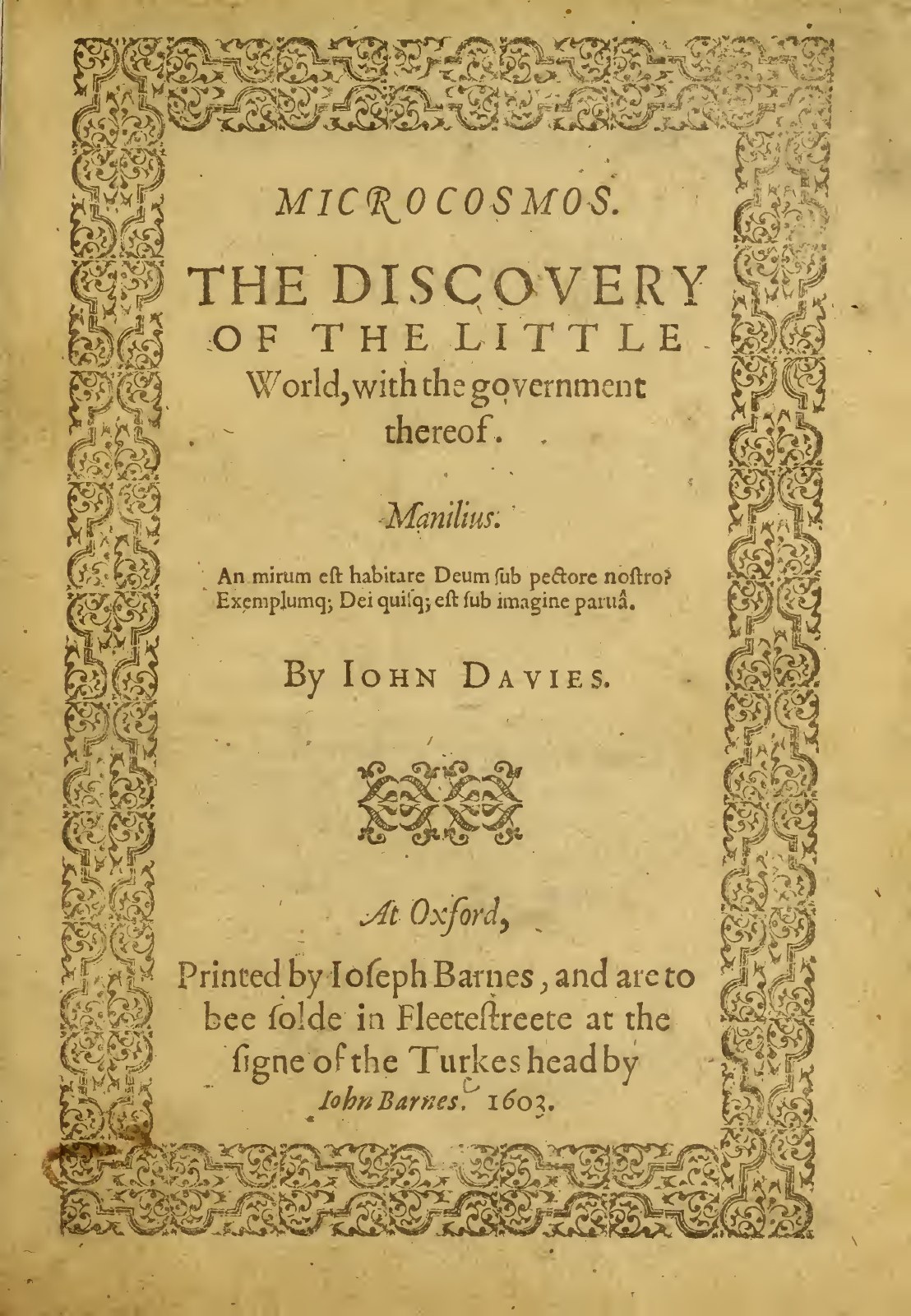
John Davies of Hereford’s Microcosmos appeared at Oxford in 1603, the same year and from the same printer, Joseph Barnes, as Carleton’s Heroici characteres. Both books addressed Henry Neville. Carleton associated him with the Muses; Davies called him “discreet” and questioned how freely his worth could be praised. Microcosmos also names Shakespeare and Burbage by their initials and contains passages compared with Sonnet 111 and Macbeth.1
Davies was a poet and professional writing master. Microcosmos examines humanity as a little world of body and soul, appetite and reason, and closes with poems addressed to named contemporaries.1
Davies: the difficulty of praising Neville
The concluding group of poems in Microcosmos includes thirty-three sonnets and a longer poem to Oxford. Neville’s sonnet sits between poems to Sir Edward Wingfield and Sir Edward Dyer. It is headed “To the Noble, discreete, and wellbeloved Knight Sir Henry Nevill.”2
The complete poem follows, with spelling modernized and its fourteen verse lines preserved:
There was a time when, ah that so there was,
Why not there is? There is and was a time,
When men might call gold, gold; and brass, but brass;
And say it, without check, in prose or rhyme.
Yet should I call thee gold, some (brass perchance)
Would say I erred because I ne’er touched thee,
And so did call thee through mere ignorance,
Or (which is worse) through abject flattery.
I am too ignorant (I do confess)
To judge thy worth, which worthiest men commend,
Yet may I say (I hope) and not transgress,
Thou art Virtue, Valour, Truth, and Honour’s friend;
All which presume thou art not gilt by guile
Because thy noble name denies the vile.
In the original, “Ne-vile” is printed as a marginal gloss to the last line, outside the verse. Davies uses the division of Neville’s name to illuminate the closing assertion of character. Chapter 41 examines the connection with Sonnet 121.
The poem turns on the assay of precious metal: to “touch” gold is to test it on a touchstone. Davies imagines calling Neville gold and being challenged by critics who may themselves be brass. In that setting, “I ne’er touched thee” concerns testing Neville’s worth; it does not establish that the two had never met. The closing “gilt by guile” distinguishes genuine worth from a deceptive surface.3
Davies invokes the judgement of the “worthiest men” while repeatedly questioning his own freedom to praise: “without check,” “I hope,” “not transgress.” The heading’s “discreet” fits this concern with judgement and guarded speech. Neville alone receives that epithet in the dedicatory headings, although Davies uses the word elsewhere for prudence and good government.4
The surrounding poems also honour people affected by the Essex rebellion: Southampton’s release and the young Earl of Essex’s restored prospects receive praise. Neville’s sonnet belongs to that setting of contested reputations, but its distinctive question is whether his worth can be acknowledged openly.5
“W. S. R. B.”: the praise of players
Davies marks this stanza with the initials “W. S. R. B.,” conventionally identified as William Shakespeare and Richard Burbage:6
Players, I love ye, and your quality,
As ye are men, that pass time not abused:
And some I love for painting, poesy,
And say fell Fortune cannot be excused,
That hath for better uses you refused:
Wit, courage, good shape, good parts, and all good,
As long as all these goods are no worse used,
And though the stage doth stain pure gentle blood,
Yet generous ye are in mind and mood.
The initials are keyed to “some,” linking poetry with Shakespeare and painting with Burbage. “Quality” means the players’ profession; “generous” suggests both noble birth and nobility of character.
Davies’s epigram to Shakespeare in The Scourge of Folly is reproduced and discussed in Appendix J.
Sonnet 111: a possible answer to Davies
Sonnet 111 likewise blames Fortune for work that stains a name:7
O, for my sake do you with Fortune chide,
The guilty goddess of my harmful deeds,
That did not better for my life provide
Than public means which public manners breeds.
Thence comes it that my name receives a brand;
And almost thence my nature is subdued
To what it works in, like the dyer’s hand.
MacDonald P. Jackson argues that Davies’s stanza probably prompted Sonnet 111. The uncertain date of the sonnet leaves the direction of borrowing open.8
For the connection between Neville’s father and Reading’s dyers, see the discussion of Sonnet 111 in Chapter 43, “The Sonnets: The Judging Eye.”
Macbeth: the three functions of drink
Davies also describes three functions of drink:9
Drink hath three offices; the first assists
Concoction, for in it is boiled the meat:
The next, to mix the food the first digests:
The last, to bring it to the liver’s heat …
“Concoction” means digestion.
The Porter gives a comic list in Macbeth 2.3:10
PORTER Faith, sir, we were carousing till the second
cock, and drink, sir, is a great provoker of three
things.
MACDUFF What three things does drink especially
provoke?
PORTER Marry, sir, nose-painting, sleep, and urine.
Brian Vickers identified this possible echo of Davies’s three-part formulation; Jackson credited him with the observation. Jackson found only these two examples in his search of Literature Online for drink associated with three effects, strengthening the case for an echo rather than an accidental resemblance.11
Notes and sources
John Davies of Hereford, Microcosmos (Oxford: Joseph Barnes, 1603), title page, main poem, and address to Oxford; 1603 scan. George Carleton, Heroici characteres (Oxford: Joseph Barnes, 1603), title page; scan. See also Falconer Madan, The Early Oxford Press (Oxford, 1895), p. 55, entries 1603.3–4; edition. Both title pages identify Joseph Barnes as printer (Iosephus Barnesius in Carleton’s Latin imprint). Davies additionally names John Barnes at the Turk’s Head in Fleet Street as the London bookseller; a common bookseller or exact simultaneous release is not established.↩︎
John Davies of Hereford, Microcosmos. The Discovery of the Little World (Oxford: Joseph Barnes, 1603), concluding poems, Neville followed by Dyer. Neville and Dyer, original page; EEBO-TCP A19903. The chapter’s modernized verse retains words and verse order while regularizing spelling, capitalization, and punctuation. Marginal matter is distinguished from the verse. The sequence from Canterbury through “To the World” contains thirty-three fourteen-line poems and the twenty-nine-line Oxford poem; this is a defined section, not a count of every poem in the volume.↩︎
Davies, Neville sonnet, lines 3–8 and 13–14. For the assay sense of touch, see University of York, Yorkshire Historical Dictionary, “touch”, including the entry’s discussion of touchstones and historical assay usage. The reading is also sustained by the poem’s own gold, brass, and gilding vocabulary.↩︎
Davies, Microcosmos, Henry VII passage, “For government discreete and temperate,” and the occurrences in the Neville heading and Magdalen poem; EEBO-TCP A19903. Robert Cawdrey, A Table Alphabeticall (London, 1604), sig. D3v, “discretion,” electronic edition by Raymond G. Siemens: text. The heading claim is restricted to this volume, not Davies’s entire career.↩︎
Davies, Microcosmos, sonnets to Southampton and the young Earl of Essex. The latter addresses Robert Devereux, the third earl, not his executed father.↩︎
Davies, Microcosmos, pp. 214–216, especially p. 215, sig. 2F4r; page 215. The marginal “W. S. R. B.” is keyed to “some”; the Simonides and Roscius notes appear on the same page. For the identification and later references, Alan H. Nelson, “Microcosmos: John Davies of Hereford alludes to Shakespeare,” Shakespeare Documented.↩︎
William Shakespeare, Sonnet 111, lines 1–7, Folger reading text. Quotation preserves its line breaks and wording; bold emphasis is added for comparison. The 1609 publication does not establish the sonnet’s composition date.↩︎
MacDonald P. Jackson, “Shakespeare’s Sonnet CXI and John Davies of Hereford’s Microcosmos (1603),” Modern Language Review 102.1 (2007), 1–10; DOI, complete article through Gale. The proposed connection is distinguished here from a demonstrated direction of borrowing.↩︎
Davies, Microcosmos, p. 69, sig. L3r; original page. The quotation gives the first four of nine lines, with an ellipsis at the cut. Spelling and the anomalous punctuation after “three” are modernized.↩︎
Shakespeare, Macbeth 2.3, the Porter’s dialogue with Macduff, Folger reading text. The excerpt preserves the edition’s speech labels, wording, and physical line breaks. The final speech continues beyond the quoted sentence.↩︎
Brian Vickers, Shakespeare, A Lover’s Complaint, and John Davies of Hereford (Cambridge: Cambridge University Press, 2007), Introduction, publisher’s excerpt. For the specific drink parallel and attribution of its identification to Vickers, see Jackson, “Shakespeare’s Sonnet CXI,” p. 5 and note 18. The present argument does not depend on Vickers’s attribution of A Lover’s Complaint to Davies. Jackson’s search, reported in 2007, covered literary texts by authors living in 1550–1700. This is his reported Literature Online result, not a new EEBO search or an exhaustive claim of uniqueness. Davies describes physiological functions; the Porter supplies comic effects.↩︎