When Volumnia pleads with her son Coriolanus to spare Rome, she reminds him that her whole life has been invested in him:
VOLUMNIA […]
[…] Thou hast never in thy life
Showed thy dear mother any courtesy
When she, poor hen, fond of no second brood,
Has clucked thee to the wars and safely home,
Loaden with honor. […]
— Coriolanus, 5.3.1
Earlier she calls him “the only son of / my womb” (Coriolanus, 1.3). Her appeal draws its force from that concentration of love and ambition. She has sent this one son into danger to win honour; now she demands that he use his power to save his country.
Thomas North’s translation of Plutarch, the play’s principal narrative source, gives Shakespeare a widowed mother and a son whose greatest pleasure is to return crowned with honours and see her joy. Another Roman historian, Dionysius of Halicarnassus, supplies a more particular family history. In Dionysius the mother, there called Veturia, recalls the choice she made:
When you reached manhood and it was in my power to be freed from these cares by marrying again, to rear other children, and lay up many hopes to support me in my old age, I would not do so, but remained at the same hearth and put up with the same kind of life, placing all my pleasures and all my advantages in you alone.2
Earlier in the same appeal she calls him her “dear and only son.” North’s corresponding account gives the widowhood and devotion, but does not specify this refusal of another marriage and further children. The hen with “no second brood” gives Shakespeare’s Volumnia the same concentration of hope in a single child.3 The image gives Volumnia a claim upon her son that no military or political allegiance can discharge.
Henry Neville studied Dionysius under his tutor, Henry Savile. His copy of the 1546 Greek Roman Antiquities, now at Audley End, contains an annotation attributed to him correcting the chronology of Rome’s kings. The note supplies sixty-two missing years and names Ancus Martius and Tarquinius Collatinus. The arithmetic restores the total from 182 to 244 years, although the second name should be Tarquinius Priscus. This was attentive reading of the ancient history. Ancus, whose reign the annotation restores to the calculation, also appears among Coriolanus’s ancestors in the play.4 Brutus includes him in the family history he coaches the citizens to repeat:
BRUTUS […]
The noble house o’ th’ Martians, from whence came
That Ancus Martius, Numa’s daughter’s son,
Who after great Hostilius here was king, […]
— Coriolanus, 2.3.5
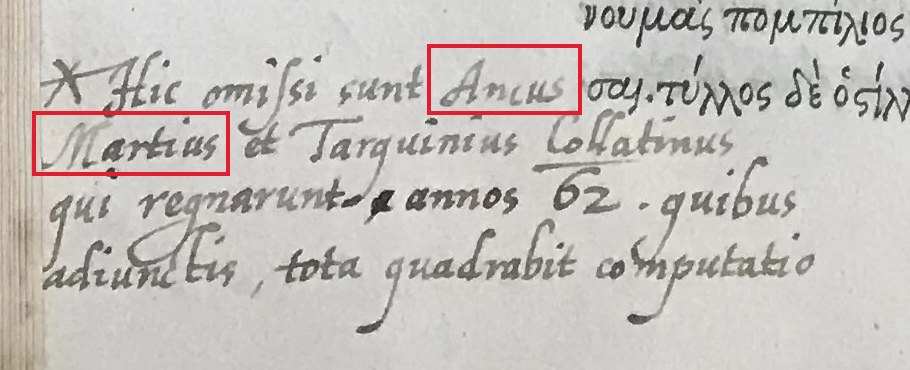
Dionysius gives fuller accounts of Rome’s food crisis, its political divisions and the mother’s intervention than the corresponding passages in North. Several of Shakespeare’s departures from North come into sharper focus beside this book Neville had studied.
Hidden food and the starving citizens
The play opens with citizens ready to kill Coriolanus. They believe that Rome’s rulers let them starve while keeping stores for themselves:
SECOND CITIZEN Care for us? True, indeed! They ne’er
cared for us yet. Suffer us to famish, and their
storehouses crammed with grain; make edicts for
usury to support usurers; repeal daily any wholesome
act established against the rich, and provide
more piercing statutes daily to chain up and restrain
the poor. If the wars eat us not up, they will;
and there’s all the love they bear us.
— Coriolanus, 1.1.6
North supplies a famine and agitators spreading “false tales and rumours” against the nobility. He emphasizes the poor’s inability to buy corn: “though there had been plenty enough, yet the common people had no money to buy it.” Dionysius gives Sicinius and Brutus a more specific accusation. The wealthy, they say, have:
not only provisions secretly hoarded up, but also money to purchase imported foodstuffs, and thus could treat the calamity with fine scorn, whereas the plebeians had neither resource.7
Both the historian’s speakers and Shakespeare’s citizens turn scarcity into an accusation of unequal suffering: food exists, but the rich possess it while the poor go hungry. The play does not describe concealed stores; it makes their abundance brutally visible in “crammed.” The play also marks this as a disputed charge. Menenius reports the citizens’ belief that “The city is well stored,” and Martius challenges it: “They say there’s grain / enough?” Dionysius supplies the allegation of hidden supplies beyond North’s account of the dearth.
Debora Shuger has placed the opening citizens beside another writer familiar to Neville’s scholarly circle: John Chrysostom. In his seventeenth homily on 2 Corinthians, Chrysostom attacks those who profit from hunger:
But when thou both shuttest up corn and raisest the price, and devisest other unusual tricks of traffic; what hope of salvation shalt thou have henceforth? Thou hast been bidden to give freely to the hungry, but thou dost not give at a suitable price even.8
Chrysostom makes the hoarder’s treatment of the hungry a test of his faith. Shakespeare gives the charge to citizens demanding political action. Neville’s former tutor Henry Savile devoted years to the Greek edition of Chrysostom published in 1610–13; Shuger herself draws attention to Savile’s work. The edition appeared after the play’s usual dating to 1607–08, but the intellectual connection joins the Roman narrative to a continuing argument about wealth, hunger and responsibility.9
War as a remedy for division
Hunger also supplies the occasion for a political remedy: war abroad to end division at home. Dudley Digges discusses that policy through the story of Coriolanus. His fourth discourse in Foure Paradoxes (1604) argues that war can sometimes do less harm to a well-governed state than peace. Andrew Hadfield, returning to a source proposal previously discussed by Kenneth Muir, connects Digges’s argument with Coriolanus.10
Digges prefers a man’s shedding his blood for his king’s honour or his “country’s safety” to “the sordid sparing, lazy living, or foolish delaying” of those who avoid action.11 Volumnia puts that choice in the imagined lives of her sons:
VOLUMNIA […]
[…] had I a dozen sons, each in my
love alike and none less dear than thine and my
good Martius, I had rather had eleven die nobly
for their country than one voluptuously surfeit out
of action.
— Coriolanus, 1.3.12
Digges discusses Coriolanus by name. He describes Rome’s famine, popular resentment and the nobility’s contempt for the poor, then the Senate’s remedy: war against the Volscians. Rich and poor will share a camp and its dangers. The play opens on the same calculation. When news comes that the Volscians are in arms, Martius welcomes it: “Then we shall ha’ means to vent / Our musty superfluity.”13 The citizens protesting over corn can now be sent to war. Digges shows this Roman episode being read in 1604 as a policy for governing a divided people.14
Menenius and the diseased limb
Later the crisis reverses. The citizens’ tribunes now seek Coriolanus’s destruction, and Menenius tries to save him. Shakespeare makes the dispute turn on a surgical distinction:
SICINIUS
He’s a disease that must be cut away.
MENENIUS
O, he’s a limb that has but a disease—
Mortal to cut it off; to cure it easy.
What has he done to Rome that’s worthy death?
— Coriolanus, 3.1.15
For Sicinius, Coriolanus is the disease; for Menenius, he is a part of Rome that can be cured. Killing him would injure the community that depends upon him.
Dionysius gives Menenius a closely related argument. Addressing the Senate during the earlier conflict with the plebeians, he warns that:
neither the ailing part of a human body ought always to be lopped off (for that would be to render the appearance of the rest ugly and its term of life brief) nor the disordered part of a civil community to be driven out (since that would be the quickest way of destroying the whole in time through the loss of its separate parts).16
The same speaker argues against the same remedy: removing the troublesome part can destroy the body that remains. The application changes. Dionysius’s Menenius defends the people against exclusion by the ruling class; Shakespeare’s defends an aristocratic soldier against the people’s leaders. An argument for preserving the community crosses from one side of the Roman conflict to the other.
North gives Rome’s rulers a different remedy. They send citizens away to colony and war to clear the city of “many mutinous and seditious persons, being the superfluous ill humours that grievously fed this disease.” That is a purge. Dionysius’s Menenius argues instead for keeping the troubled body together. Shakespeare’s Menenius takes the same side of that argument: preserving the part protects the body.17
Making laws and managing voices
The struggle to preserve Rome is also a struggle over who governs it. The opening citizen’s speech adds a pointed account of legislation. North describes creditors stripping debtors of their property and a Senate favouring the rich. Shakespeare has the rulers actively making and unmaking law: “make edicts,” “repeal daily any wholesome / act,” and provide “more piercing statutes” (Coriolanus, 1.1). Those who control legislation create advantages for their own class and remove protections from the poor.18
The same practical attention appears when Coriolanus challenges the tribunes’ authority. North already gives him a complaint against an officer who acknowledges “no superior to command him.” Shakespeare develops the constitutional consequence:
CORIOLANUS […]
It makes the consuls base! And my soul aches
To know, when two authorities are up,
Neither supreme, how soon confusion
May enter ‘twixt the gap of both and take
The one by th’ other.
— Coriolanus, 3.1.19
He objects to an arrangement in which the governing elite cannot act without popular assent:
CORIOLANUS […]
[…] where gentry, title,
wisdom
Cannot conclude but by the yea and no
Of general ignorance—it must omit
Real necessities and give way the while […]
— Coriolanus, 3.1.
North also describes mutual dependence: later, when Rome considers recalling the exile, the people cannot confirm anything by vote unless the Senate proposes it first. Shakespeare makes the dependence a matter of urgent argument, here voiced by a man who resents submitting to the people’s judgment.
The tribunes, meanwhile, know how to organize that judgment. After the citizens have promised Coriolanus their support, the tribunes rebuke them for not speaking “as you were lessoned” and tell them what to say when withdrawing it: “Say you chose him / More after our commandment” (Coriolanus, 2.3). Before the trial Sicinius asks:
SICINIUS Have you a catalogue
Of all the voices that we have procured,
Set down by th’ poll?
— Coriolanus, 3.3.20
Here “voices” means votes, and “by the poll” means by individual headcount. North supplies voting by tribes, counting by poll and manipulation of the charges. Shakespeare puts the preparation onstage: votes secured beforehand, written down and directed into coordinated responses. The audience sees how an apparent expression of popular will is arranged.
Neville had practical experience of the work required to turn opinion into parliamentary action. He took part in the debates on Anglo-Scottish union and naturalization in 1606–07, close to the play’s usual dating. On 21 June 1608, writing to Ralph Winwood about assistance to the Dutch, he expressed his willingness to:
cooperate as seriously with my voice and best endeavour in Parliament to enable the king to yield them a real assistance.21
Parliament was not sitting that year; Neville was looking towards a future meeting. His later Advice to James proposed hearing representatives chosen by the Commons themselves, so that they could explain the House’s intentions without others construing them on its behalf. The proposals would be discussed and reported back without binding the House.22 Questions of who could speak for a body, how its assent could be secured and what would prevent cooperation were part of Neville’s political work. They are questions Shakespeare develops at length beyond the corresponding account in North.
Rome’s conduits also enter the play through Coriolanus’s ancestry. Brutus coaches the citizens to explain their earlier support by claiming that the tribunes had lectured them about Coriolanus’s distinguished family. His proposed account names Ancus Martius, the king in Neville’s chronological note, and Publius and Quintus, “That our best water brought by conduits hither” (Coriolanus, 2.3). North already places these family details together. Shakespeare makes them part of the management of public opinion: even Rome’s water supply can be recruited to secure, or explain away, a politician’s support.5
Rome’s conduits and London’s New River
Water becomes an image of power when Coriolanus accuses the senators of surrendering their authority to a tribune:
CORIOLANUS […]
You grave but reckless senators, have you thus
Given Hydra here to choose an officer,
That with his peremptory “shall,” being but
The horn and noise o’ th’ monster’s, wants not spirit
To say he’ll turn your current in a ditch
And make your channel his? […]
— Coriolanus, 3.1.23
R. B. Parker, in his Oxford edition, writes that the imagery:
probably refers to the goldsmith Hugh Middleton’s scheme to bring clean water into London by channels from streams in Hertfordshire.24
Marc Geisler endorses the connection and develops its political meaning. Myddelton’s reshaping of the landscape, and the objections of landowners whose property the works crossed, offer a counterpart to the tribunes’ redirection of power away from Rome’s Senate.
Neville became an investor in the very water project Parker identifies behind the play’s imagery. Receipts document £400 in payments, an approximate measure of his investment rather than a complete total. The earliest surviving receipt dates from November 1610, after the play’s usual dating.25
In his draft estate instructions of July 1612, Neville calls the investment “my two parts in the new cut or river” and expects it to “grow and increase much more in time than at the first.” He was planning for his family’s share in the venture’s future income.26


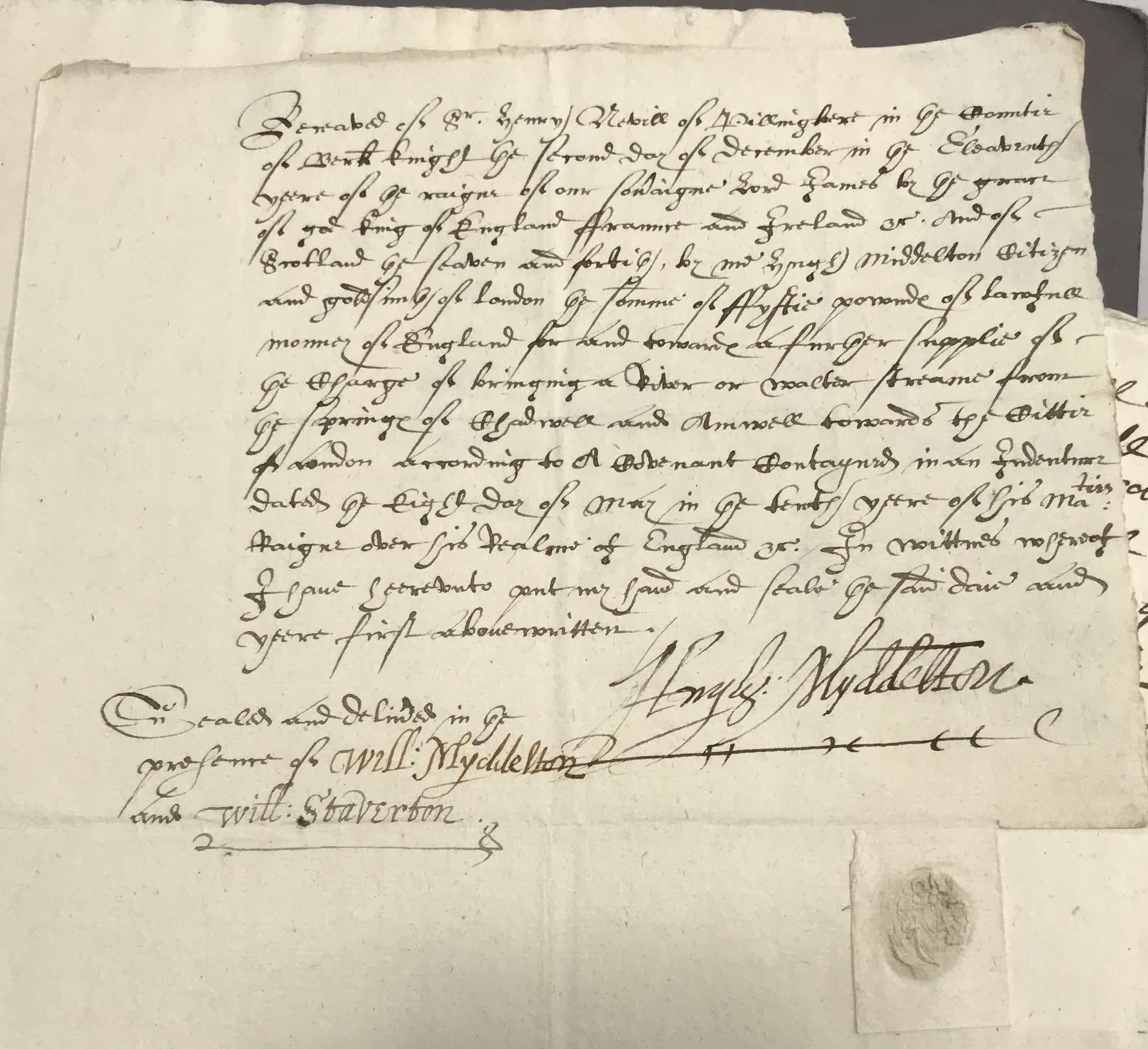
The receipts do not establish when Neville first became interested in the project.
The interpretation of the time
Coriolanus returns to the Volscians with a peace treaty signed by Rome’s consuls and patricians and bearing the Senate’s seal. Aufidius tells the lords not to read it. The charge of treason overtakes the account of service, and Coriolanus is killed.27 Aufidius has already explained how public honour can turn against a man:
AUFIDIUS […]
[…] So our virtues
Lie in th’ interpretation of the time,
And power, unto itself most commendable,
Hath not a tomb so evident as a chair
T’ extol what it hath done.
— Coriolanus, 4.7.28
Neville warns James of the same political danger in his Advice of about 1613. Before trying new financial projects, the king must repair his relations with the Commons:
whereas otherwise whiles dislikes continue seu benè, seu malè facta premunt.29
The Latin recalls Tacitus’s account of Galba: when a ruler is hated, deeds done well and deeds done badly alike count against him. Neville’s answer is to restore cooperation by hearing the Commons. Shakespeare gives the judgment to Aufidius, who exploits it: the man whose victories made him indispensable can be destroyed by the interpretation put upon his peace.
Then the verdict changes once more. After the murder, Aufidius helps give his rival a soldier’s funeral:
AUFIDIUS My rage is gone,
And I am struck with sorrow.—Take him up.
Help, three o’ th’ chiefest soldiers; I’ll be one.—
Beat thou the drum that it speak mournfully.—
Trail your steel pikes. Though in this city he
Hath widowed and unchilded many a one,
Which to this hour bewail the injury,
Yet he shall have a noble memory.
Assist.
— Coriolanus, 5.6.30
North has the Volscians “honourably bury him,” setting out his tomb “with great store of armour and spoils.” Dionysius specifies who carries the body:
the young men who were the most distinguished for their military achievements took up the bier31
The military distinction of Dionysius’s bearers reappears in Shakespeare’s order to the “chiefest soldiers,” with Aufidius adding himself to their number. The man denounced as a traitor is carried away with military honour, borne by the enemy who helped to kill him. From Volumnia’s one child to the soldiers carrying his body, Dionysius illuminates details through which Shakespeare makes the Roman story his own.
Notes and sources
Shakespeare, Coriolanus, 5.3 and 1.3. Shakespeare quotations follow Folger; North quotations modernize spelling. North, The Lives of the Noble Grecians and Romanes (1579), “Coriolanus,” pp. 237, 239, TCP A09802, supplies widowhood and maternal delight in military honours.↩︎
Dionysius of Halicarnassus, Roman Antiquities, 8.48.1–2 and 8.51.3–4, translated by Earnest Cary, Loeb Classical Library, vol. V. English quotations from Dionysius in this chapter use Cary’s modern translation for the comparison of content, not as a proposed English source. The refusal of another marriage and further children is also present in the sixteenth-century Latin translation: 1555 Gelenius, p. 153. Shakespeare does not expressly narrate refusal of remarriage; the comparison concerns the absence of another child.↩︎
A further, less exact comparison concerns the mother’s appeal. North says Coriolanus hears her “without interrupting her speech at all,” whereas Dionysius, 8.47, has him intervene during it. North then has him remain silent before his mother begins again. In Shakespeare, 5.3, he rises to leave after the exchanges with his wife and son, and Volumnia resumes the appeal: “Nay, go not from us thus.” This is an attempted departure, not the same interruption of a speech.↩︎
Dionysius of Halicarnassus, Roman Antiquities (Paris: Robert Estienne, 1546), Audley End copy, p. 45, at 1.75. Photograph and identification discussed in Ken Feinstein, “Part 8: Henry Neville and Henry Savile Annotations in Roman Antiquities”, 16 October 2020. The note reads: “Hic omissi sunt Ancus / Martius et Tarquinius Collatinus / qui regnarunt [mark, unexpanded] annos 62. quibus / adiunctis, tota quadrabit computatio.” The name Collatinus is retained as written; the chronological correction requires the reign of Priscus. Compare the printed chronology in the 1546 edition, p. 45.↩︎
Shakespeare, Coriolanus, 2.3; Plutarch, “Life of Caius Martius Coriolanus,” opening paragraph, Thomas North’s translation, Lives (1579). North likewise names Ancus and the family members who brought water by conduits.↩︎
Shakespeare, Coriolanus, 1.1. Compare North’s narrative of scarcity and purchasing power in the “Life of Coriolanus.”↩︎
Dionysius, Roman Antiquities, 7.14.3–4, English translation by Earnest Cary. The speakers are Sicinius and Brutus, then aediles; the hidden supplies are their accusation, not an established fact of the narrative.↩︎
John Chrysostom, Homilies on the Epistles of Paul to the Corinthians, in Nicene and Post-Nicene Fathers, first series, vol. XII (1889), CCEL text, Homily XVII on 2 Corinthians, §3, p. 362. The English is the nineteenth-century translation. Debora K. Shuger, “Subversive Fathers and Suffering Subjects: Shakespeare and Christianity,” in Religion, Literature, and Politics in Post-Reformation England, 1540–1688, ed. Donna B. Hamilton and Richard Strier (Cambridge University Press, 1996), pp. 46–69, chapter DOI, p. 49 and p. 64 n. 17, supplies the published comparison with Coriolanus.↩︎
Shuger, “Subversive Fathers,” p. 52 on Savile and pp. 53–54 on the wider Christian and English anti-hoarding context. Savile’s edition of Chrysostom appeared at Eton in eight volumes, 1610–13.↩︎
Andrew Hadfield, “Shakespeare and the Digges Brothers”, Reformation 25.1 (2020), 2–17, especially 13–17. Hadfield discusses Kenneth Muir’s earlier source proposal.↩︎
Thomas and Dudley Digges, Foure Paradoxes, or Politique Discourses (London, 1604), fourth paradox, opening argument, sigs. M4v–N1r; TCP A20463. Spelling modernized. Words in quotation marks are Digges’s; the rest of the sentence summarizes his argument.↩︎
Shakespeare, Coriolanus, 1.1. North also describes using war and colonization to remove “superfluous ill humours” from Rome.↩︎
Dudley Digges, fourth paradox in Thomas and Dudley Digges, Foure Paradoxes (1604), p. 104; TCP A20463. The marginal references identify Plutarch’s life of Coriolanus and Livy, book II.↩︎
North, Lives (1579), “Coriolanus,” passage on removing seditious citizens as superfluous humours; also the comparison of the Gracchi with Agis and Cleomenes, p. 895, on political remedies and the physician’s sword: TCP A09802. Related English anti-amputation arguments also occur in Jerónimo Osório, translated by John Fen, A learned and very eloquent treatie (1568), TCP A08569, and John Bridges, A defence of the government established in the Church of Englande (1587), TCP A16832.↩︎
Plutarch, “Life of Caius Martius Coriolanus” and the appended comparison with Alcibiades, in Thomas North, The Lives of the Noble Grecians and Romanes (1579), TCP A09802; compare Shakespeare, Coriolanus, 1.1. The comparison concerns these two North units, not every Life in the volume. North already supplies oppression by creditors and disagreement about the severity of the law; the added feature is the citizen’s formulation of legislation made and repealed for economic interests.↩︎
Shakespeare, Coriolanus, 3.1, especially the speeches concerning “two authorities” and the “yea and no.” North’s corn debate supplies Coriolanus’s hostility to the tribunate, the diminished consulship and the tribune acknowledging no superior; the later proposed recall supplies the rule requiring the Senate’s initiative before a popular vote. North quotations modernize spelling.↩︎
Shakespeare, Coriolanus, 2.3 and 3.3; North, “Life of Coriolanus,” trial narrative. North already describes the shift from voting by hundreds to voting by tribes, counting by poll, and manipulation of the accusation. The comparison identifies the play’s advance catalogue of procured voices and instructions for coordinated responses.↩︎
Andrew Thrush, “NEVILLE, Sir Henry I (1564–1615)”, History of Parliament: The House of Commons 1604–1629, for union, naturalization and parliamentary activity in 1606–07. Neville to Winwood, London, 21 June 1608, Ralph Winwood, Memorials of Affairs of State, ed. Edmund Sawyer, II (1725), p. 411; quotation checked against the printed page, with spelling and capitalization modernized. Folger’s dating discussion gives 1607–08 as a possible composition period. The letter anticipates parliamentary business; no parliamentary session took place in 1608.↩︎
Neville, Advice, Gardiner II, p. 393. The representatives would discuss and report to the House without binding it.↩︎
Shakespeare, Coriolanus, 3.1. Shakespeare quotations throughout follow Folger’s text and lineation; ellipses mark omissions, including omitted parts of lines.↩︎
Marc Geisler, “Collecting a National Voice: Shakespeare’s Coriolanus and the People’s Grievances”, Journal of Theatre and Drama 3 (1997), 17–44, section III and notes 40–41, quoting R. B. Parker, ed., Coriolanus, Oxford Shakespeare (1994), p. 5. Parker’s wording is quoted here through Geisler. The political explanation that follows summarizes Geisler’s next two paragraphs. Lee Bliss, Coriolanus, updated New Cambridge Shakespeare edition (2010), Introduction, pp. 3–4, records the proposed allusion but considers disputes over agricultural water rights sufficient to explain the imagery.↩︎
Bernard Rudden, The New River: A Legal History (Oxford: Clarendon Press, 1985), Appendix E, pp. 274–278, prints the agreement of 8 May 1612 acknowledging Neville’s £200 already paid and assigning two thirty-sixth shares after the Crown’s half had been reserved. Leslie Tomory, The History of the London Water Industry, 1580–1820 (Baltimore: Johns Hopkins University Press, 2017), pp. 50–57, discusses the venture, its financing and political opposition. Receipts of 26 November 1610, 18 May 1612, 2 December 1613 and 25 April 1614: Royal Berkshire Archives, D/EN/O24. The 1610 receipt is docketed £200; this is treated as evidence of the payment already acknowledged in 1612, not an additional £200. The later receipts record £50, £50 and £100 respectively. The four receipts document £400, not necessarily his total investment. Myers & Co., Illustrated Catalogue (1917), p. 29, item 129, describes a £50 receipt dated 27 June 1612. Its original has not been located, so this possible further payment is excluded from the £400 subtotal. For the fuller business account, see Chapter 9. The City obtained parliamentary powers for the watercourse in 1606; Myddelton took over in 1609. Neville held two of the thirty-six shares in the investors’ half; the Crown held the other half.↩︎
Henry Neville, draft estate instructions for his younger children and payment of debts, July 1612, Royal Berkshire Archives, D/EN/F6/1; estate instructions catalogue. The draft contains cancellations and insertions. The two quoted passages concern the New River interest; spelling is modernized, including “then” to “than.”↩︎
Neville, Advice Touching the Holding of a Parliament, in Samuel Rawson Gardiner, History of England, II (1863), Appendix V, pp. 389–394, especially p. 394. Tacitus, Histories, 1.7. The English explanation paraphrases the Latin.↩︎
Shakespeare, Coriolanus, 5.6. North, Lives (1579), “Coriolanus,” p. 259, TCP A09802. The specified military bearers are the additional detail; the honourable burial is already in North.↩︎
Dionysius, Roman Antiquities, 8.59.3, Cary translation. Dionysius does not specify three bearers or participation by Aufidius; his death narrative describes stoning.↩︎