Marriage and a learned household
On 22 December 1584 Neville married Anne Killigrew, daughter of the diplomat Sir Henry Killigrew and Katherine Cooke. Anne’s father came from the Killigrews of Arwenack in Cornwall, giving Neville a connection by marriage to an established Cornish family.1
Katherine and her sisters, daughters of Sir Anthony Cooke, were educated in both Latin and Greek. Katherine died on 27 December 1583, almost a year before her daughter’s marriage; the Cooke connection continued through her daughter Anne and Anne’s surviving aunts.2
Anne Neville’s maternal aunts included Anne Cooke, who married Sir Nicholas Bacon, Elizabeth’s Lord Keeper of the Great Seal, and Mildred Cooke, who married William Cecil, Lord Burghley, Elizabeth’s chief minister. Anne Bacon’s sons Anthony and Francis, and Mildred’s son Robert Cecil, were therefore Anne Neville’s first cousins.2
The sisters’ learning produced work that circulated beyond the household. Anne Bacon translated John Jewel’s Latin Apologia Ecclesiae Anglicanae into English in 1564. Mildred Cecil corresponded in learned languages and gave books to St John’s College, Cambridge, including a polyglot Bible. Katherine’s surviving correspondence includes a Latin appeal to Mildred as well as English letters from the Protestant preacher Edward Dering.3
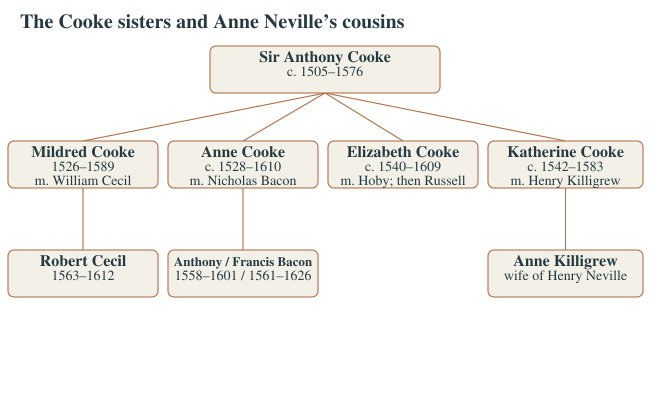
Chapter 19 prints Katherine’s Latin poem to Mildred and compares its wit and learned family setting with The Taming of the Shrew.
The marriage also established a large household of their own: Henry and Anne had at least five sons and six daughters. Chapters 6 and 7 examine Anne’s letters in connection with Neville’s disgrace and imprisonment.
Anne’s uncle William Killigrew, a groom of Elizabeth’s privy chamber, provided another connection at court.4 His house in Lothbury was used by Anne’s father and became a recurring London base for Neville, who wrote from there during Anne’s illness in 1598 and while preparing for his embassy in 1599.5,6
Music also belonged to Neville’s wider family circle. In 1591 John Baldwin completed the keyboard manuscript known as My Ladye Nevells Booke, containing music by William Byrd. The Lady Nevell was Elizabeth Bacon, Neville’s stepmother. John Harley’s 2005 study establishes her identity through the family and heraldic evidence.7
Elizabeth, by then Lady Periam, also received Thomas Morley’s 1595 dedication of his two-part canzonets. Morley’s wife had formerly served her; five years later he published the song ‘It was a lover and his lass,’ sung in As You Like It.8
Mayfield and the Weald
Neville and Anne made their home at Mayfield in Sussex. The estate came from Sir Thomas Gresham, the uncle of Neville’s mother, Elizabeth Gresham. Gresham’s land will devised Mayfield and Wadhurst to Neville’s father and the male issue of Elizabeth; Parliament confirmed the estate to father and son in 1581.9
Christopher Fetherstone dedicated his 1587 translation of A Christian and wholsom admonition directed to the Frenchmen to Henry and Anne Neville, his “singular good friends.” He dated the dedication at Mayfield on 24 June.10
Mayfield lies in the Weald, the wooded region of southern England between the North and South Downs, extending chiefly across Sussex, Kent and Surrey. Its iron ore, woodland for charcoal and streams for water power made it a major centre of iron production.11
Land, parish and county
Neville held the right to present a clergyman to the Mayfield vicarage. On 28 April 1589 George Carleton was instituted as its perpetual vicar; the appointment record names Henry “Novell,” esquire, as the lay patron.12 Carleton was a fellow of Merton College, where Neville had studied under Henry Savile. He would later address his Latin poetry to Neville and, after Neville’s death, marry Anne. Chapter 51, “Carleton, Vicars and the Jaggard Press,” discusses his Astrologomania, published in 1624.
The estate also brought dealings with local landholders. On 20 September 1591 Neville converted the holding of Richard Cade, a Mayfield yeoman, from copyhold to freehold. The grant included a house, barns, gardens, orchards, land and woodland.13
The Cade surname had been recorded in the neighbourhood for centuries. Nearby Heathfield was where Jack Cade, the rebel dramatized in 2 Henry VI, was captured in 1450. Hall describes Cade fleeing into Sussex before his final encounter with Alexander Iden; Holinshed explicitly places that encounter in a Sussex garden.14 The play instead gives Cade a firmly Kentish identity. York calls him:
I have seduced a headstrong Kentishman,
John Cade of Ashford,— 2 Henry VI, 3.1
The 1594 quarto already contains this description; the Folio has Cade’s dying message, “Tell Kent from me, she hath lost her best man” (4.10). The play omits the Sussex flight. The Sussex setting in the chronicles belongs to Neville’s own locality, where his dealings with a man named Cade are independently documented.15
Neville entered Parliament for New Windsor in 1584 and represented Sussex in 1589. His public responsibilities extended across the county. In 1589 he served as a subsidy commissioner, helping administer parliamentary taxation. By 1591 he was a justice of the peace, and in 1592 he became a commissioner concerned with recusancy—the refusal to attend the established church.16
On 5 May 1591 the Privy Council asked the lord chancellor to add “Henrie Nevel, of Mafeld, esquier” to the county’s deputy lieutenants. Too few deputies were available, and their absences could prevent the service from being performed.17 The office involved the county’s military administration.
Neville among the gunfounders
Mayfield’s manor and park included a furnace for casting iron cannon.18
Neville’s own petition to Burghley places him among the manufacturers. Recalling an order from the Earl of Warwick, Master of the Ordnance, he describes a summons:
unto all the gunfounders in Sussex […] there to understand his pleasure concerning their further continuance in that trade; whereupon the most of them appearing, and I among the rest19
Neville accepted quotas, official stamps and safeguards against unauthorized export, but resisted compulsory sales to merchants chosen by Warwick or his deputy. His alternative—open sales at Tower Hill under the required bonds—was initially accepted, then withdrawn. He questioned whether the restriction served “some private benefit” rather than “the public good.”19
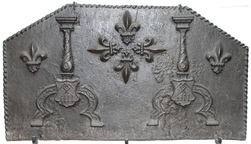
Late-sixteenth-century cast-iron fireback bearing HN and the Neville crossed-staples badge, possibly made at Mayfield. Victoria and Albert Museum, 11.1900. Image: Jeremy Hodgkinson, British Fireback Survey, no. 742. Catalogue and image.
Royal export privileges offered another route to market. Neville held an export grant with Robert Sackville and was probably the Henry Nevile named in a second grant with two foreign merchants; the relationship between the grants remains unresolved.20 Chapter 4 follows the inspections and deliveries behind the trade.
Savile’s Tacitus and Essex
Neville’s former tutor Henry Savile published his English Tacitus at Oxford in 1591. Its connection with Robert Devereux, Earl of Essex, rests most memorably on Ben Jonson’s attribution of the anonymous preface, “A.B. To the Reader.” William Drummond recorded Jonson’s statement in 1618–19:
Essex wrote that Epistle or preface before the translation of the last part of Tacitus, which is A. B.21
Jonson’s testimony concerns the preface, not Savile’s separate dedication to Elizabeth. It is an important attribution, although the authorship remains disputed.
The volume combined Savile’s account of Nero’s fall and Galba’s rise with translations of four books of Tacitus’s Histories and the Life of Agricola, supported by historical and military commentary. Its subjects included succession, civil war, the influence of advisers and the dangers facing an able servant under a jealous ruler. Savile’s dedication presented history as a guide to action; the anonymous preface invited readers to learn from Rome’s political disasters, ending with praise for England’s peace and Elizabeth’s government.22
The dangers of serving a jealous ruler gave the book a particular resonance for Essex. In his Apologie, circulated in 1600, he named Savile as a witness to his love of learning. Alexandra Gajda connects Essex’s presentation of himself as a scholarly soldier undermined by court enemies with the Agricola, whose successful general falls under an emperor’s suspicion.23
Oxford in 1592
Savile’s scholarly world was increasingly entangled with Essex’s politics. During Elizabeth’s Oxford visit in September 1592, Henry Cuffe, a Merton scholar and Regius Professor of Greek, addressed the Queen at Carfax. Henry Savile delivered an oration on whether military studies and philosophy could flourish together. At Merton, with Henry Savile’s brother Thomas moderating, Cuffe disputed whether civil dissensions could benefit the commonwealth. Thomas also praised Essex’s campaigns.
A panegyric possibly delivered by George Carleton, vicar of Mayfield, likewise celebrated Essex. Carleton later dedicated its printed appearance, with the opening book of his Essex epic, to Neville in 1603. Neville’s presence at the visit is not documented, but these were men whose learning and loyalties would remain important in his life.24
Notes and sources
Thomas Finlayson Henderson, “Killigrew, Henry (d.1603),” Dictionary of National Biography, identifies Sir Henry as the fourth son of John Killigrew of Arwenack and Elizabeth Trewenard, and describes the Killigrews as an old Cornish family. Henderson cites the pedigree in J. L. Vivian’s Visitations of Cornwall, pp. 268–269.↩︎
Gemma Allen, The Cooke Sisters: Education, Piety and Politics in Early Modern England (Manchester University Press, 2013), introduction, for the family relationships and Katherine’s death on 27 December 1583. Marion Colthorpe, Elizabethan Court Day by Day: 1584, p. 46, reports the marriage at St Margaret Lothbury on 22 December, distinct from the licence of 4 December recorded by Andrew Thrush’s History of Parliament biography. Thrush supports the child count. The cousin relationships follow the three sisters’ marriages and their named children.↩︎
Gemma Allen, ed., The Letters of Lady Anne Bacon, Camden Fifth Series 44 (2014), especially the early correspondence and Matthew Parker’s letter prefixed to the translation of Jewel, pp. 59–61, doi:10.1017/S0960116313000225. Parker’s prefatory letter states that he and Jewel compared Anne Bacon’s translation with the original and approved it without alteration. The edition discusses Mildred Cecil’s gift to St John’s and cites British Library, Lansdowne MS 104, fol. 158r. For Katherine’s correspondence and its transmission, and the sisters’ learning more generally, see Allen, Cooke Sisters (2013). The Latin appeal survives through a later printed transmission, rather than as a surviving autograph asserted here. The specific reference for Mildred’s polyglot Bible gift is Allen, Letters, p. 56 n. 23. For the six Latin lines printed by Harington with the Cooke-family allusion, see Orlando Furioso (1591), commentary to book 37, p. 314.↩︎
Marion Colthorpe, Elizabethan Court Day by Day, ‘Prominent Elizabethans,’ p. 103, entry for William Killigrew: younger brother of Sir Henry, groom of the privy chamber by 1575, and royal visits to Hanworth in 1590, 1592, 1600 and 1601. Folger edition.↩︎
Edwin Freshfield, ed., The Vestry Minute Book of the Parish of St. Margaret, Lothbury, in the City of London, 1571–1677 (London, 1887), p. 15, entry for 14 February 1582/3, recording William Killigrew’s house, garden and request for passage through the churchyard; printed edition. Sir Henry Killigrew to Robert Cecil, 14 August 1596, Calendar of the Manuscripts of the Most Hon. the Marquis of Salisbury, VI (1895), p. 335, item 43.89; printed letter.↩︎
Henry Neville to Robert Cecil, 6 May 1598, Cecil Papers, Hatfield House; see also Calendar of the Manuscripts of the Most Hon. the Marquis of Salisbury, VIII (1899), p. 158. Henry Neville to Thomas Windebank, 19 February 1598/9, research reference. Both letters bear Lothbury datelines. The letters establish his presence there on these dates; the identification of the house follows the Killigrew family records cited above. For the latter letter, see Green, Calendar of State Papers, Domestic, Elizabeth, 1598–1601, pp. 163–164, vol. CCLXX, no. 42, calendar entry.↩︎
John Harley, “‘My Ladye Nevell’ Revealed,” Music & Letters 86, no. 1 (2005), pp. 1–15, especially pp. 3–5, article. Harley places the marriage probably around May 1578 and identifies Elizabeth as the ambassador’s father’s third wife. She was Francis Bacon’s half-sister, not his full sister. Harley explicitly credits Christopher Foley’s identification, developed from findings prepared in 2003 and College of Arms research.↩︎
Thomas Morley, The First Booke of Canzonets to Two Voyces (London: Thomas Este, 1595), dedication to Lady Periam, dated 17 November 1595, Library of Congress page image. John Harley, ‘My Ladye Nevell Revealed’, Music & Letters 86.1 (2005), 1–15, identifies her as Elizabeth Bacon, formerly Lady Nevell, and connects Morley’s dedication and his wife’s service to her. Morley does not name the place where his wife served. Spelling in the short quotation is modernized. Thomas Morley, The First Booke of Ayres (London: H. Ballard for William Barley, 1600), sigs. B4v–C1r, STC 18115.5; Folger Shakespeare Library, printed song and commentary. Shakespeare, As You Like It, 5.3. The song appeared in print before the play, which was first published in the 1623 Folio.↩︎
John Gough Nichols and John Bruce, eds., Wills from Doctors’ Commons (Camden Society, 1863), pp. 57–68, especially pp. 66–67, land will dated 5 July 1575; John Ward, The Lives of the Professors of Gresham College (London, 1740), Appendix VI, pp. 16–27, especially pp. 19–20, Act of 23 Elizabeth. The Act names Edward as the alternative if his brother Henry were dead, reserves rents and services due to the chief lords, and provides for protection against the Gresham estate’s wider charges. Elizabeth supplied the family relationship; the devise and Act supplied the legal route. Public editions: Wills from Doctors’ Commons, Ward.↩︎
Léonard Constant, A Christian and wholsom admonition directed to the Frenchmen, trans. Christopher Fetherstone (London: John Wolfe, 1587), STC 5154, dedication, sigs. A5r–A6r: A5r, A6r. The author is attributed to Constant and the year supplied as [1587] by STC; neither is treated as an unambiguous literal title-page statement. Folger catalogue. Fetherstone recalls the couple’s many courtesies since their acquaintance began, offers the first fruits of his knowledge of French, and asks them to patronize this Protestant religious translation. He praises their zeal for God’s glory. The “first fruits” are the translator’s; the dedication records an existing friendship and household kindness, not a specified financial commission.↩︎
E. Margaretta Bell-Irving, Mayfield: The Story of an Old Wealden Village (London: William Clowes and Sons, 1903), pp. 4–6, public scan. For the regional iron industry and its raw materials, see the High Weald National Landscape Partnership, “History”, and the Wealden Iron Research Group, “Experimental Ironmaking”. The Weald is a wider region than the modern High Weald designation.↩︎
Clergy of the Church of England Database, appointment evidence record 53478: institution, 28 April 1589; George Carleton, MA, perpetual vicar, Maighfielde; Henry Novell, Armiger, lay “true patron.” Source: Lambeth Palace Library, Whitgift’s Register, vol. 1. The register itself was not inspected. For Carleton’s Merton fellowship and later career, see W. R. W. Stephens, “Carleton, George (1559–1628)”, Dictionary of National Biography. His 1603 literary address and later marriage are discussed elsewhere in this book.↩︎
East Sussex and Brighton and Hove Record Office, AMS6086/33, enfranchisement for £51, 20 September 1591: Henry Nevill, lord of Mayfield manor, to Richard Cade, yeoman. Catalogue inspected; original deed not inspected. The principal holding is described as eighty acres, with other parcels listed separately; Bell-Irving, Mayfield (1903), p. 50, describes eighty-one acres. The transaction converted a holding already occupied by Cade into freehold, retaining specified rents and obligations.↩︎
E. Margaretta Bell-Irving, Mayfield: The Story of an Old Wealden Village (1903), pp. 50–55, scan, for the local Cade surname; I. M. W. Harvey, “Cade, John [Jack]”, Oxford Dictionary of National Biography (2004), for capture at Heathfield, followed by death during conveyance to London. Cade’s birthplace is uncertain; no descent of Richard Cade from Jack Cade is asserted. Edward Hall, The Union of the Two Noble and Illustrate Famelies of Lancastre and Yorke (1548), Henry VI, fol. CLXI, TCP A02595; Holinshed, Chronicles (1587), Henry VI, Cade’s flight and capture, pp. 226–227 in the reprint.↩︎
1594 quarto, 3.1 and 4.10; Folger, 2 Henry VI, 3.1, for the block quotation; and 1623 Folio, 4.10. Stuart Hampton-Reeves, “Kent’s Best Man: Radical Chorographic Consciousness and the Identity Politics of Local History in Shakespeare’s 2 Henry VI”, Journal for Early Modern Cultural Studies 14.1 (2014), 63–87, especially pp. 76, 80–81, discusses the transformation into a Kentish figure. The Neville–Cade comparison was raised by Mark Bradbeer, “The Filth and Scum of Kent” (26 February 2015). The comparison here concerns geography and Neville’s documented local dealings; no motive for the alteration is proposed.↩︎
Andrew Thrush, “NEVILLE, Sir Henry I (1564–1615), of Billingbear”, The History of Parliament: The House of Commons 1604–1629, ed. Andrew Thrush and John P. Ferris (2010), family, constituency and office lists, and biography. Subsequent chapters give the particular records behind the offices, embassy and parliamentary career.↩︎
Acts of the Privy Council of England, new series, XXI, 1591, entry for 5 May, p.90, letter to the lord chancellor; Gale calendar record MC4316300024, identifying PC 2/18 f.252. Quoted from the published calendar. The entry requests addition and a new commission; it does not itself document an inspection of troops.↩︎
Andrew Thrush, “Neville, Sir Henry I (1564–1615), of Billingbear,” The History of Parliament: The House of Commons 1604–1629 (2010), biography, describes the Mayfield furnace and reports the April 1591 twenty-one-year monopoly with Robert Sackville. For the earlier furnace, Christopher Baker’s declaration, catalogued 15 February 1574, TNA SP 12/95 f.48r, names Gresham’s Mayfield furnace among those making ordnance: manuscript. The April 1591 grant is reported here on Thrush’s authority; its original instrument has not been reconciled with the separate twenty-year grant of 8 November 1592, TNA LR 15/301, discussed below. The grantee’s identification in that later transcript remains provisional.↩︎
Henry Neville to Lord Burghley, undated (filed under 1590), British Library, Lansdowne MS 65/22; manuscript images published by Ken Feinstein. See also Owen Lowe Duncan, Jr., The Political Career of Sir Henry Neville: An Elizabethan Gentleman at the Court of James I (Ohio State University PhD dissertation, 1974), pp. 69–71, especially p. 71, OhioLINK. Spelling modernized. Duncan cites Lansdowne 65, no.22, f.70; his preceding note 70 prints no.27 with the same folio. His longer transcription has textual differences, including a repeated “rather,” not reproduced here. An earlier dating to 1587 remains unresolved; no precise year is assigned here.↩︎
Andrew Thrush, “Neville, Sir Henry I,” reports an April 1591 twenty-one-year monopoly with Robert Sackville. A separate English transcript catalogued 8 November 1592, TNA LR 15/301, names Henry Nevile, esquire, Ludolfe Englested and Giles Devisher, and licenses export of minions and falcons for twenty years through Tower Wharf, Rochester, Newhaven, Hull and Bristol. The latter details follow the catalogue, not inspection of the full transcript. For the later proposal involving Sackville, see TNA SP 12/255 f.96, State Papers Online, and Mary Anne Everett Green, Calendar of State Papers, Domestic, Elizabeth, 1595–1597 (1869), vol. CCLV, entry 63, p. 153 (dated “1595?”). The grants and this proposal have not yet been reconciled into a single partnership history.↩︎
Notes of Ben Jonson’s Conversations with William Drummond of Hawthornden. January, M.DC.XIX, ed. David Laing (London: Shakespeare Society, 1842), p. 25, scan; “befor” modernized to “before.” The attribution concerns “A.B. To the Reader,” not the separate dedication to Elizabeth signed Henry Savile. Edmund Bolton also records the Essex attribution in Hypercritica: see Alexandra Gajda, “Henry Savile and the Elizabethan Court,” Erudition and the Republic of Letters 6 (2021), pp. 32–60, especially p. 51 and n. 77, article. Jonson’s report is evidence of the attribution, not conclusive proof of authorship; Mordechai Feingold, “Scholarship and Politics: Henry Savile’s Tacitus and the Essex Connection,” Review of English Studies 67 (2016), pp. 855–874, at 859, questions its reliability and the independence of Bolton’s testimony, article. Laing’s preface, pp. xx–xxiii, explains that Drummond’s notes reach his edition through Sir Robert Sibbald’s later transcript, rather than an autograph then known to him.↩︎
Cornelius Tacitus, The ende of Nero and beginning of Galba. Fower bookes of the Histories of Cornelius Tacitus. The life of Agricola, trans. and ed. Henry Savile (Oxford: Joseph Barnes for Richard Wright, 1591), dedication, sigs. ¶2r–v, and “A.B. To the Reader,” ¶3r–v, with the contents of the volume; STC 23642, ESTC S117595, facsimile, TCP A13331. The A.B. preface closes by contrasting Roman miseries with Elizabeth’s peace and government.↩︎
Savile, Life of Agricola, p. 263, and annotations on the Agricola, pp. 46–47 (separately paginated); Gajda, “Henry Savile,” pp. 49, 55–57. The analysis concerns Savile’s published text and its political reception.↩︎
Gajda, “Henry Savile,” pp. 45–47 and nn. 57–58. Cuffe’s question was An dissentiones Civium sint reipublicae utiles? The possible association of Carleton’s panegyric with this visit is retained as a qualified dating, following Gajda’s discussion of Sarah Knight’s work.↩︎
