Shakespeare’s first two published poems were dedicated to a young earl still under Lord Burghley’s control.
Henry Wriothesley, Earl of Southampton, was nineteen when Venus and Adonis was entered in the Stationers’ Register on 18 April 1593, and twenty when The Rape of Lucrece was entered on 9 May 1594. He reached legal adulthood at twenty-one on 6 October 1594. Both registrations therefore fell within his minority, while his custody and marriage arrangements remained under Lord Burghley’s control.1,2,3
The child in Burghley’s house
After Southampton’s father died, Lord Howard of Effingham bought his wardship and transferred custody and marriage arrangements to Burghley. Southampton entered Burghley’s care in late 1581 or early 1582 and spent much of his youth at Cecil House.3
In his declaration of 2 March 1601, written after the Essex rising, Neville recalled his earlier acquaintance with Southampton. Explaining his greeting at the Drury House meeting discussed below, where he found Southampton and Sir Charles Danvers, he wrote:
because I had never spoken with my Lord since he was a child in my old Lord Treasurer’s house4
Neville’s “old Lord Treasurer” was Burghley, who had died in 1598. Neville places their earlier acquaintance in Burghley’s household, but gives no date for their last conversation.4
Venus and Adonis had been registered roughly eighteen months before Southampton came of age, and Lucrece only five months before. Neville’s word “child” need not mean a small boy. If he was referring broadly to Southampton’s years as Burghley’s ward, that period extended beyond both registrations. His wording does not tell us how near to its end they had last spoken.1,2,3,4
A letter from Southampton in Neville’s house
On 6 May 1600, Sir Robert Drury wrote from London to Neville, then ambassador in France, about a letter from Southampton that had not reached him. His opening insists on the accuracy of an earlier report: “Sir, I did not a whit mistake what I writ unto you concerning the letters.” As proof, he invokes Humphrey Fludd’s account:
Humphrey Fludd, who hath been here with the Commander of Dieppe, assureth me that he saw my Lord of Southampton’s letter to me, upon a table in your house, laid down amongst many other letters.5
The letter was addressed to Drury, but Fludd had reportedly seen it lying among the papers in Neville’s house. Drury also mentions a letter from Secretary Robert Cecil, which Cecil had told him was sent in Neville’s packet. Returning to Southampton’s letter, Drury suggests neglect, then expressly declines to suspect deliberate injury:
and for the other, it might very well be lost not being cared for by anybody. […] I will not be jealous that you would willingly do me any wrong5
“Jealous” here means suspicious. Drury stands by his account of where Southampton’s letter had been seen, but closes by saying he will not believe Neville intended to wrong him. Drury’s letter does not explain what became of Southampton’s letter. The house may have been Neville’s residence in Paris: in February 1600 he had used Drury’s return to England to send intelligence to Cecil.5
For a fuller discussion of this letter and Fludd’s courier work, see “Humphrey Fludd: Letters, Trumpets, and Shakespeare” (Chapter 44).
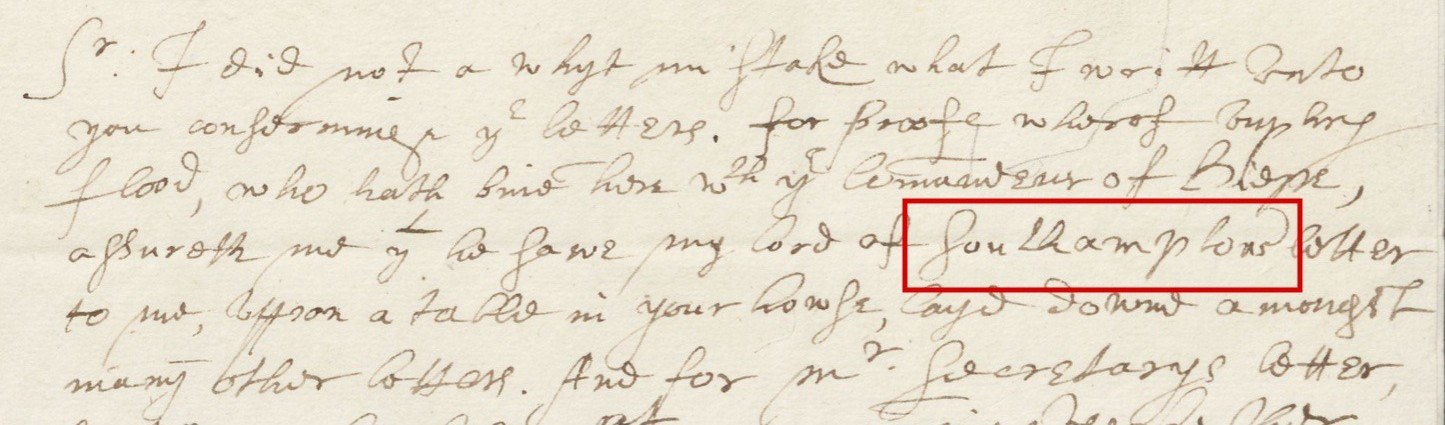
Sir Robert Drury to Henry Neville, 6 May 1600. The National Archives, PRO 30/50/2, fols. 97–98. Detail of the opening passage; Southampton’s name is boxed in red. Reproduced with the permission of The National Archives. Source and transcription.
Southampton presents the plan
Neville’s earlier visit to Essex and his later meeting with Southampton were different encounters. In his declaration of 2 March 1601, Neville says that he visited Essex after the middle of October 1600. Essex asked about foreign affairs and spoke of his hopes of regaining the queen’s favour. Neville insists:
But in all his talk I protest I did not hear him use any undutiful speech of the Queen or the state.4
Henry Cuffe, Essex’s secretary and Neville’s longstanding acquaintance, subsequently pressed him to meet Southampton and Sir Charles Danvers. Cuffe assured him that nothing would be attempted against the queen’s person or estate. After repeated delays, Neville went to Drury House on 2 February 1601. It was Southampton who then presented the plan, explaining that Essex had authorized him to disclose “a matter of great secrecy and importance.”4
Southampton made the case for Essex to reach the queen with enough armed supporters to prevent his enemies from barring access. Men would seize the court gate and the guards’ halberds; sympathetic lords would receive Essex and accompany him into the royal presence. Southampton sought Neville’s advice, and he and Danvers answered the practical objections Neville raised. At the close, Neville records:
In conclusion they prayed me to think of it because it was new unto me4
Neville’s declaration records the attempt to enlist him, together with his objections and his subsequent refusal to act against Cecil. Chapter 6 gives the fuller account of the Essex crisis.4
A later alliance
Neville and Southampton then spent nearly two years in the Tower together. Neville joined Southampton there on 1 May 1601, and both remained imprisoned until James’s accession. They were released together in April 1603: the king’s letter of 5 April ordered Southampton’s release and added Neville’s, and both were free by 10 April. Chapter 42, “The Sonnets: Bound for a Friend,” examines that shared change of fortune.6
On 2 April 1604, Neville was named to the Commons committee considering Southampton’s restitution: the parliamentary restoration of the earl’s rights after his conviction for treason.7
Less than three months later, they faced another arrest. On Sunday 24 June 1604, James and his council ordered Southampton, Henry Danvers (Lord Danvers), and Neville into custody. Henry was the brother of Sir Charles Danvers, who had been executed for his part in the Essex rising. Historian Neil Cuddy, in his 1989 article on Anglo-Scottish union and James’s court, records:
their papers were seized and the suspects interrogated, but they were released next day after ‘several examinations’.7
The accusation concerned Southampton’s supposed intention to kill Scots close to the king. Cuddy places the episode amid disputes over James’s plans to unite England and Scotland and the privileged access of his Scottish attendants to the king. It was an allegation circulated by Southampton’s enemies.7
Southampton later became Neville’s “champion” in the contest for the secretaryship. In the description reported from their political opponent Henry Howard, Earl of Northampton, Neville was Southampton’s “dear Damon.” The allusion is to Damon and Pythias, the classical exemplars of faithful friendship: one risked his life as surety for the other. Here it identifies Neville as Southampton’s especially close and trusted ally. Chapter 9 follows their campaign through the letters, including Southampton’s own hopes and doubts about Neville’s appointment.8
A promise and its answer
In 1593, years before the Tower and the secretaryship campaign, Venus and Adonis addressed Southampton with a nervous question: would the writer offend him by offering these “unpolished lines”? A year later, Lucrece opened with a declaration: “The love I dedicate to your Lordship is without end.” Uncertainty had become assurance.1,2
The dedication of Venus and Adonis offers Southampton the power to turn the writer’s public risk into success:
TO THE RIGHT HONORABLE
Henry Wriothesley, Earl of Southampton,
and Baron of Titchfield.Right Honorable,
I know not how I shall offend in dedicating my unpolished lines to
your Lordship, nor how the world will censure me for choosing so
strong a prop to support so weak a burden; only if your Honor seem
but pleased, I account myself highly praised and vow to take advantage
of all idle hours till I have honored you with some graver labor.
But if the first heir of my invention prove deformed, I shall be sorry it
had so noble a godfather and never after ear so barren a land, for fear it
yield me still so bad a harvest. I leave it to your honorable survey, and
your Honor to your heart’s content, which I wish may always answer
your own wish and the world’s hopeful expectation.Your Honor’s in all duty,
William Shakespeare.1
The uncertainty is sustained through a series of images. Southampton is a prop supporting a burden, a godfather to a possibly deformed child, and the judge of a doubtful harvest. “Ear” means plough: the writer will abandon the barren field if his first harvest disappoints. He asks for approval and promises “some graver labor” in return. “The first heir of my invention” announces a beginning in print; it need not mean the first thing the writer had ever composed.1
Lucrece answers the promise of greater gravity. Its dedication is shorter, but the commitment is larger:
TO THE RIGHT
HONORABLE, HENRY
Wriothesley, Earl of Southampton,
and Baron of Titchfield.The love I dedicate to your Lordship is without end; whereof this
pamphlet without beginning is but a superfluous moiety. The warrant
I have of your honorable disposition, not the worth of my untutored
lines, makes it assured of acceptance. What I have done is
yours; what I have to do is yours; being part in all I have, devoted
yours. Were my worth greater, my duty would show greater; meantime,
as it is, it is bound to your Lordship, to whom I wish long life
still lengthened with all happiness.Your Lordship’s in all duty,
William Shakespeare2
The writer now claims a warrant for acceptance in Southampton’s disposition. Past work, future work and personal devotion all belong to him. The modest description of “untutored lines” survives, but it no longer creates doubt.
In her 2011 study of a verse letter attributed to Southampton, literary scholar Lara Crowley distinguishes the conventional flattery of the first dedication from the intimacy and affection of the second. That judgment concerns the whole address: the change from asking whether a gift will offend to declaring an enduring attachment.9
How unusual was this dedication?
A computational study carried out for this book compared 804 dedications from 638 books dated 1590–1600. The Lucrece dedication ranked second overall for the personal character of its address—within the top quarter of one percent of the sample. Five methods examined whom the writer addressed, expressions of personal attachment, direct address and the balance between intimacy and public formality. Their individual results were:
| Method | Lucrece’s rank out of 804 |
|---|---|
| Comparisons between pairs of dedications | 2 |
| Patterns of words and phrases | 3 |
| Intimacy relative to formality | 7 |
| Word associations and textual features | 12 |
| Recipient specificity and personal relations | 16 |
| Combined ranking | 2 |
Two methods placed it in the top three; all five placed it in the top two percent.10
The dedication ranked first was William Vaughan’s The Golden-grove (1600), addressed to his own brother, Sir John Vaughan. It begins with Cato repeatedly naming his brother as the person he loved best, then turns to the author’s own affection. Vaughan writes of “our mutual love” and his wish:
to impart unto you the just half of my substance, nay in a manner all my substance.10
In Lucrece, the gift likewise extends beyond the book in hand: “What I have done is yours; what I have to do is yours.” Its declaration of love without end stands beside a dedication grounded explicitly in brotherhood. The combined ranking is exploratory, but the consistently high placement gives numerical support to the exceptional personal character of the address.10
The motto on the title page
Before the dedication presents the name William Shakespeare, the title page of Venus and Adonis presents a Latin phrase that James Leyland connects with the Neville family motto:
Vilia miretur vulgus: mihi flavus Apollo
Pocula Castalia plena ministret aqua.
— Venus and Adonis (1593), title page; Ovid, Amores 1.15.35–36
“Let the crowd admire base things; may golden-haired Apollo supply me with cups full of Castalian water.” The Neville motto, Ne vile velis, means “Desire nothing base.” Vilia and vile are forms of the same Latin adjective; the table below shows their relationship.11

The title-page epigraph enlarged; the box marks Vilia. Venus and Adonis (1593), Bodleian Libraries, Arch. G. e. 31 (2). Image © Bodleian Libraries, Oxford, 2015; Shakespeare Documented.
Both phrases use the accusative neuter of vilis, “base” or “worthless”; only the number changes.
| Phrase | Form | Meaning |
|---|---|---|
| Ne vile velis | Singular | Desire nothing base |
| Vilia miretur vulgus | Plural | Let the crowd admire base things |
The full declension is given in the note.12
Leyland draws attention to its position at the beginning of the first published work carrying Shakespeare’s name as author. He proposes that the quotation also recalls the Neville motto: a family identity suggested before the printed dedication supplies the public name. Shakespeare’s name appears beneath the address to Southampton on the following leaf, A2r.11
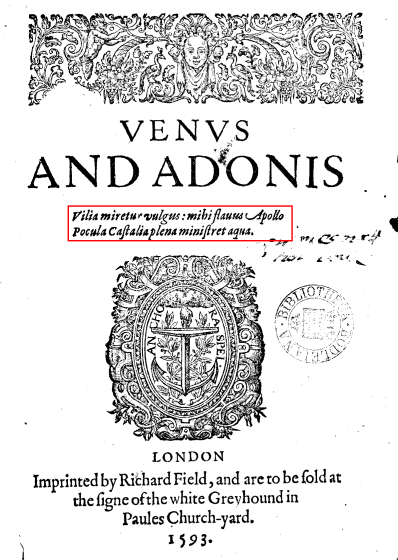
Venus and Adonis (1593), title page. The epigraph begins Vilia miretur vulgus. Bodleian Libraries, Arch. G. e. 31 (2). Image © Bodleian Libraries, Oxford, 2015; Shakespeare Documented.
Ovid’s lines contrast the crowd’s tastes with the poet’s desire for inspiration and lasting fame. That literary declaration may also carry the personal allusion Leyland proposes. The later poems and jokes explicitly playing on the Neville motto, examined in the Sonnet 121 chapter, show how readily the family name could invite such wordplay.11
Collatinus in Neville’s Dionysius
Neville’s annotation in the 1546 Greek edition of Dionysius of Halicarnassus’s Roman Antiquities, now at Audley End, names Tarquinius Collatinus. The same note appears in the Coriolanus chapter for its reference to Ancus Martius. Here the other name brings us to Lucrece’s husband.13
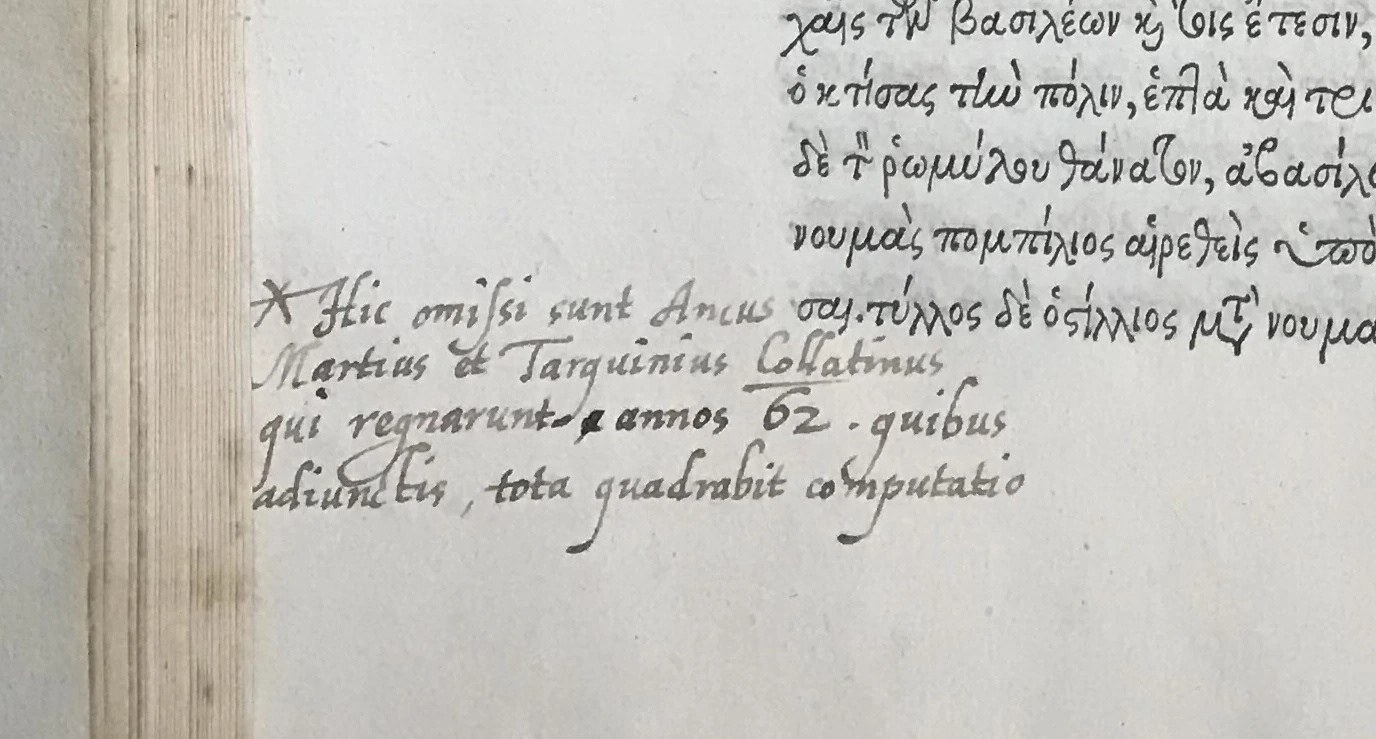
Dionysius, Roman Antiquities (1546), Audley End copy, p.45. Published image.
The note begins:
Hic omissi sunt Ancus
Martius et Tarquinius Collatinus
“Here Ancus Martius and Tarquinius Collatinus have been omitted.” It continues that sixty-two years must be added to make the calculation come right.13
The annotator likely wrote Collatinus in error: the missing king is Lucius Tarquinius Priscus, whose thirty-eight years, added to Ancus Martius’s twenty-four, supply the missing sixty-two. Collatinus appears as a consul earlier on the same page. Familiarity with the story of Lucretia and her husband may also have brought his name to mind.13
The Argument to The Rape of Lucrece places Collatinus at the beginning of the action. During the siege of Ardea, the Roman commanders compare their wives:
[…] men of the army meeting one evening at the tent of Sextus Tarquinius,
the King’s son, in their discourses after supper every one
commended the virtues of his own wife; among whom Collatinus
extolled the incomparable chastity of his wife Lucretia.14
Collatinus’s praise leads to the visit at which Sextus Tarquinius sees Lucrece. Collatinus is her husband; Sextus, the king’s son, is her assailant.
“Deep policy”
The Argument to Lucrece makes the story explicitly political: a royal crime leads to the overthrow of the monarchy. After Lucrece’s death, Lucius Junius Brutus denounces “the tyranny of the King,” moves the people to act, and brings about a change of government:
[…] the people were so moved that with one consent and a general
acclamation the Tarquins were all exiled and the state government
changed from kings to consuls.
— Lucrece, Argument14
Richard Field printed Lucrece in 1594. That year he also printed William Jones’s translation of Justus Lipsius’s Politickes, a work addressed to those who govern or advise in public states.15
The promised “graver labor” thus follows sexual violence into revolution. Tarquin’s violation of Lucrece, hospitality and royal obligation becomes the occasion for expelling his family. Brutus, who has protected himself by appearing foolish, now reveals his intelligence and directs the grieving men towards political action:
But now he throws that shallow habit by
Wherein deep policy did him disguise, […]
— Lucrece, lines 1814–181516
Political survival through a managed public appearance connects this passage with Neville’s education under Savile and his engagement with Tacitus. The disguise belongs to the classical story; the poem calls it “deep policy.” Feisal Mohamed’s 2019 study places Brutus’s prudence and pursuit of political interest at the centre of its interpretation.16
Notes and sources
William Shakespeare, Venus and Adonis (London: Richard Field, 1593), dedication, sig. A2r, Bodleian Library, Arch. G. e.31 (2); first-edition record and images, Shakespeare Documented. The record supplies the 18 April 1593 registration and Adam G. Hooks’s interpretation of “first heir” as the first published work. Dedication quoted in the modern spelling and line divisions of the Folger Shakespeare edition.↩︎
Shakespeare, Lucrece (London: Richard Field for John Harrison, 1594), dedication, sig. A2r, Folger Shakespeare Library, STC 22345 copy 1; first-edition record and images. Registration: 9 May 1594. Dedication quoted from the Folger Shakespeare edition, preserving its line divisions.↩︎
Lara M. Crowley, “Was Southampton a Poet? A Verse Letter to Queen Elizabeth,” English Literary Renaissance 41, no. 1 (2011): 111–145, pp. 123–125 and n. 31. Southampton was born on 6 October 1573. His father’s birth announcement survives as Folger MS L.b.584 and is printed in Alfred John Kempe, The Loseley Manuscripts (1836), p. 240. The digital catalogue’s bracketed 5 October conflicts with the standard date and the letter’s Tuesday dateline. Legal majority was twenty-one; receipt of inherited estates additionally required livery: The National Archives, Court of Wards guide. No claim of immediate unrestricted estate possession on the birthday is intended.↩︎
Henry Neville, declaration, 2 March 1601, The National Archives, SP 12/279, fol. 15; Calendar of State Papers, Domestic, Elizabeth, 1601–1603, p. 6. Quotation modernized from the manuscript-based transcription; “my Lord” in this sentence is Southampton. The declaration describes renewed contact through Henry Cuffe and the meeting at Drury House.↩︎
Sir Robert Drury to Sir Henry Neville, London, 6 May 1600, The National Archives, PRO 30/50/2, fols. 97–98; catalogue. Image and transcription published in Ken Feinstein, “Shakespeare, Southampton, Humphrey Fludd and Henry Neville”, 16 August 2019, transcription prepared with John O’Donnell; sender identified by Andrew Zurcher. Spelling modernized. The address identifies Neville as ambassador in France. Drury reports Fludd’s sighting; the manuscript does not locate the house or establish that Neville read Southampton’s letter. Neville to Cecil, Paris, 26 February 1599/1600, in Ralph Winwood, Memorials of Affairs of State, vol. 1 (1725), p. 155: “The opportunity of Sir Robert Drury’s return is the cause that I sent no messenger purposely with this advertisement […] hoping it will come by his means in reasonable time” (spelling modernized). This supports Paris as a possible location.↩︎
The Tower officer’s notes record Neville’s arrival on 1 May 1601: Calendar of State Papers, Domestic, Elizabeth, 1601–1603 (1870), p. 91. James I to the nobles and councillors at Whitehall, Holyrood, 5 April 1603, printed in C. C. Stopes, The Life of Henry, Third Earl of Southampton (1922), pp. 259–260; contemporary copy, Folger V.a.321, fols. 16v–17, catalogue. Calendar of State Papers, Domestic, James I, 1603–1610 (1857), p. 2, item 18, dated 10 April, reports both men’s release; Manningham’s 10 April diary reports the release as the previous day. Hence “by 10 April.”↩︎
Journals of the House of Commons, I, 2 April 1604, pp. 161–162, and second scribe’s entry. The record establishes committee nomination. For the subsequent arrest and political collaboration, Neil Cuddy, “Anglo-Scottish Union and the Court of James I, 1603–1625,” Transactions of the Royal Historical Society, 5th ser., 39 (1989): 107–124, especially pp. 113–114 and 117–119. The arrest passage quoted is on p. 113, continuing on p. 114; article. Cuddy names Neville. Nicolò Molin’s contemporary dispatch names Southampton and Danvers but leaves five other detainees unnamed: Calendar of State Papers, Venetian, X, nos. 238 and 242, pp. 165–168. The allegation is not evidence that a plot existed. For the distinction between the brothers, see G. F. R. Barker, “Danvers, Henry (1573–1644),” Dictionary of National Biography, vol. 14 (1888), biography.↩︎
Neil Cuddy, “Anglo-Scottish Union and the Court of James I, 1603–1625,” Transactions of the Royal Historical Society 39 (1989), pp.107–124, at p.117, describes Neville as Southampton’s “dear Damon.” For the attribution to Northampton, John Casson, “The Earl of Southampton, Richard III, Shakespeare and Henry Neville,” p.1 and n.2, reports Northampton’s November 1613 letter to Rochester and identifies Cambridge University Library, MS Dd.3.63, fol.50v, citing Brenda James and William D. Rubinstein, The Truth Will Out (2005), p.246. Casson paper. For the friendship story, see Cicero, De officiis 3.45 (Phintias is the form of Pythias’s name used there). The phrase is a description of the pair, not established here as Southampton’s own form of address. Chamberlain to Carleton, 4 November 1612, McClure, Letters, I, p.387; Southampton to Winwood, 6 August 1613, Sawyer, Memorials, III, p.475.↩︎
Crowley, “Was Southampton a Poet?”, pp. 123–125, especially p. 124 and nn. 31, 33. Conventional words such as duty, honour and happiness should not be treated as a personal verbal signature. The whole dedicatory progression is the comparison at issue.↩︎
Dedications extracted from the Early English Books Online Text Creation Partnership corpus, publication-date selection 1590–1600: 804 dedication records from 638 TCP texts. The analysis conducted for this book combined two rule-based scores with lexical, word-vector and pairwise regression methods, weighting their percentile ranks by performance against 270 provisional reference labels. Lucrece (TCP A12035) ranked 16, 7, 3, 12 and 2 respectively; combined rank 2. These are measures of textual personalness, not independently validated measurements of an actual relationship. The models share features and calibration material; their agreement is not five independent historical tests. The first three combined scores are close, and the precise ordering should not carry more weight than the consistently high placement. The scored corpus does not include Venus and Adonis and is not a census of all surviving dedications. For the comparison, William Vaughan, The Golden-grove (1600), dedication to Sir John Vaughan, TCP A14293, public text. Vaughan’s spelling is modernized here; the complete dedication, rather than the website’s machine-modernized version, controls the quotation.↩︎
William Shakespeare, Venus and Adonis (London: Richard Field, 1593), title page and sig. A2r, Bodleian Libraries, Arch. G. e. 31 (2), first-edition images and account by Adam G. Hooks, Shakespeare Documented. Ovid, Amores 1.15.35–36; see William Turpin’s Latin text and commentary, Dickinson College Commentaries, especially lines 31–42. Translation supplied here; Latin u/v normalized. The epigraph’s possible reference to Neville’s motto is James Leyland’s interpretation; it is not a literal quotation of the motto.↩︎
Enrico Olivetti, Latin Dictionary, declension of vilis. Full declension (masculine/feminine, neuter; singular then plural): nominative and vocative, vilis, vile / viles, vilia; genitive, vilis, vilis / vilium, vilium; dative and ablative, vili, vili / vilibus, vilibus; accusative, vilem, vile / viles, vilia. Masculine and feminine share their forms. The alternative masculine/feminine accusative plural ending -īs is not shown. In both quoted phrases the adjective stands substantivally, meaning a base thing or base things; no expressed noun is required.↩︎
Dionysius of Halicarnassus, Roman Antiquities (Paris: Robert Estienne, 1546), Audley End copy, p. 45, at 1.75; photograph reproduced and attributed to Neville in Ken Feinstein, “Part 8: Henry Neville and Henry Savile Annotations in Roman Antiquities”, 16 October 2020. The note reads “Hic omissi sunt Ancus / Martius et Tarquinius Collatinus / qui regnarunt [mark, unexpanded] annos 62. quibus / adiunctis, tota quadrabit computatio.” Translation supplied here. Compare the 1546 edition, BSB scan 00048: the missing regnal entries are Ancus’s twenty-four years and Priscus’s thirty-eight, restoring 182 to 244. Collatinus is named as a consul in 1.74 on the same printed page. Neither the nearby name nor possible familiarity with the Lucretia story establishes why the annotator wrote it; both are suggested explanations of the apparent slip. The transcription preserves Collatinus as written. The passage is a cross-reference to the figure in Lucrece, not a note about Lucrece’s assault or evidence that the poem was being composed.↩︎
Shakespeare, Lucrece (1594), the Argument, Folger Shakespeare edition. Excerpts preserve Folger’s line divisions. The opening excerpt begins within the account of the siege; the second excerpt is the conclusion of the Argument. Collatinus, Sextus Tarquinius and Lucius Tarquinius Superbus are distinct people.↩︎
Justus Lipsius, Sixe Bookes of Politickes or Civil Doctrine, translated by William Jones (London: Richard Field for William Ponsonby, 1594), STC 15701, TCP A05583. Same printer and year establish a publication context. Richard Field the printer must be distinguished from Dr Richard Field the theologian, whose visits to Neville are described in Nathaniel Field, Some Short Memorials Concerning the Life of that Reverend Divine Doctor Richard Field (1716–17), p. 12.↩︎
Shakespeare, Lucrece, Folger text, lines 1807–1817, and the Argument. Brutus’s assumed foolishness belongs to the classical narrative; the political wording is discussed as the poem’s treatment of that inherited action. For a fuller interpretation, see Feisal G. Mohamed, “Raison d’état, Religion, and the Body in The Rape of Lucrece,” Religions 10, no. 7 (2019): 426, article.↩︎
