A dispute over deer opens The Merry Wives of Windsor. Justice Shallow accuses Falstaff of breaking into his lodge, killing his deer and beating his men:
SHALLOW Knight, you have beaten my men, killed my
deer, and broke open my lodge.FALSTAFF But not kissed your keeper’s daughter.1
— The Merry Wives of Windsor, 1.1
In the fuller Folio text, venison also brings the neighbours together.2 Page thanks Shallow for a gift, and Shallow apologizes for its quality:
PAGE I am glad to see your Worships well. I thank you
for my venison, Master Shallow.SHALLOW Master Page, I am glad to see you. Much
good do it your good heart! I wished your venison
better; it was ill killed. How doth good Mistress
Page? And I thank you always with my heart, la,
with my heart.
— The Merry Wives of Windsor, 1.1
Finally Page proposes to settle the company at dinner:
PAGE Wife, bid these gentlemen welcome.—Come, we
have a hot venison pasty to dinner. Come, gentlemen,
I hope we shall drink down all unkindness.3
— The Merry Wives of Windsor, 1.1
Venison is both the cause of the dispute and the means of restoring neighbourly relations. Neville’s letter to Sir Richard Beaumont, written from Billingbear and tentatively dated 1606 by its editor, describes the same kind of exchange from inside the supplying household:
Noble Sir,
I am very sorry that it lies not in my power to send you half a buck; my keepers tell me that there is none in my walk; sure I am that I have not seene a pasty of venison of this yeere. I did adventure to send you the side of a stag which I thought might serve your turne as well if it came sweet to you, which the heate of the weather made me fearfull of. But my cooke and keeper were confident, and I caused them to take the best order for the coole conveyance of it. […]4
Neville’s keepers cannot supply the requested buck, so he sends a side of stag. He consults his cook and keeper about the heat and arranges cool transport. Like Shallow, he couples the gift with an apology about its quality: Shallow regrets the bad kill; Neville hopes the meat will arrive sweet.
Randall Martin calls Merry Wives Shakespeare’s “most locally detailed play.” Its town, river, castle and forest belonged to the landscape in which Neville’s family lived and held office.5
The work behind the comedy
Neville grew up at Billingbear, where his father built the house in 1567, and inherited it in 1593. He represented New Windsor in Parliament in 1584 and 1593 and became a freeman of the borough in 1588. His family’s responsibilities reached from the estate into the town and forest.6
Windsor Forest was governed by forest law. A walk was a district within it; parks and rails were enclosed deer grounds. John Norden’s 1607 survey names Neville as keeper of Swinley Walk, records his claim to hereditary keepership of Binfield Walk, otherwise Fines Bailiwick, and describes Warfield Walk as reputedly his private property. Much of Fines was enclosed ground which Neville had recently begun stocking with red and fallow deer.7
These appointments involved practical work. In January 1599 Elizabeth instructed Neville to arrange the restraint of deer-killing in Mote and Sunninghill Parks during his embassy in France. A royal grant of September 1607 records his keeperships of both parks, within Cranbourne Walk, and his riding forestership of Battles Walk—a mounted forest office—with succession to his son Henry. Requests for venison came to him: in August 1606 Lord Buckhurst asked for a buck for Edward Fenner.8,9
The same work had occupied Neville’s father. His correspondence shows how readily deer-taking became a confrontation between gentlemen. On 13 April 1589 he reported to Sir William More that a masked gentleman and two companions had hunted a hind and calf at Finchampstead. The man refused to uncover his face. Keepers followed the party to an inn at Guildford, where blood and hair helped establish what had happened; constables became involved.10
Shallow’s threat to take his grievance to the Council and the Star Chamber mixes anger with pride in his standing. He and his cousin Slender rehearse the titles that should make people respect him, stumbling over the official language.
SLENDER In the county of Gloucester, Justice of Peace
and Coram.
— The Merry Wives of Windsor, 1.1
SHALLOW Ay, Cousin Slender, and Custalorum.11
— The Merry Wives of Windsor, 1.1
Neville was also a justice of the peace. Shallow’s “Custalorum” garbles custos rotulorum, keeper of the county rolls—an office Neville himself held in Berkshire.1 The joke gives the dispute a recognizable social setting: an injured gentleman invokes the dignity of his public position to reinforce a personal complaint. Neville’s Warfield dispute, discussed in Chapter 8, likewise required him to distinguish the rights affected by a deer offence and who could act upon it.
A town the plot knows how to use
Falstaff hopes to profit by wooing two prosperous married women, Mistress Ford and Mistress Page. They compare his letters, discover his double approach, and use the town and its surroundings to punish him.12
The first trick results in Falstaff climbing into a large basket and being covered with dirty linen. Mistress Ford orders the servants to carry the basket from the brewhouse to the “whitsters,” or laundresses, at Datchet Mead:
MISTRESS FORD […] be ready here hard by in the brewhouse,
and when I suddenly call you, come forth, and
without any pause or staggering take this basket
on your shoulders. That done, trudge with it in all
haste, and carry it among the whitsters in Datchet
Mead, and there empty it in the muddy ditch close
by the Thames side.13
— The Merry Wives of Windsor, 3.3
The destination is a working riverside meadow. Local historian Janet Kennish locates Datchet Mead on the Windsor bank of the Thames, across from Datchet village. The old ferry connected Windsor with the route through Datchet towards Colnbrook and London. Norden’s map of Windsor and the Little Park, part of the same survey, shows the ferry, park, castle, bridge and part of Eton in one connected landscape.14
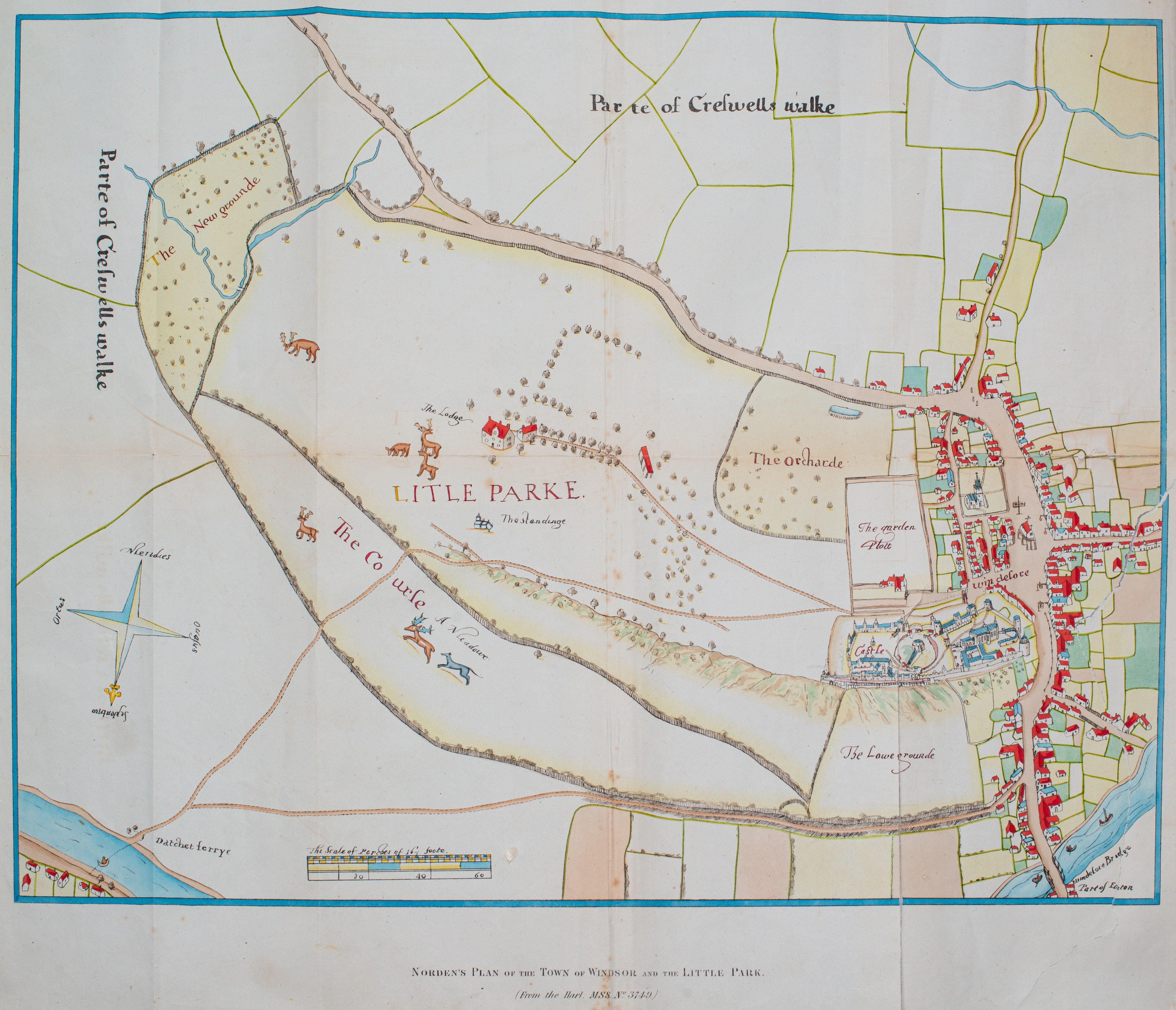
The Host keeps the would-be duellists—the French doctor Caius and the Welsh parson Evans—apart by sending parties towards Frogmore along different routes. The final trick gathers Falstaff and the disguised fairies at Herne’s oak, while rival marriage plans send Anne Page’s suitors towards Eton and the deanery, but Anne herself escapes to marry Fenton. Local geography supplies the machinery of both deceptions.15,16,17
The smaller details make these movements workable. Datchet Lane connects the laundry story to the town; the Petty-ward, Park-ward and Old Windsor way belong to the search for the duellists. The castle ditch and sawpit provide hiding places, and Windsor’s bell supplies the midnight signal. Brentford provides the supposed wise woman of Falstaff’s second disguise; Reading, Maidenhead and Colnbrook appear in the report of cheated innkeepers.18
Even the fairies emerge from a place of work. A sawpit was used to cut timber; in the play it becomes a hiding place beside the haunted oak. Windsor’s trees were a contested resource. A petition by Richard Staverton, keeper of New Lodge, complained that cutting Bray Wood and Bray Neates damaged deer breeding and threatened the lodge’s supply of timber. The archive dates it before 1596.19 The sawpit brings that working forest into the pageant, alongside Herne, whom the play describes as the ghost of a former keeper.
Richard Carew and Falstaff’s words
The play’s language supplies a further connection to Neville’s circle. Margaret Tudeau-Clayton identified a correspondence between Falstaff’s speech and the writing of Richard Carew. She published the comparison in 1999 and developed it in Shakespeare’s Englishes (2019).20
Falstaff dismisses his unwilling messengers with a string of expressions for the same command:
FALSTAFF […]
Rogues, hence, avaunt, vanish like hailstones, go,
Trudge, plod away i’ th’ hoof, seek shelter, pack!
—The Merry Wives of Windsor, 1.3.21
Richard Carew (1555–1620), the Cornish antiquary and author of The Survey of Cornwall (1602), offers a comparable list in his essay The Excellency of the English Tongue:
For example, when we would be rid of one, we use to say, Be going, trudge, pack, be faring, hence, away, shift, and by circumlocution, rather your room than your company, let’s see your back […].22
Both passages pile up commands to leave. Tudeau-Clayton relates this verbal abundance to Carew’s celebration of English linguistic variety, leaving open which passage echoes the other.
The essayist’s younger brother George travelled with Neville and Henry Savile (Chapter 2). The essayist’s son, Richard Carew the younger, later accompanied Neville’s embassy to France to learn French (Chapter 47). Neville thus knew the family across two generations.23
The Billingbear catalogue of 1780 records Carew’s 1602 Survey of Cornwall, in Neville’s family library; a copy of that edition is recorded at Audley End.24
Windsor’s witches and Neville’s father
The wives’ second trick turns local suspicion into a weapon. They disguise Falstaff as the maid’s elderly aunt from Brentford, whom Ford has barred from his house as a witch. Certain that he recognizes her, Ford attacks the disguised knight.
Jessica Dell proposes that the play draws on Windsor’s witchcraft scandals of 1579. Dell identifies the magistrate before whom the accused widow Elizabeth Stile was brought as Sir Henry Neville, the authorial candidate’s father.25
Two contemporary pamphlets recount the accusations: Richard Galis’s Brief Treatise and the anonymous Rehearsall. The latter attributes to Stile a confession involving four red-wax figures pierced with hawthorn prickles to injure the people represented.26
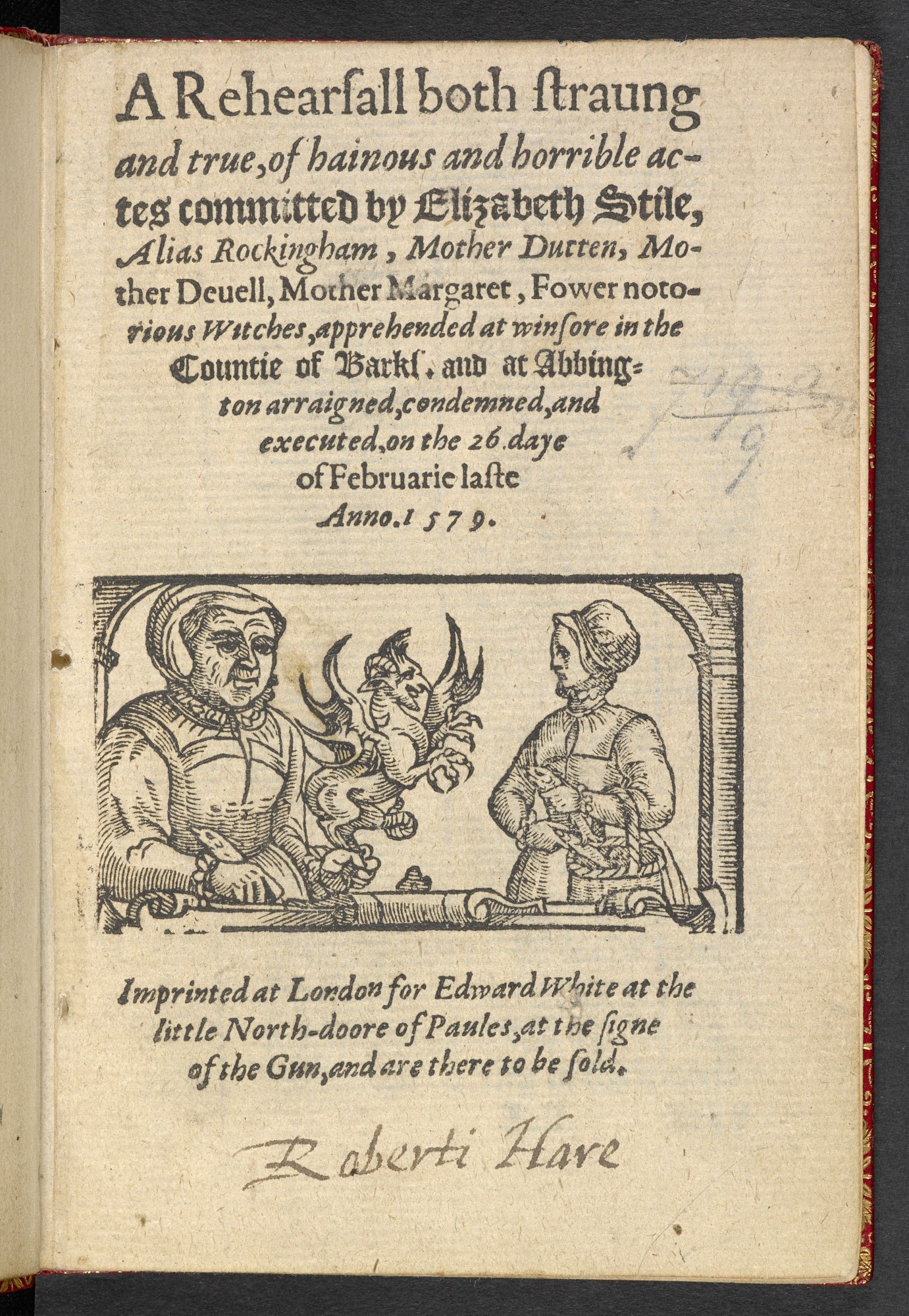

The allegations reached the Privy Council. On 16 January 1579 it wrote to Neville’s father and the Dean of Windsor about people allegedly killed through wax images. Similar devices had recently been suspected against the Queen, so the Council directed them to investigate who had made the images and who had used them.27 The accusations thus reached the household as both a local quarrel and an official investigation.
The accuser Richard Galis believed the women had harmed him. His pamphlet records repeated demands for punishment and his own violent pursuit of them. He consulted the elder Neville’s wife, sought his intervention, and attended an examination at his lodging in Windsor Castle. The women denied witchcraft. Asked to recite the Lord’s Prayer, they were instructed to learn it, the Creed and the Ten Commandments, and ordered to attend public instruction beneath the pulpit. On another occasion Galis tied a cart rope around Stile and dragged her through Windsor on market day to the elder Neville’s lodging. In Galis’s account, Neville and the assembled company let her escape, to his fury.28 The other pamphlet, A Rehearsall, records the elder Neville’s examination of Stile and her committal to Reading gaol before the assizes.26
Julie Stone Peters examines Galis’s attempts to force proof of witchcraft in Staging Witchcraft before the Law (2025). Galis describes threatening four kneeling women with a cudgel unless they identified and relieved Master Handley’s illness. After recounting Stile’s release, he describes his own repeated beatings of suspected witches:
[…] I would nowe one, then an other, so Ribrost with my cudgell (caried always about mée for the same purpose) […]29
In the comedy Ford believes that an old woman visiting his house practises precisely such hidden arts:
FORD A witch, a quean, an old cozening quean! Have
I not forbid her my house? She comes of errands,
does she? We are simple men; we do not know
what’s brought to pass under the profession of
fortune-telling. She works by charms, by spells, by
th’ figure, and such daubery as this is, beyond our
element. We know nothing.—Come down, you
witch, you hag, you! Come down, I say!30
— The Merry Wives of Windsor, 4.2
Earlier, Mistress Page anticipates the beating:
MISTRESS PAGE Heaven guide him to thy husband’s
cudgel, and the devil guide his cudgel afterwards!
— The Merry Wives of Windsor, 4.230
After the beating, Mistress Page declares that the cudgel “hath done meritorious service.” Galis beats women he believes to be witches; Ford beats Falstaff disguised as a woman he believes to be a witch. The cudgel is named in both texts. Dell connects the comedy with the Windsor accusations and emphasizes the wives’ control of the disguise; Peters analyzes Galis’s coercion. The further comparison here brings their findings together: Ford’s violence rests on a certainty the audience knows is mistaken.
The keeper’s share
The forest becomes part of Falstaff’s disguise in the final scene. Mistress Page has recalled a local tale about Herne the Hunter, a former keeper who walks round an oak at midnight, wearing ragged horns and shaking a chain. The wives use this frightening figure to set the terms of their promised meeting. Falstaff is to come dressed as Herne.31
He accepts because he still believes the women desire him. Wearing antlers, he imagines himself the successful hunter and offers them his body as a divided deer:
FALSTAFF Divide me like a bribed buck, each a haunch.
I will keep my sides to myself, my shoulders for
the fellow of this walk, and my horns I bequeath
your husbands. Am I a woodman, ha? Speak I like
Herne the Hunter? Why, now is Cupid a child of
conscience; he makes restitution. As I am a true
spirit, welcome.
[A noise of horns within.]31,32
— The Merry Wives of Windsor, 5.5
Most of the distribution is easy to follow: the wives receive the haunches, while the husbands inherit the horns that signify cuckoldry. The shoulders, however, go to someone outside this sexual arrangement—the man responsible for the walk.
William Harrison’s Description of England, published with Holinshed’s Chronicles in 1577 and 1587, explains the custom. Harrison, who became a canon of Windsor in 1586, describes the keeper’s payment in his chapter on parks and warrens. In modern spelling:
[…] who beside three shillings four pence or five shillings in money, hath the skin, head, umbles, chine, and shoulders: whereby he that hath the warrant for a whole buck hath in the end little more than half, which in my judgment is scarcely equal dealing […]33
The umbles were the entrails; the chine was the backbone with adjoining meat. The keeper’s allowance left the recipient of a whole buck with little more than half to take home.
Falstaff’s sexual fantasy preserves the keeper’s entitlement. Even as the wives turn him into their quarry, he divides the imagined carcass according to a custom familiar to the men who managed Windsor’s deer.
The Garter from ceremony to comedy
At the haunted oak, the final entertainment invokes the royal castle. Mistress Quickly, playing the Fairy Queen, sends her followers to bless Windsor and then invokes the Order of the Garter.34
The wives’ final pageant resembles the country-house entertainments staged for Elizabeth I, including the one at Bisham in 1592. The family connection with Bisham went back to 1562: Neville’s mother Elizabeth Neville and grandmother Frances Gresham were godmothers to Elizabeth Hoby, daughter of Thomas Hoby and Elizabeth Cooke. These ties preceded Neville’s own marriage to Anne Killigrew in 1584.34
The Order of the Garter’s chapel is St George’s at Windsor. Mistress Quickly’s speech names its knights’ stalls and heraldic emblems, then recreates the embroidered garter and its French motto—Honi soit qui mal y pense, “Shame on him who thinks this evil”—in meadow flowers:35
MISTRESS QUICKLY, [as Fairy Queen] […]
The several chairs of order look you scour
With juice of balm and every precious flower.
Each fair installment, coat, and sev’ral crest
With loyal blazon evermore be blest!
And nightly, meadow fairies, look you sing,
Like to the Garter’s compass, in a ring.
Th’ expressure that it bears, green let it be,
More fertile-fresh than all the field to see;
And Honi soit qui mal y pense write
In em’rald tufts, flowers purple, blue, and white,
Like sapphire, pearl, and rich embroidery,
Buckled below fair knighthood’s bending knee.35
— The Merry Wives of Windsor, 5.5
For the Garter installation at Windsor on 16 December 1589, the royal wardrobe keeper prepared Neville’s father’s lodging as well as the Dean of Windsor’s house to accommodate visiting noblemen.36
Neville’s own part in Garter ceremony is documented in 1595. On 23 April 1595, at Whitehall, Elizabeth sent him to escort the Württemberg envoy Hans Jakob Breuning von Buchenbach. Breuning records two coaches and numerous servants, Neville’s invitation in French, the journey by coach and royal barge, and his remaining with the visitors throughout the ceremony.37
Breuning’s mission was to obtain the Garter for Frederick, Duke of Württemberg and Count of Mömpelgard. His account describes the clothing, jewels, garters, French motto and procession that Neville witnessed as the Queen’s appointed host.38
This gives a particular interest to the comedy’s German visitors. In Act 4, the Host loses horses to supposed Germans; the 1602 quarto calls the cheats “cosen garmombles.” In Sir Henry Neville Was Shakespeare: The Evidence (2016), John Casson and William D. Rubinstein connect this possible play on Mömpelgard with Frederick’s visit to England and pursuit of the Garter. Neville had personally escorted the envoy pursuing that honour. His later diplomacy kept him in contact with Württemberg’s representatives: on 9 May 1600 he reported news received from its ambassador about Danish naval preparations.39
Notes and sources
Merry Wives, 1.1; Thrush, “Neville, Sir Henry I,” offices: custos rotulorum by 1601 and again by 1604 until his death.↩︎
These passages follow the longer text preserved in the 1623 Folio. The 1602 quarto already has the deer grievance, the antlered hunter, the haunches, and the husbands’ horns, but lacks the pasty exchange and the shoulders for the man of the walk. The Folio also contains the extended blessing of the Garter’s chairs, crests, and motto discussed below. The dates when these additional passages were composed remain uncertain. Barbara A. Mowat and Paul Werstine, “An Introduction to This Text,” The Merry Wives of Windsor; A Most Pleasaunt and Excellent Conceited Comedie, of Syr John Falstaffe, and the Merrie Wives of Windsor (1602), TCP A11983, compared with the 1623 Folio, TCP A11954. The quarto names the hunter “Horne” and also lacks the Folio’s extended Garter blessing.↩︎
Merry Wives, 1.1, the thanks for venison and Page’s invitation to dinner.↩︎
W. D. Macray, ed., Beaumont Papers: Letters Relating to the Family of Beaumont, of Whitley, Yorkshire, from the Fifteenth to the Seventeenth Centuries (Roxburghe Club, 1884), p. 13 and p. 14. The printed page images establish the text, address to Sir Richard Beaumont, and editorial date “[1606?].” The source manuscript, cited by Macray at fol. 120, has not been newly collated.↩︎
Randall Martin, Shakespeare and Ecology (Oxford University Press, 2015), chapter 1, “Localism, Deforestation, and Environmental Activism in The Merry Wives of Windsor,” pp. 32–55, especially p. 33; chapter DOI. Martin also considers maps, chorographies, and information received from others. His geographical finding is the starting point for the Neville comparison developed here.↩︎
John Harley, “‘My Ladye Nevell’ Revealed”, Music & Letters 86.1 (2005), 1–15, especially 4–6; Andrew Thrush, “Neville, Sir Henry I (1564–1615)”, in The History of Parliament: The House of Commons 1604–1629, ed. Andrew Thrush and John P. Ferris (2010), family, offices, and biography. Thrush dates the Berkshire magistracy from 1593 and records interruptions following the Essex affair in 1601.↩︎
R. R. Tighe and J. E. Davis, Annals of Windsor, II (1858), pp. 28–30, printing and describing Norden’s 1607 survey. The account of Fines and its stocking is on p. 30. “Reputed” and the claim to inheritance follow the survey’s distinctions. John Norden, Survey of the Honor of Windsor (1607), British Library, Harley MS 3749, f. 4r, table of walks, keepers and deer; ff. 4v–4*r, general forest map. The manuscript catalogue and Tighe and Davis’s printed account were consulted, not the original manuscript. The catalogue describes seventeen walks; the printed account lists sixteen entries, one combining Linchford and Ashe. For geographical orientation, see Horace Woollaston Monckton, Berkshire (1911), ch. 24, pp. 146–148: Fines lay between Maidenhead/Bray and Wokingham/Twyford; Ascot Racecourse occupied part of Swinley Walk. These descriptions do not establish exact modern boundaries. On forest law and the riding forester, see J. Charles Cox, The Royal Forests of England (1905), chs. I and III.↩︎
Mary Anne Everett Green, ed., Calendar of State Papers, Domestic Series, of the Reign of Elizabeth, 1598–1601 (1869), p. 157, “[Jan.]” 1599, abstract citing Warrant Book I, p. 36.↩︎
Green, ed., Calendar of State Papers, Domestic Series, of the Reign of James I, 1603–1610 (1857), p. 372, 29 September 1607, docquet; Royal Berkshire Archives, D/EN/O12/42, August 1606, letter from Lord Buckhurst to Neville requesting a buck for Edward Fenner; the catalogue describes a request, not a record of delivery. For the parks within Cranbourne Walk, see Tighe and Davis, Annals of Windsor, II, pp. 30, 39. Norden’s Moat table names “M. Staffordton” as keeper, whereas the royal docquet records Neville’s office and his son’s succession. The records cited here do not explain the relationship between the two appointments. Norden’s Moat (also spelled Mote or Moate) table is Harley MS 3749, f. 7r. For the riding forester’s office, see Cox, The Royal Forests of England, ch. III, cited above.↩︎
Surrey History Centre, Loseley manuscripts, LM/COR/3/446, 13 April 1589, Sir Henry Neville to Sir William More. The details follow the repository’s description of this damaged document.↩︎
William Shakespeare, The Merry Wives of Windsor, 1.1, Folger Shakespeare Library. Quotations preserve Folger wording and line breaks. Shallow is explicitly a Gloucestershire justice; the comparison is with Neville’s Berkshire office and park experience, not an assertion that the play makes Shallow a Berkshire officer. For Neville’s offices, see notes 1 and 6; the Warfield dispute is discussed in Chapter 8.↩︎
For Falstaff’s scheme, see Merry Wives, 1.3; for the wives comparing letters, 2.1; for their tricks, 3.3, 4.2, and 4.4–5.5. The argument connecting the play and the scholarly findings to Neville’s possible authorship is this chapter’s.↩︎
Shakespeare, The Merry Wives of Windsor, 3.3, ed. Barbara A. Mowat and Paul Werstine, Folger Shakespeare Library; Falstaff’s recollection is in 3.5. Block quotations preserve Folger’s wording and line breaks, with typographic apostrophes and dashes regularized. Brackets mark omissions; bold emphasis is editorial.↩︎
Janet Kennish, “A brief history of Datchet’s development” (2017), sections on the river, ferry, and early settlement; John Norden’s 1607 plan, in the printed reproduction displayed by the Windsor Local History Group. The plan belongs to the Windsor survey, British Library, Harley MS 3749; the reproduction, rather than the manuscript original, was inspected. The catalogue identifies the Little Park table at f. 5r and its map at ff. 5v–5*r. This town-and-park illustration is distinct from the general forest map and the table naming Neville’s walks.↩︎
Merry Wives, 2.3 and 3.1. The Host sends Shallow, Page, and Slender through the town and takes Caius by the fields.↩︎
Merry Wives, 4.4, 4.6, 5.2, and 5.5. Fenton arranges a vicar at a church; the deanery belongs to Mistress Page’s plan for Caius.↩︎
Anne Page shares her given name with Neville’s wife, Anne Killigrew. Her chosen husband, Fenton, is expressly credited with writing poetry: the Host says that he “writes verses.” The pairing of Anne with a verse-writing gentleman offers a further possible personal echo within the play’s Windsor setting. See Merry Wives, 3.2; Marion E. Colthorpe, Elizabethan Court Day by Day, 1584, p. 46, recording Neville’s marriage to Anne Killigrew on 22 December 1584.↩︎
Original name-group comparison of the 527 plays documented in Pervez Rizvi, “Collocations and N-grams”, rechecked 5 September 2026. The search used normalized spellings and included stage directions. Counts for Merry Wives: Windsor 19; Herne 9; Brentford/Brainford 6; Datchet 4; Eton 4; Frogmore 3; Maidenhead 1; Colnbrook/Colebrook 1. Five plays tie at three groups: The Roaring Girl, The Two Maids of More-Clacke, A Chaste Maid in Cheapside, The City Match, and The Sparagus Garden. The groups were selected from Merry Wives; the comparison measures their concentration across these texts. It includes the personal name Herne, and spelling matches such as “maidenhead” can have non-geographical senses. This is the book’s comparison, not a result reported by Martin or Rizvi. Merry Wives contains all eight, with forty-seven occurrences in total. No other play contains more than three of the selected groups; Datchet and Frogmore occur only in Merry Wives within this collection. For the scene-based list, see The Merry Wives of Windsor 2.3–3.5 and 4.2–5.5, Folger reading text.↩︎
Royal Berkshire Archives, D/EN/O12/27, petition of Richard Staverton to Lord Howard, dated by the catalogue before 1596. This description follows the public archive catalogue, not a new manuscript transcription. For the sawpit and Herne’s former keepership, see Merry Wives, 4.4.↩︎
Margaret Tudeau-Clayton, Shakespeare’s Englishes: Against Englishness (Cambridge University Press, 2019), pp.187–189; “Richard Carew, William Shakespeare, and the Politics of Translating Virgil in Early Modern England and Scotland,” International Journal of the Classical Tradition 5.4 (1999), pp.507–527, especially pp.518–523, article.↩︎
William Shakespeare, The Merry Wives of Windsor, 1.3, Folger Shakespeare Library. The ellipsis omits Falstaff’s preceding directions to Robin.↩︎
Richard Carew, “The Excellency of the English Tongue,” in G. Gregory Smith, ed., Elizabethan Critical Essays, II (Oxford, 1904), p.292; quoted in Tudeau-Clayton, Shakespeare’s Englishes, p.188. Spelling modernized. Compare British Library, Cotton Julius F XI, fol.267r, Shakespeare Documented. The essay first appeared in the 1614 edition of William Camden’s (1551–1623) Remaines, pp.36–44. Tudeau-Clayton, pp.187–188, n.44, argues for possible composition in 1595–96 while reporting a later date for the surviving copy; the manuscript’s date and the essay’s composition are distinct questions.↩︎
George Carew’s identity and relationship to the elder Richard: Westminster Abbey, “Sir George Carew”. W. J. Jones, “Carew, Sir George (c.1556–1612),” Oxford Dictionary of National Biography (2004), as cited in the William & Mary Law Library account; Paul Hunneyball’s History of Parliament entry gives c.1560 instead. For Richard the younger (c.1580–1643), see Historic England, Antony, list entry 1000647. For the journey see Todd, “Henry and Thomas Savile in Italy” (1996), p.440; for the son’s retrospective account see Richard Carew, in Samuel Hartlib, The True and Readie Way to Learne the Latine Tongue (London, 1654), p.46, EEBO-TCP A42982.↩︎
Royal Berkshire Archives, D/EN/F37/1, Catalogue of the Books in the Library at Billingbear, 7 November 1780, entry “Survey of Cornwall by Carew _ Lond. 1602.” English Heritage, Audley End collection inventory, object 81038804, The Survey of Cornwall (1602), Library, Case P, Shelf 1. These are records of later holdings, not a dated acquisition by Henry Neville. For the edition, see the 1602 printed volume.↩︎
Jessica Dell, “‘A witch, a quean, an old cozening quean!’: Image Magic and Shakespeare’s The Merry Wives of Windsor,” in Lisa Hopkins and Helen Ostovich, eds., Magical Transformations on the Early Modern English Stage (Ashgate, 2014), 185–201: the local-history proposal at 186; the Windsor accusations and wax figures at 188–189; the wives and Mother Pratt at 190–193.↩︎
A Rehearsall Both Straung and True, of Hainous and Horrible Actes Committed by Elizabeth Stile … (1579), TCP A12973, Stile’s examination and confession; Dell, 188–189. The age and magical acts are reported by the pamphlet, which presents the accusations as true.↩︎
John Roche Dasent, ed., Acts of the Privy Council of England, new series, XI, 1578–1580 (1895), pp. 20–22, entry of 16 January 1578/79, to Sir Henry Nevell and the Dean of Windsor.↩︎
Richard Galis, [A Brief Treatise Containing the Most Strange and Horrible Cruelty of Elizabeth Stile …] (1579; supplied title), TCP A72130, accounts of the appeal to Neville, religious examination, public instruction, and removal of Stile to his lodging. The earlier episodes are not all securely dated; Galis does not name the wife he consulted.↩︎
Galis also described unsuccessful attempts to burn Mother Dutton’s straw hovel and another adjoining her house with brimstone, gunpowder, linen, an arrow and a match on a stick. Julie Stone Peters, Staging Witchcraft before the Law: Skepticism, Performance as Proof, and Law as Magic in Early Modern Witch Trials (Cambridge University Press, online 2024; print 2025), section 2.1, pp. 8–10, especially p. 10, and the illustration on p. 12. For Galis’s own account, see Richard Galis, A Brief Treatise (1579), TCP A72130, the episodes concerning Master Handley and Mother Dutton’s straw hovels. Peters analyzes Galis’s efforts to produce proof. The comparison with Ford is developed here alongside Dell’s reading of the play. Galis, A Brief Treatise (1579), sigs. B2v, C3v–C4r: B2v describes the four kneeling women and the cudgel held over their backs; C3v–C4r recount Stile’s release and the repeated beatings. The printed pages were checked. “Ribrost” means beat or thrash; the quotation retains the 1579 spelling.↩︎
Merry Wives, 4.2, including the borrowed clothes, Ford’s accusation, and the beating.↩︎
Merry Wives, 4.4, for the tale of Herne and the planned disguise; 5.5, for Falstaff’s speech.↩︎
Shakespeare, The Merry Wives of Windsor, 5.5, Folger Shakespeare Library. The quotation follows the modern Folger edition; it is not offered as evidence for the passage’s presence in the 1602 quarto or for an exact composition date.↩︎
William Harrison, “Of Parkes and Warrens,” Holinshed’s Chronicles (1587), I, pp. 204–206, especially p. 204. The quotation follows the modern-spelling text in Elizabethan England: From “A Description of England”, ed. Lothrop Withington (London: Walter Scott), chapter XX, p. 207, Project Gutenberg text. Bracketed ellipses mark the extract’s boundaries. For Harrison’s work, rectory at Radwinter, and Windsor appointment in April 1586, see “Harrison, William,” Dictionary of National Biography.↩︎
Elizabeth Zeman Kolkovich compares the wives’ final entertainment with the outdoor performances staged for Elizabeth I’s progresses. At Bisham in 1592, Lady Elizabeth Russell’s daughters Anne and Elizabeth played shepherdesses who rejected Pan’s advances and laughed at his threats. These performers were first cousins of Neville’s wife, Anne Killigrew: Russell was the sister of Anne’s mother, Katherine Cooke. Neville’s maternal family had earlier ties to the same household. At the christening of Elizabeth Hoby on 31 May 1562, his mother Elizabeth Neville and grandmother Frances Gresham were godmothers. This Elizabeth was Lady Russell’s daughter by her first husband, Thomas Hoby, distinct from the Russell daughters who performed in 1592. Elizabeth Zeman Kolkovich, “Pageantry, Queens, and Housewives in the Two Texts of The Merry Wives of Windsor”, Shakespeare Quarterly 63.3 (2012), 328–354, especially 331–333 and 342. Kolkovich compares the endings with country-house entertainment, including Bisham in 1592; the relationship to Neville’s family is developed here. Her larger argument considers different political effects of the quarto and Folio endings and the possibility of Jacobean revision. Bisham was the Hoby family home. After Thomas Hoby’s death in 1566, Elizabeth retained possession through her marriage to John, Lord Russell in 1574 and her second widowhood in 1584. She was therefore twice widowed when she hosted the Queen in 1592. Her eldest Hoby son, Sir Edward, gained control of Bisham after her death in 1609; in 1617 he left virtually his entire estate to his son Peregrine. See Andrew Thrush, “Hoby, Sir Edward (1560–1617)”, in The History of Parliament: The House of Commons 1604–1629 (2010), opening biography and sections VI–VII; Colthorpe, “Court Women,” cited below, for the second marriage. Thomas Hoby, The Travels and Life of Sir Thomas Hoby, ed. Edgar Powell (Royal Historical Society, 1902), p. 129, records Elizabeth Hoby’s birth on 27 May 1562 and christening on 31 May, naming both godmothers. For their relationship to Neville, see Elizabeth Neville’s funeral certificate, printed in Granville Leveson Gower, Genealogy of the Family of Gresham (1883), pp. 9–10: it names Frances as Elizabeth’s mother and Henry as Elizabeth’s son and heir. Colthorpe, Elizabethan Court Day by Day, 1584, p. 46, 22 December, records Neville’s marriage to Anne, daughter of Henry Killigrew and Katherine Cooke; her “Court Women: Royal Household,” p. 39, identifies Lady Elizabeth Russell as Katherine Killigrew’s sister and as mother of Anne and Elizabeth Russell. The kinship establishes the family connection; no attendance by Neville at the 1592 entertainment is asserted.↩︎
Merry Wives, 5.5, Mistress Quickly’s fairy blessing; the chairs, coats, and crests occur earlier in the same speech. For the foundation, chapel, heraldry, and translation of the motto, see the Royal Household’s historical account, “The Order of the Garter”.↩︎
The wardrobe account records six days’ preparation by the keeper and four labourers, followed by six days putting things in order, at a cost of fifty-two shillings. Marion E. Colthorpe, Elizabethan Court Day by Day, 1589, p. 34, 16 December: installation of Henry Radcliffe, Earl of Sussex, and Thomas Sackville, Lord Buckhurst. Colthorpe prints the preparation account for John Stephenson, Keeper of the Standing Wardrobe at Windsor Castle, marking its source “T” for Treasurer of the Chamber accounts. The date is the installation date under which she places the account. This follows her published transcription.↩︎
Hans Jakob Breunings von Buchenbach Relation über seine Sendung nach England im Jahr 1595, ed. August Schlossberger (Stuttgart, 1865), pp. 27–30, Bavarian State Library digitization; Marion E. Colthorpe, Elizabethan Court Day by Day, 1595, pp. 12–13, 23 April. The account follows the German printed edition and Colthorpe’s chronology. For Martin’s suggested occasion in 1597, see Shakespeare and Ecology, p. 33.↩︎
Breuning’s address to Elizabeth on 6 April 1595 expressly requests the Garter for Frederick and recalls the promise he believed she had made during his visit three years earlier. Victor von Klarwill, ed., Queen Elizabeth and Some Foreigners (London: John Lane, 1928), pp. 363–365; Neville’s escort, p. 375; public digitization. The embassy’s purpose is also documented in the Landesarchiv Baden-Württemberg catalogue, HStAS A 114 Bü 12.↩︎
John Casson and William D. Rubinstein, Sir Henry Neville Was Shakespeare: The Evidence (Amberley, 2016), chapter 6, Kindle location 2762 and following, notes 32–33 (eBook ISBN 9781445654676). They also report an alternative involving Monsieur de Chastes in 1596, citing Giorgio Melchiori’s 2000 edition, p. 26, note; that alternative is cited here through Casson and Rubinstein. Their date of 27 April 1600 for the Württemberg passage is incorrect: the passage on p. 183 of Edmund Sawyer, ed., Memorials of Affairs of State, vol. I (1725), belongs to Neville’s letter dated 9 May 1600, O.S., beginning on p. 179; see p. 183. For “cosen garmombles,” see the 1602 quarto, TCP A11983; compare the Folger text, 4.3 and 4.5. The identification of the joke with Frederick is an interpretation; the play does not establish an actual theft by the duke or his party. David Lindley, ed., The First Quarto of The Merry Wives of Windsor (Cambridge University Press, 2020), introduction, pp. 5–7, discusses the uncertain identification and dating implications; publisher’s excerpt.↩︎