Henry Neville’s letters from France sometimes change abruptly from ordinary prose into cipher. A familiar-looking string of letters conceals a word; a letter and number replace a ruler or a country. The recipient needed a key to restore the hidden information. In some surviving dispatches, the deciphered words have been written above the coded passage, allowing us to follow both layers on the same page.
A letter with its decipherment
On 13 July 1599 (Old Style), Neville reported to Robert Cecil from Orleans about three Englishmen detained at La Rochelle. Letters found on them described an offer of money to sustain war against England. The dispatch is in Ralph Winwood’s handwriting. As Neville’s secretary in France, Winwood wrote out many of the letters that Neville signed.1
The concealed words include “clergy.” In this enlargement, its cipher group appears in the line of the letter; the reading “Clergy” sits above it.
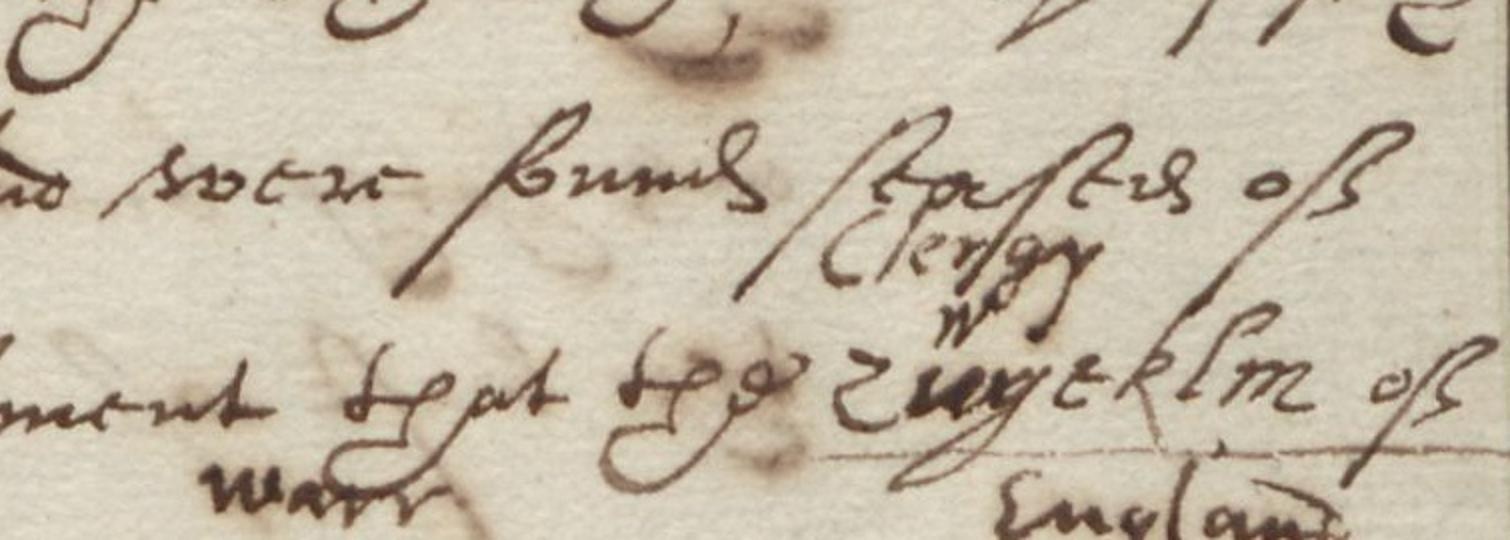
The passage was also printed in the eighteenth-century collection known as Winwood’s Memorials, which preserves the coded groups alongside their readings. Here the group is easier to distinguish:

Using the surviving key
Neville’s embassy key survives in the State Papers. Its first sheet contains four alphabets, each written as two rows of paired letters. The accompanying instructions explain how to use them: exchange a letter in the upper row for the letter beneath it, or a letter in the lower row for the one above it. The exchange works in either direction.2
The four characters x, y, z and q tell the reader which alphabet to use:
| Character | Alphabet selected |
|---|---|
| x | First |
| y | Second |
| z | Third |
| q | Fourth |
These characters are instructions, not letters of the concealed word. Select the indicated alphabet, exchange each subsequent cipher letter with its partner, and change alphabets when another selector appears. The change can occur inside a word.
First example: “clergy”
The dispatch’s Z selects the third alphabet. Here is that part of the manuscript key:
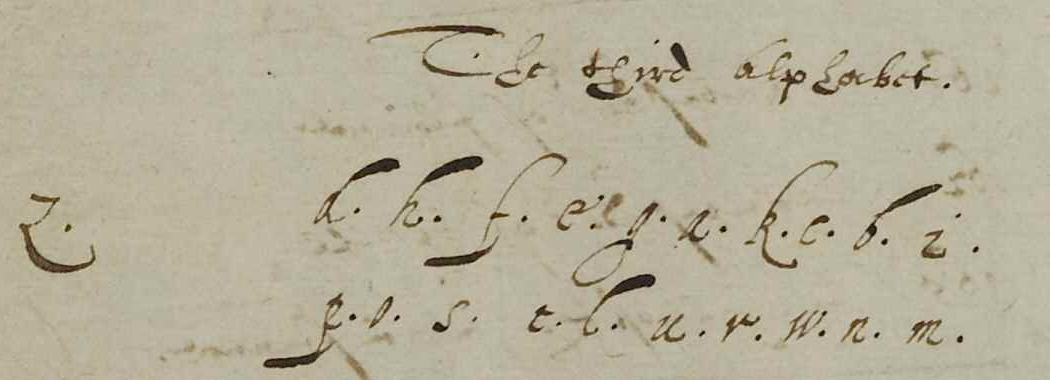
Transcribed into a table, its pairs are:
| Upper row | d | b | f | e | g | a | k | c | h | i |
|---|---|---|---|---|---|---|---|---|---|---|
| Lower row | p | o | s | t | l | u | r | w | n | m |
Each letter appears only once in this paired alphabet, so its partner is unambiguous. Now read w g t k l m. Find w in the lower row: its partner above is c. Find g in the upper row: its partner below is l. Continue, moving in either direction as necessary:
| Cipher | w | g | t | k | l | m |
|---|---|---|---|---|---|---|
| Decoded | c | l | e | r | g | i |
The result is clergi. The final i is explained by another instruction in the key: ordinary y is represented by i, leaving y available as an alphabet selector. The recovered word is therefore “clergy,” exactly as supplied above the cipher in the letter and beside it in the printed Memorials.3
Second example: “hither”
The next group is q. w t i w u g. This time q directs us to the fourth alphabet:
| Upper row | g | i | c | h | e | k | a | d | b | f |
|---|---|---|---|---|---|---|---|---|---|---|
| Lower row | r | t | o | w | u | p | l | s | n | m |
Using those pairs gives:
| Cipher | w | t | i | w | u | g |
|---|---|---|---|---|---|---|
| Decoded | h | i | t | h | e | r |
The result is “hither.” Both occurrences of w give H. In the third alphabet, the same w gave C. The selector tells the reader which of these meanings applies.
Changing alphabets inside a word
On the following manuscript page, f. 235v, the letter uses a more elaborate sequence for “title”: e m q i a u. The third alphabet is already in use at this point. Decode the first two letters with it: e gives T and m gives I. Then q tells us to change to the fourth alphabet. The remaining i a u give T, L and E:
| Cipher | e | m | q | i | a | u |
|---|---|---|---|---|---|---|
| Action | Third | Third | Switch to fourth | Fourth | Fourth | Fourth |
| Decoded | t | i | — | t | l | e |
The selector contributes no letter: the result is title. The two Ts in that word are concealed differently—first as e, then as i—because the alphabet changes between them.
The printed ſ is a long s, not an f. Points in the printed groups and spaces in the examples below help separate the selectors and letters; they do not encode letters themselves.
The same procedure works across all four alphabets in this passage:
| Cipher sequence | Alphabet used | Result from the key |
|---|---|---|
| z.wgtklm | Third | clergi: clergy |
| q.wtiwug | Fourth | hither |
| su y.bghmwfo | Fourth, then second | deputieof: deputie of |
| x.kwfd | First | sent |
| z.eb | Third | to |
| em q.iau | Third, then fourth | title |
In su y.bghmwfo, the fourth alphabet remains in force from “hither”: su gives de. The y then switches to the second alphabet, giving putieof. The combined result is deputie of. Word spacing must be restored as the message is read. These six sequences have been decoded from the manuscript tables and checked against the printed readings.3
Other parts of the key
The alphabet sheet also offers alternative signs for vowels. A sender could vary those signs as well as change alphabets, making repeated vowels less immediately recognizable. The examples above use the paired letters; they do not require the alternative vowel signs.
The sheet identifies Neville and France; the archival index dates it to 1600. Its successful decoding of these passages shows that its alphabet arrangements were already in use in the July 1599 dispatch. That does not date the surviving sheet itself.4
The next two pages supply codes for whole names and expressions—a nomenclator, or code vocabulary.
This part works by direct lookup. The key and the July dispatch agree: m.173 stands for Spain, c.100 for the King of Spain and a.101 for England. The prefix forms part of the code. The writer could therefore conceal “clergy” letter by letter while replacing “Spain” with a single code group.
Porta’s book and the manuscript copy
A separate manuscript in Neville’s collection at The National Archives copies material from Giambattista della Porta’s De furtivis literarum notis, a book about secret writing. The corresponding passages appear in the Naples edition of 1563. They include a table and worked example that let us demonstrate a complete operation, from an ordinary word to cipher and back again.5
Porta’s method also uses reciprocal pairs, but selects them by successive letters of a key phrase. In the dispatch just decoded, the writer instead inserts alphabet selectors into the message.
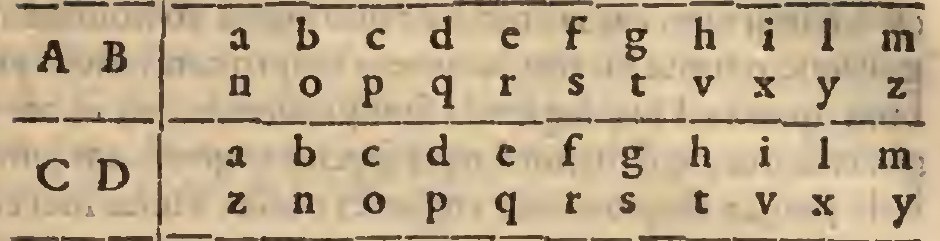
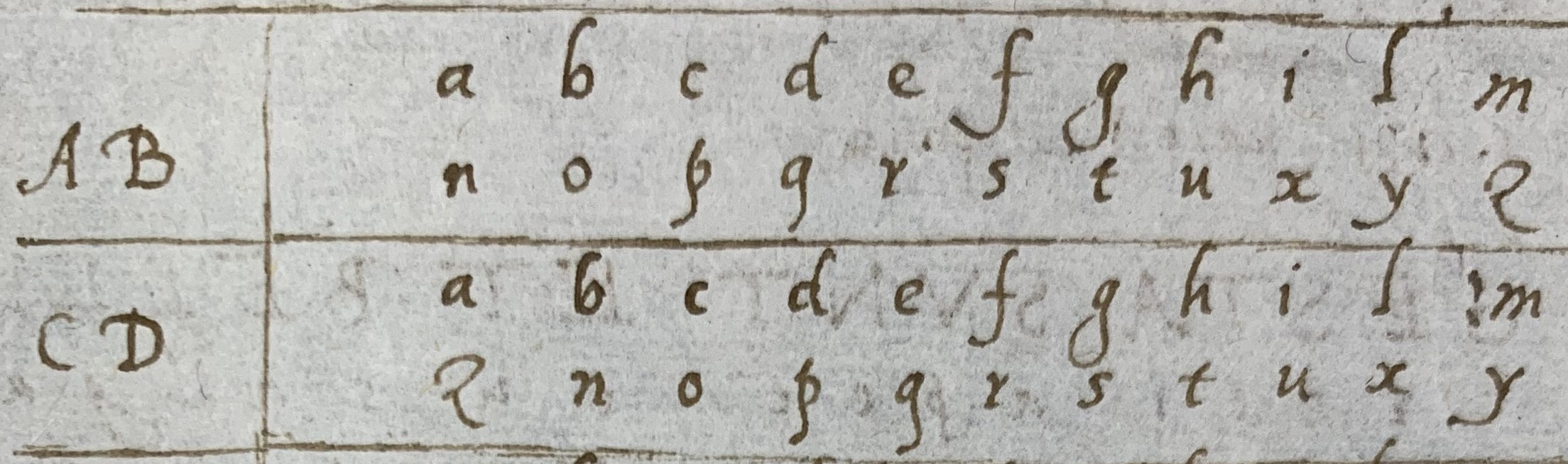
Each row divides the alphabet into two paired lines. A letter in one line exchanges places with the letter directly opposite it. The exchange works both ways: if B becomes N, N becomes B. The alphabet has twenty-two letters, without separate J, K, U or W.
Following the example
Porta’s example begins with the message BELLA and a key phrase beginning CASTVM. Put the first five message letters above the first five key letters:
| Message | B | E | L | L | A |
|---|---|---|---|---|---|
| Key | C | A | S | T | V |
Start with B. The key letter beneath it is C, so use the row labelled CD. Find B in that row: its partner is N. Write N as the first cipher letter.
For the next letter, E, the key supplies A. Move to row AB, where E is paired with R. Continuing through the five positions gives:
| Message letter | Key letter | Row | Cipher letter |
|---|---|---|---|
| B | C | CD | N |
| E | A | AB | R |
| L | S | ST | O |
| L | T | ST | O |
| A | V | VX | P |
The result is NROOP. To read it, use the same key letters and the same rows. In row CD, N gives B; in row AB, R gives E; the remaining rows restore L, L and A. The recipient recovers BELLA.6
The two Ls happen to become O because their key letters, S and T, select the same row. A different row can give the same message letter a different cipher partner.

The manuscript therefore preserves both the table and its application. Porta’s key phrase includes the Latin words “Lucretia had pierced her chaste breast.” These words already occur in the printed example copied into the manuscript.6
Getting hold of somebody else’s key
Neville also reported obtaining a cipher used by other correspondents. On 25 January 1600, he described sending a friar to Rome. Before leaving, the friar cultivated Scottish contacts in Paris and obtained letters of recommendation. Neville inspected the letters and copied one. Its writer proposed that the traveller receive a cipher on reaching Rome.
Neville had the friar ask for the key earlier, explaining that he would need to write from Lyons on the way. Once it was obtained, Neville reported that he could read the letter.7
He also inspected the cipher’s list of English names. It included the Queen, Cecil, Essex, the English ambassador, Sir Henry Bromley, Mr Bacon, Father Parsons, Doctor Cecil, Henry Constable, Bishop (a priest), Mr Paget and the English College at Rome, among others.8
Henry Constable appears in this reported list. The entry enabled the correspondents to refer to him in code; it does not establish that he took part in their correspondence. The acquired key has not been identified with either the embassy key or the Porta extracts.
In March, Neville was still waiting for a fuller answer from Rome.9 His January dispatch explains how he hoped to obtain further letters:
I have willed him to offer his means of conveying their letters, which they will never distrust; and thereby their letters will fall into my hands.8
Notes
Notes and sources
Henry Neville to Robert Cecil, Orleans, 13 July 1599 Old Style, The National Archives, SP 78/43, ff. 232–236, especially ff. 235r–v. The manuscript closing date is 23 July, corresponding to the 13 July Old Style date printed at the head of the letter in Winwood, I, p. 61. The manuscript page and enlarged detail were compared with the printed passage in Ralph Winwood, Memorials of Affairs of State in the Reigns of Q. Elizabeth and K. James I, ed. Edmund Sawyer, I (London, 1725), p. 65. The selected numerical pairs and alphabetic groups were checked against the manuscript images and the printed page; the “title” group is on f. 235v. The alphabetic decoding is explained in the following note. The hand responsible for the interlinear readings is not identified here. Spelling in the prose quotation is modernized; omissions are marked. Alphabetic cipher groups are not silently reconstructed from OCR.↩︎
The National Archives, SP 106/2, ff. 32–33, volume catalogue; State Papers Online, manuscript volume MC4323480003, viewer scans 38–40. The figures reproduce crops from the original embedded scan images. The preceding leaf and the following f. 34r are separate items and are omitted. No attribution of the key’s writing hand is made.↩︎
The National Archives, SP 106/2, f. 32r, paired alphabets and instructions, tested against the cipher groups and supplied readings in Winwood, Memorials, I, p.65. The first alphabet pairs
aebfhcgkidwithmwunolpsrt; the second,fbdachiekgwithopnsrtmwlu; the third,dbfegakchiwithpostlurwnm; the fourth,gichekadbfwithrtowuplsnm. Read each pair in either direction. Selectors x/y/z/q designate the first/second/third/fourth alphabets. The instructions also replace ordinary x with cs, y with i, z with s and q with k, reserving these four characters for selection. The six displayed sequences give clergi, hither, deputieof, sent, to and title; i/y and the spacing in deputie of are explained in the text. The sequences for deputie of and title retain the alphabet previously selected in the passage until their internal selector changes it. This demonstrates the tested alphabetic mechanism, not a complete collation of every entry and sign in the key.↩︎The National Archives, SP 106/1, handwritten index p. 4, Neville entry, France, 1600, old reference 86; index volume; State Papers Online MC4323480002, scan 5. The index reference corresponds to the older number on the key.↩︎
The National Archives, PRO 30/50/8, cryptographic extracts, catalogued under Sir Henry Neville’s diplomatic correspondence in the Neville and Aldworth family papers, PRO 30/50, formerly held in the Braybrooke family archives at Audley End. This family collection is distinct from the State Papers cipher series SP 106; Giambattista della Porta, De furtivis literarum notis, vulgo de ziferis libri IIII (Naples: Giovanni Maria Scotto, 1563), II.16, pp. 99–103, and III.2, pp. 147–150. The printed work controls the explanation and calculation here; manuscript variants require separate collation. Neither its placement in the bundle nor its resemblance to the printed source establishes Neville as its copyist.↩︎
Porta, II.16, table, p. 101, and example and instructions, p. 102. The first five letters are recalculated directly from the table rather than copied from the complete printed ciphertext. The full printed key is
CASTVM FODERAT LVCRETIA PECTVS ALGAZEL; its final word is retained without translation. The reciprocal alphabet isABCDEFGHILMNOPQRSTVXYZ.↩︎Neville to Cecil, 25 January 1599/1600 Old Style, Winwood, I, p. 146. Compare the preceding report, p. 145, where Neville asks for special characters for the friar, the intermediary and Rome.↩︎
Henry Neville to Robert Cecil, Paris, 25 January 1599/1600 Old Style, in Winwood, Memorials, I, pp. 146–147, especially p. 147. The year is 1600 in modern year numbering; the January date retains the English calendar. Prose quotations modernize spelling and capitalization. The acquired cipher itself has not been identified with SP 106/2.↩︎
Neville to Cecil, Paris, 12 March 1599/1600 Old Style, Winwood, I, p. 159. Neville writes that he has heard nothing from Rome concerning the matter he has undertaken there, but expects a fuller answer.↩︎