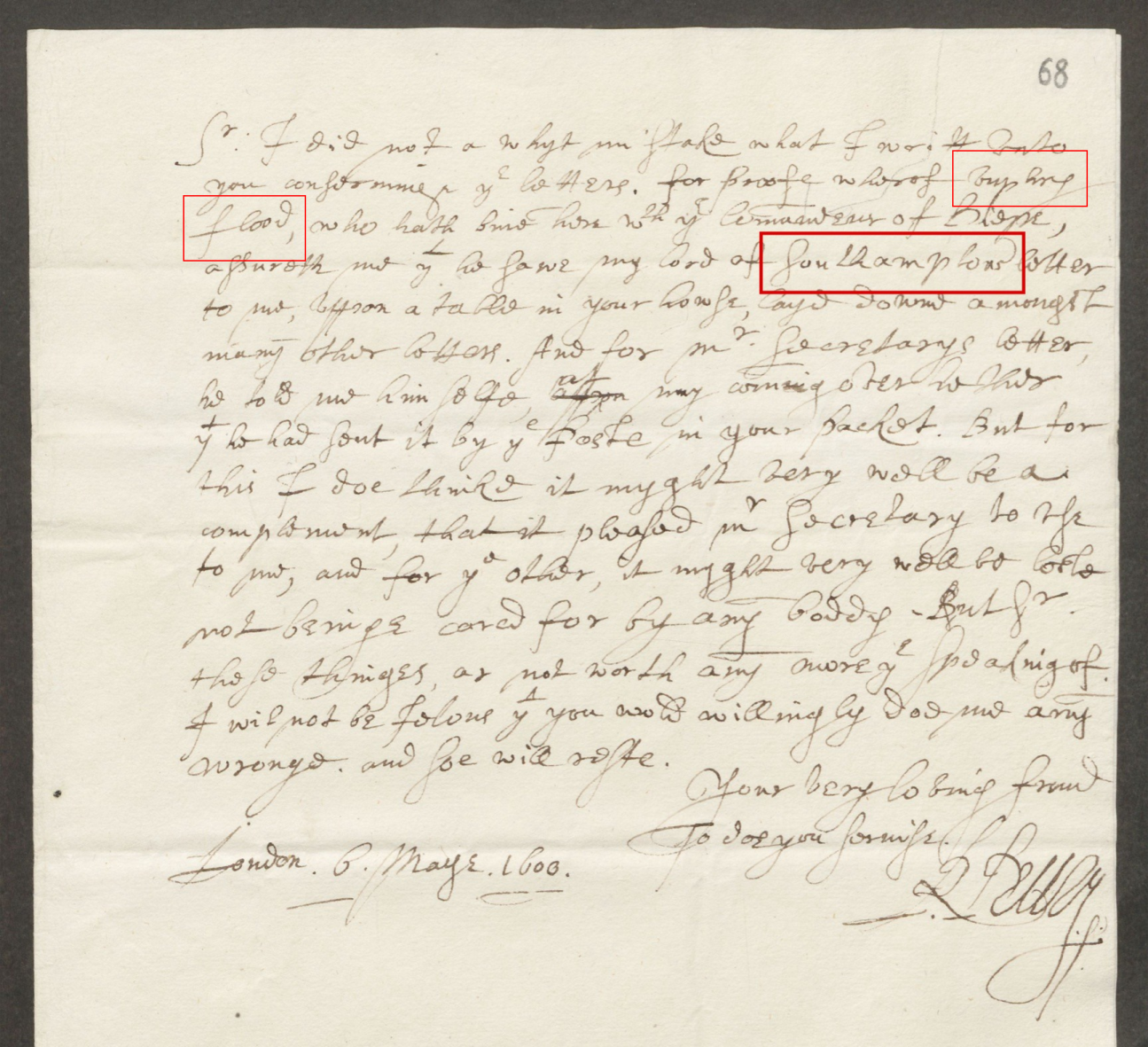
On 6 May 1600, Sir Robert Drury wrote to Henry Neville about a missing letter. Humphrey Fludd had seen it on a table in Neville’s house. Its sender was the Earl of Southampton, the dedicatee of Venus and Adonis and Lucrece:
Humphrey Flood, who hath been here with the Commander of Dieppe, assureth me that he saw my Lord of Southampton’s letter to me, upon a table in your house, laid down amongst many other letters.1
Southampton’s letter was addressed to Drury, not to Neville. Drury’s account places it in Neville’s house and identifies Fludd as the witness—a man who also appears in Shakespeare’s London biography. Humphrey Fludd was a royal trumpeter, a carrier of letters between England and France, and Stephen Bellott’s stepfather. Bellott was the apprentice whose marriage Shakespeare helped arrange in the Mountjoy household. The French connection runs through both sets of records: Fludd married Bellott’s mother in France, while his official journeys carried correspondence to and from Paris.2, 3
Drury’s French business
Drury’s journey was an unofficial diplomatic mission to the Duke of Bouillon in the winter of 1599–1600. He reported to Robert Cecil from Paris on 15 January; that report survives among the French State Papers. John P. Ferris identifies the mission in his parliamentary biography of Drury. Neville’s correspondence then shows Drury helping to convey the embassy’s intelligence to England. Writing to Cecil from Paris on 26 February 1600, Neville explained:
The opportunity of Sir Robert Drury’s return is the cause that I sent no messenger purposely with this advertisement […] hoping it will come by his means in reasonable time.4
Drury therefore belonged to the practical network through which Neville’s intelligence reached England. By May he was back in London, trying to establish what had happened to letters intended for him. Fludd reported seeing Southampton’s letter amongst other correspondence at Neville’s house. The setting was evidently Neville’s house during his French embassy.1
Fludd’s work carrying letters appears again in Winwood’s Memorials. On 13 January 1601, Ralph Winwood wrote from Paris to Neville in England. His earlier letter had remained in the post’s hands, and he now entrusted letters to Fludd:
I have entreated this gentleman, Mr. Fludde, who I understood was purposed within some few days to return home, for the more speedy and assured conveyance of these letters, to deliver them […].5
A later letter opens, “I have not written since my last by Mr. Fludd.” These notices show Fludd serving as a trusted carrier when the ordinary post had failed to move promptly. Together with Drury’s letter, they place him inside Neville’s Anglo-French correspondence.
One of the king’s trumpeters
Carrying letters was part of a court trumpeter’s work. Music historian Trevor Herbert records several payments to Humphrey Flood at the beginning of the seventeenth century expressly for “taking a letter to France.” His source is Andrew Ashbee and David Lasocki’s Biographical Dictionary of English Court Musicians. Charles William Wallace had likewise described Fludd in 1910 as a member of the royal household frequently employed to carry official letters to and from Paris and elsewhere.2
This gives the courier in Neville’s correspondence a recognizable occupation. His royal service included both trumpeting and official journeys to France.
His musical office can also be followed through Henry Cart de Lafontaine’s The King’s Musick. Its summary of a warrant dated 17 April 1609 records yearly livery for:
Humphrie Floud, appointed trumpeter in the place of Robert Dromond […].6
The accounts ending at Michaelmas 1615 list him among the trumpeters; the 1621 records provide for liveries and banners. He remains in the accounts ending at Michaelmas 1624. On 7 March 1625 a warrant appointed Cuthbert Collin in his place. The spellings vary between Floud and Floyd, but de Lafontaine’s index groups these Humphrey entries together, separately from Randolph Floud.6
A French family and Shakespeare’s London household
The lawsuit Bellott v. Mountjoy supplies the personal history behind Fludd’s French connection. In his deposition of 19 June 1612, he was described as a resident of St Giles without Cripplegate, about fifty-three years old, and “one of his Majesty’s trumpeters.” Asked how he knew Stephen Bellott and Christopher Mountjoy, he answered:
He hath known the plaintiff about eighteen years, for he married his mother in France; and the defendant he hath known about eighteen years, for he put the plaintiff to be the defendant’s apprentice.3
Fludd was Bellott’s stepfather. He had arranged the young man’s apprenticeship with Mountjoy, a French Huguenot who made fashionable headpieces in Silver Street. He also supported Bellott during that apprenticeship. His testimony records clothes and linen supplied by himself and Bellott’s mother, money given to the young man, and even payments to the barber to cut his hair. This was a continuing family responsibility.
William Shakespeare lodged in the Mountjoy household and helped persuade Bellott to marry Mountjoy’s daughter Mary in 1604. The later dispute concerned the financial provision promised with the marriage. Shakespeare testified on 11 May 1612; Fludd followed in June. Their evidence concerns different parts of the same household history: Fludd had placed and supported the apprentice, while Shakespeare participated in the marriage negotiations.3
Drury and John Donne
Drury’s later literary association was substantial. He became a friend and patron of John Donne, providing lodging for Donne and his family at his London property. After Drury’s daughter Elizabeth died in 1610, Donne commemorated her in the two Anniversary poems: An Anatomy of the World, published in 1611, and Of the Progress of the Soul, published in 1612.7
In 1611–12 Donne accompanied Sir Robert and Lady Drury on a continental journey. A surviving letter discusses his book commemorating Elizabeth, French affairs, and plans to travel to Frankfurt and the Palatinate. Donne acknowledged that he had never seen the girl whose death his poems memorialized. The poems grew from his relationship with her family.8
Notes and sources
Sir Robert Drury to Sir Henry Neville, London, 6 May 1600, The National Archives, PRO 30/50/2, fols. 97–98. Andrew Zurcher identified the sender; John O’Donnell’s transcription accompanies Ken Feinstein’s publication of the manuscript: “Shakespeare, Southampton, Humphrey Fludd”. The address identifies Neville as ambassador in France. Drury writes the name as “Humphrey flood.” The house’s location is inferred from Neville’s embassy and the French context; Drury calls it “your house.”↩︎
Trevor Herbert, “‘…men of great perfection in their science…’: The Trumpeter as Musician and Diplomat in England in the Later Fifteenth and Sixteenth Centuries”, Historic Brass Society Journal 23 (2011), p. 14 and note 43 (p. 22), DOI 10.2153/0120110011001. Herbert cites Andrew Ashbee and David Lasocki, A Biographical Dictionary of English Court Musicians, 1485–1714, I (1998), p. 433; the payment evidence is cited here through Herbert’s article. Charles William Wallace, “Shakespeare and his London Associates as Revealed in Recently Discovered Documents,” University Studies, University of Nebraska, 10 (1910), p. 265, refers to further records concerning Fludd’s official courier work without printing their account references in that passage.↩︎
Bellott v. Mountjoy, second depositions, 19 June 1612, The National Archives, REQ 4/1/4/2, facsimile, transcription and contextual account in Shakespeare Documented. The record identifies Fludd’s age and occupation and records his French marriage, apprenticeship arrangements and support for Bellott. For Shakespeare’s testimony, see the first depositions, 11 May 1612, The National Archives, REQ 4/1/4/1.↩︎
John P. Ferris, “Drury, Sir Robert (1575–1615), of Hawstead, Suffolk and Drury House, Westminster”, The History of Parliament: the House of Commons 1604–1629 (2010), especially note 24, citing R. C. Bald, Donne and the Drurys (1959), pp. 39–40, and The National Archives, SP 78/44, fol. 30. Drury’s report to Cecil, Paris, 15 January 1599/1600, survives in State Papers Online. Neville to Cecil, Paris, 26 February 1599/1600, in Ralph Winwood, Memorials of Affairs of State, ed. Edmund Sawyer, I (1725), p. 155. The printed page reads “sent.”↩︎
Winwood to Neville, Paris, 13 January 1600/1601, Memorials, I, p. 289; subsequent letter, p. 295. January’s printed year is 1600 under the English calendar then in use; the modern year is 1601. The second notice recalls the earlier dispatch.↩︎
Henry Cart de Lafontaine, ed., The King’s Musick: A Transcript of Records Relating to Music and Musicians, 1460–1700 (London: Novello, 1909), pp. 48, 51, 53–55; index, p. 500. The appointment warrant is dated 17 April 1609 and cites Lord Chamberlain’s records, vol. 812, p. 72, in the edition’s numbering. The replacement warrant is printed as 7 March 1624/25. It records a replacement without stating that Fludd had died.↩︎
REED Online, Suffolk, record suffk-rid64, inventory of Drury’s goods, 27 May 1613, and accompanying biographical account. See also Ferris’s parliamentary biography, especially note 47, for Donne’s patronage and the continental journey. The dates 1611 and 1612 are the poems’ publication years.↩︎
John Donne, Letters to Severall Persons of Honour, ed. Charles Edmund Merrill Jr (New York: Sturgis & Walton, 1910), letter XXVI, pp. 63–67, with notes, pp. 284–85; reprinting the 1651 collection. The letter discusses Elizabeth Drury, the French journey and the projected German itinerary.↩︎