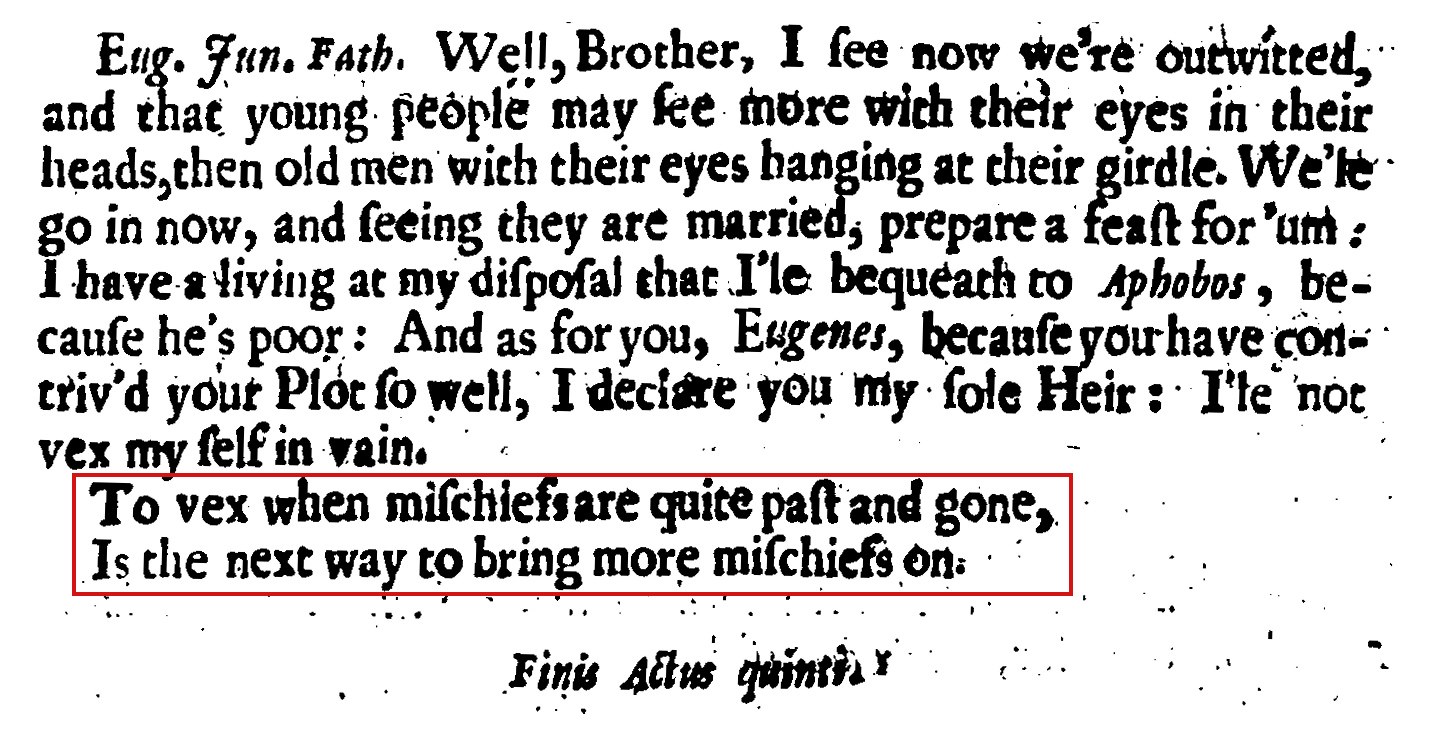
The final lines of Robert Nevile’s play The Poor Scholar, published in 1662, are a couplet adapted from Othello. A father who has opposed his son’s marriage finally accepts it, restores his inheritance and calls for a feast. He ends his speech:
To vex when mischiefs are quite past and gone,
Is the next way to bring more mischiefs on.
In Othello, the Duke offers Brabantio this advice after Desdemona has married against her father’s wishes:
To mourn a mischief that is past and gone
Is the next way to draw new mischief on.1
Both passages concern a father who must accept a marriage he cannot undo.
A playwright in the Neville family
Robert Nevile was very probably Sir Henry Neville’s great-nephew, through the ambassador’s younger brother Edward. The playwright’s parents were Robert Neville of Sunninghill Park and Mary Umfreville. The Umfreville pedigree names the playwright’s father as a younger son of Edward Neville of Sunninghill Park. This Edward is very probably the ambassador’s younger brother, whose children Henry and Anne each received £50 in Neville’s will, as discussed in Chapter 9.2
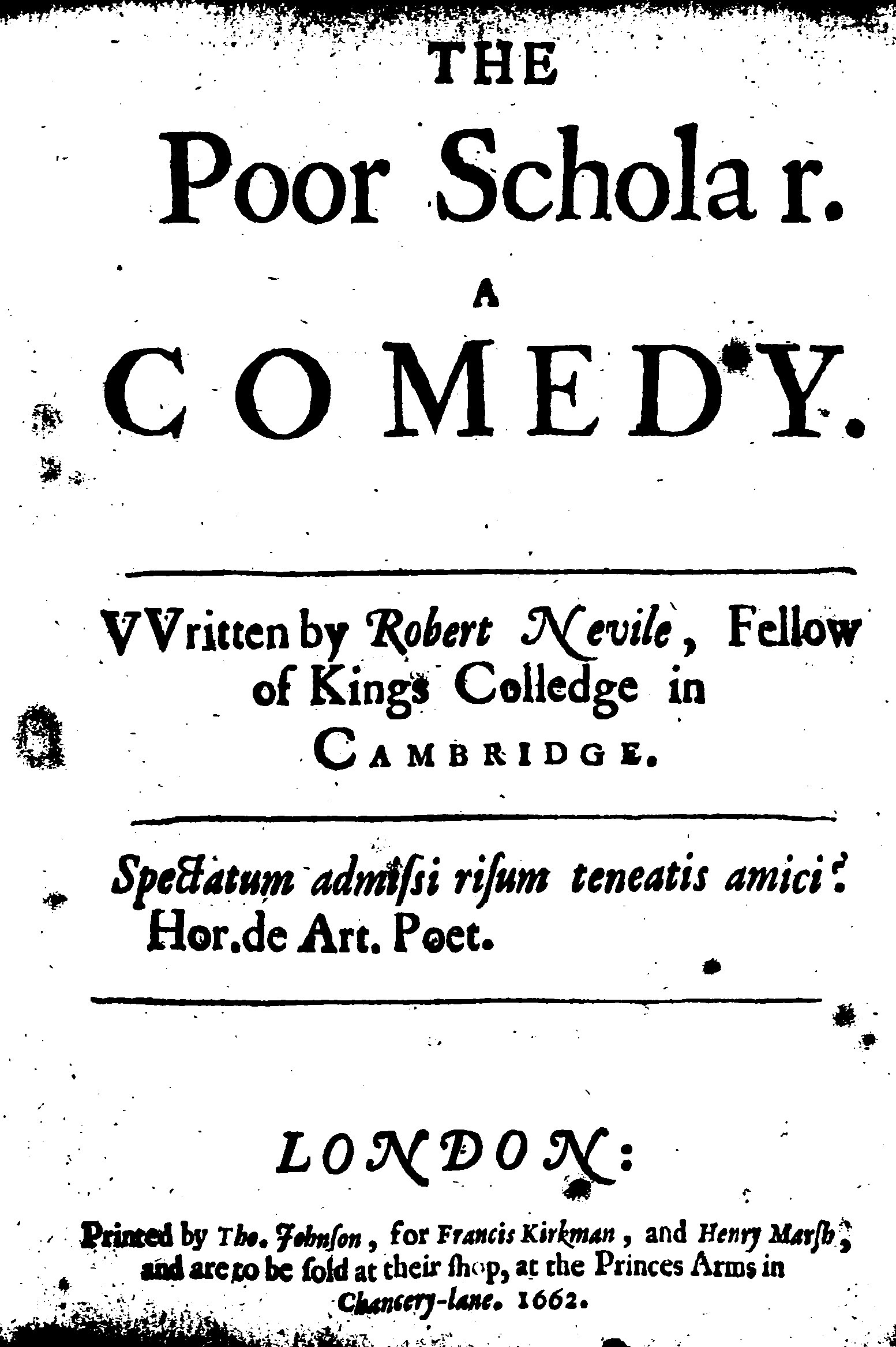
Born about 1640–41, Robert attended Eton and King’s College, Cambridge. He became a fellow of King’s in 1660 and took his BA in 1661. His comedy appeared the following year, with his name and college prominently displayed on its title page. He later became rector of Anstey in Hertfordshire.3
Shakespeare in a university comedy
The poor scholar is Eugenes Junior, whose father restricts his money and whose uncle presides over the college. The plot brings learning, courtship and family authority into collision. Eugenes and his companions obtain money, escape detection and secure their marriages through borrowed books, changes of clothing and disguise. In the last act, Eugenes and his intended bride, Morphe, pose as country strangers and trick his clerical uncle into marrying them. The elders discover that their attempts to prevent the marriages have failed.4
Two other features may recall Shakespeare’s comedies. During his tutor’s reprimand, Eugenes remarks aside:
I’d rather hear a Dog bark, then him speak now.
Beatrice says in Much Ado About Nothing:
[…] I had rather hear my dog bark at a crow
than a man swear he loves me.5
This may be a remembered comic phrase, adapted from an unwanted lover to an unwanted lecture. The ending also invites comparison with The Merry Wives of Windsor: secret marriage and disguise defeat parental designs, and the older generation must accept the result. The possible verbal echo and the parallel ending complement the clearest connection: the close adaptation of the Othello couplet.6
The Killigrew playwrights and a First Folio
Anne Neville’s Killigrew relatives also had strong ties to the theatre. Thomas Killigrew was a playwright and a leading figure in the Restoration theatre. In 1660, he and William Davenant received royal authority to establish London’s two licensed theatre companies. Killigrew’s company helped bring Shakespeare’s plays back to the public stage.7
His brothers William and Henry also wrote plays. William published Three Playes in 1665; Henry, a clergyman, wrote The Conspiracy, later revised as Pallantus and Eudora.8
The three brothers were sons of Sir Robert Killigrew, Anne Neville’s first cousin and Henry Neville’s political and business associate. Robert’s father, Sir William Killigrew, was the brother of Anne’s father, Sir Henry Killigrew. Robert was involved with Neville in the alum venture and was among the trustees of his estate. Neville also remembered him in his will with a gift of silver plate.9
Thomas’s son Charles Killigrew owned a First Folio that subsequently belonged to the playwright William Congreve. Both men’s names survive in the volume.10
Notes and sources
Robert Nevile, The Poor Scholar. A Comedy (London: Thomas Johnson for Francis Kirkman and Henry Marsh, 1662), 5.6, Wing N524, ESTC R14670, EEBO-TCP A52863; Shakespeare, Othello, 1.3. The play quotations modernize long s and a few spellings while retaining vocabulary and lineation. The 1622 quarto reads “draw more mischiefe on”; the 1623 Folio reads “draw new mischiefe on.” Robert’s “bring more mischiefs on” agrees with the quarto’s “more,” but does not identify the edition he used. See TCP A11992 and A11954. An EarlyPrint regularized-spelling search for “past and gone is the next way” on 2 October 2026 returned three documents: the 1622 quarto, the 1623 Folio and The Poor Scholar. This is the result within the searched corpus, not a claim of universal uniqueness.↩︎
W. Harry Rylands, ed., The Visitation of the County of Buckingham Made in 1634 (1909), p. 122, Umfreville pedigree: Mary Umfreville married Robert Neville, a younger son of Edward Neville of Sunninghill Park, of the Abergavenny family. John and J. A. Venn, Alumni Cantabrigienses, part I, vol. III (1924), p. 244, identifies the playwright and his father. Caroline L. Leachman, “Neville, Robert”, Oxford Dictionary of National Biography, names both parents, supplying the Mary Umfreville link to the pedigree. Alan Harding, “NEVILLE, Edward II (b.1567), of Wargrave and Windsor, Berks.”, History of Parliament (1981), identifies Henry’s brother and discusses his associations with Sunninghill, Culham and Windsor, with qualifications about the identification. This is Edward II, born in 1567, not the older Edward who claimed the Abergavenny barony. The relationship follows from joining these sources: the identification of the pedigree’s Edward with Henry’s brother is strongly supported by name, place, family and chronology, rather than stated in a single document giving the complete descent. The pedigree includes later additions and does not date the marriage simply by its visitation heading. Neville’s registered will, dated 30 April 1615, names “my brother Edward Nevill” in the bequest to Edward’s children Henry and Anne; Anne is also identified as Neville’s wife’s goddaughter: The National Archives, PROB 11/126/63, register f.26. The kinship does not establish a particular route by which Robert knew Othello.↩︎
Caroline L. Leachman, “Neville, Robert (b. 1640/41, d. in or before 1694)”, Oxford Dictionary of National Biography; Venn, Alumni Cantabrigienses, I.III, p. 244. The title page spells the surname “Nevile.”↩︎
Nevile, The Poor Scholar, cast list and acts 1–5, especially 5.3–6. Gerard Langbaine, An Account of the English Dramatick Poets (1691), pp. 384–85, TCP A49533, records the 1662 publication but does not know whether it was acted; no historical performance is asserted here. UCLA’s William Andrews Clark Memorial Library holds an original, PR3605.N19 P8*. The illustrations reproduce the microfilm witness associated with TCP, not a photograph of the Clark copy.↩︎
Nevile, The Poor Scholar, 2.3; Shakespeare, Much Ado About Nothing, 1.1. The printed play reads “hear,” where the TCP text has “heat.” Unlike the closing couplet, the frequency of this expression outside Shakespeare has not been established here.↩︎
Shakespeare, The Merry Wives of Windsor, 5.5; Nevile, The Poor Scholar, 5.3–6. The comparison concerns the arrangement of the ending rather than an exact quotation. A commendatory poem invokes Jonson’s audience, and the prologue names Randolph; the comedy’s literary affiliations extend beyond Shakespeare.↩︎
Beal, CELM, Thomas Killigrew introduction; Joseph Knight, “Killigrew, Thomas (1612–1683)”, Dictionary of National Biography, vol. 31 (1892), citing Malone’s list of the company’s stock plays.↩︎
Sir William Killigrew, Three Playes (1665), Wing K470; Peter Beal, Catalogue of English Literary Manuscripts 1450–1700, introductions to Sir William Killigrew and Thomas Killigrew. For Henry’s play and revision, see G. A. Aitken, “Killigrew, Henry (1613–1700)”, Dictionary of National Biography, vol. 31 (1892).↩︎
For Robert’s parentage and children, see Thomas Seccombe, “Killigrew, Robert”, Dictionary of National Biography, vol. 31 (1892), and “KILLIGREW, Sir Robert (c.1580–1633)”, History of Parliament. For Anne’s father and his parentage, see T. F. Henderson, “Killigrew, Henry (d.1603)”, Dictionary of National Biography, vol. 31 (1892). Read together, these biographies trace both branches to John Killigrew of Arwenack. The playwright brothers were Anne Neville’s first cousins once removed. Neville’s will, 30 April 1615, leaves Robert Killigrew a piece of plate worth £10: The National Archives, PROB 11/126/63, register f.26; see Chapter 9. For his political association with Neville, see Alastair Bellany, “Killigrew, Sir Robert (1579/80–1633),” Oxford Dictionary of National Biography, https://doi.org/10.1093/ref:odnb/15537: Bellany connects their friendship with Robert’s possible stake in the 1614 undertaking investigation. For the joint alum undertaking, see Edward Jorden’s complaint, 1 December 1615, The National Archives, SP 14/84, f. 7, and R. B. Turton, The Alum Farm (1938), pp. 111–113. Robert is named among Neville’s feoffees in the estate-settlement abstract of 30 April 1615, Royal Berkshire Archives, D/EN/F6/1/19.↩︎
John C. Hodges, The Library of William Congreve (New York Public Library, 1955), catalogue item 541; Peter W. M. Blayney, The First Folio of Shakespeare (Folger Shakespeare Library, 1991), p. 34. Blayney confirms Charles’s ownership but explains that there is no evidence for the suggestion that his father Thomas previously owned this copy. It should not be confused with Folger copy 73: the abbreviated name “T: Killig” in that volume is not in Thomas Killigrew’s handwriting (pp. 34–35).↩︎