On 22 February 1601, Sir Thomas Fane added a postscript to his letter from Dover Castle to Sir Robert Cecil:
While I sought to prevent his passage by sea, he on the sudden took horse, leaving his wife and children here with the gentlemen of his retinue.1
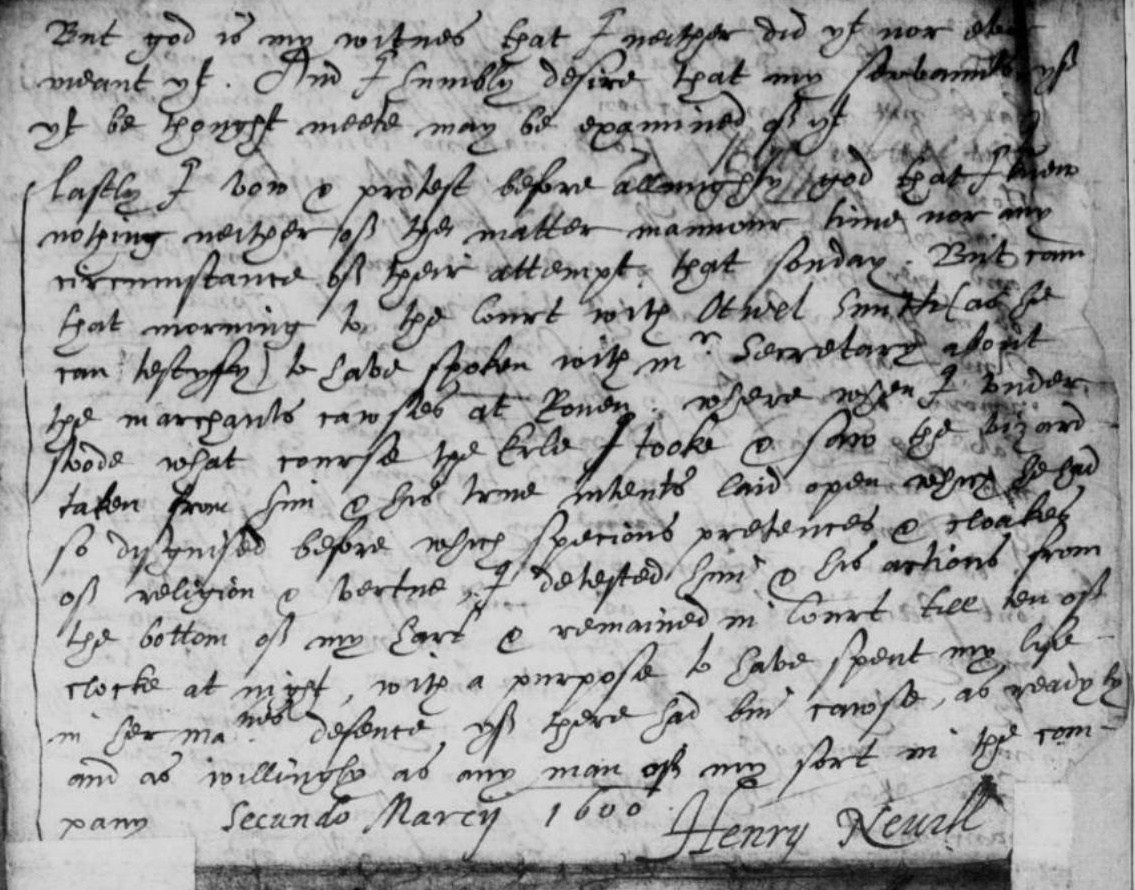
Henry Neville, the queen’s ambassador to France, was riding back to court under Cecil’s recall. Two weeks earlier, Robert Devereux, Earl of Essex, had risen against the government. Neville had heard a plan from the earl’s associates. On 2 March he wrote out, in his own hand, an account of what they had told him and how he had answered. Much of the following reconstruction comes from that declaration: it preserves his recollection while also making his defence. Appendix M prints the complete declaration.2
Neville’s declaration distinguishes the earlier plan to seize the court gate and reach the queen from the rising in London six days later.3,4,5,6
| Date | Event | Neville’s account |
|---|---|---|
| 2 February 1601 | At Drury House, Southampton and Danvers outlined a plan to seize the court gate and guard chamber so that Essex could reach the queen. | Neville heard the plan and raised objections. When Cuffe returned a day or two later, Neville said he would not approve the enterprise unless its undertakers swore to attempt nothing against the queen’s person or estate. His declaration does not place Essex in the Drury House conversation. |
| 8 February 1601 | Essex and his company entered London in the rising that failed. | Neville denied advance knowledge of that Sunday’s attempt and said he was at court on embassy business, remaining there to defend the queen. |
Cuffe and foreign intelligence
Henry Cuffe, the Merton scholar introduced in Chapter 3, moved from Savile’s scholarly circle into Essex’s service by 1595. His journeys through France and Italy produced reports on the grand duke of Tuscany, Spanish preparations and finance, the prospect of Franco-Spanish peace, and Italian fears. He sent intelligence to Savile for transmission to Essex. In a June report he described the order explicitly: Savile first, then Essex “so far as you shall think fit.”7
A March 1598 letter makes the connection between reporting and history explicit. Cuffe reports that the grand duke wants Elizabeth to obstruct the Franco-Spanish peace, but doubts whether the proposed means could work. Writing for his “most honourable Lord,” he invokes the rule “Nemo irascitur historico”—no one is angry with the historian. The historian should not be blamed for the news he reports.8
Cuffe teaches Aristotle to Southampton
Essex also sent Cuffe to teach Henry Wriothesley, Earl of Southampton, in Paris. In a later report to Robert Cecil, Sir Thomas Arundel wrote:
This Cuff was sent by my lord of Essex to read to my lord of Southampton in Paris, where he read Aristotle’s Politics to him with such expositions as, I doubt, did him but little good: afterwards he read to my lord of Rutland.9
Southampton’s own letter to Essex from Paris on 19 September 1598 confirms that he had kept Cuffe with him:
I beseech you to impute not the stay here of your servant Mr. Cuff as his fault, for I have taken on me the boldness to hold him here until my departure.10
Cuffe’s book on the ages of life is discussed alongside Jaques in Chapter 23, on As You Like It. Chapter 27, on Othello, considers Rubinstein’s proposed comparison between Cuffe and Iago. In 1600 Cuffe would approach Neville on Essex’s behalf.
Cuffe’s approaches
More than a year before the recall, another ambassador had reported on Neville’s position. Writing from France on 12 December 1599, Francesco Contarini, Venice’s ambassador at the French court, told the Doge and Senate:
The ambassador here resident, who is of the Earl’s party, has had his despatches stopped for many days, and has sent his secretary in all haste to keep an eye on what is taking place in England and to put an end to such irregularities.11
Neville returned to London from the Boulogne negotiations in August 1600—“as I remember the sixth of August,” he later wrote. Henry Cuffe, Essex’s secretary, had left a message at his lodging. According to Cuffe, the earl had learned that Neville would be blamed for the breakdown of the negotiations. Neville went to court and found “no such matter but rather altogether the contrary.” Cuffe maintained that the intention had existed, whatever had since changed.2
Cuffe was someone with whom Neville had “had long acquaintance,” likely through their connections with Henry Savile and Merton College. Cuffe brought a letter from Essex asking for Neville’s love and promising to hold it “as a great treasure.” Neville replied with compliments and offers of service. Later, Cuffe visited Neville’s house and proposed staying two or three days, but Neville had business in the Vale; they parted at Nettlebed.12
After the middle of October, when Neville was again in London, Cuffe urged him to visit Essex and, after Neville delayed, named a time. Glascock, the earl’s servant, met Neville at about eight in the evening and took him to the study. Essex joined him half an hour or more later, asked “many questions of foreign matters,” and spoke of his hopes concerning the sweet-wine import concession and his restoration to the queen’s “presence and favour.”13 He conducted Neville to the back gate himself. Neville wrote that Essex had used no “undutiful speech of the queen or the state” during the visit, and that afterwards they neither spoke nor exchanged letters.2
Cuffe continued to call. Sometimes he offered hope about Essex’s prospects; sometimes he spoke angrily. Once he quoted Lucan:
Arma tenenti, omnia dat qui iusta negat.
Whoever denies justice to one holding arms grants him everything.
Neville answered in French, “tout beau”—easy; not so fast. Cuffe said such treatment would give Essex cause to think sooner of “other courses.” In Lucan, Caesar speaks these words after crossing the Rubicon.14
Around Christmas, Cuffe reported a supposed intention to imprison Southampton and then Essex. In January he pressed Neville to hear a proposal from Southampton and Sir Charles Danvers, assuring him that nothing would be attempted against the queen’s person or estate. Neville agreed to listen on that condition. Meetings were delayed by his work with Secretary John Herbert and the French ambassador, and by private business.2
Neville was meanwhile preparing to resume his embassy. On 23 January he wrote to Ralph Winwood, his colleague in France:
I look now to be dispatched forthwith, and to set forward, about the morrow after Candlemas-day. I mean to come by Rouen wheresoever I land.
At Rouen he intended to seek redress for English merchants’ grievances. Candlemas fell on 2 February; he expected to leave about the following day.15
Candlemas: the plan at Drury House
On Monday, 2 February 1601, Candlemas, Neville left Serjeants’ Inn at about four in the afternoon. He had acknowledged a statute before the judge, Sir Edmund Anderson, and sealed other papers. A coach passed carrying Essex, Southampton, Sir Christopher Blunt and Danvers. Neville had told Cuffe he would come that day; the men in the coach had now seen him nearby. He went to Drury House, where he met Southampton and Danvers. His account does not place Essex in that conversation.3
Neville wrote that he had not spoken with Southampton since the earl was a child in Lord Burghley’s household. Southampton now told him that Cuffe had assured Essex of Neville’s goodwill, honesty, discretion and secrecy. Essex’s enemies, Southampton claimed, controlled access to the queen and prevented his grievances from reaching her. Essex would therefore approach her with enough supporters to ensure that he could not be excluded.
Southampton described forty men waiting in separate groups at the Mews, the stables near the court. When Essex and Southampton approached in a coach, these men would seize the court gate. Others already in the hall would enter the guard chamber and take the guards’ halberds. Lords and supporters in the presence chamber would welcome Essex and accompany him to the queen.3
Neville recorded his first answer to Southampton:
I told him it was a matter of too great weight to be suddenly digested. But for [as for] the assurance which Mr Cuffe had given of me, if he had not exceeded his commission, as I hoped he would not, being an honest man, I would perform what he had delivered from me.2
In the same declaration, he denied having offered his sword:
But for offering to draw my sword in the cause, I vow before God and his angels I never offered it nor ever meant it.2
Among his objections, Neville invoked Tacitus:
This was an action of the nature of those which, as Tacitus saith, non laudantur nisi peracta, and would be interpreted by the success.
Such actions “are not praised until accomplished.” The words condense Histories 1.38, where Otho urges his soldiers to complete their coup against Galba.16
Neville raised three practical objections. Recruiting enough men would risk discovery. A closed door could stop the movement through the palace. Even if they took the gate, a force from nearby Westminster could dislodge them. Southampton and Danvers answered that their followers would assemble under another pretext and learn the purpose only that morning. Surprise and supporters inside would prevent doors being closed. Once they held the court and had “the show of the state on their side,” they expected no resistance.3
Neville understood the aim to be the arrest of Essex’s enemies and their replacement in office. For the operation as a whole, he remembered no more than 120 men being discussed. They spoke of seizing the Tower through Sir John Davies “as a matter which they could do when they would.” Neville wrote that they had settled “neither the time nor any circumstance of their attempt.” He could not be certain whether Parliament had been mentioned at Drury House; Cuffe spoke of it afterwards. Danvers was to visit him again, but Neville said that he never subsequently saw either Danvers or Southampton, or exchanged messages with them.3
Cuffe’s visit after the Drury House meeting
Within a day or two, Cuffe returned. Neville said he would not approve the enterprise unless its undertakers swore to attempt nothing against the queen’s person or estate, “as they had done in the enterprise of Amboise, a precedent whereof was to be seen in the story.” The French conspiracy of 1560 had sought to remove Francis II from the control of the Guise; an oath protecting king and state appeared in accounts of it.17
Neville also refused to act against Cecil:
I would have no hand nor be no actor in it, because I was near allied unto him and had been beholden to him, as all the world took knowledge. And I would not blot my reputation to be false unto him or any man.4
Cuffe said they would not press him, but wanted him in the presence chamber because Essex meant to name him “to supply some place there.” Neville replied that his dispatches had been signed and he would shortly leave for France. Cuffe suggested feigning sickness. Neville said he instead pressed for his money from the Exchequer, naming Mr Skinner as a witness to his efforts to obtain it.4
Cuffe asked Neville to sound out an unnamed minister whom Neville knew well: did the minister favour Essex, and what did he think of London’s affection for the earl during his earlier troubles? Neville wrote that he had not done so and that the minister was out of town throughout. Cuffe also claimed that twenty or twenty-one of London’s twenty-four aldermen were on the earl’s side. Finally, he asked Neville to instruct his servants to support Essex, or at least not oppose him, if the encounter occurred at court. Neville recorded his answer and his denial together:
Whereunto I answered very well. Which how he construed I know not. But God is my witness that I neither did it nor ever meant it. And I humbly desire that my servants, if it be thought meet, may be examined of it.4
8 February: the rising
In his history of Elizabeth’s reign, William Camden describes the earlier plan as one to “seize upon the Court”; Essex was then to “fall upon his knees before the Queen.” On 7 February, after Essex was summoned to the Privy Council, the plan changed:
Now did his design fail which had been full four months digested [worked out], and out of fear they hasten to a new. […] He resolved therefore […] to enter the next day, which was Sunday, with 200 gentlemen into the City […] there to inform the aldermen and people of the causes of his coming, and to crave their aid against his adversaries. […] If they showed themselves easy [willing], then to make himself a way unto the queen with their help.6
The earlier plan was to seize the court gate and reach the queen directly; the new plan sought Londoners’ support first. On Sunday, 8 February, Essex and his company entered London. The rising failed. At about three the following morning, Essex and Southampton were brought to the Tower with the Earl of Rutland and Lord Sandys.5
During the rising, Neville said he was at court. He denied knowing in advance what Essex would do:
I knew nothing neither of the matter, manner, time nor any circumstance of their attempt that Sunday.
He said he had gone to court that morning with Otwell Smith to speak to Cecil about the merchants’ business at Rouen. He maintained that, after learning what Essex had done, he stayed until ten at night, ready to defend the queen.5
Recalled from Dover
Neville set out on the journey to France he had been preparing since January. On 19 February he wrote to Cecil from Rochester about a passport for Mr Tiery.18 On 22 February Fane sent the letter from Dover Castle:
Sir Henry Neville in satisfying of your letters is posted with some three or four men to the Court to you, after whom I have sent Captain Windebank and one of my servants in post to observe him and such course as he shall take; which if the same be direct, then to pass as unknown persons; otherwise to make stay of him by force of your warrant.1
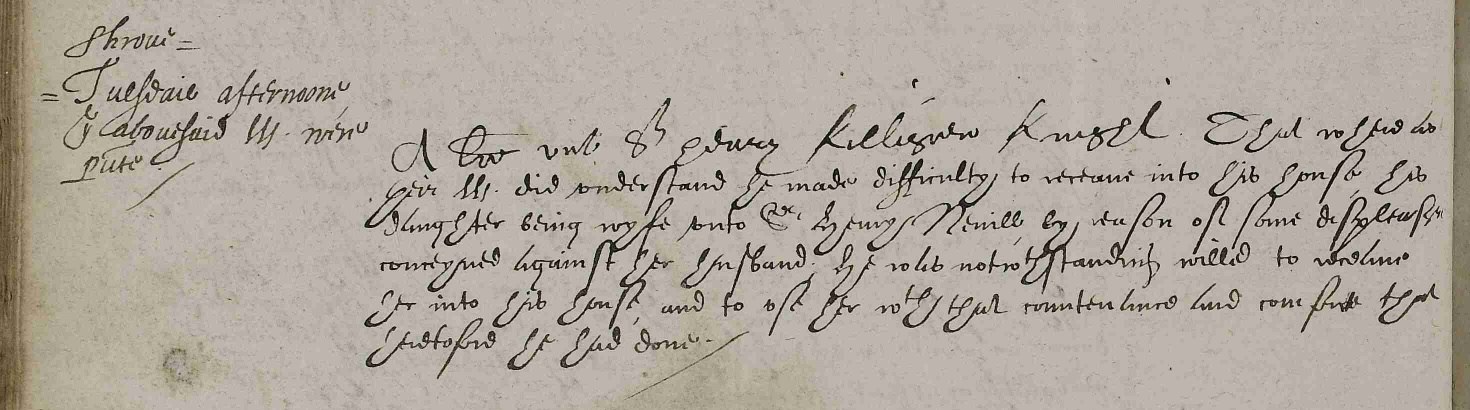
Neville’s wife, Anne, and the children remained at Dover. On 24 February, Shrove Tuesday, the Privy Council directed her father, Sir Henry Killigrew, to receive her, put aside his displeasure against her husband and treat her with his former “countenance and comfort.”19
On 25 February Essex was beheaded inside the Tower.5
Examined on 2 March 1601, Cuffe said that Essex had proposed Neville or Thomas Bodley as Robert Cecil’s replacement as secretary. Green’s calendar abstract of another examination that day records Cuffe’s agreement that “the declaration of Sir Hen. Neville, of 2 March, is in substance true.”20
At Cuffe’s trial on 5 March, Neville’s confession was read aloud. William Camden, who attended, recalled:
if my memory fail me not, for I was then present and heard his confession read.21
By 6 March Neville was in custody at Chelsea, with Zachary Lok as his keeper. Embassy business continued. Lok reported that he had admitted Winwood’s servant and sent for a cabinet of Neville’s writings from Killigrew’s house. Anne supplied the key. Neville selected the papers he needed in Lok’s presence:
Every till [compartment] in the cabinet was full of several writings touching his employments and private estate. All are safe in the cabinet, the key whereof he delivered presently to my keeping.
Winwood was to remain in France until the queen gave further instructions. Neville’s French household was to be dissolved and its furniture and utensils sent away.22
Anne’s appeals and Cuffe’s execution
That same day, 6 March, Anne asked Thomas Windebank, her “good friend and kind neighbour,” to speak for her to Cecil, her first cousin. She had heard that Neville had lost the office of custos rotulorum, keeper of the county records, and that Sir Edward Norris had taken his place in the commission of peace. She appealed to Cecil’s earlier kindness and asked Windebank to “polish my rough-hewn speech.”23
On 11 March she asked permission to consult Neville about the people retained for his French employment and the settlement of household affairs. She pointed to his continuing expenses in the country. She offered to speak in his keeper’s presence, adding that her deafness would make Neville speak loudly enough to be heard.24
Cuffe was executed in March.25 A surviving report records his attempts to distinguish the earlier design from the action of 8 February. When he separated intention from means, Lord Grey interrupted: “This is no time for logic.”
When charged on the scaffold with “seducing” Neville, Cuffe acknowledged that “he drew him into that unfortunate action” and asked his forgiveness. He also qualified his earlier claim about the aldermen: their affection for Essex had not meant that they were prepared to take arms for him.
As Cuffe continued, another interruption warned him to leave these matters and not “shorten his own time.” He turned to prayer. The report records his request for pardon from God, the queen and those involved,
but principally of Sir H. Nevill, who was drawn into trouble by him as an instrument.25
On 22 March the Lord Admiral, Charles Howard, Earl of Nottingham, together with Cecil, authorized Lok to admit Anne privately to her husband, accompanied by no more than one or two servants. A note on the warrant records that she came that Sunday. Two days later, writing from Lothbury, she asked Cecil to weigh Neville’s first fault against his earlier life and service. She reported hearing that Cuffe had cleared him at his death. That was part of her appeal, rather than the wording of the surviving scaffold report.26
The declaration he did not want printed
On 22 April 1601 Neville wrote to Cecil about the expected publication of an account of the conspiracy. He asked to be mentioned sparingly and wanted his own declaration withheld—probably his declaration of 2 March. He feared that public disgrace would prevent his return to royal service.
The declaration, he explained, had been prepared in haste. Mr Browne, the Lord Admiral’s servant, arrived to collect it when Neville had barely begun, with instructions to deliver it at the Tower by eleven. The previous evening some of the councillors had assured Neville that it was wanted for another purpose, rather than to be used against him. In those circumstances, he wrote:
I omitted both matter and circumstances which would much have justified me and cleared mine intention from consent or participation in these actions.
So as if it should be published in that naked sort as it is set down, it would be to my infinite disadvantage, and lay me open to the censure of every common person, even for that whereof I am not guilty. Therefore chiefly I desire it may not be published; or if that must needs be—as I verily hope there is no such necessity, matters being otherwise clear enough, and my knowledge of the Earl’s designs being but at the second or third hand, and that only in generalities—I humbly desire that I may be permitted to revise it and to add some circumstances which I have either by word or writing already declared unto your Honours, that so the world may know the best of me as well as the worst.27
Chapters 26–27 compare his request that the world know his “best” as well as his “worst” with passages in Hamlet and Othello.
On 27 April John Packer wrote to Winwood that “our good lady,” apparently Anne, had narrowly survived a grave illness and remained too weak to leave her bed. The same letter conveyed instructions from “my master” about Winwood’s continued service in France, his account and payment from the sale of household goods.28
The contemporary chronological notes record Neville’s arrival at the Tower:
The first of May Sir Henry Nevill, late lord ambassador for France, was brought to the Tower.29
Notes and sources
Sir Thomas Fane to Sir Robert Cecil, Dover Castle, 22 February 1600/1, Hatfield House, Cecil Papers 76/100; Historical Manuscripts Commission, Calendar of the Manuscripts of the Marquis of Salisbury, XI (London, 1906), p. 76. Quoted from the calendar text, which describes the original as a holograph with seal. The instruction to use force is conditional on Neville departing from the direct course to court.↩︎
Henry Neville, declaration, 2 March 1600/1, The National Archives, SP 12/279, beginning at f.15, autograph. Quotations follow John O’Donnell’s transcription of the manuscript, with spelling and punctuation modernized. Supplementary calendar: Mary Anne Everett Green, ed., Calendar of State Papers, Domestic, Elizabeth, 1601–1603 (London, 1870), pp. 5–8. This declaration is distinct from the separate defence printed as “Sir Henry Nevill’s Case” in Winwood’s Memorials, I, pp. 302–304. The conversations narrated here are Neville’s retrospective account.↩︎
Neville’s declaration, 2 March 1601, SP 12/279, f.15 onwards; supplementary calendar, Green, CSPD Elizabeth 1601–1603, pp. 6–8. Neville names Southampton and Danvers as the men who disclosed the plan, and distinguishes their discussion from Cuffe’s subsequent remarks about Parliament. The recollection of Southampton in Burghley’s household does not place Neville’s own education there.↩︎
Neville’s declaration, 2 March 1601, SP 12/279, f.15 onwards; supplementary calendar, Green, CSPD Elizabeth 1601–1603, pp. 7–8. Cuffe’s reported offer is “to supply some place there”; this passage does not specify Cecil’s secretaryship. Bold emphasis added to the quotation about Neville’s reputation.↩︎
Neville’s declaration, 2 March 1601, SP 12/279, f.15 onwards. For the rising and surrender on 8 February, the prisoners’ arrival at about three on 9 February, and Essex’s execution on 25 February, see the contemporary chronological notes in TNA SP 12/281, beginning at f.127, manuscript; supplementary calendar, Green, CSPD Elizabeth 1601–1603, pp. 89–90. For the rising and nighttime surrender on 8 February, see Camden, Annales, 1601, §§5–13, text.↩︎
William Camden, Annales rerum Anglicarum et Hibernicarum regnante Elizabetha, Part II (1589–1603), year 1601, §§4–5. Camden wrote the history in Latin: Part I appeared in London in 1615; Part II first appeared posthumously in the complete Leiden edition of 1625, followed by a separate London Latin edition in 1627. The quotation follows Richard Norton’s English translation (London, 1630; STC 4500), as edited by Dana F. Sutton in the Philological Museum, 1601, §§4–5, with spelling and capitalization modernized, omissions marked, and editorial glosses supplied in square brackets. Norton’s translation is distinct from Thomas Browne’s English translation of Part II, first published in 1629 (STC 4498; USTC 3014090). For the identification of the Norton text used here, see Sutton’s Introduction, §§15–17; compare the Latin, 1601, §§4–5.↩︎
Gajda, “Henry Savile,” p. 50 and n. 74, citing Cuffe to Savile, 4/14 June 1597, Cecil Papers 52/10. The later channel also appears in Cuffe’s 26 July/5 August 1598 letter to Savile or, in his absence, Edward Reynolds, Cecil Papers 72/26. These are distinct letters from the report of 4/14 March 1598. Spelling in the quoted letter is modernized. The year is disputed: Gajda and the Salisbury calendar, VII, pp. 234–235, give 1597; Paul E. J. Hammer, “The Uses of Scholarship,” p. 38 n. 5, argues for June 1598 from internal evidence. The exact Savile-first wording quoted here follows Gajda, not the calendar abstract. Hammer.↩︎
Calendar of the Manuscripts of the Most Honourable the Marquess of Salisbury, Preserved at Hatfield House, part VIII (London: HMSO, 1899), p. 76, Henry Cuffe to Henry Savile, 4/14 March 1598, Cecil Papers 175/2, printed page. The endorsement gives Florence and 14 March 1597 in the contemporary year style. “Nemo irascitur historico” occurs before the final report and subscription.↩︎
Sir Thomas Arundel to Robert Cecil, post-rebellion report, Bodleian Library, MS Ashmole 1729, f.190r; quoted by Lisa Jardine, “‘Studied for action’ revisited,” in Gabriel Harvey and the History of Reading, ed. Anthony Grafton, Nicholas Popper and William Sherman (UCL Press, 2024), p. 337 and n.28, chapter. Spelling modernized and abbreviated titles expanded. The adverse judgment on Cuffe’s expositions is Arundel’s. Paul E. J. Hammer, “The Uses of Scholarship: The Secretariat of Robert Devereux, Second Earl of Essex, c.1585–1601,” English Historical Review 109 (1994), pp. 26–51, at p. 49 n.7, cautions that the dates of the readings are unclear; article.↩︎
Henry Wriothesley, Earl of Southampton, to the Earl of Essex, Paris, 19 September 1598, Cecil Papers 64/32; Calendar of the Manuscripts of the Marquis of Salisbury, VIII (1899), p. 353, printed letter. Quoted from the published text. The letter confirms their company in Paris, without specifying the subject or dates of the lessons.↩︎
Francesco Contarini to the Doge and Senate, Paris, 12 December 1599, in Horatio F. Brown, ed., Calendar of State Papers, Venetian, IX: 1592–1603 (London, 1897), no. 832, p. 386. Quotation follows Brown’s English calendar abstract of the Italian dispatch. Contarini does not identify the secretary or who stopped the dispatches. His report of 22 January 1600 (1599 in the Venetian year style), no. 844, p. 390, adds that Elizabeth instructed the English ambassador to explain Essex’s confinement as intended to make him acknowledge his fault, not destroy or ruin him.↩︎
Neville’s declaration, 2 March 1601, SP 12/279, f.15 onwards. On the earlier academic connections, see Alexandra Gajda, “Henry Savile and the Elizabethan Court,” Erudition and the Republic of Letters 6 (2021): 32–60, article, especially pp. 49–51: Savile elected Cuffe to a Merton fellowship in 1586; Cuffe later sent intelligence to Essex through him. This does not establish that Neville and Cuffe studied together.↩︎
Neville’s declaration, 2 March 1601, SP 12/279, f.15 onwards, records Essex’s hopes concerning sweet wines and restoration to the queen’s presence and favour. Camden, Annales, 1601, §1, describes the refusal to renew the farm of wines: text.↩︎
Neville’s declaration, 2 March 1601, SP 12/279, f.15 onwards; Lucan, Pharsalia 1.348–349, Latin text. Translation supplied here; Latin u/v and i/j normalized. For “tout beau,” see Randle Cotgrave, A Dictionarie of the French and English Tongues (1611), s.v., “Soft and faire, not too fast, ynough I say”: entry.↩︎
Neville to Ralph Winwood, London, 23 January 1600/1, in Edmund Sawyer, ed., Memorials of Affairs of State, I (London, 1725), p. 290. Spelling modernized. Later letters of 28 and 29 January, pp. 291–292, record further delay and uncertainty about the dispatches.↩︎
Tacitus, Histories 1.38, Latin text: nullus cunctationis locus est in eo consilio quod non potest laudari nisi peractum—there is no room for delay in a plan which cannot be praised until it has been carried through. Neville’s compressed plural wording and explanation concerning success occur in his autograph declaration, SP 12/279, f.15 onwards; see also Green, CSPD Elizabeth 1601–1603, p. 7. The words survive in Neville’s handwriting; Chapter 31, on Macbeth, reproduces the passage. Identifying the passage does not identify the physical edition he used.↩︎
Neville’s declaration, 2 March 1601, SP 12/279, f.15 onwards; supplementary calendar, Green, CSPD Elizabeth 1601–1603, pp. 7–8. For the historical oath, see Jean de Serres, An historical collection, of the most memorable accidents, and tragicall massacres of France (London: Thomas Creede, 1598), pp. 63–64, STC 11275, ESTC S121331, facsimile, TCP A01160. The printed account expressly requires an oath protecting the king and the state. The TCP catalogue identifies the opening work as a translation of Serres; a later section, separately paginated, translates Pierre Matthieu. This supplies a contemporary witness to the precedent without identifying Neville’s unnamed history.↩︎
Neville to Cecil, Rochester, 19 February 1600/1, HMC, Salisbury Manuscripts, XI, pp. 73–74; Fane to Cecil, 22 February, ibid., p. 76. The January correspondence establishes that the journey was planned before the rising; Fane’s letter records recall and surveillance on the return, not an arrest while attempting a newly improvised escape.↩︎
The National Archives, PC 2/26, catalogued f.92, Council register image. The surviving witness is the register’s record of the instruction, not the dispatched letter. Independent printed control: John Roche Dasent, ed., Acts of the Privy Council of England, New Series, XXXI, p. 179, order to Sir Henry Killigrew, Shrove Tuesday afternoon: printed edition. The sequence places this Tuesday on 24 February: the preceding session is Monday 23 February on p. 178, and the following session is also dated 24 February on p. 179. The Council directs Killigrew to receive his daughter into his own house and treat her as formerly; this is distinct from the later orders admitting her to her husband in custody. Short quotation modernizes spelling.↩︎
Henry Cuffe’s examination, 2 March 1601, calendared in Mary Anne Everett Green, ed., Calendar of State Papers, Domestic Series, of the Reign of Elizabeth, 1601–1603 (London, 1870), p. 2, nos. 4–5, printed calendar. The quotation follows Green’s calendar abstract of examination no. 4, dated 2 March; no. 5 abstracts a separate examination recording the proposed secretaryship. The proposed secretaryship is evidence of the discussion, not Neville’s acceptance of a role in the rising.↩︎
Camden, Annales, Part II, year 1601, §§45 and 51, Richard Norton’s English translation (London, 1630; STC 4500), as edited by Dana F. Sutton: trial and confession. Section 45 dates the trial to 5 March; §51 contains Camden’s statement that he was present. The memory qualification is Camden’s own. Spelling modernized. The Latin Part II was first published at Leiden in 1625; see the edition details in the earlier Camden note. Compare Latin §51.↩︎
Zachary Lok to Sir Robert Cecil, Chelsea, 6 March 1600/1, Calendar of the Manuscripts of the Marquess of Salisbury, XI, p. 110, Cecil Papers 77/32. The complete calendar entry is the witness used here; it describes the underlying letter as a one-page holograph with seal. The bracketed “compartment” is an editorial gloss of “till.” The printed words identify writings concerning employment and private estate, not a detailed inventory or a specific filing scheme. A related undated letter from Neville to Cecil (CP 83/26; HMC, Salisbury Manuscripts, X, p. 371) describes Lok reading his letter to Winwood, watching him select papers and retaining his desk key. Neville also returned the queen’s letters intended for France and discussed Winwood’s allowance of thirty shillings a day. The calendar’s conjectural placement “[1600, c. Oct.]” is not secure enough to establish an earlier custody episode.↩︎
Anne Neville to Thomas Windebank, 6 March 1601, The National Archives, SP 12/279 f.30, State Papers Online, MC4304680023. Spelling modernized. Office changes are presented as Anne’s report.↩︎
Anne Neville to Thomas Windebank, 11 March 1601, TNA, SP 12/279 f.32, State Papers Online, MC4304680025. The request concerns the retained company and household costs following the end of the French employment.↩︎
“The speech of Mr Cuffe at his death,” TNA SP 12/279, f.35, manuscript, dated 13 March 1601 in the calendar: Green, CSPD Elizabeth 1601–1603, no. 25, pp. 14–15. This is a report of the speech, not Cuffe’s autograph. It is distinct from no. 26, “The last words of Mr Cuffe.” The quoted passages have been checked against the manuscript and Green’s printed report, with spelling and punctuation modernized and abbreviated personal names retained. Green omits the manuscript’s “as an instrument.” Camden, Annales, 1601, §54, gives 13 March; the separate Tower chronologies calendared by Green at pp. 88 and 90 give 9 March. The discrepancy remains unresolved. Camden.↩︎
Nottingham and Cecil to Zachary Lok, 22 March 1600/1, TNA PRO 30/50/4, manuscript leaf numbered 7; the note at the foot records Anne’s visit. Anne Neville to Cecil, 24 March 1600/1, Hatfield House, Cecil Papers 77/90; supplementary calendar, HMC, Salisbury Manuscripts, XI, p. 145.↩︎
Neville to Cecil, Chelsea, 22 April 1601, Hatfield House, Cecil Papers 86/1; Calendar of the Manuscripts of the Marquess of Salisbury, XI (1906), pp. 175–176. Quotation follows the printed calendar, pp. 175–176. Bold emphasis added. Identification of the declaration with the March confession is probable; the letter’s account of its preparation is Neville’s own.↩︎
John Packer to Ralph Winwood, London, 27 April 1601, in Edmund Sawyer, ed., Memorials of Affairs of State, I (London, 1725), p. 319: printed page. The master and lady are not named in this letter; their identification is contextual. Short quotations modernize spelling and capitalization.↩︎
Contemporary chronological notes relating to the Essex rebellion, TNA SP 12/281, beginning at f.127, manuscript, entry for 1 May 1601; supplementary calendar, Green, CSPD Elizabeth 1601–1603, p. 91. The entry is in the packet catalogued under August because its record continues into that month. Spelling modernized.↩︎