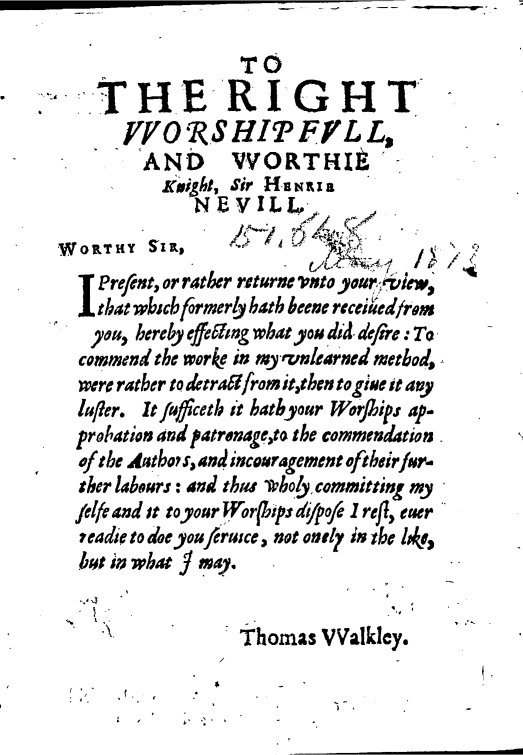
I present, or rather return unto your view, that which formerly hath been received from you, hereby affecting what you did desire.1
With these words in 1619, Thomas Walkley dedicated Beaumont and Fletcher’s A King and No King to the ambassador’s eldest son, Sir Henry Neville. The ambassador had died in 1615. The title page advertised a play performed at the Globe by the King’s Men; the dedication described a text received from the younger Neville and now returned to him in print.
Walkley also invoked Neville’s “approbation and patronage.” The younger Neville thus appears as both supplier and patron of the published text. The family’s connections with the Jaggard press are examined in Chapter 51.
A play read through the father’s politics
Zachary Lesser used the dedication to frame his 2002 study, “Mixed Government and Mixed Marriage in A King and No King.” Following an earlier suggestion by Charles Mills Gayley, he proposed that the father had bought a private manuscript copy of the play and that his son subsequently gave it to Walkley. Walkley’s words establish the son’s involvement; the earlier ownership is Lesser’s reconstruction.2
Lesser then asked what the play might have meant to the elder Neville. Its story turns on a king who discovers that he is a subject. Arbaces returns victorious from war, only to become consumed by desire for Panthea, whom he believes to be his sister. The final revelation overturns their places in the succession: Arbaces is the son of Gobrius, the Lord Protector, while Panthea is the rightful sovereign. Their marriage joins a queen to the man who had mistakenly occupied her throne.
Lesser reads this ending through the relationship between king and Parliament that Neville sought to repair. Neville’s Advice Touching the Holding of a Parliament treats political harmony as something maintained by reciprocal acts. A ruler cannot simply demand affection and money: grievances must be heard and answered.
The play gives that problem a family form. Arbaces must recognize an authority he does not possess, while the settlement joins sovereign and subject in a relationship of mutual dependence. Gobrius reconciles the rival claims to the throne through the marriage, as Neville sought to reconcile the Crown and Commons. Marriage then restores Arbaces to legitimate kingship through Panthea. Lesser’s argument depends on that transformation, rather than a simple replacement of a king by a subject. This is Lesser’s “mixed government”: sovereign and gentry sharing political authority. He also shows the cost of the settlement to Panthea, whose voice and sovereignty give way to her husband’s.2
Two stationers place the play’s publication within the Shakespeare publishing world. Edward Blount entered A King and No King in the Stationers’ Register on 7 August 1618. Walkley published it the following year; in 1622, he published the first quarto of Othello. Blount would be one of the First Folio’s publishers in 1623.3 How the play passed from Blount’s registration to Walkley’s publication is not recorded in the entry.
Notes and sources
Beaumont and Fletcher, A King and No King (1619), sig. A2r, Boston Public Library copy. Dedication signed Thomas Walkley; spelling modernized and emphasis added. The dedicatee is Sir Henry Neville III (1588–1629), identified by Folger’s Early Modern English Drama catalogue; his father died in 1615.↩︎
Zachary Lesser, “Mixed Government and Mixed Marriage in A King and No King: Sir Henry Neville Reads Beaumont and Fletcher,” ELH 69.4 (2002), 947–977, especially 949 (ownership reconstruction), 952–953 (the Advice), 957–960 (Gobrius and the settlement), and 963–964 (Panthea and the restoration of male rule), DOI. Lesser’s father-to-son manuscript history is an inference, following Gayley. In note 13 (p.972), he disputes Shapiro’s identification of a cousin as the Neville in the Mitre group; that disputed group membership is not used here as an established link. Lesser extends the dedication’s praise to the father through his ownership reconstruction; the present text assigns Walkley’s direct address to the son.↩︎
Stationers’ Register Online, SRO6958, 7 August 1618, Register C, f.293r; Arber III, 631. Published transcription. Othello (1622), Shakespeare Documented; First Folio (1623), facsimile.↩︎