At Wolsey’s banquet, the cardinal mistakes Sir Edward Neville for Henry VIII. He offers him his ceremonial seat, or chair of state; the king laughs and unmasks them both. That is Holinshed’s account. In Henry VIII, Wolsey identifies the king correctly, and Sir Edward’s part in the comedy disappears. Sir Edward was Henry Neville’s grandfather.1,2
The change belongs beside the treatment of Neville’s ancestors in Richard II (Chapter 20) and Henry V (Chapter 22). There, the plays enlarge their parts and give them memorable speeches. Here, a comic incident involving his grandfather is left out.
The grandfather who disappears
Holinshed describes the king and his companions arriving at Wolsey’s entertainment in disguise. The cardinal suspects that one visitor has a better claim to his chair of state and is challenged to identify him. He selects the man with the black beard, Sir Edward Neville, whose appearance resembles the king’s. Henry cannot contain his laughter. He removes his own mask and Sir Edward’s, revealing the mistake to the company.1
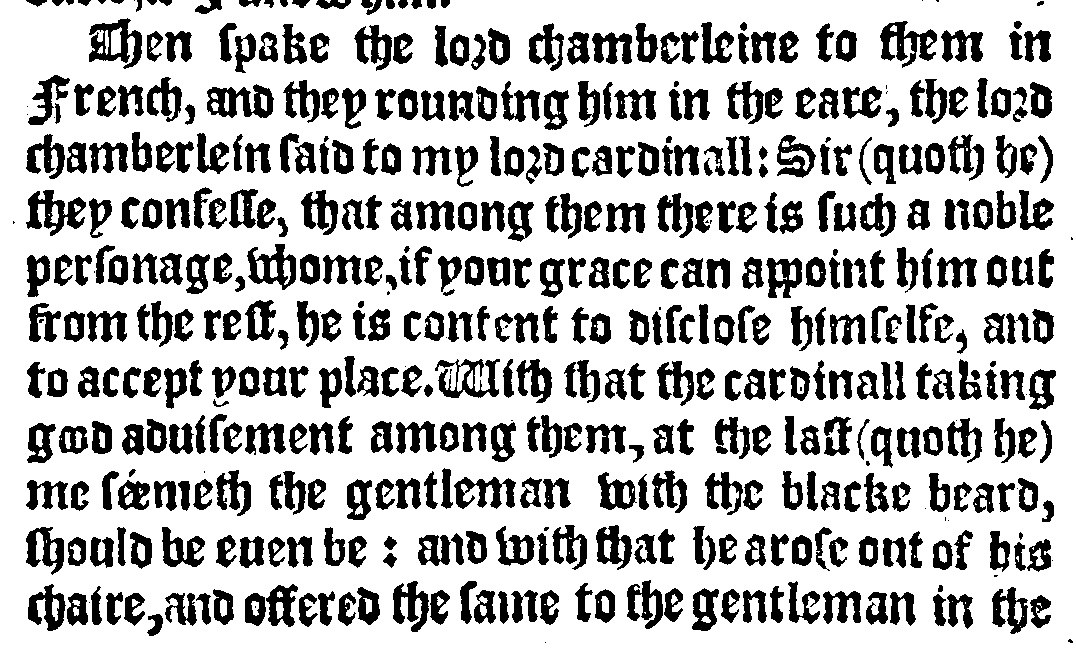
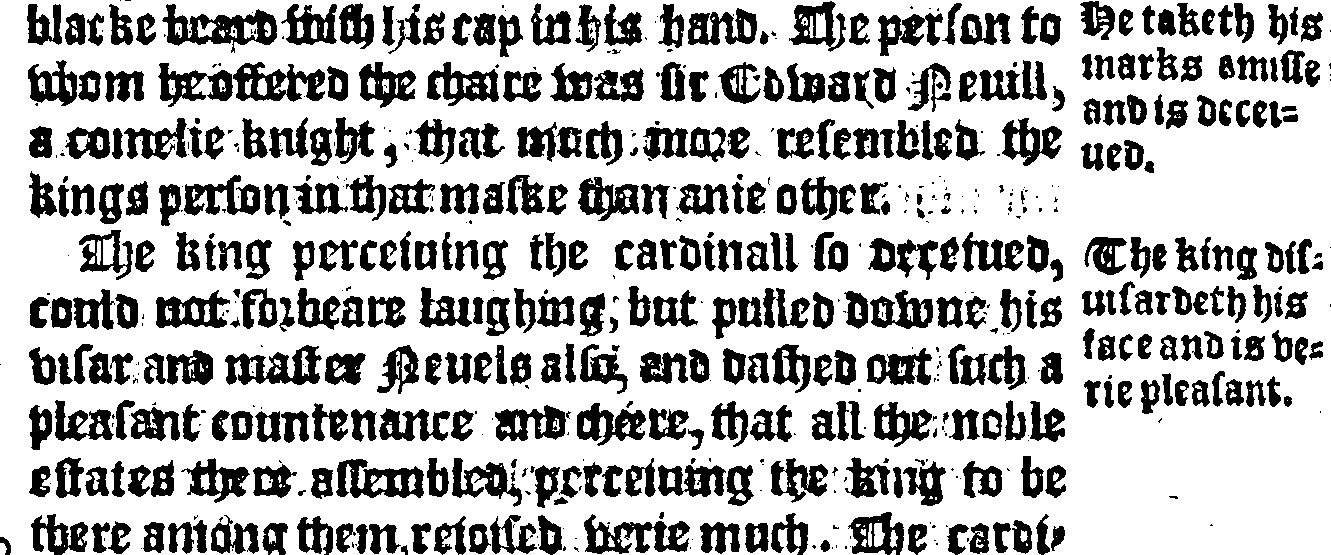
The play retains the masked visitors, the dancing and Wolsey’s offer of his chair. At the moment of recognition, however, the joke is gone:
WOLSEY Let me see, then.
[He leaves his state.]
By all your good leaves, gentlemen.
[He bows before the King.]
Here I’ll make
My royal choice.KING, [unmasking] You have found him, cardinal.
[…]— Henry VIII, 1.4.3
The king’s reply makes the change explicit: Wolsey has chosen correctly. Sir Edward is neither named in the play nor given the mistaken recognition that distinguishes him in the chronicle. The scene continues towards Henry’s interest in Anne Bullen, with whom he has danced.
The family is not otherwise absent. Sir Edward’s brother George, Lord Abergavenny, is arrested with Buckingham in the opening scene.4
An omission noticed long ago
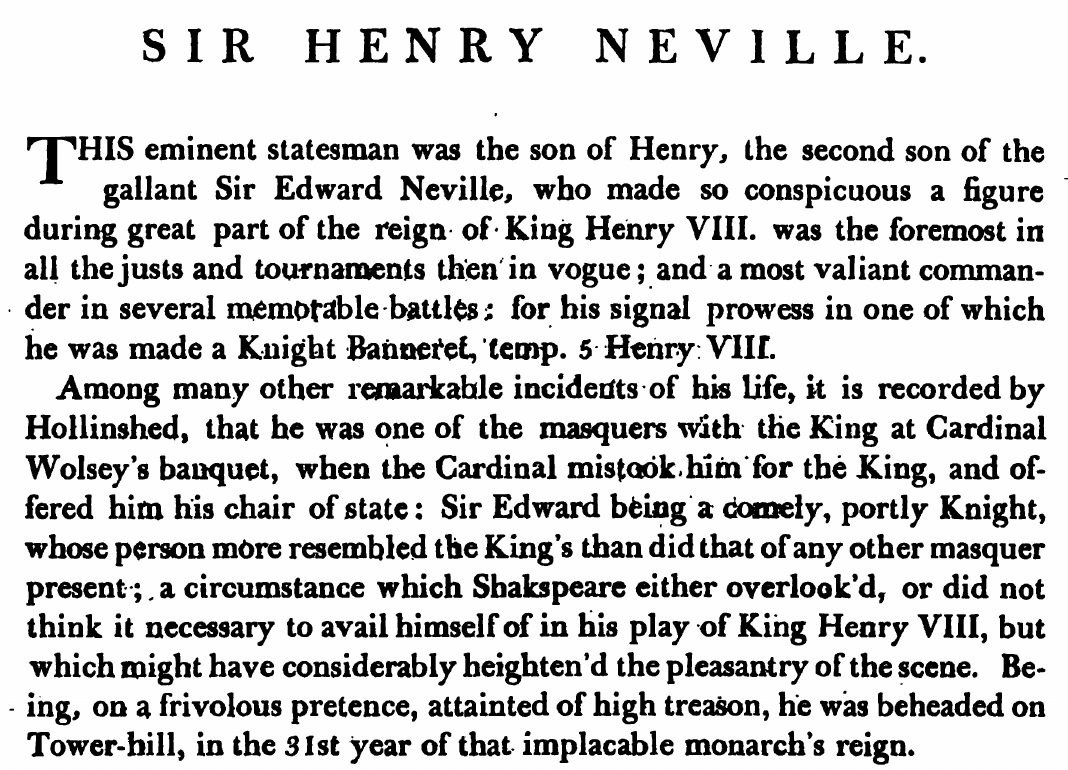
This difference was noticed long before the modern Neville authorship argument. In 1795, The Biographical Mirrour discussed it in its life of the ambassador. The entry remarks that Shakespeare either overlooked the incident or thought it unnecessary. It nevertheless judges that including the mistake could have heightened the scene’s comedy.5
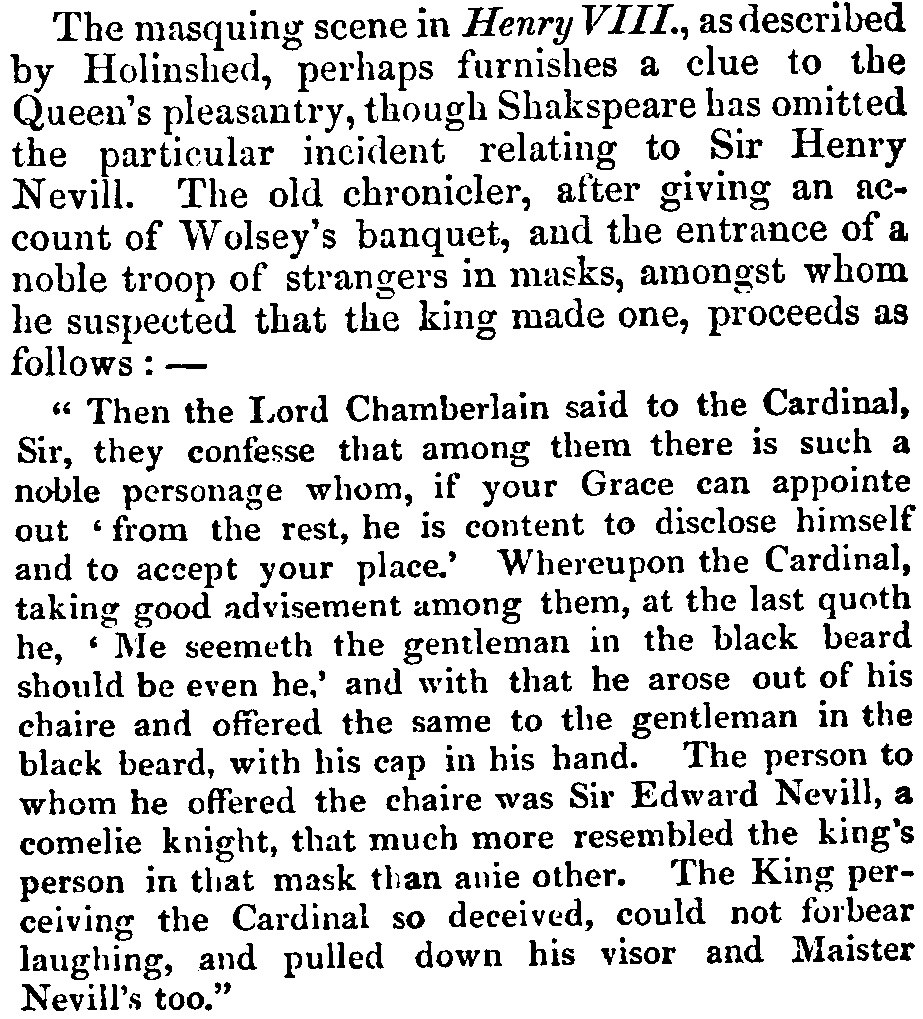
Lord Braybrooke, a descendant of the Billingbear Nevilles, wrote about the omission in Notes and Queries in 1850.6
An ague and a chamber prison
The play’s opening supplies a more intimate comparison. Buckingham explains why he missed the meeting between Henry VIII and François I at the Field of the Cloth of Gold:
BUCKINGHAM An untimely ague
Stayed me a prisoner in my chamber when
Those suns of glory, those two lights of men,
Met in the vale of Andren.— Henry VIII, 1.1.7
Writing to Robert Cecil, Earl of Salisbury, probably in early 1608, Neville had explained why illness prevented him from attending in person, using almost identical language:
Although I have shaken off an ague and a cold which have kept me a prisoner to my chamber more than a full month, yet I am not so strong as I dare venture abroad in this extreme weather; therefore I make bold to advertise your Lordship by writing […].
— Henry Neville to the Earl of Salisbury, probably early 1608.7
Both passages make an ague the cause of confinement, describe the sufferer as a prisoner in his own chamber, and use that confinement to explain his absence. Buckingham repeats the confinement metaphor:
BUCKINGHAM All the whole time
I was my chamber’s prisoner.— Henry VIII, 1.1.7
This explanation also departs from the chronicle. Holinshed places Buckingham with Wolsey escorting the French king during the festivities. In his edition of the play, C. Knox Pooler noted that he could find no evidence for Buckingham’s ague and that the duke was certainly not absent throughout. The play turns him into the man who missed the spectacle and must hear about it from Norfolk; the language used to explain that absence closely resembles Neville’s account of his own illness.7
Notes
Notes and sources
Raphael Holinshed and continuators, The Third Volume of Chronicles (London, 1587), p. 922, STC 13569; Wellcome Library copy at Internet Archive. The episode passes from the lower left column to the upper right. The images reproduce that edition. The searchable text witness is EEBO-TCP A68202, in the account of Henry VIII.↩︎
W. A. J. Archbold, “Neville, Edward (d. 1538),” Dictionary of National Biography, identifies George as Edward’s brother and the elder Henry as Edward’s son, through whom he was grandfather of the ambassador. See also Archbold, “Neville, Henry (1564?-1615).” These entries are used here for the stated family links, not for the Edward entry’s confused account of the paternity rumour. The 1795 Mirrour, p. 90, also explicitly sets out the three generations.↩︎
William Shakespeare, Henry VIII, Act 1, scene 4, Folger Shakespeare Library, especially lines 101-123. Quotation preserves the Folger text’s line breaks and speaker labels. The stage directions supplied by the modern edition are retained in brackets; the king’s spoken reply independently establishes the successful recognition. The banquet scene, 1.4, is generally assigned to John Fletcher within the collaborative play. Petr Plecháč, “Relative contributions of Shakespeare and Fletcher in Henry VIII” (2019), tables 1 and 3 and §4, supports that allocation. Attribution of the scene’s wording does not by itself identify who chose its departures from Holinshed.↩︎
Shakespeare, Henry VIII, Act 1, scene 1, Folger Shakespeare Library, concluding arrest sequence. See Chapter 1 for the family setting. The play’s Abergavenny and the masque’s Sir Edward are brothers, not interchangeable names for the same person.↩︎
The Biographical Mirrour, Comprising a Series of Ancient and Modern English Portraits, of Eminent and Distinguished Persons, from Original Pictures and Drawings (London: S. and E. Harding, 1795), “Sir Henry Neville,” p. 90; Internet Archive, Google-digitized New York Public Library copy. The illustration reproduces the entry’s heading and first two paragraphs.↩︎
Lord Braybrooke, “Queen Elizabeth and Sir Henry Nevill,” Notes and Queries, first series, II, no. 50 (12 October 1850), p. 307; bound-volume scan; Project Gutenberg transcription. Braybrooke’s introductory sentence names Sir Henry, but the chronicle passage he quotes names Sir Edward. The separate anecdote concerning Elizabeth and the ambassador’s father is discussed in Appendix C, “The Parentage Tradition.” No independence from the 1795 notice is claimed. The printed signature reads “Braybrooke”; the transcription’s “Brathbrooke” is erroneous. The adjacent item is “Further Notes on the Authorship of Shakspeare’s Henry VIII,” pp. 306-307. Braybrooke’s family connection is set out in his History of Audley End (London, 1836), pp. 53–55: Catherine Neville’s son Richard Neville Aldworth inherited Billingbear after the death of Henry Neville Grey’s widow in 1762; his son became the second Lord Braybrooke, father of the third. See also Essex Record Office, D/DBy F61, for the Neville–Aldworth descent and the family pedigree.↩︎
Henry Neville to Robert Cecil, Earl of Salisbury, probably early 1608, Edmund Lodge, Illustrations of British History, Biography, and Manners, III (London, 1791), no. XCII, p. 340. Quotation checked against the printed page; spelling and capitalization modernized, with “off” for printed “of.” The manuscript itself is undated, but the Hatfield calendar, XX (1968), p. 2, Cecil Papers 124/100 places it conjecturally after 1 January 1607/8 (1608 with the year beginning on 1 January). It follows a dated letter about the same exemption scheme, Cecil Papers 120/1. Shakespeare, Henry VIII, 1.1, Buckingham; Folger wording and line breaks retained. The interest lies in the combination of ague, chamber confinement and explanation of absence; the broader chamber-prison metaphor occurs elsewhere. Act 1, scene 1 is assigned to Shakespeare in all five earlier allocations summarized by Petr Plecháč, “Relative contributions of Shakespeare and Fletcher in Henry VIII” (2019), table 1; his own scene-level analysis agrees, table 3. C. Knox Pooler, ed., The Famous History of the Life of King Henry VIII (London: Methuen, 1915), notes to 1.1, pp. 7–8, reports finding no evidence for Buckingham’s ague and points to his recorded attendance at the festivities. Holinshed’s Chronicles, III (1587), p. 860, places Buckingham with the cardinal escorting the French king; this passage was checked in the EEBO-TCP transcription, A68202.↩︎