A man arriving in his shirt
Henri IV ran downstairs in his shirt with a sword in his hand. Neville reported the scene to Robert Cecil on 7 August 1599, after a fight outside the king’s lodgings:
The king, hearing of the matter, leapt out of his bed and ran down in his shirt with a sword in his hand, but by that time the rest were gone, and le Grand was brought in wounded as he was.1
The prince of Joinville believed that Bellegarde, the king’s grand equerry or “le Grand,” had made Henri jealous by reporting that Joinville was courting Mademoiselle d’Entragues. Bellegarde was caught unarmed and wounded through the thigh; others were hurt.
In Othello’s fifth act, Cassio has been attacked at night. Lodovico and Gratiano hesitate to approach the wounded men in the darkness. Iago returns with a light:
GRATIANO
Here’s one comes in his shirt, with light and
weapons.2
— Othello, 5.1
Both men arrive amid nocturnal violence “in his shirt,” carrying a weapon. Henri has hurried from bed; Iago looks similarly roused by the alarm, concealing his own part in the attack.
Cinthio, whose Italian tale supplies the play’s main plot, already gives the dark night, the sword attack, the thigh wound and the assailant’s return pretending to help. He says nothing of the ensign’s dress, light or weapon when he returns; Shakespeare adds the shirt, light and weapons at that moment.3
Shakespeare adds another detail when Iago offers the shirt as a bandage: “Light, gentlemen. I’ll bind it with my shirt.” The garment helps him perform concern for the man he has just injured.2
How to plant jealousy
On 24 September 1599 Neville reported a French attempt to weaken the understanding between Elizabeth and the States of the Netherlands. The method was to persuade the States that England would abandon them:
put a jealousy into the States’ heads of her Majesty, that she will abandon them.4
Neville explains the purpose: to break communication and understanding between the allies. Iago uses very similar language to plan the destruction of trust within a marriage:
IAGO
Or, failing so, yet that I put the Moor
At least into a jealousy so strong
That judgment cannot cure. […]5
Another letter brings the language of suspicion together with watching. On 15 November 1600 Neville discussed the possibility of secret measures against the Protestants and expected those concerned to be:
jealous enough of it, and therefore open-eyed to observe what is done.6
Iago uses the same association when advising Othello:
IAGO
Look to your wife; observe her well with Cassio;
Wear your eyes thus, not jealous nor secure.6
“Secure” means unsuspecting or overconfident. Iago poses as a prudent adviser while making innocent actions look suspicious.
Italian newsletters and naval intelligence
Cinthio sends his commander to Cyprus during a routine change of troops, on a calm voyage.7 Shakespeare adds a naval emergency: conflicting reports of a Turkish fleet, messengers arriving one after another, and ships bringing news of storm losses.8
The newsletters Neville received from Thomas Savile
Italian newsletters dated 1591 survive among Neville’s family papers. They were addressed to Thomas Savile, Henry Savile’s younger brother, who forwarded them to Neville. His accompanying note addresses Neville as “Cosen”; Neville’s handwritten notes appear on the sheets. Some are headed “Di Venetia”—“From Venice.”9
These sheets report Ottoman naval preparations, deceptive military movements and ships arriving with news of losses—the kinds of intelligence Shakespeare adds to Cinthio’s story. The translations below have been checked against manuscript photographs; uncertain readings are marked.
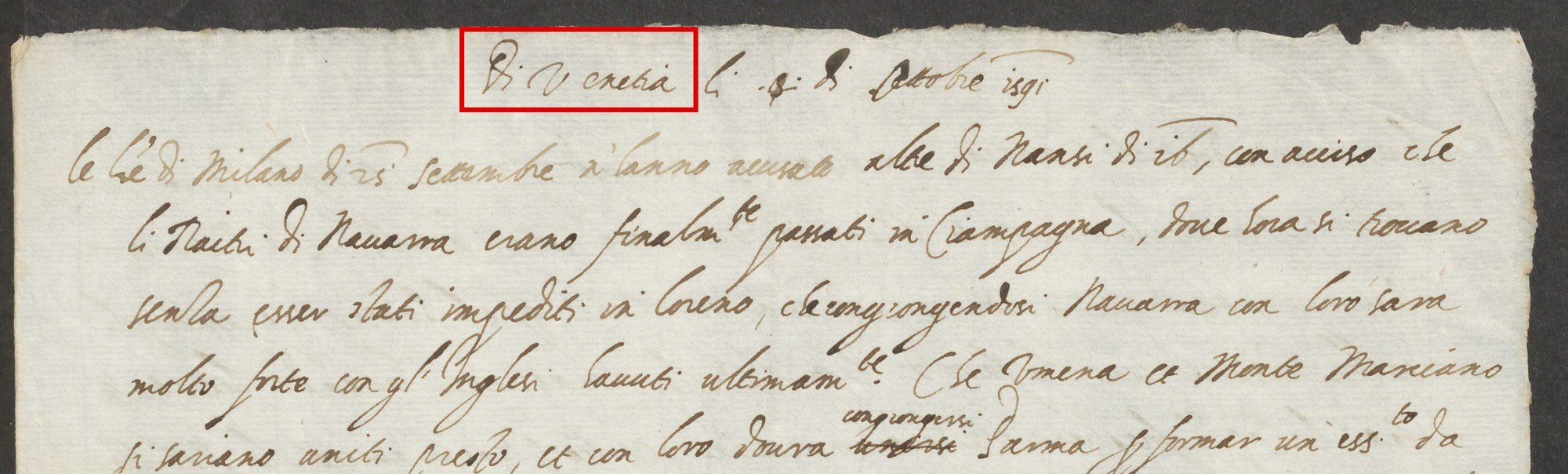
Figure 27.1. “Di Venetia”—“From Venice”—boxed in red in the newsletter of October 1591. The opening lines relay letters from Milan referring to earlier letters from Nancy. The National Archives, PRO 30/50/70/2; catalogue. Detail of the manuscript; red box added.
Thomas had travelled in Italy and maintained connections in Padua, Venice and Rome.10 These handwritten newsletters, or avvisi, assembled news from several places: a Venetian sheet could carry reports from France or Constantinople; others in the packet have Antwerp and Cologne datelines. The sheets repeatedly preserve stages of transmission: a place, a date, a letter or arriving vessel, and the news it brings.
Juraj Kittler’s study of Venetian communications describes the historical setting for such reports: official intelligence from Constantinople supplied to foreign diplomats, alongside private letters and less formal sources used when official information was restricted.11
Othello greets Cassio and the Duke’s officers by asking:
OTHELLO
The servants of the Duke and my lieutenant!
The goodness of the night upon you, friends.
What is the news?
— Othello, 1.2.12
Cassio knows that messengers have arrived before he knows exactly what their reports establish:
CASSIO
Something from Cyprus, as I may divine.
It is a business of some heat. The galleys
Have sent a dozen sequent messengers
This very night at one another’s heels,
[…]
— Othello, 1.2.12
“Sequent” means following one another. Shakespeare makes the arriving reports part of the action: Venice’s officials must decide what they establish.
Which reports deserve belief?
In the council chamber, the papers disagree:
DUKE, [reading a paper]
There’s no composition in these news
That gives them credit.FIRST SENATOR, [reading a paper]
Indeed, they are disproportioned.
My letters say a hundred and seven galleys.
— Othello, 1.3.13
The Duke’s report gives 140 galleys; another senator’s gives 200. Yet disagreement over the number does not invalidate everything the reports say:
SECOND SENATOR, [reading a paper]
And mine, two hundred.
But though they jump not on a just account
(As in these cases, where the aim reports
’Tis oft with difference), yet do they all confirm
A Turkish fleet, and bearing up to Cyprus.
— Othello, 1.3.13
The senator separates an uncertain detail from the common warning. A newsletter headed Venice, 1 November 1591, weighs reports brought by travellers against the absence of letters. People arriving from Nevers and Moulins report a battle, but the writer withholds full belief:
ma p[er] non esserci alcune l[ette]re non si crede così facilmente, ben si ha p[er] certo […] et che li Campi congiunti non erano discosti 4 leghe l’un dall’altro.
In translation:
but because there are no letters, it is not believed so readily; it is, however, held for certain […] that the assembled armies were not four leagues apart.14
The newsletter separates a doubtful battle story from a position it treats as certain; Shakespeare’s senator separates disputed numbers from an agreed warning. Neither accepts nor rejects the reports wholesale.
Neville’s own dispatches show him testing reports in the same way. On 20 February 1600 he told Cecil that two couriers had arrived from Spain “one after another,” travelling with extraordinary speed. He had been secretly informed that the Spanish king was dead or dangerously ill. He sent an urgent messenger to England and promised another dispatch when he had obtained either “confirmation or controlment”—confirmation or information contradicting the first report. Speed did not remove the need to test what he had heard.15
Ottoman preparations and concealed intentions
The newsletters also convey the substance of the intelligence Venice needs. Shakespeare brings an incoming report directly before the state:
SAILOR
The Turkish preparation makes for Rhodes.
So was I bid report here to the state
By Signior Angelo.
— Othello, 1.3.13
A sheet dated 15 November 1591 relays a report from Constantinople that Cicala had inspected the Ottoman Arsenal, found it poorly furnished with sails, cables and anchors, and informed the Sultan. The report then gives the Sultan’s order and follows the preparations through to their expected result:
ordering him to ensure that the said Arsenal was supplied with twice as much of everything necessary, as the said Cicala had begun to do, having ordered along the whole coast of the Black Sea the making of galley timbers, cables and other things belonging to the naval fleet, which it is believed without doubt will go out the following year.16
A later Venetian newsletter, dated 27 December 1591, cites Constantinople letters of 2 and 12 November. It sets rumour against the visible preparations:
There was talk among the Turks that a large fleet would put out in the new season at the instance of the King of Navarre and the Queen of England; despite all this, work in the Arsenal was not seen proceeding with much diligence.16
One report builds an expectation from orders and supplies; the other sets talk of a large fleet against the observed pace of work. Neither names Cyprus as the destination, but both show the kind of intelligence about Ottoman naval readiness that Shakespeare’s council must weigh.
Knowing that a force is preparing to move leaves another question: where is it really going? When a sailor reports that the Turkish fleet is making for Rhodes, Shakespeare’s senator suspects a diversion:
FIRST SENATOR This cannot be,
By no assay of reason. ‘Tis a pageant
To keep us in false gaze. When we consider
Th’ importancy of Cyprus to the Turk,
[…]
— Othello, 1.3.13
He argues that Cyprus matters more to the Turks and is less well defended. A further messenger reports thirty additional sail joining the fleet and a turn back towards Cyprus. Fresh news supports the senator’s reading of the manoeuvre.
The newsletter headed Venice, October 1591—the one illustrated above—reports just such a distinction between apparent movement and military intention. The action is on land, in the Dauphiné, relayed through letters from Milan. Its account of Lesdiguières reads, in translation:
Lesdiguières, pretending to turn with all his forces towards [Provence?], seemed to have left Grenoble unprovided; Don Amedeo consequently turned into the Dauphiné […]; but Lesdiguières, having returned secretly with his men-at-arms, fell upon him unexpectedly and routed him.17
The newsletter describes a successful trap; Shakespeare’s senator detects the suspected diversion. Both turn on reading a commander’s intention behind an apparent movement. Shakespeare adds this military problem to Cinthio’s domestic intrigue.
Printed histories of the Turks
Richard Knolles’s Generall Historie of the Turkes (1603) has been proposed as a source for the play’s military setting, though the case is not established.18,19
Neville was in Venice in 1582, the year of the Venetian edition of Sansovino’s history of the Turks recorded in the 1780 catalogue of the Neville library at Billingbear.7 The catalogue does not establish when the book was acquired. That edition describes the Ottoman admiral Piali’s departure with eighty galleys and thirty galliots. Later, a hundred galleys move from Cyprus towards Rhodes to obtain news of the Christian fleet; five galliots are sent towards Crete, intelligence is gathered, and Piali returns to Cyprus with a detailed report. Knolles names Sansovino among the authors he used; his account likewise gives eighty galleys and thirty galliots, figures already present in Sansovino’s 1582 edition.18,20
Ships bringing news of shipwreck
The same dependence on reports governs the arrival in Cyprus. Cinthio’s Moor fears the dangers of the sea, but the couple make their voyage together in calm weather. Shakespeare separates his travellers in a storm, then lets each arriving ship alter what those waiting ashore know. A gentleman announces news of the Turkish fleet:
THIRD GENTLEMAN News, lads! Our wars are done.
The desperate tempest hath so banged the Turks
That their designment halts. A noble ship of Venice
Hath seen a grievous wrack and sufferance
On most part of their fleet.MONTANO
How? Is this true?THIRD GENTLEMAN The ship is here put in,
A Veronesa. Michael Cassio,
Lieutenant to the warlike Moor Othello,
Is come on shore; the Moor himself at sea,
And is in full commission here for Cyprus.
— Othello, 2.1.21
The question “Is this true?” is answered by identifying an arriving ship and its officer. The northern reports in Savile’s packet preserve a closely comparable form of maritime news. An Antwerp report dated 7 December relays news from London of the previous month:
From London, on the 17th of the preceding month, they report the arrival in that port of a vessel from Malaga. Its mariners reported that twenty-five ships of the fleet had reached Lisbon and Sanlúcar; but, because the remainder had not appeared, it was feared that it had perished in a storm.22
Here the missing ships prompt fear, not a claim of witnessed destruction. Shakespeare also leaves a fate unresolved after news arrives: Cassio is safe, but Othello is still at sea.
A passage citing Lisbon letters dated the last day of October reports losses more definitely:
Letters from Lisbon dated the last day of October confirm the arrival in that port of eighteen ships of the New Spain and Tierra Firme fleet; these gave news that twenty-four others, including the two richest, had perished in a storm.22
In each, the arrival of ships is joined to news of losses elsewhere. Shakespeare explicitly makes the Venetian ship a witness to the wreck; the newsletter does not say how its loss report was obtained. The newsletters’ differing totals need not describe the same group of ships.
The packet documents Neville’s access to the kinds of intelligence Shakespeare adds to Cinthio: reports that must be tested, military movements that may deceive, and arrivals that bring only partial news, whether from the Mediterranean or the Atlantic. It does not establish that Shakespeare used these particular sheets.
Command, letters and false stories
The storm ends the immediate naval threat, but the island remains a military outpost. Colm MacCrossan’s 2020 study of Othello and Cyprus makes this point especially forcefully. Shakespeare turns Cinthio’s captain into a general and governor whose destruction deprives Cyprus of its defender. Cassio’s drunken disturbance terrifies a community expecting war. Read against the Ottoman conquest of Cyprus in 1571, the collapse of command acquires a consequence beyond the household: private malice disables the island’s defence.23
Venice continues to govern through letters after the storm. Othello entrusts Iago with papers for the pilot to carry to the Senate before he turns to inspecting the fortifications:
OTHELLO
These letters give, Iago, to the pilot
And by him do my duties to the Senate.
[He gives Iago some papers.]
That done, I will be walking on the works.
Repair there to me.
— Othello, 3.2.24
Iago occupies a trusted place in the commander’s official communications as well as in his private confidence. Later, Lodovico’s arrival brings the order recalling Othello and appointing Cassio. Iago exploits that genuine appointment by telling Roderigo that Othello will take Desdemona to Mauritania, and that removing Cassio can prevent her departure. An authentic change of command supplies a false story with its persuasive foundation (Othello, 4.1–4.2).25
Digges and Cassio’s military mathematics
Michael Neill’s Oxford edition connects Iago’s description of Cassio as a “great arithmetician” with Thomas Digges’s defence of military learning. Digges was a mathematician and military writer whose Stratioticos challenged experienced soldiers’ dismissal of knowledge they themselves lacked—the attitude Iago adopts towards Cassio.26
Digges also had a family connection to Neville: his wife, Anne St Leger, was Neville’s second cousin. Appendix H discusses his argument for an infinite universe and his work with Henry Savile and John Chamber on calendar reform. His sons, Dudley and the younger Leonard Digges, are discussed in Chapter 49; Dudley’s writing on Coriolanus appears in Chapter 34.27
Thomas Digges’s Stratioticos, incorporating work begun by his father, Leonard Digges, appeared in 1579 and was enlarged in 1590.27
Iago resents Othello’s choice of Cassio as lieutenant:
IAGO
Forsooth, a great arithmetician,
One Michael Cassio, a Florentine,
A fellow almost damned in a fair wife,
— Othello, 1.1.26
The adjoining “fair wife” may suggest Anne, though this is speculative and distinct from Neill’s argument.26
Stratioticos also addresses the ensign, the officer entrusted with the company’s flag—the office Iago holds. He should guard that flag with a husband’s care:
to be no less careful and jealous thereof, than every honest and honorable gentleman should be of his wife.28
The manual connects a soldier’s reputation, his responsibility for the ensign and jealousy over a wife. In the play, as in Cinthio, the ensign exploits jealousy to destroy his commander’s marriage.
Cuffe and the concerned adviser
The historian Paul E. J. Hammer writes that Henry Cuffe, Essex’s secretary, “was cast as an Iago-like figure in Essex’s fall” at his trial and in official propaganda.29 Hammer describes how Cuffe was portrayed; William D. Rubinstein goes further, proposing in a 2024 article that Cuffe was a model for Iago.30
Neville’s account records an approach by Cuffe after the failed Boulogne peace conference in August 1600. Cuffe told him that Essex had heard from friends at court that Neville was likely to be blamed for the failure.
Neville went to court to investigate and found the contrary. When he told Cuffe, Cuffe replied that there had been such an intention, but circumstances had changed. He added that Essex esteemed Neville and regretted his ill treatment. Neville responded with thanks and an offer of service to Essex.30
Rubinstein’s comparison concerns the adviser’s role: Cuffe brought Neville an alarming report and assurances of Essex’s goodwill; Iago presents his warnings to Othello as the service of a concerned friend. Neville records what Cuffe said, without establishing his motives.31
Service, fault and reputation
In Cinthio, discovery leads to proceedings in Venice: the ensign and the wounded officer travel to Venice, accusations are made, and the Moor is brought back from Cyprus for examination. The ensign’s wife ultimately supplies the narrative of what occurred. Shakespeare compresses discovery into the final scene, where Emilia’s testimony, Cassio’s account and the papers found on Roderigo expose the deception. The distinctive addition is the use of those papers as evidence before Othello’s death.32,33
Stripped of command and held prisoner pending Venice’s judgment, Othello asks to shape the written account of his offence:
OTHELLO
Soft you. A word or two before you go.
I have done the state some service, and they
know ’t.
No more of that. I pray you in your letters,
When you shall these unlucky deeds relate,
Speak of me as I am. Nothing extenuate,
Nor set down aught in malice.
— Othello, 5.2.34
Writing from the Tower on 8 May 1601, Neville likewise asked that admitted fault be judged alongside his life of service. He appealed to Cecil as both friend and counsellor of state:
I acknowledge a great fault, only I would be glad it might be conceived that there was more misfortune than malice in it.35
Later in the same letter he asks:
Let my whole life and former carriage towards her Majesty be examined, and by that let there be some judgment made of my heart and intention towards her.35
In the separate defence printed as “Sir Henry Nevill’s Case,” he acknowledges his failure to disclose the conspiracy:
But howsoever, I do freely and from my heart acknowledge my offence in concealing of it, and do humbly implore her Majesty’s pardon and mercy for it; but protest it was not from any malice or discontent against the state, for who had more interest therein than I?36
He also acknowledges the conflict between public duty and his reluctance to become an accuser:
Although I confess, that my duty to the public should have prevailed above all respect of my own private disgrace which I apprehended in it.36
Near the close, he recalls that he had been preparing to return to France “with a full purpose, desire, and resolution to serve her Majesty […]”.36
The malice belongs to the reporters in Othello’s appeal and to the accused in Neville’s, but both ask that fault be weighed against intention and service. Neville had also asked Cecil on 22 April 1601 to suppress his declaration or let him restore omitted circumstances (Chapter 26).37
Neville’s own declaration calls the threat to his name a “blot”; his prison letter imagines washing it away in blood (Chapters 6–7). As early as 1795, The Biographical Mirrour linked that loss with Othello, describing his good name as “the immediate jewel of his soul” and imagining him speaking Cassio’s lament:
Reputation! reputation! reputation! O, I have lost my reputation! I have lost the immortal part of myself, my reputation, my reputation!38
Notes and sources
Henry Neville to Robert Cecil, 7 August 1599 O.S., Ralph Winwood, Memorials of Affairs of State, ed. Edmund Sawyer (London, 1725), I, p. 86, page image; manuscript: The National Archives, SP 78/43, fols. 272–273. The quotation follows the printed transcription, with spelling, capitalization and light punctuation modernized. This rule applies to all Winwood quotations in the chapter; historical vocabulary and meaning are retained. The king arrives after the other participants have gone. Ken Feinstein drew attention to the shirt-and-sword comparison in a post of 1 June 2019. Neville’s “le Grand” is Roger de Saint-Lary et de Termes, seigneur and later duc de Bellegarde. The designation came from his office as grand equerry of France: François de Bassompierre, Journal de ma vie, ed. marquis de Chantérac, I (Paris: Veuve Jules Renouard, 1870), p. 60 n. 1. Bassompierre recounts the same quarrel on pp. 75–76, but describes a wound in the buttock and the king coming out with his robe and sword, with Bassompierre carrying a torch. Neville’s account is retained here. The catalogue of BnF, Dupuy 407, fol. 147 also identifies “Mr Le Grand” as Bellegarde in its description of Henri IV’s autograph instructions for settling the quarrel.↩︎
Shakespeare, Othello, 5.1, Iago’s return with a light, Gratiano’s description, and Iago’s offer to bind Cassio’s wound. The wording is present in both early printed texts: the 1622 quarto reads “in his shirt, with lights and weapons”; the 1623 Folio reads “in his shirt, with Light, and Weapons” (long s normalized). See the Text Creation Partnership transcriptions of the quarto, A11992, and Folio, A11954. Quotations from Shakespeare follow Barbara Mowat and Paul Werstine’s Folger reading text. The play survives in materially different texts in the 1622 quarto and 1623 Folio; see their “An Introduction to This Text”. Bold emphasis in comparisons identifies matching or corresponding language; it is editorial.↩︎
Giovanni Battista Giraldi Cinthio, De gli hecatommithi, first part (Venice, 1580), third decade, seventh tale, p. 582, scanned edition. The absence concerns the returning ensign’s appearance in this episode. The tale does use camiscia elsewhere: on p. 573 Disdemona declares that she would accompany her husband even through fire in her shift. That separate occurrence does not supply the armed responder’s costume in the ambush scene.↩︎
Neville to Cecil, Paris, 24 September 1599 O.S., Winwood, I, pp. 106–107, especially p. 107. The continuation seeks to “break off the intelligence” between Elizabeth and the States: their communication and understanding.↩︎
Shakespeare, Othello, 2.1, Iago’s closing soliloquy. The excerpt begins with the alternative to his desire to be revenged “wife for wife.”↩︎
Neville to Winwood, London, 15 November 1600, Winwood, I, pp. 273–275, especially p. 274; Shakespeare, Othello, 3.3, Iago’s advice to observe Desdemona. Neville’s letter anticipates secret measures against “the Religion,” meaning the Protestant cause.↩︎
Cinthio, Hecatommithi, pp. 571–586. For a modern translation, see Joseph Grossi, trans., Jessica Slights, ed., “Cinthio’s Tale”, Internet Shakespeare Editions. The source comparison here follows the Italian narrative as well as that translation. Neville was in Venice in 1582: Dudith to Hájek, 29 January 1582, Epistulae, VII, letter 1115, pp. 207–209, especially p. 208, lines 17–20 (edition). The Billingbear catalogue of 7 November 1780, Royal Berkshire Archives, D/EN/F37/1, records Venetian editions of Cinthio (1580) and Sansovino (1582), without dating their acquisition; see catalogue discussion and images.↩︎
Cinthio, pp. 572–574; Shakespeare, Othello, 1.3 and 2.1. These additions are identified by direct comparison of the narratives.↩︎
The National Archives, PRO 30/50/70/2, sixteen Italian newsletters addressed to Thomas Savell of London by an anonymous correspondent, dated from Rome and Venice, September–November 1591, item catalogue; PRO 30/50/70, “Additional diplomatic correspondence of Sir Henry Neville,” parent catalogue. The catalogue identifies the recipient as Thomas Savell and places the packet in Neville’s additional diplomatic correspondence. An English note on the reverse, beneath the Italian report headed “Di Colonia li 5 Decembre,” begins “Cosen I caused yor man to stay this day” and apologizes for detaining the recipient’s man beyond the appointed time. The note is Thomas Savile’s to Neville: its address as “Cosen,” the newsletters’ address to Thomas, Neville’s handwriting on the sheets and their provenance among his family papers establish the route. The leaf is identifiable by this heading and opening; no archival folio number is visible. The surviving photographic sequence also includes December datelines; the catalogue’s September–November range should not be treated as a complete dating of every sheet. Newsletter translations are supplied here from unverified AI readings checked against manuscript photographs; they are not human-certified transcriptions. Bold emphasis in translations identifies correspondences in meaning, not identical original wording. Particular reading uncertainties are noted below. The catalogue controls the packet’s identity, not its individual reports or their historical accuracy.↩︎
Robert B. Todd, “Henry and Thomas Savile in Italy,” Bibliothèque d’Humanisme et Renaissance 58.2 (1996), pp. 439–444, especially pp. 439, 442–444, article: relationship, travels, Italian contacts, books and return to England. The newsletter information comes separately from the National Archives catalogue.↩︎
Juraj Kittler, “Venetian Control of Information Flows with Constantinople and the Soft Power of a Renaissance State,” The Historical Journal 68 (2025), 259–284, especially pp. 269–270, article. Kittler supplies the historical context; the comparison with Neville’s packet is made here.↩︎
Shakespeare, Othello, 1.2, Folger Shakespeare Library, ed. Barbara Mowat and Paul Werstine. All Shakespeare extracts follow the Folger reading text and retain its lineation; editorial emphasis is added in comparisons.↩︎
Shakespeare, Othello, 1.3. The extended comparison of the islands’ defences contains Folio material absent from the 1622 quarto; this chapter does not use that difference to date the play or identify a particular report as its source.↩︎
TNA, PRO 30/50/70/2, newsletter headed Venice, 1 November 1591, near the end of the report of fighting involving Navarre and the League; catalogue. Abbreviations are expanded in square brackets. The ellipsis omits a partly obscured clause concerning a battle; no reconstruction of that clause is used here. “Ha per certo” introduces what the writer treats as certain, not independently established fact. The following clause places the assembled armies less than four leagues apart.↩︎
Neville to Cecil, Paris, 20 February 1599 O.S. (1600 in modern year numbering), Winwood, I, pp. 153–154, especially p. 153. The report is expressly uncertain. “Controlment” retains the historical sense of contradiction or refutation.↩︎
TNA, PRO 30/50/70/2, Venice, 15 November 1591, embedded Constantinople report; and Venice, 27 December 1591, report citing Constantinople letters of 2 and 12 November; catalogue. The October day in the first embedded dateline is obscured and is not adopted. In the second report, the working reading usciria (would put out) was checked again against the photograph for this extract. The newsletter reports the alleged request by the King of Navarre and Queen of England as part of the rumour, not as independently confirmed diplomacy. Neither passage supplies the Senate’s 107/140/200 figures or an explicit Cyprus destination. The longer quotation follows the order to supply the Arsenal through the production of galley timbers and equipment and the forecast of the fleet’s sailing. “Black Sea” translates “Mar Maggiore.” Cicala is the name in the report; no further identification is assumed.↩︎
TNA, PRO 30/50/70/2, Venice, October 1591, report naming Lesdiguières; catalogue. The day appears to be 4, but is not certain. The destination is provisionally read as [Provence?]; no independent human transcription of that word has been identified. The ellipsis omits the cavalry’s and infantry’s places of origin. The translation retains the reported feigned movement, secret return and rout; casualty totals and independent authentication of the manoeuvre are not claimed.↩︎
Richard Knolles, The Generall Historie of the Turkes (London, 1603), account of Selimus II, pp. 845–846, Bavarian State Library copy. The eighty galleys and thirty galliots occur on p. 845; the Rhodes rendezvous and combined fleet of two hundred on p. 846. For discussion of Knolles in relation to Othello, see Colm MacCrossan’s article cited below.↩︎
Knolles, Generall Historie, pp. 575 and 579, in the account of Solyman’s campaign against Rhodes. The Grand Master detects the diversion on p. 575; the councillor’s reassurance on p. 579 is followed by the siege, so the two judgements have different outcomes. For Shakespeare’s variant texts, compare the TCP transcriptions of Q1, A11992, and F1, A11954. The seven-line passage from “For that it stands not in such Warrelike brace” through “To wake, and wage a danger profitlesse” is present in F1 and absent from Q1. This is a structural comparison, not a claim of identical wording.↩︎
Francesco Sansovino, Historia universale dell’origine et imperio de’ Turchi (Venice: Altobello Salicato, 1582), pp. 442 and 447, digitized edition; Knolles, unpaginated list headed “The names of the Authors whom we especially used,” at the end of “To the Reader,” naming Franciscus Sansouinus. This acknowledgement identifies the author, not a particular Sansovino title or edition.↩︎
Shakespeare, Othello, 2.1. The scene also uses gunfire to identify a friendly arrival before its passengers are known.↩︎
TNA, PRO 30/50/70/2, newsletter headed Rome, 21 December 1591: the Antwerp section headed 7 December relays a London report dated 17 November and letters from Lisbon dated the last day of October, before the Cologne heading of 12 December; catalogue. In the Lisbon passage, le quali davano nova follows the mention of the eighteen ships, the natural antecedent adopted in the discussion, but the feminine plural can also refer back to the letters. It does not explicitly claim eyewitness observation of the losses. The totals are the newsletters’ reported figures, not independently established casualty returns. The London/Málaga report does not name the fleet; the Lisbon report explicitly names the New Spain and Tierra Firme fleet. Their counts are not reconciled here. Both passages belong to the northern reporting sequence in the photographed packet; neither is presented as a Venetian dateline. “In a storm” translates “per fortuna” in its maritime sense.↩︎
Colm MacCrossan, “‘What, in a Town of War … to Manage Private and Domestic Quarrel?’: Othello and the Tragedy of Cyprus,” Shakespeare 16.3 (2020), pp. 239–257, DOI; open accepted manuscript. MacCrossan’s interpretation establishes the importance of the military and political setting; the application to Neville is the argument of this chapter.↩︎
Shakespeare, Othello, 3.2.↩︎
Shakespeare, Othello, 4.1 and 4.2.↩︎
Shakespeare, Othello, 1.1, Iago’s opening account of Cassio’s appointment. The quotation preserves the Folger reading and verse lines. Michael Neill, ed., Othello, the Moor of Venice (Oxford: Oxford University Press, 2008), pp. 196–197, note to 1.1.18, connects the passage with Digges’s epistle “To the Reader” in Stratioticos (1590), sig. B2r, and refers to Paul A. Jorgensen, Shakespeare’s Military World, pp. 113–115. Neill establishes the military-intellectual comparison, not an identification of Cassio as Digges. The further suggestion here concerns the adjoining “fair wife” and Anne St Leger’s relationship to Neville; the play does not name the couple.↩︎
Leonard and Thomas Digges, An Arithmeticall Militare Treatise, Named Stratioticos (London: Henry Bynneman, 1579), digitized edition; enlarged as An Arithmetical Warlike Treatise Named Stratioticos (London: Richard Field, 1590), digitized edition. For Anne’s parentage and marriage, see “St. Leger, Sir Warham,” Dictionary of National Biography, vol. 50, p. 168. The second-cousin relationship follows the descent through the brothers George Neville, Lord Bergavenny, and Sir Edward Neville: George–Ursula–Anne; Edward–Henry Neville of Billingbear–Henry Neville the ambassador. See The Complete Peerage, vol. 1, p. 35, and the DNB lives of Sir Edward Neville and Henry Neville. This is a calculation from the compiled genealogy. No description of Anne’s appearance is asserted.↩︎
Digges, Stratioticos (1590), chapter VII, “The office and duty of the ensign of a band,” p. 93, printed page. Spelling and capitalization are modernized; the wording and comparison with a wife are retained. The wife in this instruction is generic, distinct from the proposed personal allusion in Iago’s speech.↩︎
Paul E. J. Hammer, “Cuffe [Cuff], Henry (1562/3–1601),” Oxford Dictionary of National Biography, published 23 September 2004, revised 3 January 2008, article. Hammer’s comparison concerns Cuffe’s portrayal at his trial and in official propaganda; he does not identify Cuffe as Shakespeare’s source for Iago.↩︎
William D. Rubinstein, “Why William Shakespeare Did Not Write the Works Attributed to Him, and Why Sir Henry Neville Did,” Journal of Scientific Exploration 38.2 (2024), pp. 258–272, especially p. 263, section 2, DOI; open article. Rubinstein proposes Cuffe as a model for Iago. For Neville’s own account, see his declaration to Egerton, Buckhurst, Nottingham and Cecil, 2 March 1601, Calendar of State Papers, Domestic, Elizabeth, 1601–03, pp. 5–8, item 11, especially p. 5. The description follows the printed calendar’s account, not a new transcription of the manuscript.↩︎
Cinthio, pp. 575–577; Shakespeare, Othello, 3.3, from Iago’s questions about Cassio’s participation in the courtship through his warnings about Desdemona. Cinthio’s ensign already presents his accusation as reluctant, dutiful disclosure; Shakespeare elaborates the posture in 3.3.↩︎
Cinthio, Hecatommithi (1580), pp. 584–586; edition. The Moor is taken from Cyprus to Venice after accusations; the ensign’s wife tells the story after her husband’s death. The dispatch, recall and final papers extend the play’s communications; no particular newsletter is proposed as the source of those incidents.↩︎
Shakespeare, Othello, 5.2, Roderigo’s papers, Cassio’s account and the proposed report to Venice.↩︎
Shakespeare, Othello, 5.2, Othello’s last speech, following Lodovico’s announcement that Cassio now rules Cyprus and Othello will remain a close prisoner. “Speak of me as I am” is the First Folio reading (1623); the first quarto (1622) reads “Speake of them as they are,” referring back to the deeds. See Folger’s textual notes, 5.2.402.↩︎
Neville to Cecil, Tower of London, 8 May 1601, Calendar of the Manuscripts of the Marquess of Salisbury, XI (1906), pp. 193–194, manuscript reference 86.37, printed letter. The acknowledgement of fault and phrase about malice occur on p. 193; the appeal to his whole life and former conduct continues on p. 194. The quotations follow the printed calendar.↩︎
“Sir Henry Nevill’s Case,” Winwood, I, pp. 302–304, especially pp. 303–304. This is a separate document from the letter of 8 May. The volume’s marginal year 1600 reflects old-style dating in this part of the sequence; the defence concerns the Essex conspiracy of 1601. The quotations from the Case follow the printed pages, with spelling, capitalization and light punctuation modernized. “State” is the word printed on p. 303; it is not supplied by paraphrase. The public-duty sentence and the phrase about serving her Majesty are on p. 304.↩︎
Neville to Robert Cecil, Chelsea, 22 April 1601, Hatfield House, Cecil Papers 86/1; also Calendar of the Manuscripts of the Marquess of Salisbury, XI (1906), pp. 175–176. Chapter 26 quotes the plea from the document and discusses the probably intended March declaration.↩︎
The Biographical Mirrour, Comprising a Series of Ancient and Modern English Portraits (London: S. and E. Harding, 1795), “Sir Henry Neville,” p. 93, visually checked in the Google-digitized New York Public Library copy. The words quoted here preserve the 1795 entry’s wording and punctuation, not a modern Shakespeare edition. Its imagined application to Neville is reception evidence, not a record of Neville speaking Cassio’s lines or evidence of the play’s authorship. Compare Shakespeare, Othello 2.3 (Cassio’s lament) and 3.3 (Iago on the good name as the soul’s jewel).↩︎

