Asking Cecil for a postponement
Henry Neville tried to postpone the French embassy almost a year before he left England.
On 6 May 1598, writing from Lothbury, he asked to be excused from a meeting because Anne was dangerously ill. The Queen’s physicians had examined her that morning, and he feared that her last hour might be near. He appealed to Cecil “as one that hath sometimes had feeling of the like grief.” If the summons concerned “the employment whereunto I was lately named,” his estate presented a further obstacle: he had sold his land in Sussex and other property to buy land formerly belonging to Sir Henry Unton in Berkshire, entering obligations exceeding £12,000 to be completed within three months. Departure would prevent him from attending to them:
How impossible it is for me to accomplish this if I should be employed I do assuredly know. And not accomplishing it, I foresee the overthrow of my poor estate, and shall both serve her Majesty without comfort now, and be utterly disabled to serve her in any sort hereafter.
I do therefore again most humbly beseech your Honour to free me at the least till Michaelmas.1
He offered to serve after Michaelmas, 29 September.
His objections did not end in May. On 8 November 1598 John Chamberlain reported to Dudley Carleton that Neville was to go to France despite his remonstrances and was expected to be ready by Christmas.2
Preparing to leave
As Neville prepared to leave for France, Elizabeth informed him that the deer in the parts of Windsor Forest under his care were “very greatly decayed.” With Neville “now to be absent in our service as our Ambassador,” she wanted the stock “restored and preserved, and farther replenished.” She instructed him to order the keepers to restrict hunting during his absence.3
On 17 February 1599 Neville asked Thomas Windebank, a clerk of the signet, to arrange a passport for five companions: Sir Jonathan Trelawny, Herbert Morley, Richard Carew the younger, Thomas Moone and the mathematician John Chamber, a fellow of Eton College. Carew was the nephew of George Carew, Neville’s companion on the earlier continental journey.4
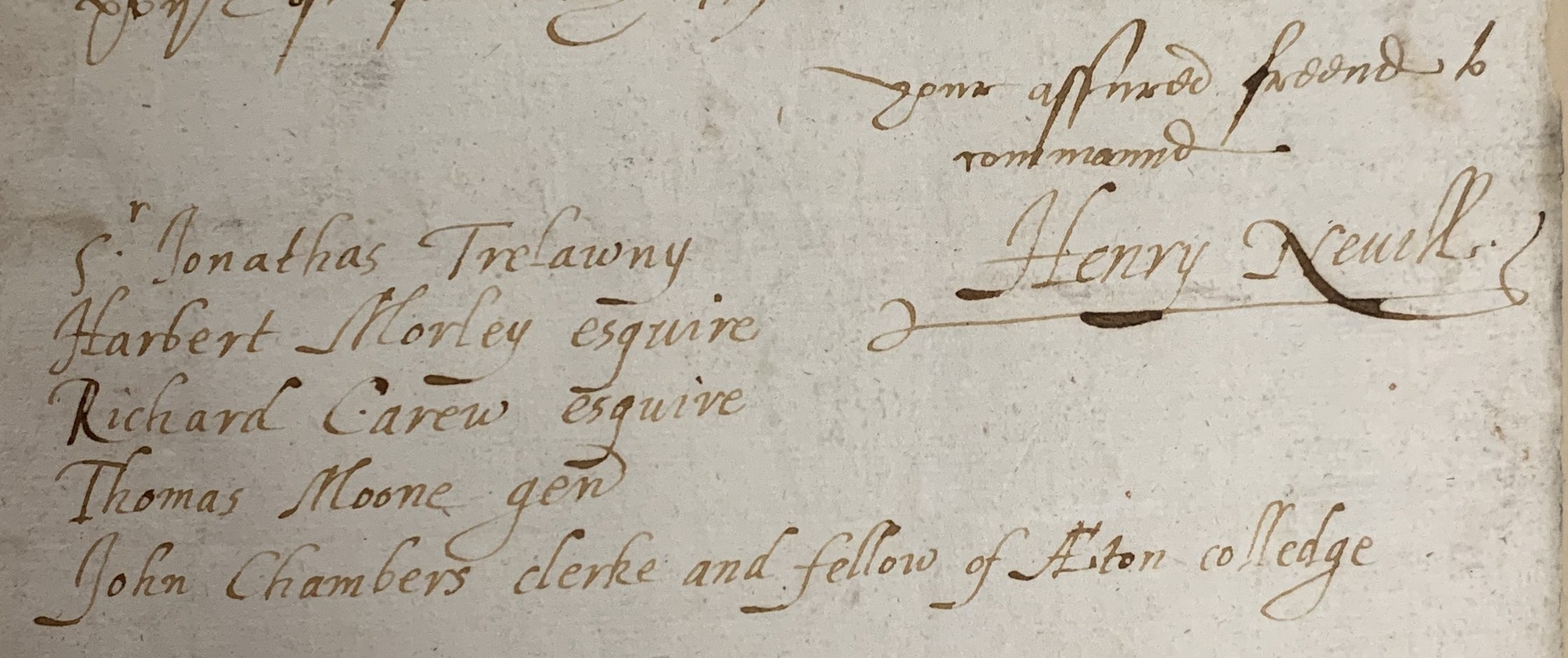
Carew later explained why his father had sent him with Neville:
I was sent by my father into France with Sir Henry Nevill, who was then ambassador leiger [resident ambassador] unto Henry the Fourth, that there I might learn the French tongue.5
Neville also took Ralph Winwood as his secretary. An Oxford man, Winwood had studied at St John’s College and become a fellow of Magdalen. He would later become Secretary of State under James I in 1614.6 Writing to Cecil from Blois on 28 July 1599, Neville called him:
a friend of mine, whom I entreated to come over with me in the place of my secretary
Winwood had hoped to buy a manor, but a mistaken assurance from the Solicitor and his hurried departure with Neville had prevented the purchase. Neville asked Cecil to help have it transferred to Winwood, saying he would receive the favour as thankfully as if it had been done to himself.7
On 9 April 1599 Neville was knighted at Greenwich before leaving for France as Elizabeth’s ambassador to Henri IV. His later account put the land sales associated with his French employment at about £4,000, including £2,400 from part of his Yorkshire manor of Lund when he first went to France.89
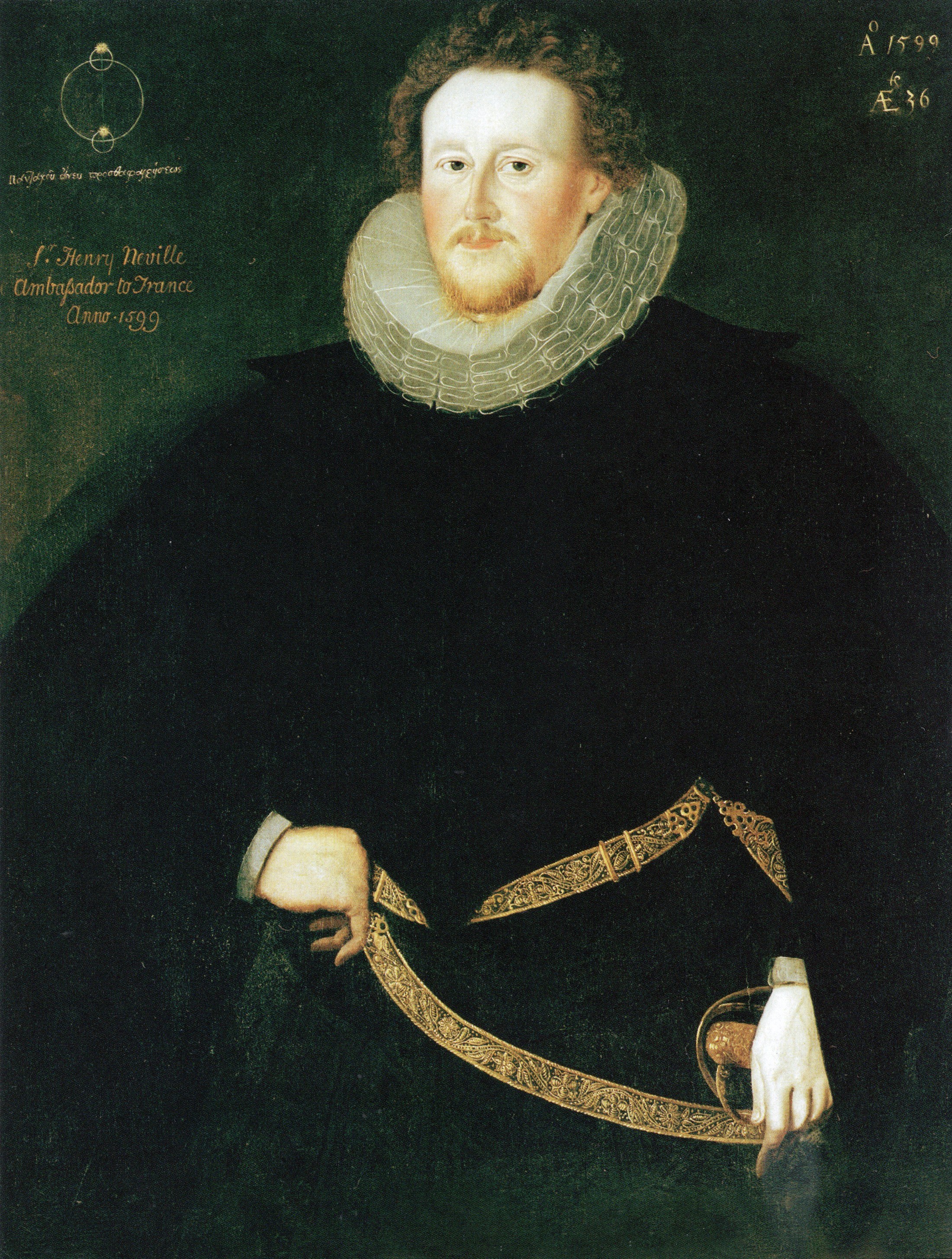
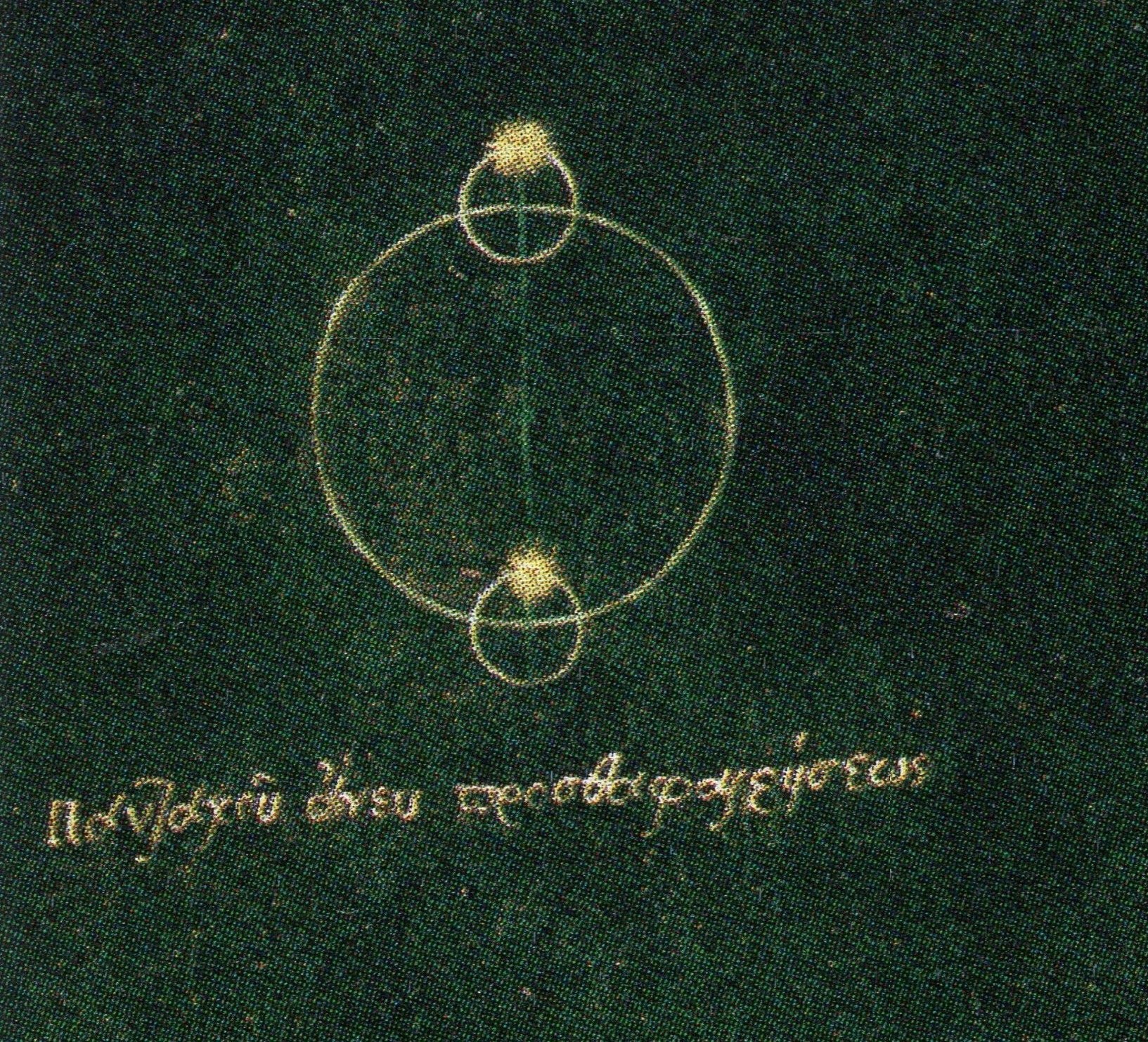
The portrait was likely painted before Neville left England for France. It carries the words “Sr Henry Neville / Ambassador to France / Anno 1599” and gives his age as thirty-six. A Greek inscription stands beside an astronomical diagram. The GrECI catalogue records the painting as oil on wood at Audley End and gives the attribution to Marcus Gheeraerts the Younger with a question mark.10
The diagram shows the sun at apogee and perigee—its farthest and nearest points from Earth—in Ptolemy’s alternative epicycle model. When the sun stands at either point, its calculated mean position and its true position coincide, so no correction, or prosthaphaeresis, is needed. The device thus presents Neville’s appearance and true character as coinciding. The Greek inscription, “Absolutely without correction,” also echoes the family motto, Ne vile velis.11
By 26 April 1599 Neville was at Dover, waiting for a wind that would let him cross the Channel. He wrote to Cecil:
I am here attending the wind, which is directly contrary. As soon as it turns I will lose no opportunity.
The following day he was still unable to sail: “the wind is yet so contrary, and the weather so foul, as we cannot put to sea.”12
At the French court
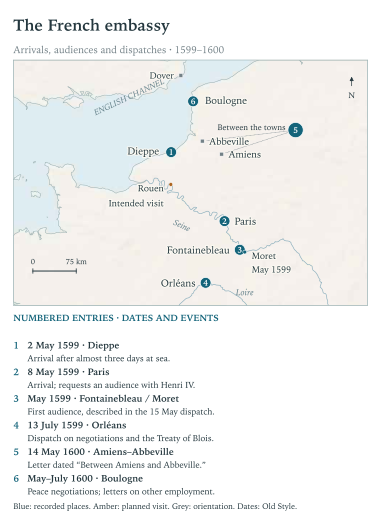
Neville reached Dieppe on 2 May 1599 after almost three days at sea. With the governor and his lieutenant away, the sergeant major received him. His first report covered shipping intelligence, military preparations and customs revenues assigned to repay Elizabeth’s loans. Rumours that the duke of Savoy was fortifying his frontier required checking in Paris; at Rouen he intended to question English merchants about the customs. He sent a messenger ahead to Thomas Edmondes, the experienced English diplomatic secretary, to establish the king’s movements.13
His work combined maintaining the alliance, pursuing repayment and protecting English merchants.14
In his dispatch to Cecil of 15 May 1599, Neville described his arrival in Paris on 8 May. Henri was temporarily in the city, staying privately at the house of the financier Sébastien Zamet. Through Edmondes, Neville requested an audience. The king directed him to Moret, about two leagues from Fontainebleau, where the Spanish ambassador, papal nuncio, and Savoyard ambassador were lodged close together. On Sunday two French courtiers, Gondi and Lussan, escorted him to Fontainebleau. A chamber and dinner awaited him; afterward the French commander Charles de Gontaut, duke of Biron, conducted him to the king’s gallery.15
Henri advanced two or three paces and embraced him. He told Neville that he had not moved one foot to receive the Spanish ambassador. Neville added that he had learned this comparison was true. The king’s welcome established England’s standing before a word of business was exchanged.
Neville delivered Elizabeth’s letters and explained his charge to strengthen the alliance. Henri replied that an ambassador’s character mattered: ministers could further or obstruct their masters’ purposes, and he had found some English representatives much easier to deal with than others. He expected well of Neville and promised him honourable treatment.
Neville calls this his “first audience.” Answering Elizabeth’s concern for his safety, Henri said that if she were a man he would call himself her perfect friend; as she was, “Je me dirai son serviteur”—“I shall call myself her servant.” Neville preserves the French courtesy within his English report.16
The conversation moved from attempts on the rulers’ lives to the Edict of Nantes, which granted protections to French Protestants, and then to maritime trade. Neville asked for justice for English merchants whose lawsuits could cost more than their original losses. He pressed the danger that freedom from searches for French shipping might conceal enemy goods or carry arms, munitions, and grain to Spain. Henri interrupted one point with “non, non, non”; Neville recorded the interruption and resolved to seek a more definite answer at his next audience.
Henri then asked about the Earl of Essex’s campaign in Ireland. Neville knew only that Essex had arrived safely, but Henri had heard that “two or three of the principal rebels” had come in and submitted to Essex. Neville admitted in his report that he was ashamed the king knew more than he did. Rather than appear ignorant, he answered that there had been a rumour and expectation of such an event. On the Scottish question he exercised a different restraint: changed circumstances made him defer the matter until he knew Elizabeth’s wishes.
Neville ended the audience by urging free trade between the kingdoms. He argued:
Those were the surest and most durable friendships, which were founded not only upon the disposition of the princes, but upon the interest of the subjects also.14,17
Henri asked him to submit a written statement of his request for the council to consider.
In his dispatch from Orléans on 13 July 1599, Neville described a dispute over Elizabeth’s demand for repayment. The king had promised a written answer; the French secretary of state Nicolas de Neufville, seigneur de Villeroy, then denied hearing the promise and required a written proposition. Neville supplied one. In the same negotiations he challenged wording that prohibited exports from France but left goods bought elsewhere free to reach England’s enemies. Villeroy agreed to alter it. Finding discrepancies between their copies of the Treaty of Blois, Neville asked Cecil for a reliable text.18
The Queen asks for court news
Elizabeth wanted more than treaties and accounts from her ambassador. In a letter sent before Neville’s reply of 24 April 1600, Cecil added a royal instruction in his postscript:
Since the writing of this letter, her Majesty hath commanded me to tell you merrily, that although you write one letter of state matters, yet she must have always one half sheet of court news and accidents.20
On 24 April Neville reported Henri’s efforts to recover his written promise of marriage to Mademoiselle d’Entragues, discussed in Chapter 29, All’s Well That Ends Well. She withheld both the document and her company, invoking her honour and her confessor’s prohibition. According to Neville, she eventually returned the promise in exchange for pensions and ready money: “both honour and conscience have given place to profit.”21
Neville reported that the pair had resumed their relationship at Fontainebleau, adding ut dicitur—“as it is said.” During the quarrel, however, Henri had found other company:
But in this meantime of unkindness between them, the king was not unprovided, but had sundry haunts in this town; and among the rest within three houses of me.
The detail places Neville’s Paris household startlingly close to the king’s private life. He ended the report by explaining exactly why he had included it:
These petty matters I am bold to write your Honour to give some satisfaction to the postscript of your last letter, which I therefore beseech you to interpret the best of.21
The same dispatch also discussed the expected arrival and dowry of the Princess of Florence.
Henri’s private pursuits could also obstruct public business. On 27 April Neville warned Cecil that obtaining an audience might take at least five days. If the king came to Paris, it would be “for his secret pleasure,” and “he will not be known to be here till his Council come likewise.” Neville promised to press for an audience as urgently as possible.22
Alongside the court gossip, Neville reported fears of renewed religious conflict. On 9 May 1600 he told Cecil that Henri was expected to spend the winter in Languedoc and Guyenne. It was feared that the king intended to support a plan to dismantle towns held by “those of the religion”—the French Protestants. Neville described the threatened consequences in theatrical language:
Which if he do or attempt, it is like to prove the first act of the tragedy which all men expect here within short time.23
Books and publication
Earlier, on 22 October 1599, Neville had written to Cecil about the French lawyer Étienne Pasquier’s book against the Jesuits. The papal nuncio had blocked its printing in France. Pasquier had approached Neville to ask whether it could be printed in England with Douai or another continental place on its title page. Neville passed the question to Cecil:
… to know if it might not be printed in England, though bearing the name of Douai or some other place; I told him I would answer within this month … I desire therefore to know what I may say unto him.24
In May 1600 Theodore Beza, the Protestant theologian in Geneva, sent Neville four copies of newly printed writings, together with a packet left by three English gentlemen who had visited him at Geneva on their way to Italy. One copy was for Neville; three were to be kept for delivery to the gentlemen in England. The author had died after entrusting the work to Beza for publication.25
John Chamber, the Eton fellow and mathematician in Neville’s passport request, published Barlaami Monachi Logistica in Paris in 1600: his Latin translation of Barlaam of Calabria’s mathematical writings, with explanatory notes. Its title page addresses Elizabeth; an internal poem to Neville records Neville’s repeated requests that Chamber publish it:
I need not now recount how earnestly, or how often, you asked
that I should put his writings under the press.
Chamber credits Henry Savile with first encouraging the undertaking and Neville with helping to save it. Chapter 47, “Neville Among the Muses,” gives the full poem and examines its praise of Neville’s learning and eloquence.26
In his Latin verse collection Affaniae (1601), the poet and clergyman Charles Fitzgeoffrey describes Richard Carew the younger (c.1580–1643) at the French court beside “Aonii … Nevilli,” Aonian Neville, and “Phaebaeumque Trelaunium,” Phoebean Trelawny. These epithets associate Neville with the Muses and Trelawny with Phoebus Apollo.27
Jersey and the Boulogne negotiations
In May 1600 Neville joined John Herbert, Robert Beale and Thomas Edmondes at Boulogne to negotiate peace with Spain.28 The conference became entangled in disputes about the commissioners’ authority and which sovereign’s representatives should take precedence.29 Cecil awaited “the first prologue to that comedy,” suspecting that the French minister Villeroy wanted the parties to fall out at the meeting so that they would never agree.30
Even while ambassador, Neville was looking for another appointment. From Boulogne on 27 June 1600, during these negotiations, he wrote to Cecil about Sir Anthony Paulet’s dangerous illness. Friends had urged him to seek the government of Jersey if Paulet died. Neville explained why the prospect mattered:
The consideration of my mean estate and overgreat charge do continually summon me to embrace any occasion whereby I may hope to sustain it.
He would proceed only with Cecil’s support, asking him to tell William Killigrew, Anne’s paternal uncle, whether he approved the attempt. If Cecil approved, Neville begged his recommendation to Elizabeth:
Without which I have neither hope, will, nor means, to begin or effect it.31
The office went to Sir Walter Ralegh: by 10 October Chamberlain was reporting that Ralegh had been to Jersey to take possession of his new government.32
John Packer also served as Neville’s secretary in France, helping to carry news and instructions between the household and its correspondents. The life written at his death in 1649, as summarized by the Historical Manuscripts Commission, records that service; Neville’s correspondence shows what the work involved.33
Winwood meanwhile carried on diplomatic business at the French court. On 23 July 1600 Neville told him that he was sending letters by the route Winwood had recommended in a letter carried by Packer. He urged Winwood to write frequently even at the risk of losing some: England wanted news from France.34
The opposing commissioners departed on 28 July. Formally, the negotiation remained open for sixty days; privately, Neville told Winwood the next day, “for my part I account this action for dissolved.”35 He told Winwood how to present the breakdown to Henri. If the belief that the talks had failed might draw Henri sooner into war with Savoy, Winwood could say, as his own opinion, that Elizabeth was so displeased with the proceedings that she would not be drawn into another conference. If Henri was already at war, Winwood should turn his language “clean the other way”: finding so little assurance in France, Elizabeth might have to provide for her safety elsewhere, “at least to disburthen herself of certain enemies, seeing she finds so uncertain friends.”35 The summer ended without a peace settlement, and Neville returned to England hoping to leave the embassy altogether.
Return to England and the stayed plays
Neville’s return coincided with an intervention in the publication of Shakespeare’s plays. He landed at Dover on 2 August 1600, left for London on 4 August and arrived there on 6 August.
News of his return travelled much faster. Sir Thomas Fane wrote from Dover Castle to Lord Cobham, Lord Warden of the Cinque Ports, on the evening Neville landed. Marked “Hast hast hast post hast,” the letter left Dover at ten that night and reached London at ten the following night, 3 August: just twenty-four hours later, three days before Neville himself arrived.36
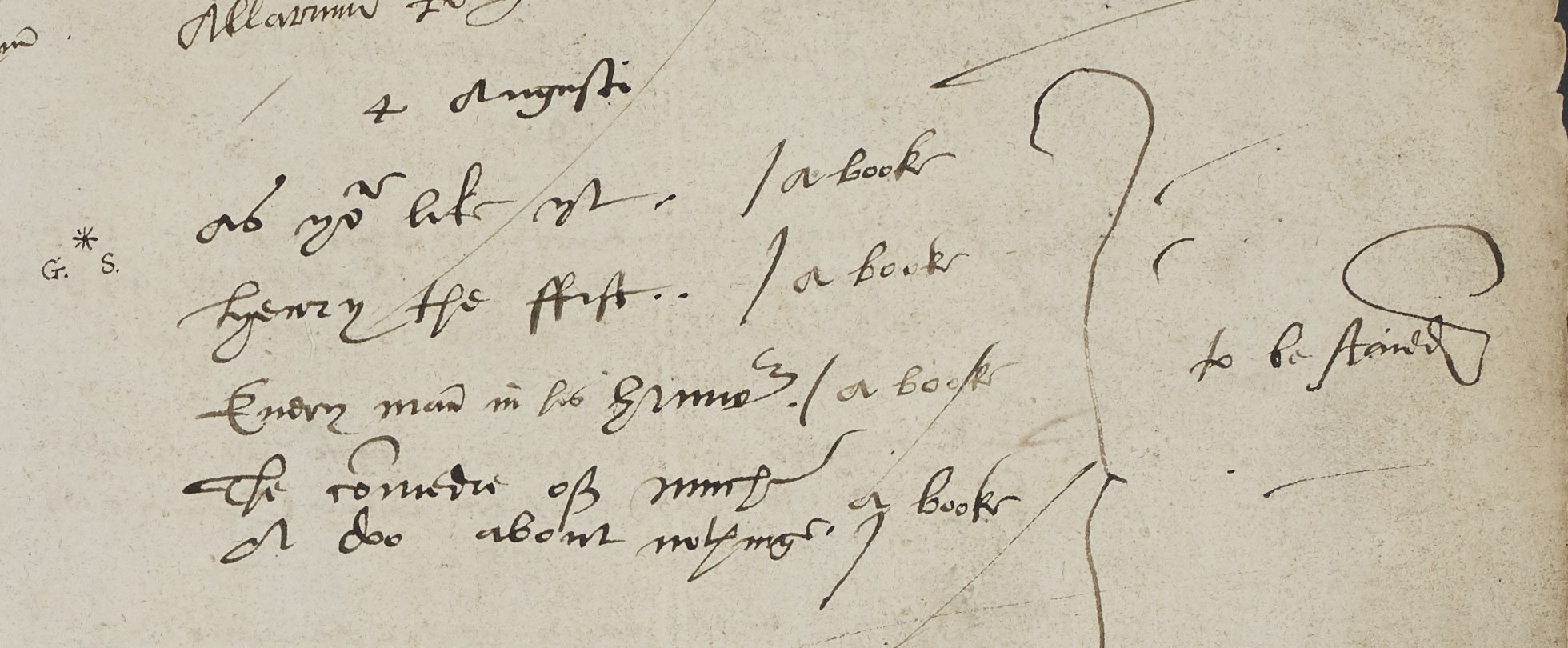
On 4 August—the day after the announcement reached London and the day Neville left Dover—the Stationers’ Register grouped As You Like It, Henry V and Much Ado About Nothing, together with Ben Jonson’s Every Man in His Humour, under a single instruction: “to be staied.” The previous new Shakespeare play entered in the register had been The Merchant of Venice, on 22 July 1598—just over two years earlier. Three Shakespeare plays and a Jonson play were thus stayed after Neville had arrived back in England but before he reached London; news of his return was already in the city. The coincidence is extraordinary and deserves particular attention in assessing Neville’s relationship to the plays.36
Appendix B gives the fuller documentary evidence, including the postal endorsements, the Dover–London chronology and images of the letters and register entry.
“Enforced to return”
Back in England after Boulogne, Neville worked to secure his discharge. On 28 August 1600 he told Winwood:
I cannot yet be discharged of my employment, although I labour it much, but I hope in the end to prevail.
Elizabeth had received his service graciously. Neville thought that made it a suitable moment to leave, “lest the latter end should not answer to the beginning.” The same letter continued to direct diplomatic business in France.37
By October his resistance was again court news. Chamberlain reported on 21 October that Neville was being urged to return to France but would not go unless compelled. On 2 November Neville himself told Winwood how far the dispute had gone:
I am now at length enforced to return into my charge after long contestation, even to the extremity almost of a commitment. All I have won is a confirmation of the Queen’s promise, that I shall but serve out my two years; which how it will be kept I know not, but I have now some more ground than I had to press it, and I leave my wife behind to solicit it.38
“Commitment” means committal to custody. Neville delayed setting out, hoping to avoid following the travelling French court beyond Paris.
Before he could cross the Channel, another political crisis intervened.
Notes and sources
Neville to Cecil, Lothbury, 6 May 1598, Hatfield House, Cecil Papers 60/114. Manuscript quotations checked against John O’Donnell’s transcription; spelling, abbreviations and punctuation modernized. Compare HMC, Calendar of the Manuscripts of the Marquis of Salisbury, VIII (1899), p. 158, which abridges the letter and omits the Michaelmas request. The letter names only “the employment whereunto I was lately named”; identification as the forthcoming embassy is contextual.↩︎
John Chamberlain to Dudley Carleton, 8 November 1598, calendared in Mary Anne Everett Green, ed., Calendar of State Papers, Domestic, Elizabeth, 1598–1601 (London, 1869), p. 118, vol. CCLXVIII, no. 108. The statement is paraphrased from the printed calendar, not presented as a manuscript quotation.↩︎
The National Archives, SP 40/1, p. 36, Queen Elizabeth to Henry Nevill, precedent-book copy; manuscript photographs supplied by Gregory Thompson. Spelling modernized and abbreviations expanded. Mary Anne Everett Green, ed., Calendar of State Papers, Domestic, Elizabeth, 1598–1601 (London, 1869), p. 157, dates the entry “[Jan.]” 1599; the month is supplied editorially. The manuscript leaves the term of years blank and ends “Given &c.”↩︎
Henry Neville to Thomas Windebank, 17 February 1599, named list following the subscription; transcription by John O’Donnell, published transcription and images. Compare Mary Anne Everett Green, ed., Calendar of State Papers, Domestic, 1598–1601 (London, 1869), p. 163, vol. CCLXX, no. 40, printed abstract. The abstract names Trelawny and refers to four other gentlemen without printing their names. The letter requests licensing arrangements; it is not itself the issued passport.↩︎
Richard Carew the younger, “The True and Ready Way to Learn the Latin Tongue,” in The True and Readie Way to Learne the Latine Tongue (London, 1654), p. 46. This is Carew’s retrospective account, not a 1599 dispatch. Spelling and capitalization modernized; the square-bracketed gloss is editorial. The preceding account describes travelling with his uncle on an embassy to the King of Poland.↩︎
“Winwood, Ralph,” Dictionary of National Biography (1885–1900), entry: matriculated at St John’s College, Oxford, on 20 December 1577; elected a probationer-fellow of Magdalen in 1582; appointed Secretary of State on 29 March 1614.↩︎
Henry Neville to Robert Cecil, Blois, 28 July 1599 O.S., Edmund Sawyer, ed., Memorials of Affairs of State, I (London, 1725), p. 81. The quotation follows the printed witness with spelling and capitalization modernized. Winwood wished to purchase the Queen’s manor of Denshanger, annexed to the honour of Grafton in Northamptonshire. Neville asked Cecil to arrange for the purchase to be transferred to him for reasonable consideration, after an erroneous assurance from the solicitor and his departure with Neville had prevented him from securing it.↩︎
He also held a joint tellership in the Exchequer—an office concerned with receiving and paying out royal money—with his father-in-law, Sir Henry Killigrew. In July 1601 he explained that he had agreed to take no benefit from it during Killigrew’s time. Kirsty Wright, “Tally Sticks and Townhouses: The Exchequer of Receipt at St Stephen’s”, Virtual St Stephen’s, 13 July 2020, on the tellers’ receipt and issue of royal money. Henry Neville to Robert Cecil, 9 July 1601, Cecil Papers 86/146, printed in HMC, Calendar of the Manuscripts of the Marquis of Salisbury, XI (1906), pp. 274–275, describes the joint interest and agreement.↩︎
Andrew Thrush, “NEVILLE, Sir Henry I (1564–1615), of Billingbear”, The History of Parliament: The House of Commons 1604–1629, ed. Andrew Thrush and John P. Ferris (2010), family, constituency and office lists, and biography. Neville’s estate statement, 20 July 1601, Royal Berkshire Archives, D/EN/F6/1/6 (parent catalogue), itemizes £2,400 from the first Lund sale, £1,000 from the remainder, £330 from Wargrave land and £300 from other parcels: £4,030 in all. His later appeal rounds the burden to £4,000: HMC, Salisbury Manuscripts, XI (1906), p. 371. These are his retrospective figures; the total is not a single sale or a separate £1,600 transaction.↩︎
GrECI Project, “Portrait of Sir Henry Neville”, MUSEU-HUB, record created 6 July 2024, image 042_Id_17. The attribution to Gheeraerts is questioned in the record. The catalogue dates the portrait only to 1599; completion before departure is an inference, not a documented month of execution.↩︎
Ken Feinstein, “The Greek Inscription on Henry Neville’s Portrait: Solved!”, 9 July 2021, publishing an anonymous astronomical specialist’s interpretation of the inscription and diagram. Here prosthaphaeresis denotes the astronomical correction between mean and true positions, not the computational technique associated with Paul Wittich, the astronomer mentioned in Chapter 2. The shared term alone does not establish a connection between Wittich and the portrait. This account distinguishes the astronomical explanation from a diplomatic transcription of every Greek letter and from the proposed connection with the family motto. See also GrECI Project, “Portrait of Sir Henry Neville”, MUSEU-HUB, 6 July 2024, for the translation and connection with the family motto.↩︎
Henry Neville to Robert Cecil, Dover, 26 and 27 April 1599, The National Archives, SP 78/43; see also Edmund Sawyer, ed., Winwood’s Memorials (London, 1725), I, pp. 16–18. Quotations follow the manuscript wording with spelling and punctuation modernized. The 26 April manuscript omits “yet” before “directly contrary,” which appears in the printed version. The letters establish the delay on those dates, not its total duration.↩︎
Neville to Robert Cecil, 27 April and 3 May 1599, Ralph Winwood, Memorials of Affairs of State, ed. Edmund Sawyer, I (London, 1725), pp. 18–19. The ships were detained in Spain. The fleet figures are reported intelligence.↩︎
Neville to Cecil, 15 May 1599, Winwood, Memorials, I, pp. 22–24, maritime business and conclusion. The report distinguishes the Irish conversation from the Scottish matter, which Neville deferred.↩︎
Neville to Cecil, 15 May 1599, Winwood, Memorials, I, pp. 20–25, especially pp. 20–21 for the arrival and reception.↩︎
Chapter 24 compares this serviteur courtesy with Viola’s French reply in Twelfth Night 3.1. Winwood, Memorials, I, p. 21, French courtesy; p. 24, explicit identification as the first audience. The French is retained within Neville’s English account of the conversation. Contarini independently reported on 29 May 1599 that the English ambassador had been to Fontainebleau “for his first audience”: Horatio F. Brown, ed., Calendar of State Papers, Venetian, IX (1897), no. 797, p. 369. This is the report’s date, not the audience’s.↩︎
Henry Neville to Robert Cecil, Paris, 15 May 1599 O.S., in Edmund Sawyer, ed., Memorials of Affairs of State, I (London, 1725), pp. 20–25, especially p. 24. The date is that of the dispatch, not an asserted date for the audience.↩︎
For Neville’s Orléans dispatch of 13 July 1599 O.S., see the same volume, pp. 61–66, especially pp. 61–64 for the negotiations and p. 66 for the defective treaty copy. The English dispatch is complete on p. 66; the separate French proposition begins on p. 67. Contarini reported on 22 August 1599 that Neville, on learning Spain had requested access to Brest for its fleet, went directly to the king and obtained his promise to refuse. On 19 September he reported similar requests at Dieppe and other ports, adding that Neville had personally told him of the king’s offer to assist Elizabeth if necessary: Brown, Calendar of State Papers, Venetian, IX, nos. 807 and 815, pp. 372–373, 376–377.↩︎
Author’s map, following the dispatches and narrative cited in this chapter, and the letter of 14 May 1600 dated “Between Amiens and Abbeville,” discussed in Chapter 23: Edmund Sawyer, ed., Memorials of Affairs of State, I (London, 1725), pp. 183–184. No midpoint or road is supplied for that dateline. Fontainebleau and Moret are places in Neville’s account of his first audience, rather than separate datelines. Base geography: Natural Earth (public domain); settlement locations: GeoNames (CC BY).↩︎
Robert Cecil to Henry Neville, undated in the printed edition, Edmund Sawyer, ed., Memorials of Affairs of State, I (London, 1725), pp. 166–167, especially p. 167, postscript. The letter precedes Neville’s reply of 24 April 1600 O.S. Quotations here and in the following two notes have modernized spelling and typography.↩︎
Neville to Cecil, Paris, 24 April 1600 O.S., Sawyer, Memorials, I, pp. 175–176, especially p. 176 for d’Entragues, the pensions, other haunts and explicit response to Cecil’s postscript. Neville reports a pension of 6,000 crowns a year for d’Entragues, pensions of 4,000 crowns apiece for her parents, and 100,000 crowns in ready money to provide for her marriage. The Princess of Florence and her projected dowry appear on p. 175. These are Neville’s reports; the printed dispatch is not independent confirmation of the alleged transactions.↩︎
Neville to Cecil, Paris, 27 April 1600 O.S., Sawyer, Memorials, I, pp. 177–178, opening paragraph on p. 177. The anticipated delay is Neville’s estimate, not a record of five days actually elapsed.↩︎
Henry Neville to Robert Cecil, Paris, 9 May 1600 O.S., Edmund Sawyer, ed., Memorials of Affairs of State, I (London, 1725), pp. 179–183, quotation on p. 183. Spelling and typography modernized. The date appears at the opening on p. 179; the separate letter of 14 May begins farther down p. 183. The passage reports a feared design, introduced by “as it is feared,” rather than confirming that the towns were dismantled.↩︎
Neville to Cecil, Paris, 22 October 1599, TNA SP 78/43, letter beginning f.374, passage f.375, manuscript record. Edmund Sawyer, ed., Memorials of Affairs of State, I (London, 1725), pp. 123–124, printed witness. Quotation follows the printed text with modernized spelling and marked omissions; emphasis added. The surviving letter does not establish that the proposal was carried out. The letter does not name the projected book. A likely candidate is Étienne Pasquier’s Le Catéchisme des Jésuites, composed in 1599–1602 and first published at La Rochelle in 1602. See Robert Sauzet’s review of Claude Sutto’s critical edition, Revue de l’histoire des religions 201.4 (1984), p. 447.↩︎
Theodore Beza to Neville, Geneva, 12 May 1600 (Old Style), TNA PRO 30/50/2. The photographs are numbered 102–103 in the image sequence; these are not established archival page or folio numbers. The letter does not name the book or the three travellers. The request concerns four copies, one intended for Neville and three for onward delivery.↩︎
Barlaam, Barlaami Monachi Logistica, translated and annotated by John Chamber (Paris: Guillaume Auvray, 1600), Neville address, Augsburg, Staats- und Stadtbibliothek, 4 Math 43, digitized by the Bayerische Staatsbibliothek, image 8. The quoted English translates two Latin lines near the close of the address. Chapter 47 gives a complete English translation of the twenty-four-line address and selected Latin passages.↩︎
Charles Fitzgeoffrey, Affaniae (Oxford: Joseph Barnes, 1601), III.41, pp. 129–130. The verse depicts Neville with Richard Carew the younger and Trelawny at the French court. Chapter 47 discusses the text. For “Aonian” as an epithet of the Muses and things associated with them, see Charlton T. Lewis and Charles Short, A Latin Dictionary (Oxford: Clarendon Press, 1879), s.v. “Aonia.”↩︎
Elizabeth’s commission, Greenwich, 10 May 1600, Winwood, Memorials, I, pp. 186–187. The authority extends to the four commissioners or three of them. Their arrival is reported in the dispatch of 20 May, p. 188.↩︎
Commissioners to Cecil, 20 May 1600, Winwood, Memorials, I, pp. 188–189, including the postscript defending the Spanish seal; compare the Latin statement of 21 May, p. 190. The dispatch records the questions referred home and the Spanish response.↩︎
Cecil to Neville, undated in the printed edition, Winwood, Memorials, I, p. 185.↩︎
Neville to Cecil, Boulogne, 27 June 1600, TNA SP 78/44, f. 201, manuscript record. Quoted passages checked against the photograph and John O’Donnell’s transcription; spelling, abbreviations and punctuation modernized. The manuscript dateline reads 27 June; a reported catalogue date of 26 June is not followed. Neville calls William Killigrew “mine uncle Killigrew”; William was the brother of Anne’s father, Sir Henry Killigrew. The letter establishes a proposed suit, not a completed application or an exchange of offices.↩︎
John Chamberlain to Dudley Carleton, 10 October 1600, Green, Calendar of State Papers, Domestic, Elizabeth, 1598–1601, pp. 476–477, vol. CCLXXV, no. 89. The calendar reports Ralegh’s possession of the government; the underlying appointment patent has not been inspected.↩︎
Historical Manuscripts Commission, The Manuscripts of the Marquess of Abergavenny, Lord Braye, G. F. Luttrell, Esq., &c. (London, 1892), p. 174, summary of “Life and character of Mr. John Packer,” dated 9 February 1648/9: printed page. The witness used here is the complete printed summary, not the underlying manuscript life.↩︎
Sir Henry Neville to Ralph Winwood, Boulogne, 23 July 1600, O.S., in Edmund Sawyer, ed., Memorials of Affairs of State, I (London, 1725), p. 231. The complete printed letter supplies the date, sender, recipient and the reference to Winwood’s letter carried by Packer. The corresponding Gregorian date is 2 August 1600 New Style.↩︎
Commissioners to Cecil, 28 July 1600, Winwood, Memorials, I, pp. 225–226; Neville to Winwood, 29 July, p. 232, including the conditional instructions about Henri and Savoy.↩︎
Historical Manuscripts Commission, Calendar of the Manuscripts of the Marquis of Salisbury, X (London, 1904), p. 261, Fane to Cobham, 2 August 1600, Cecil Papers 87/46, including the postal endorsements recording departure from Dover at ten at night on 2 August and arrival in London at ten at night on 3 August; p. 268, Neville to Cecil, 6 August 1600. Neville confirms his departure on Monday and arrival in London on the sixth. Stationers’ Company, Liber C, flyleaf, 4 August 1600: the other plays are Henry V, Much Ado About Nothing and Jonson’s Every Man in His Humour. As You Like It first appeared in the 1623 Folio; see the Folger textual introduction. The return dates and the Stationers’ Register entry are English-calendar dates. For the previous new Shakespeare play entered, see Stationers’ Company, Liber C, f. 39v, 22 July 1598, The Merchant of Venice entry, and the Folger register chronology.↩︎
Neville to Ralph Winwood, London, 28 August 1600, Edmund Sawyer, ed., Memorials of Affairs of State, I (London, 1725), pp. 248–249, especially p. 249. The heading and date are on p. 248; both passages quoted here are on p. 249. Spelling and typography modernized.↩︎
Neville to Winwood, London, 2 November 1600, Sawyer, Memorials, I, pp. 270–272, especially p. 271; spelling and typography modernized. For the independent report, Chamberlain to Carleton, 21 October 1600, Green, CSPD, Elizabeth, 1598–1601, p. 481, vol. CCLXXV, no. 100. This near-committal precedes the imprisonment following the Essex crisis.↩︎