Richard II: making an ancestor a hero
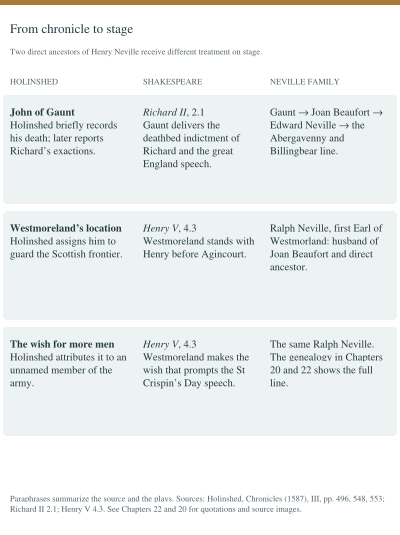
Holinshed gives John of Gaunt a brief death notice; Richard II gives him a deathbed scene in which he speaks for England and confronts the king. Gaunt was Henry Neville’s direct ancestor: his daughter Joan Beaufort married Ralph Neville, first Earl of Westmorland, and their son Edward began the Abergavenny line from which Henry Neville descended. Shakespeare makes Neville’s ancestor the dying counsellor whose warning the king refuses to hear.1
Holinshed’s notice names the house in Holborn where Gaunt died and records his burial beside Blanche at St Paul’s. The chronicle subsequently describes Richard’s exactions and the complaint that the kingdom had been set to farm—its revenues leased out. The play gives that indictment to Gaunt while he is still alive, turning historical commentary into the ancestor’s prophetic judgment.2
Gaunt’s importance extends beyond one celebrated speech. Despite dying early, he has the fourth-largest speaking part in the play; up to his final speech, he supplies about a quarter of its dialogue.3
In Richard II, 2.1, the play first tells its audience why Gaunt’s words deserve to survive him:
GAUNT
O, but they say the tongues of dying men
Enforce attention like deep harmony.
[…]
As the last taste of sweets, is sweetest last,
Writ in remembrance more than things long past.4
Dying gives Gaunt’s counsel urgency and the freedom to confront his king. His prophetic England speech follows:
GAUNT […]
This royal throne of kings, this sceptered isle,
This earth of majesty, this seat of Mars,
This other Eden, demi-paradise,
This fortress built by Nature for herself
Against infection and the hand of war,
This happy breed of men, this little world,
This precious stone set in the silver sea,
[…]4
The repeated “This” accumulates England’s glories while withholding the sentence’s decisive verb. When that verb finally arrives, all the magnificence becomes the subject of a humiliating transaction:
GAUNT […]
This land of such dear souls, this dear dear land,
Dear for her reputation through the world,
Is now leased out—I die pronouncing it—
Like to a tenement or pelting farm.
England, bound in with the triumphant sea,
Whose rocky shore beats back the envious siege
Of wat’ry Neptune, is now bound in with shame,
With inky blots and rotten parchment bonds.
That England that was wont to conquer others
Hath made a shameful conquest of itself.4
England’s glories collapse into leased property; its protecting sea encloses shame. Richard has already proposed farming the realm. Gaunt turns that policy into national humiliation.5
When Richard arrives, Gaunt confronts him directly. The sick man diagnoses the healthy king as the one whose deathbed is the whole country. Richard threatens him; Gaunt refuses to retreat. The king’s cruelty confirms the old man’s judgment. After Gaunt’s death, Richard seizes his property, and York protests the destruction of lawful inheritance. The play thus follows the patriotic speech with an act that proves its accusation.4
Already a father, counsellor and grieving brother, Gaunt becomes England’s moral voice at his death. As with Westmoreland in Henry V, Shakespeare enlarges the role of Neville’s ancestor and gives him words that define the play.
John of Gaunt, the Neville branches, and Shakespeare
John of Gaunt (1340–1399)
Duke of Lancaster — Richard II
            │ daughter
Joan Beaufort (c.1379–1440) ── married ── Ralph Neville (c.1364–1425)
                           │           1st Earl of Westmorland — Henry V
              ┌────────────┴──────────────┐
              ↓                          ↓
Edward Neville (d. 1476)       Richard Neville (1400–1460)
Lord Abergavenny               Earl of Salisbury — 2 Henry VI
              │                          │
              ↓                          ↓
George Neville (d. 1492)       Richard Neville (1428–1471)
Lord Abergavenny               Earl of Warwick, “the Kingmaker”
              │               2 Henry VI and 3 Henry VI
              ↓
Sir Edward Neville (d. 1538)
              │
              ↓
Sir Henry Neville (d. 1593)
Of Billingbear
              │
              ↓
Sir Henry Neville (c.1563–1615)
Ambassador to France
Arrows show parent to child; the marriage line joins Joan and Ralph. Edward and Salisbury were brothers; Warwick was Edward’s nephew. Henry Neville descends through Edward: Salisbury and Warwick belong to the collateral branch. Gaunt and Ralph are direct ancestors. c. means approximately; d. means died.1
The family in Henry VI
The Neville family references are already present in the 1594 quarto of 2 Henry VI, published as The First Part of the Contention. Warwick declares, “The Nevilles are thy subjects to command” (2 Henry VI, 2.2); Suffolk invokes “the Nevilles’ noble race” while attacking Warwick’s parentage (2 Henry VI, 3.2); and Warwick swears by “old Neville’s crest” (2 Henry VI, 5.1). All three appear in that early printing as well as in the 1623 Folio.1
Richard II before the Essex rising
On 7 February 1601, the day before the Essex rising, a specially requested play about Richard II was performed at the Globe. Augustine Phillips, one of the players, later testified that the company had objected because the play was old and unlikely to draw a paying audience. The men who requested it offered an additional forty shillings. Sir Gelly Meyrick’s examination independently records the outing to the Globe and a play involving the killing of Richard II. Together, the examinations document the performance conventionally identified with Shakespeare’s Richard II.6
Later that year, Elizabeth reportedly made the comparison herself. On 4 August 1601, while examining a catalogue of the Tower records with the antiquary William Lambarde, she reportedly declared:
I am Richard II, know you not that?
Lambarde answered by referring to Essex’s ingratitude. Elizabeth continued:
He that will forget God will also forget his benefactors; this tragedy was forty times played in open streets and houses.7
Jason Scott-Warren’s 2013 article identifies a manuscript copy sent in 1627 by Lambarde’s son-in-law Thomas Godfrey to Sir Edward Dering. This early witness strengthens the account’s authenticity: the exchange was not first recorded when it appeared in eighteenth-century print.7
For Neville, this political crisis was personal: Southampton and Danvers had outlined the plan to seize the court to him at Drury House on 2 February. The play about a king’s deposition was revived five days later for men in that same circle. The history that honoured his ancestry had become entangled with the crisis that brought him to the Tower (Chapter 6).
The “Parliament Sceane”: 1608
In 1608, during Neville’s return to political prominence, a new title page for Richard II advertised “new additions of the Parliament Sceane, and the deposing of King Richard.” The fourth quarto was the first printed edition to include Richard’s public surrender of the crown. Its advertisement made Parliament itself a selling point.8
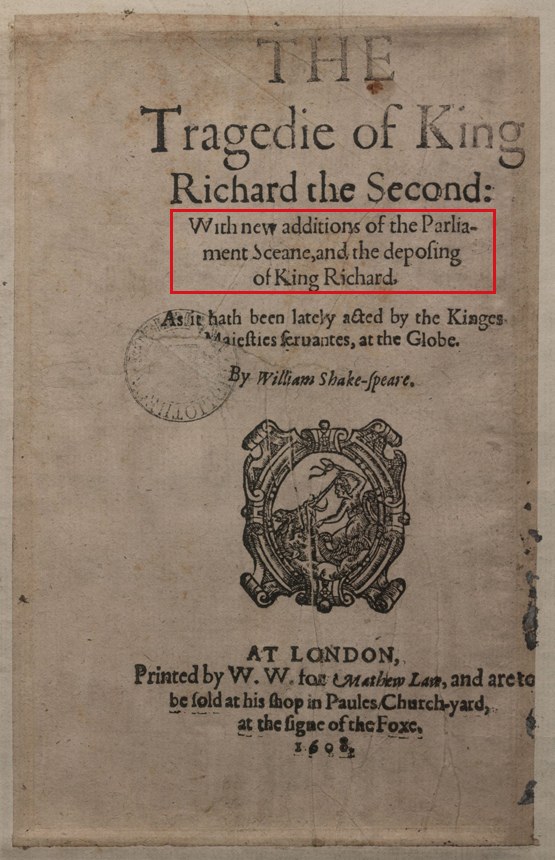
The first quarto appeared in 1597, followed by two editions in 1598. All three omit the extended passage in which Richard enters Parliament and relinquishes his crown. They do not omit the whole parliamentary scene: the surrounding action, including Carlisle’s protest against judging the king, was already present. What readers gained in 1608 was the confrontation with Richard himself. The First Folio of 1623 would print a fuller, differently transmitted version of that passage.9
The distinction matters because “new additions” does not establish when the passage was written. It may preserve material withheld from the earlier printings, or a later revision. Censorship is a substantial scholarly explanation, not a documented instruction surviving from the censor. The publication date is secure; the composition history remains disputed.8,10
What makes the passage especially relevant here is the Commons’ role. Richard is pressed to read accusations against his government so that his removal will seem justified. When Bolingbroke tells Northumberland to stop, Northumberland answers:
NORTHUMBERLAND
The commons will not then be satisfied.11
Bolingbroke has obtained the crown, but the demand for public justification persists. In the 1608 quarto, Northumberland both presents the Commons’ petition and orders Richard to be fetched; the Folio gives that order to Bolingbroke. Cyndia Susan Clegg argues that the quarto makes the Commons’ initiative especially prominent. Comparing the play with Holinshed, she shows how it combines separate proceedings and brings the Commons’ demands into Richard’s surrender. She locates the passage’s political sensitivity in Elizabethan controversy over Parliament’s authority to determine the succession.10
Parliament did not sit in 1608; the publication falls between the sessions of 1606–07 and 1610, during an important phase of Neville’s political recovery. Elected for Berkshire in 1604, he received twenty-six committee appointments that session and forty-two in 1606. In the Union debates of 1606–07, the Commons drew on his diplomatic knowledge of France and Scotland. By 1608 his return to public business was well established. His parliamentary connections continued to strengthen: in February 1609 his daughter Elizabeth married Henry Berkeley, brother of the MP Sir Maurice Berkeley, who also became a trustee of Neville’s estates. When Parliament met again in 1610, Salisbury treated Neville as one of the Commons figures whose cooperation was needed to negotiate over royal revenue and impositions.12
Thus the “Parliament Sceane” reached print during the years in which Neville was developing the parliamentary influence that would define his later career. The play asks how power acquires lawful authority, what a ruler owes the realm, and whose consent can make a political settlement hold. Neville’s work increasingly required him to negotiate those relationships between king and Commons. Gaunt’s ignored counsel, the crisis of 1601, and the parliamentary passage advertised in 1608 give this family history a continuing political relevance.
Notes and sources
James Tait, “Neville, Edward (d.1476),” Dictionary of National Biography, vol. 40 (1894), biography; W. A. J. Archbold, “Neville, Edward (d.1538),” ibid., biography. The descent continues from Edward (d.1476) through George Neville (d.1492), Sir Edward Neville (executed 1538), Henry Neville of Billingbear and the ambassador. George Neville (d.1535) was Sir Edward’s brother, not his father. Chart dates: John of Gaunt, 1340–1399; Joan Beaufort, c.1379–1440; Ralph Neville, c.1364–1425. See John of Gaunt, Joan Beaufort, and James Tait, “Neville, Ralph (1364–1425)”. George’s death in 1492 is recorded in Tait’s biography of his son. The ambassador’s approximate birth year follows the age evidence discussed in Chapters 1–9. Where no birth year is supplied, d. denotes the year of death. For the collateral branch, James Tait, “Neville, Richard (1400–1460)”, identifies Salisbury as Ralph and Joan’s son and Edward’s brother; his “Neville, Richard (1428–1471)” identifies Warwick as Salisbury’s son. The Neville-family speeches are in Shakespeare, 2 Henry VI, 2.2, 3.2 and 5.1; Warwick also appears in 3 Henry VI. The three Neville references occur in the 1594 quarto, The First Part of the Contention: Internet Shakespeare Editions, 2.2, 3.2, and 5.1. Short quotations in the text use modern spelling and the Folger reading text. In the crest passage, Q1 reads “my fathers age” where the Folio-based text reads “my father’s badge”; the quoted words “old Neville’s crest” are present in both. See also Folger’s textual introduction.↩︎
Raphael Holinshed and others, The Third Volume of Chronicles (London, 1587), p. 496, Holinshed Project text, Gaunt’s death, confiscation, York’s response and the complaint about farming the realm. Compare Shakespeare, Richard II, 2.1, cited below.↩︎
Counts from the Folger Digital Texts edition of Richard II, 7 September 2026: a speech is a TEI speech element; words are word tokens excluding speech prefixes and stage directions. Gaunt has 28 speeches and 1,515 words; 6,146 dialogue words occur through his final speech, giving him 24.65% of that span. The whole-play word ranking places him fourth. These counts describe the allocation of dialogue in this edition.↩︎
Shakespeare, Richard II, 2.1, Folger Shakespeare. Quotations preserve Folger line breaks; ellipses mark omissions. For Gaunt’s earlier scenes, see 1.1–1.3.↩︎
Shakespeare, Richard II, 1.4, Folger Shakespeare, Richard’s plan to farm the royal realm and use blank charters.↩︎
Examinations of Augustine Phillips, 18 February 1601, TNA SP 12/278, ff. 85r–86v, and Sir Gelly Meyrick, 17 February 1601, TNA SP 12/278/78, ff. 141–142; images and transcriptions in Shakespeare Documented, descriptions by Alan H. Nelson. The examinations describe the subject rather than name Shakespeare as author.↩︎
Jason Scott-Warren, “Was Elizabeth I Richard II?: The Authenticity of Lambarde’s ‘Conversation’”, The Review of English Studies 64.264 (2013), pp. 208–230; published online in 2012. Quotations follow the early transcript printed in his appendix, with spelling, abbreviations and punctuation modernized. Godfrey’s covering letter is dated 6 October 1627. “Forty times” is Elizabeth’s reported expression, not a verified performance count. The conversation does not name Shakespeare. Author’s accessible account of the discovery.↩︎
William Shakespeare, The Tragedie of King Richard the Second (London: W. W. for Mathew Law, 1608), fourth quarto, reissued title page, Bodleian Libraries, Arch.G d.43 (1), image and description, described by Manuel Jacquez, Shakespeare Documented, DOI 10.37078/658. Both title-page issues of the 1608 edition contain the deposition passage; the earlier title page does not advertise the additions. These are two issues of the fourth quarto, not separate fourth and fifth editions. The fifth quarto appeared in 1615.↩︎
Barbara Mowat and Paul Werstine, “An Introduction to This Text: Richard II”, Folger Shakespeare Library. Q4 adds approximately 160 lines absent from Q1–Q3; the Folio supplies a fuller version, apparently from a different manuscript. For the parliamentary setting already present in the early quartos, see Clegg, pp. 442–444, including n. 48. The 1601 performance testimony does not establish the wording of the passage performed that day.↩︎
Cyndia Susan Clegg, “‘By the choise and inuitation of al the realme’: Richard II and Elizabethan Press Censorship”, Shakespeare Quarterly 48.4 (1997), pp. 432–448, especially pp. 437, 442–447. Clegg’s argument for suppression is circumstantial, as she explicitly acknowledges; her comparison distinguishes Q4’s speech assignments from the Folio’s. Her discussion concerns Elizabethan succession and resistance arguments, not Neville’s later parliamentary career; the connection to that career is the present chapter’s interpretation.↩︎
Shakespeare, Richard II, 4.1, Folger Shakespeare. The displayed quotation follows the Folger reading text, based on the Folio for this passage. For the distinct 1608 speech assignments discussed in the text, see Clegg, pp. 442–444.↩︎
Andrew Thrush, “Neville, Sir Henry I (1564–1615)”, in The History of Parliament: The House of Commons 1604–1629, ed. Andrew Thrush and John P. Ferris (Cambridge University Press, 2010), especially the accounts of the 1604 and 1606 sessions, the Union debates, the Berkeley connection, and the July 1610 negotiations. Parliament did not sit in 1608: the date falls between the 1606–07 and 1610 sessions. The connection proposed here is to Neville’s developing political career, not to a parliamentary event in that year. St Margaret Lothbury parish register, marriage of Henry Berkeley and Elizabeth Neville, 1 February 1608/9 (register image), supplies 1 February 1609 in modern year numbering. Thrush dates the marriage to 1608; the register controls the date used here.↩︎