Prison on stage
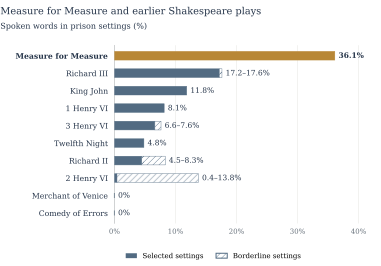
Scenes set in the prison or the street outside it contain more than a third of the spoken words in Measure for Measure, a much larger share than in any of the nine earlier plays charted here.1
Neville left the Tower in April 1603 after nearly two years of confinement.2 Measure for Measure is usually dated to late 1603 or 1604; its first recorded performance was at Whitehall on 26 December 1604.3 Claudio, condemned to death by Angelo, waits in prison while his sister Isabella pleads for his life.
A friar inside the prison
On 16 September 1599, Neville explained to Cecil how a former priest could gain trust while serving as an agent in Spain:
yet for his more safety, and to avoid suspicion in his abode there, he will take upon him the habit, and for need the function of a priest, which will also give him credit and trust there, and means thereby to do the better service.4
The Duke of Vienna likewise uses religious disguise to observe others unsuspected. He leaves Angelo in charge and pretends to depart, but remains among his subjects. He asks Friar Thomas for the clothing and instruction that will make his impersonation convincing:
DUKE
[…]
I will, as ’twere a brother of your order,
Visit both prince and people. Therefore I prithee
Supply me with the habit, and instruct me
How I may formally in person bear
Like a true friar. […]
— Measure for Measure, 1.3.
As a friar, the Duke gains access to the prison and the confidence accorded to a spiritual adviser. He arranges to overhear Claudio and Isabella while concealed.5 Neville’s report likewise pairs the habit with, if necessary, the priest’s function. Religious trust provides access for intelligence work.
The same device appears in two other plays. In All’s Well That Ends Well, the captive Parolles confesses his life to Morgan, whom he supposes to be a friar. In Twelfth Night, Feste impersonates Sir Topas to interrogate the confined Malvolio. In all three plays, assumed religious authority gives someone access to—and power over—a prisoner. All three plays are generally dated after Neville’s 1599 report of a proposed agent who would assume a priest’s habit and function to gain trust.6
Shakespeare inherited the story of a corrupt magistrate and a sister’s plea for her condemned brother from Cinthio and Whetstone. Neither Cinthio’s novella nor Whetstone’s Promos and Cassandra gives its ruler the Duke’s friar disguise. Whetstone includes a preacher attending prisoners and a rescued man returning in disguise, but these are separate characters.7
A book listed in the 1780 Billingbear library catalogue offers a political explanation for a ruler’s disguise. Giovanni Botero’s Della ragion di stato (1589) describes Aripert, king of the Lombards, going in disguise to discover what people said against him and his ministers. Botero explains:
It is necessary that princes either hear or see matters themselves, because all the other methods are more or less corruptible, like the officials themselves.8
This gives a close comparison with the Duke’s purpose in watching Angelo: “Hence shall we see, / If power change purpose, what our seemers be” (Measure for Measure, 1.3). The disguise allows the ruler to test an official’s conduct for himself.9
In a separate operation reported on 25 January 1600, Neville told Cecil that he had sent a friar to Rome after arranging for him to gain the confidence of suspected Scottish conspirators:
In this confidence (he having governed himself discreetly, and seeming very zealous and passionate in the common cause) they have opened themselves in general terms very far unto him …
Their trust produced letters of recommendation and access to a cipher. Neville also instructed the friar to offer to carry their correspondence:
I have willed him to offer his means of conveying their letters, which they will never distrust; and thereby their letters will fall into my hands.10
The Provost and the Duke’s letter
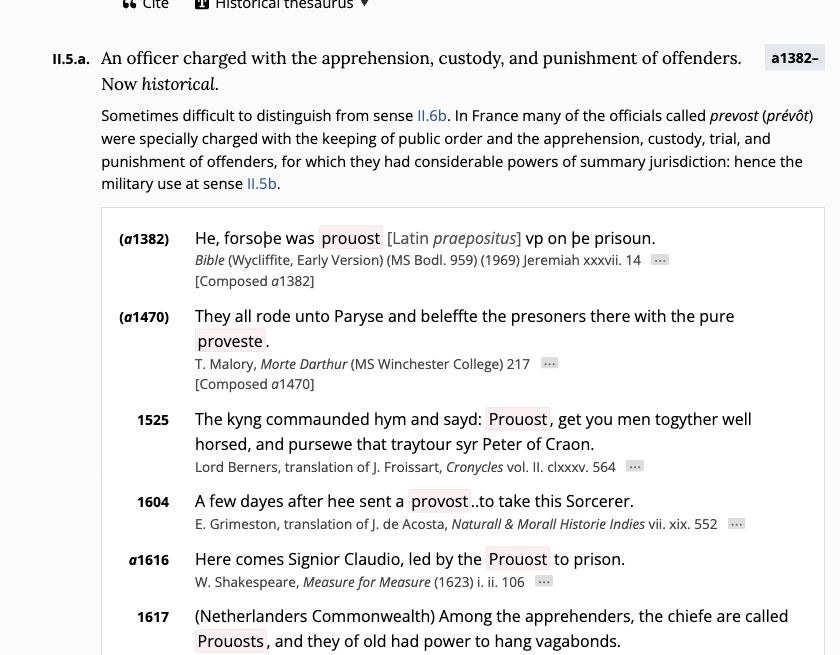
Shakespeare calls the prison keeper the Provost, where Cinthio has il prigioniere and Whetstone “gaoler.” The Oxford English Dictionary places the play’s use under the judicial subsense concerning the apprehension, custody and punishment of offenders. Its explanation links this subsense to the French prévôt and his powers of summary jurisdiction.11,12
Neville used the word in a dispatch from France of 30 May 1599, reporting the punishment planned for French soldiers implicated in an enterprise against Charlemont:
the King has sent a Provost thither to do round justice upon them, and to proceed to their execution.13
The Provost’s question to Angelo makes the corresponding responsibility explicit:
PROVOST
Is it your will Claudio shall die tomorrow?
— Measure for Measure, 2.2.14
In both passages the officer is responsible for carrying out an execution.
At a knock in the night, the Provost hopes for “some pardon or reprieve” for Claudio, but the visitor is the disguised Duke. A later knock brings Angelo’s messenger with an order pressing the execution. The friar’s assurances cannot overcome the Provost’s fear of disobeying. The Duke therefore produces a letter announcing his own return:
DUKE, [as Friar] […]
since I see you fearful, that neither my coat, integrity,
nor persuasion can with ease attempt you, I will
go further than I meant, to pluck all fears out of
you. Look you, sir, here is the hand and seal of the
Duke. [He shows the Provost a paper.] You know the
character, I doubt not, and the signet is not strange
to you.PROVOST I know them both.
— Measure for Measure, 4.2.15
The Provost recognizes both handwriting and seal. Where the habit has failed, the Duke offers documentary assurance that he will return to uphold the officer’s actions.
On 19 November 1599, Neville used the same formula for the representative who would collect his English pay and allowances. Before leaving, he had:
authorized one under my hand and seal to demand and receive my entertainment and other allowances
“Entertainment” means pay or maintenance. Neville’s hand and seal authorize a representative; the Duke’s authenticate the letter announcing his return.16
English kersey and French velvet
In the street banter of Measure for Measure, 1.2, a gentleman contrasts “an English kersey” with “French velvet”. Protecting English cloth exports to France was part of Neville’s work as ambassador. On 18 July 1599 he asked Cecil for a treaty clause protecting the sale of English “cloth, kersey, bays and cotton” in France as manufactured, because merchants faced threatened confiscation. Northern cloth depended heavily on that market, “not being vendible almost in any other place.” Reading kerseys were a recognized English export from Neville’s own Berkshire.
A memorandum among his embassy papers, headed “Contraventions to the treaties by public authority,” traces decades of French charges and restrictions on English trade, including levies on kersey. Its account of the May 1600 restriction on imported cloth records that it passed “notwithstanding the opposition made thereunto by the Queen’s Ambassador.” Neville was actively contesting the barriers facing English textiles in France—the Anglo-French trade that the play’s national contrast evokes.17
The language of the hearings
Three expressions recurring in Neville’s letters appear together in the hearing before Escalus in Measure for Measure 2.1:
| Expression in Neville’s letters | Uses | Letters |
|---|---|---|
| I beseech your honour | 33 | 28 |
| In my poor opinion | 9 | 8 |
| So for this time | 9 | 9 |
The counts come from 162 English letters.18 Pompey, a bawd, appeals to the magistrate Escalus:
POMPEY, [to Escalus] I beseech your Honor, ask me.
— Measure for Measure, 2.1.
He then challenges the suppression of prostitution in the language of modest advice:
POMPEY Truly, sir, in my poor opinion, they will to ’t
then. If your Worship will take order for the drabs
and the knaves, you need not to fear the bawds.
— Measure for Measure, 2.1.
Escalus closes the encounter:
ESCALUS
[…] shall have you whipped. So, for this time, Pompey,
fare you well.
— Measure for Measure, 2.1.19
Pompey gives an impertinent argument the form of respectful counsel; Escalus follows a threat with courteous leave-taking. “In my poor opinion” appears in no other play in the selected comparison through 1616, though it is widespread in printed prose. The scene turns the familiar language of petitions and correspondence into comic exchanges between a magistrate and a bawd.18
The play’s final hearing turns from petition to denial. In his account of the Essex affair, Neville marked the end of an encounter by denying any subsequent communication:
After which, I never spake with them, nor heard from them;
Angelo makes a closely matching denial of further dealings with Mariana:
ANGELO
[…] Since which time of five years
I never spake with her, saw her, nor heard from her,
Upon my faith and honor.
— Measure for Measure, 5.1.
The matching syntax dates a last encounter and denies any subsequent conversation or message. This particular form of denial appears rare: a search of the EarlyPrint collection found no other example of this denial of speaking with or hearing from the same people after an encounter. Angelo’s denial is false because Mariana has secretly taken Isabella’s place, though he believes he has slept with Isabella.20
“Liberty of the prison”
On 12 July 1601, following Neville’s petition, the Privy Council instructed Sir John Peyton, Lieutenant of the Tower:
that he may have such liberty of the prison as that his wife may have access unto him
Anne Neville could visit at convenient times; two or three business visitors a day could also confer with him about his estate, especially the means of paying his fine. The order was Peyton’s warrant to admit them.21
In Measure for Measure, the Provost uses the same expression when describing Barnardine:
PROVOST He will hear none. He hath evermore had the
liberty of the prison; give him leave to escape
hence, he would not.
— Measure for Measure, 4.2.22
Waiting for mercy
Writing from the Tower on 6 January 1602, Neville described selling his plate, horses, cattle and even household goods and bedding to meet his expenses. He told Cecil:
And if my imprisonment continue, I cannot but expect the uttermost of misery.23
On 11 March 1602, Neville told Cecil that he had raised his offer for a pardon from £4,000 to £5,000. The payments would leave scarcely £50 a year for himself, his wife and eight children. Imprisonment itself cost over £150 a year, consuming money that could otherwise reach the Queen.24
Asking Cecil to ease the terms, he recalled:
the rigour of the law, according as your honour did deliver it yesterday.
Lucio’s account of Claudio’s predicament uses the corresponding expression:
LUCIO
[…]
Falls into forfeit. He arrests him on it,
And follows close the rigor of the statute
To make him an example. All hope is gone
Unless you have the grace by your fair prayer
To soften Angelo. […]
— Measure for Measure, 1.4.
Cinthio already gives Juriste the “rigour” of a harsh law. Neville’s letter gives that legal concept a prisoner’s urgency: the cost to his household. Like Lucio’s appeal, it asks what might move authority to relax a punishment.25
The waiting brought further suffering. By April 1602, the Queen had accepted £5,000 in principle, but the securities remained disputed. On 3 April Neville reported that his wife had lost one child and feared losing another.26
In May 1602, Neville put the cost of confinement most starkly:
My state is wholly decayed and my health of late much impaired. There is little left but my life, which, if it please God and her Majesty, I am willing to preserve.27
Claudio brings the same burdens together when he recoils from death:
CLAUDIO
[…]
The weariest and most loathed worldly life
That age, ache, penury, and imprisonment
Can lay on nature is a paradise
To what we fear of death.
— Measure for Measure, 3.1.28
Neville sought release from confinement; Claudio pleads to escape execution. Neville’s letters describe three of the burdens Claudio compresses into a line: ache, penury and imprisonment. Neville still wanted life, and time to remove the “blemish and blot” upon his reputation.27
In January 1603 Neville was still thanking Cecil for efforts to obtain his liberty; release came in April.26,2 The play that followed gives that waiting a dramatic urgency. Access to a prisoner, an officer’s trust, and the arrival of a letter can decide whether mercy comes in time.
Notes and sources
Calculation from the Folger Shakespeare XML editions, public reading texts, counting spoken word tokens and excluding speaker names, directions and apparatus. In Measure for Measure, scenes 2.3, 3.1, 4.2 and 4.3 contribute 5,539 words; 3.2, the street before the prison, adds 2,154: 7,693 of 21,301 words, or 36.1%. The same whole-scene method is applied to the nine comparators, with traditional editorial locations checked against the dialogue. Tower palace and fortress scenes are included. Hatched extensions mark alternative location classifications, not statistical uncertainty; the large extension for 2 Henry VI includes 3.2, adjoining Gloucester’s murder in custody. Zero means no qualifying staged location, not no imprisonment in the story. This selected comparison excludes later plays, including Cymbeline, The Winter’s Tale and The Two Noble Kinsmen; it is not a complete-canon ranking or a measure of performance duration.↩︎
Mary Anne Everett Green, ed., Calendar of State Papers, Domestic Series, of the Reign of Elizabeth, 1601–1603 (London, 1870), p. 45, Chamberlain’s letter of 27 May 1601, and p. 91, the Tower officer’s entry recording Neville’s arrival on 1 May, public scan. Neville’s Tower confinement followed supervised custody at Chelsea. Chamberlain reported that the term had passed without his arraignment; Neville should not be described as a prisoner sentenced to death. For the financial petitions, see the letter of 11 March 1602 and the Salisbury calendar entries cited under “Waiting for mercy”. For his April 1603 release, see Green, ed., Calendar of State Papers, Domestic Series, James I, 1603–1610 (London, 1857), vol. 1, item 18, 10 April 1603, Council report.↩︎
Folger Shakespeare Library, “Historical Background,” Measure for Measure, section 1, on the Whitehall performance recorded in the Revels accounts. The performance date is not a demonstrated date of first composition. The surviving printed text first appeared in the 1623 Folio: Barbara Mowat and Paul Werstine, “An Introduction to This Text”. For the usual composition date, 1604 or late 1603, see the Royal Shakespeare Company, “Dates and Sources”.↩︎
Neville to Cecil, 16 September 1599, in Ralph Winwood, Memorials of Affairs of State, ed. Edmund Sawyer, vol. 1 (London, 1725), pp. 102–105, quotation p. 104. Winwood describes the man as “of the Religion”, that is, Protestant. This proposed agent for Spain is not identified with the friar whom Neville reported dispatching to Rome in January 1600. Shakespeare quotations follow the Folger edition, retaining its line breaks. Ellipses mark omissions; bold type identifies the words carrying the verbal or conceptual comparison. Winwood quotations have modernized spelling, capitalization and light punctuation, preserving vocabulary and meaning. His printed orthography is not treated as manuscript spelling. Other historical quotations are identified by their witness; the short quotation from the letter of 11 March 1602 has spelling modernized after image collation.↩︎
Shakespeare, Measure for Measure, 1.3, 2.3 and 3.1. The opening request to the Provost invokes the friar’s charitable office; the concealed overhearing occurs in 3.1. Christy Desmet’s “A Modern Perspective” reads the disguise as political surveillance and stresses religious function as well as dress.↩︎
Shakespeare, All’s Well That Ends Well, 4.3, the reported confession to Morgan; Twelfth Night, 4.2; Measure for Measure, 2.3, the Duke’s examination of Juliet. Morgan’s supposed friarhood is reported retrospectively, not enacted in the scene. The Royal Shakespeare Company’s chronology dates Twelfth Night to 1601, Measure for Measure probably to 1604, and All’s Well usually to 1603–06. Andrew Griffin’s textual introduction, “Dating All’s Well,” paragraphs 3–13, favors 1603–04 while explaining the uncertainty. These are composition estimates, not dates established by the comparison with Neville. The September 1599 dispatch describes a proposed mission; it does not establish that the agent carried it out.↩︎
Cinthio, Hecatommithi, VIII.5, Venice edition of 1574; Whetstone, Promos and Cassandra, Part I, 2.6 (the printed scene number; the sequence is sometimes counted as 2.7), prisoners accompanied by a preacher; Part II, 5.1, Andrugio’s return in disguise (4.2 presents his earlier life in exile). Shakespeare, Measure for Measure, 1.3, 2.3, 3.1 and 4.2–4.3. The comparison is between these particular treatments, not an assertion that Shakespeare invented the general device of a disguised ruler.↩︎
Giovanni Botero, Della ragion di stato (Venice: Gioliti, 1589), book I, “Del contenere i Magistrati in Ufficio,” especially p. 38. Translation supplied here from the Italian: “egli è necessario, che i Prencipi, ò ascoltino, ò veggano essi medesimi le cose: perche tutti gli altri modi sono più, ò manco corrottibili, come gli Ufficiali istessi.” The Italian quotation normalizes u/v. The 1780 Billingbear library catalogue lists the Venice, Gioliti, 1589 edition. That later entry does not date the book’s acquisition or establish Neville’s personal reading.↩︎
Shakespeare, Measure for Measure, 1.3, Folger Shakespeare Library; slash marks the line break. Botero, book I, pp. 36–39. The comparison concerns the political use of concealed observation; it does not establish a direct borrowing from Botero.↩︎
Neville to Cecil, 25 January 1599/1600 O.S., Winwood, Memorials, vol. 1, pp. 146–147. The printed heading explicitly says O.S.; the year is 1600 in modern year numbering. Quotations from pp. 146 and 147 respectively, with spelling and capitalization modernized. The report distinguishes gaining confidence, obtaining a cipher and offering to convey correspondence. It does not identify this friar as the proposed former priest discussed in September 1599.↩︎
Oxford English Dictionary, “provost (n.), sense II.5.a”, September 2026, accessed 7 October 2026 (citation supplied by the OED). This judicial subsense concerns apprehension, custody and punishment; its explanation describes French officials’ summary jurisdiction and points separately to military usage at II.5.b. It cites Measure for Measure 1.2. The screenshot was taken directly from the OED entry.↩︎
A contextual review of surface-form occurrences, including early spelling variants, in the dramatic corpus described by Pervez Rizvi distinguishes judicial custody from military, civic, household and fencing senses. The word is not unique to Shakespeare: Greene’s Alphonsus, King of Aragon orders a provost to take Fabius to the Marshalsea, and Chapman’s May Day connects a provost with threatened whipping. Military provost-marshals provide additional punitive uses. These examples prevent a claim of exclusive usage; the comparison here is the specific judicial sense, independently identified by the OED, and its French setting in Neville’s dispatch. Exact totals for that narrow sense are not used because some institutional classifications remain debatable.↩︎
Neville to Cecil, 30 May 1599 O.S., Winwood, Memorials, vol. 1, p. 42. The report concerns French soldiers implicated in Count Maurice’s enterprise against Charlemont. Round indicates summary or decisive proceeding. The comparison concerns a French judicial officer ordered to proceed to execution; other ecclesiastical, civic and educational senses of provost are distinct.↩︎
Shakespeare, Measure for Measure, 2.2, the Provost’s question to Angelo about Claudio’s execution.↩︎
Shakespeare, Measure for Measure, 4.2, the Duke’s production of a letter announcing his return within two days. A handwritten, sealed order already appears in Cinthio’s Epitia (Venice, 1583), Act III, pp. 50–51; the comparison concerns Neville’s use of the formula.↩︎
Neville to Cecil, 19 November 1599 O.S., Winwood, Memorials, vol. 1, p. 130. The authorized representative was to demand and receive it and pursue his affairs in England.↩︎
Neville to Cecil, Orleans, 18 July 1599 O.S., Ralph Winwood, Memorials of Affairs of State, ed. Edmund Sawyer, I (London, 1725), pp. 73–74; spelling modernized. “Vendible” means saleable. The National Archives, PRO 30/50/2, fols. 106–107, unsigned memorandum of trade grievances, May 1600 or later; the heading, kersey charges and account of the ambassador’s opposition were checked against the manuscript photographs and John O’Donnell’s transcription. It records alleged infringements of treaties, including Blois, rather than simply listing treaties. The May entry describes a prohibition on importing or selling cloth unless white or dyed in the wool. Association with Neville’s embassy papers does not establish that he personally wrote the memorandum. Shakespeare, Measure for Measure, 1.2, First Gentleman’s reply to Lucio. The Merchant’s Avizo (1589), TCP A73575, model letter from Lisbon, lists “Reding kersies” among “our English commodities”; Neville’s July letter does not identify its cloth as Reading manufacture. The broader English–foreign contrast also appears in Gerrard de Malynes, A Treatise of the Canker of England’s Commonwealth (1601), pp. 43, 84: English kerseys are exchanged for foreign velvets, satin, silks and other goods. Thus the commercial contrast was contemporary, not exclusive to Neville. A search of 239 plays assigned dates 1590–1615 in the collection described by Pervez Rizvi found the adjacent normalized phrase “English kersey” only in Measure for Measure. A separate EarlyPrint standard-spelling search on 24 October 2026 for “English kersey” followed within 100 tokens by “French velvet” returned the 1623 First Folio alone. These are bounded phrase results; kersey itself occurs elsewhere, and Neville’s letter does not contain “French velvet.”↩︎
Original recurring-phrase study, 13 September 2026: 162 English letters, 127,352 analysis tokens; contiguous surface sequences, capitalization ignored, with honor/honour and declared spelling equivalents. The three counts are 33 uses in 28 letters, 9 in 8, and 9 in 9, respectively. They are overlapping features of one scene, not independent proofs of authorship. In 38 Shakespeare plays and 254 other dramatic entries assigned dates through 1616, “I beseech your honor” occurs in four Shakespeare plays and three others; “in my poor opinion” in Measure for Measure alone; “so for this time” in that play and 1 Edward IV. EarlyPrint searches of publications through 1616 returned 47, 49 and 41 records respectively, including editions and repeated material, not independent authors. The dramatic corpus is described by Pervez Rizvi. Neville examples are printed in Winwood, Memorials, I, pp. 16–17 (closing formula), 44–45 (request), and 47–50 (opinion); counts use modernized research text and make no claim about manuscript spelling.↩︎
Shakespeare, Measure for Measure, 2.1, Folger text. Pompey speaks both the request and the opinion; Escalus supplies the dismissal. Quoted line breaks are preserved. The chapter compares the scene’s use of a correspondence register, not three exclusive verbal matches.↩︎
“Sir Henry Nevill’s Case,” relating to the Essex rising of 1601, Winwood, Memorials, I, p. 302. The Case is distinct from Neville’s separate declaration of 2 March. Shakespeare, Measure for Measure, 5.1, Folger Shakespeare Library. Angelo’s denial is false within the play; the comparison concerns the form of the denial, not the truth of Neville’s account. A lemma-based search of the EarlyPrint collection on 19 October 2026 sought “never” immediately followed by a form of “speak,” then up to six intervening words before “nor” and a form of “hear.” It returned seven document records, including the First Folio (1623). Inspection of the returned contexts found that only the Folio combined speaking with a person and hearing from that person; the other six concern different constructions or senses. This is a bounded search of indexed texts, not an exhaustive claim of uniqueness; alternative wording, wider gaps and texts outside the collection may escape it.↩︎
John Roche Dasent, ed., Acts of the Privy Council of England, vol. 32, 1601–1604 (London, 1907), p. 64, order of 12 July 1601 to Sir John Peyton, British History Online. Spelling modernized. The order permits two or three necessary business visitors in a day, in addition to the stated provision for Lady Neville.↩︎
Shakespeare, Measure for Measure, 4.2, the Provost’s account of Barnardine. The shared phrase identifies qualified liberty while remaining in custody; the specific privileges in the two passages differ. Henry Arthington, The seduction of Arthington by Hacket (London, 1592), passage beginning “But to speake of some particular favours,” TCP A21681: “the libertie of the prison. That all my friends may come and see me.” This independent usage explains the concession; the Council order is wording about Neville, not a letter authored by him.↩︎
Neville to Cecil, 6 January 1601/2, Hatfield House, Cecil Papers 84/45, first text leaf; the quotation was checked against the manuscript image, with spelling and punctuation modernized. The abridged entry in Calendar of the Manuscripts of the Marquis of Salisbury, XII (1910), pp. 6–7, records the sale of plate, horses, cattle and bedding but omits the quoted sentence. The original uses the old-style year 1601; the date here is 1602 in modern year numbering.↩︎
Henry Neville to Robert Cecil, 11 March 1601/2, Hatfield House, Cecil Papers 85/76; calendared in Calendar of the Manuscripts of the Marquis of Salisbury, vol. 12 (London, 1910), pp. 72–73, printed calendar. The sums and family circumstances are Neville’s representation of his financial position. His letter explains that an indisposition of his head and eyes prevented him from writing it in his own hand. The annual cost of more than £150 is his stated expense under continued confinement, not a general tariff asserted for every Tower prisoner.↩︎
Neville to Cecil, 11 March 1601/2, Cecil Papers 85/76, first text page, transcription by John O’Donnell. The calendar at vol. 12, pp. 72–73, abridges this part of the letter. Shakespeare, Measure for Measure, 1.4. Rigour/rigor is a correspondence in legal register and application, not a claim that Neville coined the word. Cinthio’s novella VIII.5 already has “rigore della dura Legge” in Juriste’s response to Epitia; see Cinthio, Hecatommithi, VIII.5, Venice, 1574. The earlier Comedy of Errors 1.1 also speaks of rigorous statutes. Neither the word nor the concept begins in this play.↩︎
Calendar of the Salisbury Manuscripts, vol. 12, pp. 95–96 and p. 589. These are paraphrases of the published calendar.↩︎
Neville to Cecil, May 1602, Hatfield House, Cecil Papers 93/44, checked against the manuscript image and the Calendar of the Salisbury Manuscripts, XII, pp. 151–152, which dates the letter 11 May. Spelling and punctuation modernized. The sentence continues with his hope to “wipe and wear out this blemish and blot” upon him in the Queen’s eyes. Neville’s appeal concerns preservation of health and life under confinement; unlike Claudio, he was not under sentence of death.↩︎
Shakespeare, Measure for Measure, 3.1, Claudio’s response to Isabella. “Penury” is the Second Folio reading (1632), adopted by Folger; the First Folio (1623) prints “periury.” See Folger’s textual notes, 3.1.145.↩︎