Inheriting Billingbear
Neville’s father died in January 1593, and Neville inherited Billingbear. He enlarged Billingbear with two wings.1
He returned to Parliament for New Windsor in 1593 and represented Liskeard in Cornwall in 1597. His marriage to Anne Killigrew had already connected him with the county through her father’s family, the Killigrews of Arwenack.1
County and forest office
Neville’s local responsibilities included county courts and militia duties as well as royal estate offices. He served as a Berkshire justice of the peace from 1593 until his removal from office following the Essex rising in 1601, and was back in office by 1604. He also held the office of custos rotulorum, keeper of the county’s records, before 1601 and again by 1604, continuing to his death. He was sheriff in 1595–96 and was appointed a Berkshire deputy lieutenant in 1596.
His royal estate responsibilities included serving as keeper of the house at Windsor Castle and steward of Sonning manor. His forest offices had their own dates: Sunninghill Park is recorded from 1593, while Swinley Walk and Fines Bailiwick are documented by 1607.2
Neville’s responsibilities as steward of Sonning included the upkeep of its bridges. In October 1594, he and Berkshire surveyor Edward Martin submitted estimates to Lord Burghley for repairing two decayed bridges: Middle Bridge over the Thames and Loddon Bridge. Their certificate assessed the timber and money required for each.3
As a justice of the peace, Neville belonged to the body of local gentlemen responsible for keeping order and administering justice through Quarter Sessions, the county courts held four times a year. Royal government in the shires depended on such unpaid gentlemen.4
The commission calendared on 26 October 1596 makes the militia connection specific. Henry Lord Norris and Sir William Knollys were authorized to appoint four Berkshire deputies: Sir Francis Knollys, Sir Humphrey Forster, Sir Thomas Parry and Henry Neville. Deputy lieutenants helped organize county defence, including supervising musters and checking arms.5
His local influence also mattered in dealings over land. On 19 December 1606, Charles Howard, Earl of Nottingham, asked Neville to support a lease for his servant Turner of a farm in Wokingham. This was a lease in reversion, to take effect after the existing interest ended, and Lord Norreys had promised not to grant it without Neville’s agreement. Nottingham therefore asked him to write to Norreys approving the arrangement: securing a local tenancy could depend on Neville’s goodwill as well as the grantor’s.6
Parks, walks and deer
Forest office brought Neville into the management of land and deer around Windsor. A royal forest was a legal jurisdiction protecting the Crown’s deer and their habitat, not necessarily continuous woodland.7 A walk was a district assigned to a keeper; parks and smaller enclosed deer grounds could lie within it. A bailiwick was an officer’s jurisdiction. These divisions combined responsibilities for animals and land with questions of boundaries and rights. Norden’s survey later recorded disputes between neighbouring keepers who did not agree where their walks ended.8
Neville’s connection to Sunninghill Park is recorded from 1593. In early 1599, as he prepared to leave for France, Elizabeth instructed him to arrange restrictions on killing game and deer in Mote and Sunninghill Parks during his absence.9
The fullest picture comes from John Norden’s survey of 1607. It names Neville as keeper of Swinley Walk, describes Warfield Walk as reputedly his private property, and records his claim to hold Fines Bailiwick by inheritance. Fines extended northwards from Wokingham towards the Thames. Much of it was enclosed, and Neville had recently begun stocking it with red and fallow deer. These were different kinds of responsibility: the keepership of a walk, reputed private ownership, and a claim to an inherited forest office.8
In August 1606 Robert Sackville, by then Lord Buckhurst, asked Neville for a buck for Edward Fenner—venison requested as a favour.10
In September 1607 Neville’s eldest son Henry received a grant in reversion: he would succeed his father as keeper of Sunninghill and Mote Parks and riding forester of Battles Walk. These offices were distinct from Fines and Swinley.10 A riding forester was traditionally a mounted officer with a wider area to oversee.7
His father’s example
Neville’s father had dealt with a similar mixture of forest offences, local authority and personal obligations. On 13 April 1589 he reported to Sir William More that a masked gentleman and two companions had hunted a hind and calf at Finchampstead; keepers traced the party to an inn at Guildford, and constables became involved.11
An earlier letter from the Earl of Leicester to Neville’s father and More, dated 26 March 1574 but probably written in 1575, called for action against dishonest keepers and indictments at Quarter Sessions. It also concerned a man who wanted an appointment to a walk nearer his home. Forest administration involved supervising officers as well as pursuing those who took deer.12
Keepers also received customary fees and portions of the deer, including its shoulders, as William Harrison explains in his Description of England.13 These family records give practical substance to Neville’s forest titles. Chapter 25 returns to this setting in The Merry Wives of Windsor: the stolen deer, gifts of venison and the keeper’s customary share of a buck belong to the world of duties and privileges described here.
The scale of the gunfounding business
Neville’s Sussex gunfounding business continued after he inherited Billingbear. His surviving delivery papers show its scale: he was accounting for cannon by the hundred tons, with agents overseeing inspection and shipment.14
Inspection could prevent cast guns from being accepted as completed deliveries. In August 1595, Neville’s correspondent at Mayfield reported that the buyer’s inspector had rejected ten guns, including some described as only slightly faulty at the mouth. In November, Abraham James reported two shipments totalling about fifty tons, with more guns still awaiting Neville’s instructions at Lewes.15
The larger scale appears in Neville’s draft letter to Robert Sackville, ca. 1593: he reckoned that he had supplied more than the contracted 150 tons, with another order intended to bring the total to 175 tons.16
Leaving Mayfield
Neville disposed of his Mayfield interests in transactions dated 1597–98. Eva Margaretta Bell-Irving’s Mayfield: The Story of an Old Wealden Village (1903) quotes a 6 May 1598 conveyance of the manor and associated property to Thomas May for £6,387, with specified exceptions; a separate 1597 transaction concerned waste lands. The Sussex sale helped finance his purchase of lands formerly owned by Sir Henry Unton in Berkshire, the obligations he would describe to Cecil in May 1598 (Chapter 5). Berkshire became the centre of his landed responsibilities.17
Notes and sources
Andrew Thrush, “NEVILLE, Sir Henry I (1564–1615), of Billingbear”, The History of Parliament: The House of Commons 1604–1629, ed. Andrew Thrush and John P. Ferris (2010), family, constituency and office lists, and biography. Subsequent chapters give the particular records behind the offices, embassy and parliamentary career. For the Cornish family connection, see Thomas Finlayson Henderson, “Killigrew, Henry (d.1603),” Dictionary of National Biography, identifying Anne’s father as a son of John Killigrew of Arwenack, of an old Cornish family.↩︎
Andrew Thrush, ‘Neville, Sir Henry I (1564–1615)’, History of Parliament: The House of Commons 1604–1629 (2010), Offices Held. The biography lists keeper of the house at Windsor Castle 1593–?1601; Sunninghill Park 1593–1601 and by 1607 to death; Swinley Walk and Fines Bailiwick by 1607; Sonning by 1598–1601 and by 1603 to at least 1608; Newbury ?1593 to at least 1604. These are separate tenures, not a single uninterrupted office. Thrush lists the Berkshire deputy lieutenancy as 1596–at least 1608; that range does not resolve any interruption. For the 1596 commission, see the following note on the commission of 26 October 1596.↩︎
Henry Neville and Edward Martin to Lord Burghley, 7 October 1594, The National Archives, SP 12/250, f. 29; Mary Anne Everett Green, ed., Calendar of State Papers, Domestic Series, of the Reign of Elizabeth, 1591–1594 (1867), p. 559, no. 14. The estimates specify £16 and 24 loads of timber for Middle Bridge, and £15 and 20 loads for Loddon Bridge. They record proposed repairs, not their completion. The certificate identifies Neville as steward of Sonning in 1594.↩︎
UK Parliament, “Local criminal justice”, on justices’ responsibility for local law and order, quarterly sessions, and their role as unpaid representatives of central government. The paragraph explains the institution; it does not assert Neville’s attendance at any particular session.↩︎
Mary Anne Everett Green, ed., Calendar of State Papers, Domestic Series, of the Reign of Elizabeth, 1595–1597 (London, 1869), commission of lieutenancy, 26 October 1596, pp.296–297, first page and continuation. The entry is marked “Docquet.” It authorizes the lieutenants to make the named men deputies; it is not a separate surviving instrument recording each appointment’s execution. The Oxfordshire deputy list follows and is kept distinct. For the duties of Tudor deputy lieutenants, see the Lord-Lieutenant of Devon, “Our History”, describing supervision of musters, gunpowder stores and weapons. These are institutional duties, not evidence of a particular inspection by Neville.↩︎
Charles Howard, Earl of Nottingham, to Henry Neville, Whitehall, 19 December 1606, Royal Berkshire Archives, D/EN/F6/1/11; catalogue of the correspondence bundle. The letter asks Neville to signify his approval to Lord Norreys, who had promised not to grant the reversion without Neville’s assent. The farm’s name is unclear. The letter does not establish Neville’s ownership of the farm or explain the legal basis of Norreys’s undertaking.↩︎
J. Charles Cox, The Royal Forests of England (London: Methuen, 1905), chapters I and III, on the legal meaning of forest and the mounted general or itinerant forester, public text. The explanation of a riding forester describes the office; it does not establish Neville’s personal patrol routine.↩︎
R. R. Tighe and J. E. Davis, Annals of Windsor, II (1858), pp. 28–30, printing and describing Norden’s 1607 survey. The account of Fines and its stocking is on p. 30. “Reputed” and the claim to inheritance follow the survey’s distinctions. The descriptions distinguish walks and enclosed parks, list their keepers, and report disputes over boundaries. This survey records conditions in 1607, not a complete list of Neville’s appointments at his inheritance in 1593.↩︎
For Sunninghill from 1593, see Thrush’s office list cited above. Mary Anne Everett Green, ed., Calendar of State Papers, Domestic Series, of the Reign of Elizabeth, 1598–1601 (1869), p. 157, “[Jan.]” 1599, abstract citing Warrant Book I, p. 36.↩︎
Green, ed., Calendar of State Papers, Domestic Series, of the Reign of James I, 1603–1610 (1857), p. 372, 29 September 1607, docquet, explicitly granting the offices to Henry Neville “in reversion after Sir Hen. Neville, his father”; Royal Berkshire Archives, D/EN/O12/42, August 1606, letter from Lord Buckhurst to Neville requesting a buck for Edward Fenner; the catalogue describes a request, not a record of delivery.↩︎
Surrey History Centre, Loseley manuscripts, LM/COR/3/446, 13 April 1589, Sir Henry Neville to Sir William More. The details follow the repository’s description of this damaged document.↩︎
Surrey History Centre, 6729/3/88, Leicester to Neville and More. The catalogue assigns 26 March 1575, explaining that the document bears 1574 and probably intends 1575.↩︎
William Harrison, “Of Parkes and Warrens,” Holinshed’s Chronicles (1587), I, p. 204; also Elizabethan England: From “A Description of England”, ed. Lothrop Withington, chapter XX, p. 207. Harrison lists money, skin, head, umbles, chine and shoulders among the keeper’s customary receipts.↩︎
Royal Berkshire Archives, D/EN/O/23/2–5, delivery correspondence and draft account; parent catalogue. These papers support the account of deliveries below. For later comparative context, Howard C. Tomlinson, “Wealden Gunfounding: An Analysis of Its Demise in the Eighteenth Century,” Economic History Review 29, no. 3 (1976), pp. 383–400, especially pp. 385, 390–395 and 398, JSTOR. This is chiefly a study of later seventeenth- and eighteenth-century production, including the Fuller works at Heathfield. It describes hollow casting, finishing and proof, skilled labour, subcontracting and transport; its later specifications, proof procedures, prices and failure rates cannot simply be assigned to Neville’s period. Hollow casting and boring a gun from a solid casting must also be distinguished.↩︎
A correspondent at Mayfield to Henry Neville, August 1595, Royal Berkshire Archives, D/EN/O/23/4; the rejected-gun passages are from this letter. The writer was probably William Luck, but the surname in the subscription remains uncertain. The Abraham James endorsement on the reverse does not identify the writer. The separate report of 15 November 1595, D/EN/O/23/2, distinguishes two shipments, approximately 28 tons 13 hundredweight and 22 tons 19 hundredweight, with stock remaining at Lewes; the figures do not necessarily describe separate stocks. The following description of two of the pieces contains an unresolved word and is not used here. The near-match between November’s 22 tons 19 hundredweight and the Sackville draft’s 22 tons 19 hundredweight 1 quarter does not establish that they are the same consignment. The parent catalogue describes correspondence concerning Neville’s sale and shipment of ordnance, 1593–1597. A separate account has not been securely connected with the November letter. The August report lists two sakers, six falcons and two minions rejected. The November letter reports 17 tons and additional hundredweight remaining at Lewes and also lists 15 pieces; whether these pieces are included in that weight or additional remains unclear.↩︎
Draft letter to Robert Sackville, ca. 1593, Royal Berkshire Archives, D/EN/O/23/3; same parent catalogue. The approximate date is used here provisionally. The letter closes “the first of August”, without a year, whereas the endorsement reads “8° feb. 1595” (8 February 1596 with the year beginning in January). These dates conflict; the endorsement does not establish the date of composition. The opening deliveries are 44 tons 2 hundredweight 3 quarters, 28 tons 13 hundredweight, and 79 tons with unspecified hundredweight. Five hundredweight is inferred from the stated subtotal, not explicitly written. At 20 hundredweight per ton and four quarters per hundredweight these total 152 tons 0 hundredweight 3 quarters; a further order for 22 tons 19 hundredweight 1 quarter was intended to bring the total to 175 tons. The letter continues in the margin; the sheet contains revisions and is a draft, not a clean sent letter. The final delivery location remains uncertain. No claim is made that all these guns came from a single furnace.↩︎
Eva Margaretta Bell-Irving, Mayfield: The Story of an Old Wealden Village (London: William Clowes and Sons, 1903), pp. 159–160, public volume. The 1597 waste-land transaction and 1598 manor conveyance are distinct. Thrush gives 1597 and a total of nearly £8,800, but the two components in his note 28 sum to £7,787. The larger total remains unreconciled; the figure quoted here is Bell-Irving’s stated consideration for the particular 1598 conveyance, not an aggregate sale price. For the connection with the Unton purchase, Neville to Cecil, 6 May 1598, Hatfield House, Cecil Papers 60/114; HMC, Calendar of the Manuscripts of the Marquess of Salisbury, VIII (1899), p. 158; discussed in Chapter 5.↩︎
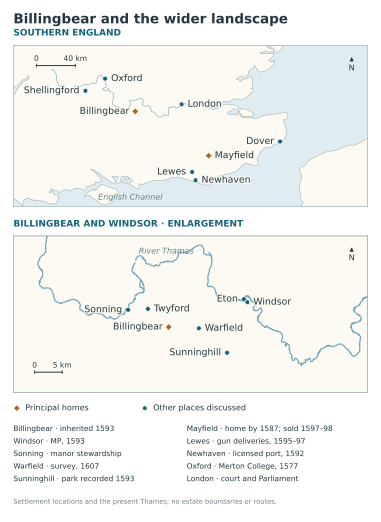
Author’s map. The historical associations are documented in Chapters 1–9. Base geography: Natural Earth (public domain); settlement locations: GeoNames (CC BY). Billingbear marks the former mansion site, approximately 51.445° N, 0.807° W, as recorded in the Wikimedia Commons geographical record for Billingbear House, rather than the modern hamlet’s centre. The enlarged river uses OS Open Rivers: contains Ordnance Survey data © Crown copyright and database right 2026, under the Open Government Licence. The present river is supplied for orientation; the map does not establish a sixteenth-century channel, ferry location, or forest boundary. Sunninghill is the settlement, not an exact reconstruction of the park.↩︎