The First Folio’s dedication thanks William and Philip Herbert for “prosecut[ing] both [the plays], and their author living, with so much favour”—that is, supporting the plays and their author during his lifetime.1 Both brothers also supported Neville’s family after his death. William probably helped Neville’s eldest son Henry become MP for Wilton; Philip secured him a place in the royal household. After Henry’s death, William received the wardship of Richard, the ambassador’s grandson.234
A place at court for Neville’s son
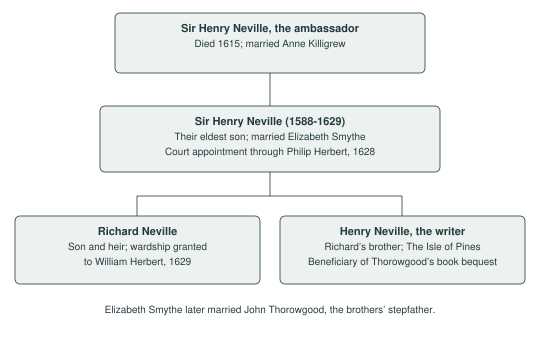
Sir Henry Neville (1588–1629), the ambassador’s eldest son, inherited Billingbear in 1615.5 His father’s forest offices proved harder to retain, and influential patrons remained important to his career.
In his study of patronage in early Stuart parliamentary elections, John K. Gruenfelder describes Wilton as Pembroke’s “pocket borough”—a constituency whose elections he effectively controlled. He describes the election of a Sir Henry Neville there in 1621 as probably reflecting Pembroke’s influence. Andrew Thrush identifies the MP as probably the ambassador’s son.2
In December 1628 William’s brother Philip, Earl of Montgomery and Lord Chamberlain, appointed him a gentleman of the privy chamber in extraordinary. This made him an additional member of the royal household attached to the king’s private chamber; “in extraordinary” distinguished him from the regular establishment. Andrew Thrush records the appointment in the History of Parliament, citing a Lord Chamberlain’s record now at The National Archives.36
The younger Neville also appears as a literary patron. Thomas Walkley addressed him in the 1619 edition of A King and No King (Chapter 52). In 1628 Anthony White dedicated two Oxford sermons to him as his “much honoured Patron,” submitting them to his judgment. His brother Edward was likewise remembered for learning: the English rendering of his epitaph describes him as “versed in Poetry, and all the Liberal Sciences.”78
Richard’s wardship
Sir Henry died on 29 June 1629, leaving his son Richard under age. On 3 November the Crown granted William Herbert, Earl of Pembroke, the benefit of Richard’s wardship. The surviving document’s English note states:
Your Majesty hereby granteth unto the Earl of Pembroke, Lord Steward of your Majesty’s household, the benefit of the wardship of Richard Nevill, son and heir of Sir Henry Nevill, knight, deceased.4
Wardship carried rights over the young heir’s custody, marriage and estate during his minority. The grant thus gave Pembroke a direct legal and financial interest in the ambassador’s grandson.
After Sir Henry’s death, his widow, Elizabeth Smythe Neville, married John Thorowgood, Pembroke’s secretary. He became stepfather to Richard and his younger brother Henry.91011 Thorowgood also acquired Richard’s wardship: a Court of Wards entry records its grant to him for a fine of £1,000, paid to the Receiver in February 1631.12 A draft quitclaim, annotated as sealed on 25 June 1637, records his release of rights concerning Richard’s wardship and marriage.13
Pembroke’s secretary and the theatre
Before joining the Neville family, Thorowgood had sought Pembroke’s support for a place in theatrical government. In February 1623 a bill proposed giving him the right to succeed as Master of the Revels, the official responsible for supervising plays. He did not obtain the office.14
Notes and sources
John Heminge and Henry Condell, dedication to William, Earl of Pembroke, and Philip, Earl of Montgomery, in Mr. William Shakespeares Comedies, Histories, & Tragedies (London, 1623), sig. A2r, Boston Public Library copy. Spelling and capitalization modernized; brackets adapt “prosecuted” to the sentence and replace “them” with its referent, the plays. “Prosecuted” here means pursued or continued their favour. Checked against the printed page.↩︎
Andrew Thrush, “NEVILLE, Sir Henry III (1588–1629), of Billingbear, Waltham St. Lawrence, Berks.”, in The History of Parliament: the House of Commons 1604–1629, ed. Andrew Thrush and John P. Ferris (2010), biography and notes 18–25. Thrush treats the identification of the 1621 Wilton member as probable. The appointment and wardship concern the ambassador’s son and his heir respectively. John K. Gruenfelder, Influence in Early Stuart Elections, 1604–1640 (Columbus: Ohio State University Press, 1981), p.125 and p.170 n.5, specifically includes Neville’s 1621 by-election among those that “probably reflected Pembroke’s influence.” For the family’s earlier remembered conversation with William Herbert, see Chapter 49 and Lippincott, Merry Passages and Jeasts (1974), pp.30–31, jest 69 and person index p.219. Lippincott identifies “Sir William Herbert” and “Mr Wil: Nevill” as Pembroke and the ambassador’s son William.↩︎
Thrush, “NEVILLE,” “Offices Held,” note 10, and the paragraph discussing the Wilton election: December 1628 appointment by Montgomery; The National Archives, LC 5/132, p. 67. The archival locator is given as Thrush’s cited authority. The register page has not been independently inspected for this chapter. For the distinction between ordinary and additional household appointments, see E. K. Chambers, The Elizabethan Stage, vol.1, discussion of supernumerary and “extraordinary” household members. This explains the terminology, not Neville’s particular duties or remuneration.↩︎
The National Archives, SP 39/28, 3 November 1629, Latin grant and accompanying English note, checked against photographs of the manuscript. Quotation from the English note, with spelling and punctuation modernized and abbreviations expanded. The Latin names William, Earl of Pembroke, and covers custody, marriage and lands during Richard’s minority. The reverse supplies 3 November in Charles I’s fifth regnal year, with a 1629 docket. Compare John Bruce, ed., Calendar of State Papers, Domestic, Charles I, 1629–1631 (1860), p.86. Neither record specifies Richard’s residence.↩︎
The son’s commercial interests included permission to invest £300 in the East India Company in May 1618; a £100 timber-payment order of August 1619 may also concern him, though the entry alone does not establish identity. His East India membership is recorded by Thrush in “Neville, Sir Henry III (1588–1629)”, Offices Held and note 9. Compare Calendar of State Papers Colonial, East Indies, China and Japan, 1617–1621, pp. 164–165, no. 347, minutes of 8–15 May 1618, and pp. 287–288, no. 717, 4 August 1619. The former grants permission; the latter orders payment. Neither entry alone proves completed payment. Their underlying references are Court Book IV, pp. 170–174 and 390–391, respectively.↩︎
Arthur Herbert Dodd, “HERBERT family, earls of Pembroke (second creation)”, Dictionary of Welsh Biography, sections on William, third earl, and Philip, fourth earl. William became Lord Steward and Philip Lord Chamberlain on 3 August 1626; this was a succession to the chamberlainship, not a literal exchange of two offices between the brothers.↩︎
Anthony White, Truth and error discovered, in two sermons in St Maries in Oxford (Oxford: John Lichfield for Henry Curteyne, 1628), dedication, sig. ¶2r–v, STC 25376, TCP A15075, printed witness. The address reads ‘Sr HENRY NEVILL OF PILLINGBERE IN Berks his much honoured Patron’; spelling and abbreviations are modernized in the main text. White praises ‘the exactnesse of your iudgement’ and invites Neville to show the sermons to others. The dedicatee is the son (1588–1629), not the ambassador (d.1615).↩︎
Elias Ashmole, The History and Antiquities of Berkshire (Reading, 1736), pp.82–83, Shellingford, Latin epitaph and English rendering. The memorial gives Edward’s age as thirty in 1632 and names his wife Alice. The literary praise concerns the ambassador’s son, not the ambassador’s brother Edward; ‘vers’d’ is expanded in the quotation.↩︎
John P. Ferris, “THOROWGOOD, John (1588–1657)”, History of Parliament (2010), offices, family details and biography; Thrush, “NEVILLE,” concluding paragraphs. Ferris distinguishes this man from the other Sir John Thorowgood of Kensington, who died in 1675.↩︎
In his will of 20 January 1657, Thorowgood left his stepson Henry Neville all his French and Italian books and a brass figure of a Roman fencer. Henry, Richard’s younger brother, became the author of The Isle of Pines (Chapter 56). Ferris, “THOROWGOOD,” final paragraph and note 17, citing The National Archives, PROB 11/265, ff.209v–211. The date and bequests follow Ferris; the original will has not been independently collated here, and no complete list of the books is supplied.↩︎
In a Chancery bill of 8 June 1670, Richard Neville alleged that deeds entrusted to Thorowgood had passed to William Thorowgood and that papers in the Billingbear study were left “much disorderly & tumbled.” This concerns property deeds, not literary manuscripts, and is Richard’s allegation as summarized in the catalogue. Hull History Centre, U DDBA/4/100, Richard Neville’s Chancery bill against William Thorowgood, 8 June 1670; Barnard catalogue, 25. The answer is separately catalogued as U DDBA/4/101. The statement about disorder is the plaintiff’s allegation as summarized in the catalogue.↩︎
The National Archives, WARD 9/163, Richard Nevill entry under “Anno Sexto / Caroli Regis,” checked against the photographed page and entry detail. It records the wardship grant to Sir John Thorowgood for “one thousand pounds,” paid to the Receiver in February in Charles I’s sixth regnal year: February 1630/31, or 1631 in modern year numbering. The exact day and folio are not treated as settled. This entry does not explain the intervening transfer from Pembroke.↩︎
Hull History Centre, U DDBA/4/98, “Draft. Quitclaim,” 1637, annotated “Sealed 25 Jun 1637”; Barnard family catalogue, 24. The description names Thorowgood, Richard Neville and the wardship and marriage. The account follows the catalogue, not a transcription of the full instrument. The exact date of Thorowgood’s marriage and the terms by which the wardship passed from Pembroke remain unestablished.↩︎
Mary Anne Everett Green, ed., Calendar of State Papers, Domestic, James I, 1619–1623 (1858), 503, Conway to Pembroke, 28 February 1623, citing Conway’s letter book, p. 6; Ferris, “THOROWGOOD,” note 14 and biography. These sources document an attempted reversion, not Thorowgood’s service as Master of the Revels. Conway wrote to Lord Chamberlain Pembroke on 28 February 1622/3 (1623 in modern year reckoning) about the bill sent for signature. The proposal preceded Thorowgood’s marriage into the Neville family.↩︎