Appendix C
A seventeenth-century account makes Henry Neville the grandson of Henry VIII. It comes from the family of Sir Thomas Overbury, the courtier who supported Neville’s bid to become secretary of state. Thomas’s father, Sir Nicholas Overbury, was a Middle Temple lawyer and MP for Gloucester. Nicholas Oldisworth, who recorded Sir Nicholas Overbury’s recollections in 1637, was Sir Nicholas’s grandson through his daughter Muriel and therefore Thomas’s nephew.1
Thomas’s importance to Neville was political. As Jackie Watson explains in Epistolary Courtiership and Dramatic Letters (2024), he was the intimate adviser of James I’s favourite, Robert Carr, Viscount Rochester, later Earl of Somerset. Neville and Ralph Winwood relied on Thomas to promote their claims through Carr. This is the background to Sir Nicholas’s recollection, which first praises the ambassador and recalls the secretaryship campaign, then turns to Neville’s father:
Sir Henry Neville was a wonderful wise man, whom Sir Thomas Overbury would fain have made the King’s Secretary, and once brought him to be sworn; but Somerset interrupted him, as not loving him for being against the Countess. He was son to that Henry Neville who was bastard to King Henry VIII.1
The prospective secretary was the ambassador, who died in 1615; the alleged son of Henry VIII was his father, who died in 1593. Oldisworth’s compilation survives as British Library Add MS 15476; the passage quoted here is the printed transcription published in The Herald and Genealogist in 1874.
“Somerset” in this retrospective account is Carr; “the Countess” is Frances Howard, Countess of Essex, whom Carr married in 1613. Thomas opposed the marriage. He died in the Tower in September 1613, a death that led to the poisoning scandal discussed in Chapter 49, where Dudley Digges’s deposition records his conversations with Neville about Overbury and Carr. Sir Nicholas Overbury’s account therefore came from a family closely involved in the political struggle around Neville, though its parentage claim remained a recollection recorded more than twenty years after the ambassador’s death.1
Another version appears in an anecdote published by Lord Braybrooke in 1850 from a volume of Berkshire pedigrees. Elizabeth calls the elder Neville “Brother Henry”; he protests that the court will consequently think him a bastard. The lost identification of Braybrooke’s source prevents a firm date being attached to that telling of the story.2
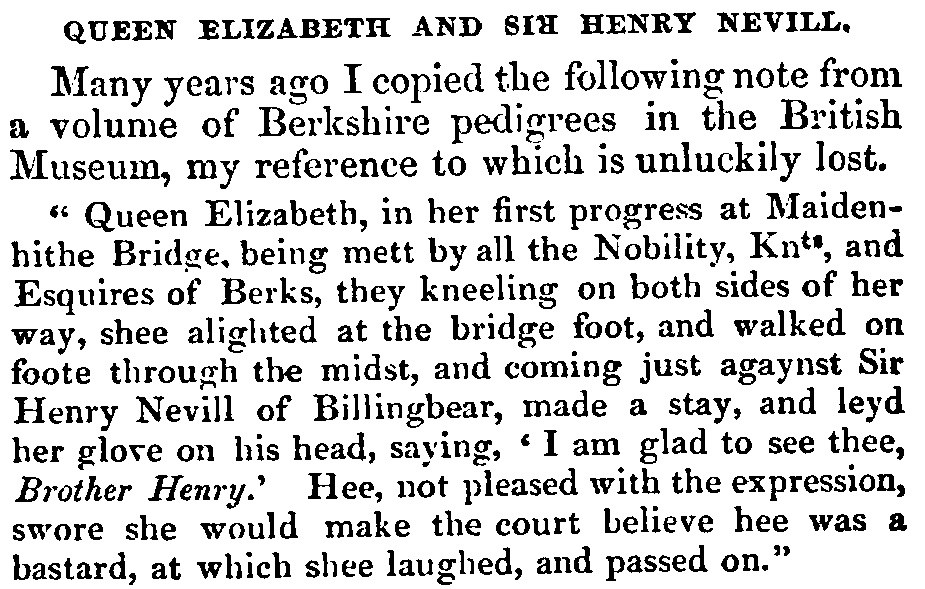
Braybrooke printed this anecdote alongside the masque episode discussed in Chapter 38. The two passages concern different generations: the elder Henry Neville in the Elizabeth story and his father, Sir Edward Neville, at the masque.
Thomas himself supplies the contemporary comparison of Neville with Henry VIII. After his imprisonment in the Tower in April 1613, he continued to write secretly to Carr. In Letter 41 of Watson’s edition he instructs him:
Call Neville hereafter Similis and because he is like Hen 8;
The same letter assigns James I the name Julius and Pembroke Niger, alongside precautions about seals and messengers. Similis was a name for use in clandestine political correspondence, and Thomas expressly explains it by Neville’s likeness to Henry VIII. The letter is undated; Watson places it soon after the arrest, probably in late April or very early May 1613. It describes resemblance, not a father–son relationship.3
Holinshed also records a resemblance in the previous generation. At Wolsey’s banquet, the cardinal mistakes Neville’s grandfather, Sir Edward Neville, for Henry VIII. Holinshed calls him “a comely knight, that much more resembled the king’s person in that mask than any other.” The king laughs and unmasks them both.4
The biography records the father’s documented royal connections: Henry VIII was his godfather, granted him an annuity in 1539, left him £100 and included him among the witnesses to his will. The family pedigree identifies his father as Sir Edward Neville, executed in 1538. Royal favour and a later parentage story are separate pieces of evidence. The sources establish the existence of the tradition; they do not settle its biological truth.
Notes and sources
“A Booke touching Sir Thomas Overbury,” printed from British Library Add MS 15476 in The Herald and Genealogist, VIII (1874), p. 446 for the transmission through Nicholas Overbury and Nicholas Oldisworth, and p. 449, item 25 for the passage. Spelling modernized and abbreviated names expanded. British Library catalogue. The quoted witness is the printed transcription, not a photograph of the manuscript leaf. Jackie Watson, Epistolary Courtiership and Dramatic Letters: Thomas Overbury and the Jacobean Playhouse (Edinburgh University Press, 2024), pp. 11–12, 68–70 and 111–113, supplies the family’s legal background, the secretaryship alliance and the crisis over Carr’s marriage. For Muriel’s marriage to Robert Oldisworth and the resulting kinship, see Sidney Lee, “Overbury, Thomas”, Dictionary of National Biography, opening family account. For Thomas’s imprisonment, death and the later trials, see Watson, pp. 1–2 and 105–114; the political consequences are discussed in the last-years chapter.↩︎
Lord Braybrooke, contribution to Notes and Queries, 12 October 1850, p. 307. The source is described as a British Museum volume of Berkshire pedigrees; its precise shelfmark has not been established. The date of the anecdote’s “first progress” remains uncertain.↩︎
Jackie Watson, Epistolary Courtiership and Dramatic Letters: Thomas Overbury and the Jacobean Playhouse (Edinburgh University Press, 2024), Letter 41, pp. 133–134, source and dating in n. 104, code-name comment in n. 105; see also the discussion on pp. 112–114. Watson transcribes British Library Harley MS 7002, fol. 281. Book DOI. The quotation follows her printed transcription; the manuscript leaf has not been independently collated here.↩︎
Raphael Holinshed and continuators, The Third Volume of Chronicles (1587), p. 922, right column, with the preceding action at the foot of the left column. Spelling modernized; “in that mask” retained.↩︎