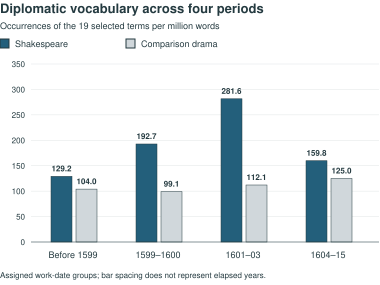
Nineteen terms selected from Neville’s writing become markedly more frequent in Shakespeare during the embassy and its aftermath. They occur more than twice as frequently in Shakespeare’s works assigned to 1601–03 as in Shakespeare’s writing assigned to before 1599—and about two and a half times as frequently as in contemporary comparison drama. The graph shows the change: Shakespeare rises sharply while the comparison rate remains relatively level.1
The significance lies in the timing. Neville became ambassador to France in 1599. His surviving dispatches record the daily business of audiences, treaties, negotiations and passports. A vocabulary characteristic of that work grows more prominent in Shakespeare during and just after the embassy.2
How the test works
To keep the selection independent of Shakespeare’s word counts, the study starts with Neville’s writing. It selects diplomatic and administrative terms that recur across his documents, are much more frequent there than in comparison drama, and first appear in his surviving record in 1599 or 1600. The complete list and every counted occurrence in Troilus and Cressida appear below.3 Only seven letters survive from before 1599, against ninety-six from 1599–1600, so first surviving uses may partly reflect when the archive becomes abundant.4
The computer then counts these words, including spelling and grammatical variants, in Shakespeare and other drama across four periods. The main comparison adjusts for length: it measures uses per million words, so a longer play does not score higher simply because it contains more words. The question is straightforward: does this vocabulary become more common in Shakespeare around the embassy years, and does other drama change in the same way? The sample contains forty-one Shakespeare works and 203 comparison plays.4
Among the four periods shown, the increase begins in works assigned to 1599–1600 and is strongest in 1601–03. It then falls partway back. The five plays in that peak group are Hamlet, Twelfth Night, Troilus and Cressida, All’s Well That Ends Well and Measure for Measure. The result concerns a cluster of plays, rather than one unusually diplomatic scene.
What survives further checks
The rise remains when any one term or any one of the five peak-period plays is removed.5 It also survives plausible changes to the dates assigned to Hamlet, All’s Well and Measure for Measure. With all three dates changed, only Twelfth Night and Troilus and Cressida remain in the peak group. The concentration stays near the embassy years, though the evidence cannot fix an exact year of change.6
The rise is consistent across these checks, but its size and timing remain uncertain. The estimated difference between Shakespeare’s increase and that of comparison drama is not statistically secure; a search across all three-year windows does not establish an unusual peak.57 The study is exploratory: comparison drama helped select the vocabulary, and the original peak contains only five plays.8 The counts include different meanings of the words and do not establish a shared pattern of local word combinations.7
What it does show is a change in Shakespeare’s language alongside a defining change in Neville’s working life. The selected vocabulary becomes substantially more frequent during the embassy and its aftermath, while the comparison drama shows much less movement. That is the connection this study adds to the individual verbal parallels examined elsewhere in the book.
Why Troilus and Cressida stands out
Troilus and Cressida has the highest length-adjusted frequency of these words among Shakespeare’s works assigned to 1599–1603, the embassy and its aftermath. Its twelve occurrences amount to about 462 uses per million words. Across the whole Shakespeare sample it ranks third, behind Henry VIII, assigned to the years after the embassy, and 3 Henry VI, assigned to the years before it. Those exceptions matter: the study identifies a rise across a group of works around the embassy, not a claim that every play with a high rate belongs to that period.9
It also uses the widest range: eight different words from the nineteen-word list, more than any other work in the sample. This separate count of distinct words is not adjusted for length. The comparison covers forty-one Shakespeare works, including three poetic units, and 203 comparison plays assigned to 1590–1615; it is not a claim about every surviving play from those years.
The full nineteen-word list is: advertise, advertisement, allowance, audience, avow, commissioner, communication, difficulty, insist, mediation, memorial, negotiation, overture, parliament, passport, propose, proposition, secretary, and treaty. These are dictionary forms: advertised, for example, counts under advertise, and negotiations under negotiation.
Here are all twelve counted uses in Troilus and Cressida, in their order in the play. The final column explains what each word means in its particular scene.10
| Word and scene | Words in the play | What the word does here |
|---|---|---|
| proposition · 1.3 | AGAMEMNON […] The ample proposition that hope makes In all designs begun on Earth below […] |
The grand prospect held out by hope at the start of an undertaking. |
| avow · 1.3 | AENEAS […] And dare avow her beauty and her worth In other arms than hers–to him this challenge. […] |
Publicly declaring a lady’s worth as part of Hector’s challenge. |
| allowance · 1.3 | ULYSSES […] Give him allowance for the better man, […] |
Giving Ajax superior standing to provoke Achilles. |
| difficulty · 2.2 | PARIS […] Were I alone to pass the difficulties And had as ample power as I have will, […] |
The obstacles Paris says he would face to keep Helen. |
| propose · 2.2 | PARIS […] Sir, I propose not merely to myself The pleasures such a beauty brings with it, […] |
Setting an aim beyond his own pleasure. |
| advertise · 2.2 | HECTOR […] I was advertised their great general slept, Whilst emulation in the army crept. […] |
Receiving intelligence about Greek inactivity and rivalry. |
| allowance · 2.3 | AGAMEMNON […] A stirring dwarf we do allowance give Before a sleeping giant. Tell him so. […] |
Preferring useful action to idle greatness in a rebuke to Achilles. |
| propose · 3.2 | TROILUS […] Where I may wallow in the lily beds Proposed for the deserver! O, gentle Pandar, […] |
Imagining the pleasures awaiting a deserving lover. |
| difficulty · 3.2 | TROILUS […] enough than for us to undergo any difficulty imposed. This is the monstruosity in love, lady, that […] |
The trials lovers promise to undertake. |
| negotiation · 3.3 | CALCHAS […] That their negotiations all must slack, Wanting his manage; and they will almost […] |
Trojan business slowed by Antenor’s captivity: the reason to exchange him for Cressida. |
| memorial · 5.1 | THERSITES […] statue and oblique memorial of cuckolds, […] |
Mocking Menelaus as an emblem of cuckoldry. |
| memorial · 5.2 | CRESSIDA […] And gives memorial dainty kisses to it As I kiss thee. […] |
Kisses given to a love-token in remembrance. |
These words run through councils of war, challenges, reports and a prisoner exchange. Hector is “advertised” of trouble in the Greek camp; Ulysses and Agamemnon use “allowance” to weigh military worth; Calchas makes Antenor’s importance to Trojan “negotiations” the basis of a bargain. Shakespeare also carries the vocabulary into courtship and mockery: lovers face “difficulty,” imagine pleasures “proposed” for them and give “memorial” kisses. The study counts the words across these different meanings. Troilus brings the widest range of them into a play where public bargaining and private desire repeatedly intersect.11
Notes and sources
Work-level counts from the 16 September 2026 analysis. The 1601–03 group comprises Hamlet, Twelfth Night, Troilus and Cressida, All’s Well That Ends Well, and Measure for Measure. Rates per million words for Shakespeare/comparison drama are: before 1599, 129.2/104.0; 1599–1600, 192.7/99.1; 1601–03, 281.6/112.1; 1604–15, 159.8/125.0. Corresponding ratios are 1.24, 1.94, 2.51 and 1.28. The four Shakespeare periods contain respectively 54, 13, 34 and 47 panel occurrences in 418,093, 67,455, 120,752 and 294,102 tokens. Comparison drama contains 39, 19, 27 and 118 plays, with 66, 39, 53 and 278 panel occurrences in 634,764, 393,359, 472,918 and 2,224,464 tokens. The peak/pre-Shakespeare ratio is 2.180036; the peak/contemporary-comparison ratio is 2.512433. These are aggregate vocabulary rates using assigned work dates, without a claim of exact composition years or identical senses in every occurrence.↩︎
Neville’s French embassy began in 1599. See Andrew Thrush, “NEVILLE, Sir Henry I (1564–1615),” History of Parliament: The House of Commons 1604–1629, and Neville’s dispatches in Ralph Winwood, Memorials of Affairs of State, ed. Edmund Sawyer, vol. 1 (London, 1725), especially the letter of 13 July 1599, pp. 61–66. The detailed documentary account appears in the earlier chapter on Neville’s public career. First surviving word dates describe the available archive, not the acquisition of vocabulary. For the passport example, see Neville to Cecil, 27 February 1599/1600 O.S., Winwood I, p. 156, recording a passport given to Gowrie; the same page contains his later request for one for Lord Hume. This February letter belongs to 1600 in modern year reckoning.↩︎
Original analysis for this book, begun in July 2026 and rerun on 16 September 2026 using corpus version 25. The source selection used 169 English documentary records and 139,145 normalized lemma tokens, excluding three French records and an identified editorial tail. Each selected term occurs at least five times across at least five Neville records, first appears in the surviving record in 1599 or 1600, and is at least fifteen times as frequent per word in Neville as in comparison drama. The nineteen dictionary forms are advertise, advertisement, allowance, audience, avow, commissioner, communication, difficulty, insist, mediation, memorial, negotiation, overture, parliament, passport, propose, proposition, secretary, and treaty. Of the earlier panel, commission no longer meets the fifteenfold enrichment threshold (54 occurrences; 13.2054-fold enrichment), while omission has only two instances in two documents, below both minima. Including the French records does not change the selected terms. The rate-ratio selection adds 0.5 to both corpus counts. The semantic field was curated, and the numerical rule uses Neville and comparison-drama counts without a Shakespeare-count criterion. This is an updated exploratory analysis, not externally preregistered or fully blinded research. This September run retains both witnesses of one 1606 letter and embedded quoted or enclosed material; Chapter 14 uses a later deduplicated selection, and Chapter 11’s descriptive census also excludes embedded material. The record-dispersion counts therefore do not count wholly independent communications. A selection check on 15 October 2026 used the deduplicated corpus version 26 and a disjoint pool of 201 comparison plays, retaining exactly the same nineteen terms. Under that check’s counting rules, the English selection contains 168 records and 138,057 lemma tokens; embedded quotations and enclosures remain. The displayed rates, intervals and calibrations retain the September run and are not presented as a complete rerun of the later selection.↩︎
For the comparison collection, see Pervez Rizvi, “Collocations and N-grams”, documenting modern-spelling, lemmatized texts of 527 plays derived from EarlyPrint and Folger. This study retains 203 comparison plays assigned dates 1590–1615. The target contains 41 works and 900,402 tokens: plays and three poetic units. The 358-word Phoenix and Turtle, which contains no panel term, is excluded throughout, including the calibration. The four periods contain 20, 3, 5 and 13 Shakespeare works respectively. This is not identical to Chapter 14’s dramatic sample. Chapter 11 records seven letters before 1599 and ninety-six in 1599–1600: the selection’s first-surviving-use rule may partly reflect the growth of the archive, not newly acquired vocabulary. Pericles and The Two Noble Kinsmen occur in both target and comparison selections; removing them from the latter leaves the earlier three periods unchanged and changes the final period’s ratio only from 1.279 to 1.273. The studies share material and should not be treated as independent replications.↩︎
Updated nineteen-term work bootstrap: 20,000 resamples, seed 1599. The peak/comparison 95% interval is 1.475308–4.033447; the peak/pre-Shakespeare interval is 1.181538–4.114480. The ratio of the Shakespeare change to the comparison-drama change is 2.022578, interval 0.906613–4.476176; one denotes equal proportional changes. Leaving out each peak play gives comparison ratios from 2.071411 to 2.789416; leaving out each term gives 2.216853–2.959088. Every deletion preserves the rise within Shakespeare too. These checks use the same data and are not independent replications.↩︎
Updated targeted date sensitivity with the same nineteen terms, comparison dates fixed and The Phoenix and Turtle excluded. The Royal Shakespeare Company’s timeline dates Measure for Measure to 1604, All’s Well to 1603–06 and Hamlet around 1600. Moving Measure alone gives 312.6 uses per million in four 1601–03 plays; also placing All’s Well after 1603 gives 315.2 in three; moving Hamlet to 1600 as well gives 327.3 in two, while the 1599–1600 rate becomes 225.0. The pre-1599 rate remains 129.2. These are selected boundary checks, not a complete remapping to RSC dates or new significance tests.↩︎
Updated nineteen-term checks: the unrestricted three-year scan selects 1600–02 (three works, 24 panel occurrences in 76,139 tokens), with a rate ratio of 2.095310 against the remaining years. Across 20,000 permutations of whole-work dates, seed 1900, maximum-scan p = .380981. Windows run from 1590–92 through 1611–13, requiring at least two works inside and five outside. In a twenty-token local-network check, the selected panel gives 102 distinct-term pair events in Neville’s 1599–1603 records and none in peak Shakespeare; there is no positive network similarity. For the broader 83-term diplomatic core, Shakespeare–Neville similarities at eight and twenty tokens are not exceptional against five-work samples from contemporary comparison drama (20,000 draws, seed 1603; upper-tail p = .355232 and .186691). These checks do not establish a personal pattern of local word associations.↩︎
Updated exploratory matched-panel calibration: 41 target works, 20,000 accepted panels, seed 1599, forty nearest candidate neighbours per selected term. The internal-rise ratio is 2.180036, empirical upper-tail probability .057347; the peak/comparison ratio has probability .150192. Candidate selection and matching use current Neville frequency, document dispersion, first year and comparison-drama counts, without Shakespeare counts. Controls are drawn without duplicate terms within a panel. Matching remains imperfect: the selected panel averages 42.5 Neville occurrences per term, against a matched-panel median of 27.0. The calibration was devised after the original pattern had been observed; it is not a confirmatory authorship test.↩︎
Counts from the same work-level analysis underlying the graph: Troilus and Cressida has 12 occurrences in 25,983 words, or 461.8 per million; Henry VIII has 14 in 24,712 (566.5 per million); 3 Henry VI has 13 in 24,145 (538.4 per million). Troilus ranks third among the 41 Shakespeare works on both total and rate. Its eight distinct terms are the maximum across all 244 study records; Henry VIII and Cynthia’s Revenge follow with seven. This is a comparison within the defined study, not every surviving early modern play. Troilus’s term totals are proposition 1, avow 1, allowance 2, difficulty 2, propose 2, advertise 1, negotiation 1 and memorial 2. The eleven other selected terms do not occur in its encoded study text.↩︎
Shakespeare, Folger Shakespeare Library, Troilus and Cressida, 1.3, 2.2, 2.3, 3.2, 3.3, 5.1 and 5.2. Extracts retain Folger line divisions, with omissions marked and emphasis added. All twelve study occurrences were checked against these passages; the table’s explanations distinguish the actual senses from the diplomatic and administrative vocabulary used to select the words.↩︎
Shakespeare, Troilus and Cressida, 3.3, Folger Through Line Numbers 1877–1895 (Calchas’s request and the exchange) and 2100–2103 (Patroclus). The Patroclus quotation below preserves four complete Folger lines. Negotiation belongs to the selected panel; omission and commission illustrate the broader register but are excluded from the current quantitative panel. These passages are not presented as exact phrase matches with Neville. Troilus has twelve occurrences across eight panel terms; Hamlet has nine across three.
Later in the same scene, Patroclus urges Achilles to act before his refusal to fight destroys his standing (Troilus and Cressida, 3.3):
PATROCLUS […]
Omission to do what is necessary
Seals a commission to a blank of danger,
And danger, like an ague, subtly taints
Even then when they sit idly in the sun.The administrative language makes the warning precise: failing to act gives danger its authority. These two words belong to the play’s broader administrative register; they are not among the nineteen terms counted in the updated test.↩︎