Ben Jonson certainly knew who wrote the works of Shakespeare. He listed William Shakespeare as an actor in two of his plays, and commented directly on Shakespeare’s writing. In Discoveries, a collection of notes and reflections published posthumously in 1641, he declared: “I loved the man, and do honour his memory (on this side idolatry) as much as any. He was, indeed, honest and of an open and free nature; had an excellent fantasy, brave notions, and gentle expressions; wherein he flowed with that facility that sometime it was necessary he should be stopped.”1
And, of course, his two poems in Shakespeare’s First Folio of 1623 frame the author for posterity: the address facing the portrait directs readers to the book; the longer tribute celebrates the author and his surviving work. Jonson was also likely deeply involved in preparing the Folio, although the extent of his work on the volume remains unknown.2
Jonson’s writing about Henry Neville is therefore one of the most essential pieces of evidence for determining whether Neville wrote the works of Shakespeare.
Jonson’s own folio and its book of epigrams
In November 1616, Jonson published his collected Workes. This folio gathered nine of his plays, court masques and entertainments, and two collections of poetry, Epigrams and The Forest. The epigrams form a distinct collection within the volume, dedicated to William Herbert, Earl of Pembroke. Their 133 poems include praise of named individuals as well as satire.3,4
The Epigrams had also appeared separately before the folio, in an edition dated approximately 1612. The collection was entered in the Stationers’ Register on 15 May that year. Tara L. Lyons’s research supplies strong evidence of the earlier printed book: Bodleian records list it among books sent for binding on 15 September 1614. Her later study argues that a small octavo edition was circulating as early as 1612. No copy has yet been recovered, so its full contents cannot be checked.5
In the 1616 folio, Jonson addressed epigrams to both Henry Neville and Neville’s former tutor Henry Savile. Epigram XCV (95), “To Sir Henry Savile,” praises Savile’s translation of Tacitus and his account of the interval between Nero and Galba. Epigram CIX (109), “To Sir Henry Nevil,” praises Neville’s character, understanding of honour and approach to public service.6
The eighteen-line epigram to Neville occupies parts of pages 803 and 804. The image below shows it as printed in the 1616 Workes:3
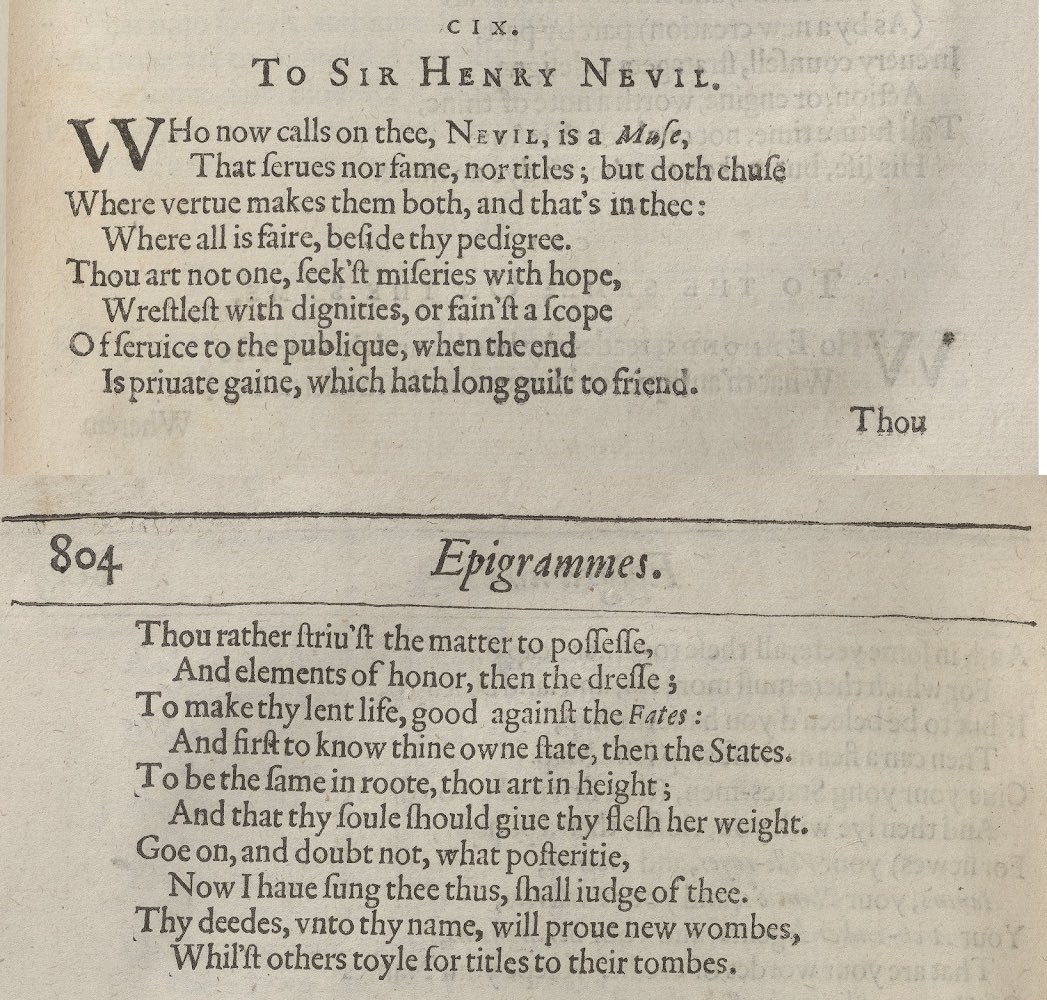
Figure 46.1. Jonson’s complete epigram “To Sir Henry Nevil,” Workes (1616), pp. 803–804.
The eighteen lines as a whole
Here spelling and punctuation are lightly modernized, while the folio’s “then” in lines 10 and 12 and “States” in line 12 are retained.3,7
Who now calls on thee, Nevil, is a Muse,
That serves nor fame, nor titles; but doth choose
Where virtue makes them both, and that’s in thee:
Where all is fair, beside thy pedigree.
Thou art not one, seek’st miseries with hope,
Wrestlest with dignities; or feign’st a scope
Of service to the public, when the end
Is private gain, which hath long guilt to friend.
Thou rather striv’st the matter to possess,
And elements of honour, then the dress;
To make thy lent life good against the Fates:
And first to know thine own state, then the States.
To be the same in root thou art in height;
And that thy soul should give thy flesh her weight.
Go on, and doubt not what posterity,
Now I have sung thee thus, shall judge of thee.
Thy deeds unto thy name will prove new wombs,
Whilst others toil for titles to their tombs.
Neville, Donne and Beaumont
In the first line, Jonson addressed Neville by name, with language recalling a Shakespeare sonnet and an opening resembling his salutations to Donne and Beaumont, two of the greatest writers of the time.
Read the three openings together:
To John Donne, Epigram XXIII
Donne, the delight of Phoebus and each muse,
To Francis Beaumont, Epigram LV
How I do love thee, Beaumont, and thy muse,
To Sir Henry Neville, Epigram CIX
Who now calls on thee, Neville, is a muse
Each opening names the recipient and ends with “muse.” Donne is the Muses’ delight; Beaumont has his own Muse; the one who calls on Neville is a Muse.4,8,9
The sonnet within the salutation
Sonnet 38 invites its addressee to become the tenth Muse:10
Be thou the tenth muse, ten times more in worth
Than those old nine which rhymers invocate;
And he that calls on thee, let him bring forth
Eternal numbers to outlive long date.
Jonson places the same words in a single line:
Who now calls on thee, Neville, is a muse
James Leyland and James Goding drew attention to this comparison in their 2018 book Who Will Believe My Verse?.11
An EarlyPrint search for the calling phrase near “muse,” in either order, returned only Jonson’s 1616 Workes and printings of Shakespeare’s Sonnet 38.12
Sonnet 29: the inward measure of a man
In Sonnet 29, the speaker’s dissatisfaction with his condition becomes envy of other men’s advantages:
Wishing me like to one more rich in hope,
Featured like him, like him with friends possessed,
Desiring this man’s art and that man’s scope,
With what I most enjoy contented least;
Jonson’s Neville is distinguished from the man who seeks advancement at the cost of misery and pretends to a public “scope”—an aim or purpose—while pursuing private gain:
Thou art not one, seek’st miseries with hope,
Wrestlest with dignities; or feign’st a scope
Of service to the public, when the end
Is private gain, which hath long guilt to friend.
Thou rather striv’st the matter to possess,
And elements of honour, then the dress;
Both poems make hope and scope their third distinct rhyme group: lines 5 and 7 of the sonnet, lines 5 and 6 of the epigram. The sonnet’s “friends possessed” also corresponds to Jonson’s “guilt to friend” and “matter to possess”: both passages bring those words into a discussion of status and dissatisfaction.
A second pair of rhyming words appears in Sonnet 29’s opening quatrain. Sonnet 29 has state/fate; Jonson has Fates/States:
When in disgrace with fortune and men’s eyes,
I all alone beweep my outcast state,
And trouble deaf heaven with my bootless cries,
And look upon myself and curse my fate,
Jonson’s Epigram CIX, lines 11–12, reverses the pair:
To make thy lent life good against the Fates:
And first to know thine own state, then the States.13,14
Jonson’s tributes to Neville and Shakespeare
Jonson’s promise to Neville anticipates the language of his First Folio tribute to Shakespeare. The epigram ends:
Thy deeds unto thy name will prove new wombs,
Whilst others toil for titles to their tombs.
In the Folio, Shakespeare needs no tomb to preserve him:
Thou art a monument without a tomb,
And art alive still, while thy book doth live,
And we have wits to read, and praise to give.
The connection extends beyond survival. Neville’s deeds become “new wombs” for his name; Shakespeare’s writing becomes his offspring:
Look how the father’s face
Lives in his issue; even so the race
Of Shakespeare’s mind and manners brightly shines
In his well-turnèd and true-filèd lines;
In both tributes, achievement gives the man a continuing life. Neville’s deeds renew his name; Shakespeare’s lines preserve his mind and character. Jonson does not identify Neville’s deeds as writings, but his imagery in the two poems is closely related.15
When was Neville’s epigram written?
The surviving text was published in 1616, after Neville’s death on 10 July 1615. That leaves two possibilities: Jonson was publishing an epigram written during Neville’s lifetime, or he wrote it after Neville’s death. Whether the lost collection of about 1612 contained the epigram is unknown since no copy is extant.16,5 An epigram written during his lifetime could also have been revised after his death; Jonson revised other epigrams for the 1616 collection.17
Colin Burrow, following F. G. Fleay, proposes Neville’s failure to obtain the secretaryship in 1612 as the occasion. The epigram’s contrast between genuine public service and the pursuit of office for private gain would fit that setting. “Go on” also sounds like encouragement to a living man. But in my view, it seems unlikely that Jonson would write about Neville’s failure in this way while Neville still had the opportunity of political advancement and high office.17
Other lines sound commemorative. Neville’s “lent life,” the appeal to “posterity,” and the closing contrast between “wombs” and “tombs” turn attention towards death and the survival of his name. Read after his death, “Now I have sung thee thus” can sound like Jonson securing a dead friend’s reputation.
However, “lent life” need not mean a life already ended. In The Forest III, Jonson urges Sir Robert Wroth to “live long innocent,” then closes:
To do thy country service, thyself right;
That neither want do thee affright,
Nor death; but when thy latest sand is spent
Thou mayst think life a thing but lent.
Death is still ahead of the man addressed. The phrase describes life as something temporarily entrusted to him, much as Neville is urged to make his “lent life good against the Fates.”17
The closest example of the Muse and the tomb language comes in Jonson’s epistle to Elizabeth, Countess of Rutland, originally sent as a New Year’s gift in 1600, while she was alive. Jonson declares that “the muse alone” can preserve the people she loves, then contrasts that power with monuments:
… Those other glorious notes,
Inscribed in touch or marble, or the coats
Painted or carved upon our great men’s tombs,
Or in their windows, do but prove the wombs,
That bred them, graves: when they were born, they died,
That had no muse to make their fame abide.
The same “tombs” and “wombs” rhyme thus appears in a poem offering lasting fame to a living recipient. It therefore leaves open whether Neville’s epigram was written before or after his death.17
Notes and sources
Ben Jonson, Discoveries, ed. Lorna Hutson, The Cambridge Edition of the Works of Ben Jonson Online, lines 468–482, text and commentary. The work was printed in 1641. Hutson’s introduction describes its commonplace-book form: notes, quotations and observations arising from Jonson’s reading. For the actor lists, see Jonson’s Workes (1616), pp. 72 and 438, naming Shakespeare in Every Man in His Humour (1598) and Sejanus (1603), reproduced and transcribed in Shakespeare Documented. Jonson’s personal knowledge is the historical judgement drawn here from his testimony; the passage does not identify Neville as Shakespeare.↩︎
Jonson, “To the Reader” and “To the Memory of My Beloved, The Author, Master William Shakespeare, And What He Hath Left Us”, ed. Colin Burrow, Cambridge Edition, complete poems and commentary. Both were first printed in Shakespeare’s 1623 Folio. The short poem faced the Droeshout engraving. The view that Jonson was very deeply involved in preparing the volume is the interpretation advanced here; neither the poems nor these editorial accounts establish the extent of his editorial or organizational work.↩︎
Jonson, The Workes of Benjamin Jonson (London: William Stansby, 1616), pp. 803–804, page-image witness. The full CIX quotation modernizes spelling, capitalization and punctuation, while retaining “then” at lines 10 and 12 and the unapostrophized “States” at line 12. The first-line comparisons use the Cambridge edition instead, as specified in note 4. On the volume as a collection of plays and other writings, see Ian Donaldson, “Note on folio title-page (1616)”, Cambridge Edition.↩︎
Ben Jonson, Epigrams, ed. Colin Burrow, The Cambridge Edition of the Works of Ben Jonson Online, XXIII, LV and CIX, text and commentary. These opening comparisons follow Burrow’s modern text, with typographic apostrophes normalized; bold type is editorial emphasis. CIX’s opening differs in spelling and punctuation from the lightly modernized folio text printed above, not in the phrase being compared. Jonson’s second Donne poem, XCVI, opens “Who shall doubt, Donne, whe’er I a poet be, / When I dare send my Epigrams to thee?” Its question brings together the addressee, poetic identity and “thee”; the closer verbal comparison with Sonnet 38 is CIX’s “calls on thee” and “muse.” See also Epigrams XXIII, lines 1–10.↩︎
Tara L. Lyons, “New Evidence for Ben Jonson’s Epigrammes (ca. 1612) in Bodleian Library Records,” The Papers of the Bibliographical Society of America 114, no. 3 (2020): 343–364, article. The Bodleian evidence establishes an earlier printed collection; it does not identify CIX among its contents. See also Tara L. Lyons, “Reading a Lost Book: Ben Jonson’s Epigrammes (c.1612) and Disposable Authorship,” English Literary Renaissance 53.1 (2023), pp. 1–34, DOI. The publisher’s abstract, consulted here, describes an octavo edition circulating as early as 1612; the full 2023 article has not been consulted for this revision.↩︎
Ben Jonson, Epigrams XCV, “To Sir Henry Savile,” in Colin Burrow’s Cambridge edition, poem and commentary. The poem praises both the translation and Savile’s historical supplement; CIX is the address to Neville reproduced here.↩︎
Jonson, Epigrams CIX, commentary to line 12. The folio has “then”; Burrow prefers “than,” governed by “rather” in line 9. He observes that most modernized editions retain “then” at line 12. The folio’s unapostrophized “States” does not by itself establish a plural sense: Burrow reads “the State’s,” with the possessive referring back to “state.” The printed forms and the editorial interpretation are distinguished here. The main text retains the folio’s “then”; Burrow’s reading makes the preference comparative, while “then” at line 12 can place self-knowledge before statecraft.↩︎
Jonson, Epigrams XLIII, “To Robert, Earl of Salisbury,” in Burrow’s edition. Four of the 133 epigrams end their first line with “muse”: XXIII (Donne), XLIII (Cecil), LV (Beaumont), CIX (Neville). Cecil’s opening is different: “What need hast thou of me, or of my muse”. “My muse” explicitly means Jonson’s own Muse, not Cecil’s. The poem turns back towards Jonson’s reputation: Cecil’s name may add fame to Jonson’s book, and Jonson calls himself “not the worst” of poets. Its professed modesty thus includes self-congratulation and a defence of Jonson’s freedom from flattery.↩︎
Shakespeare, Sonnet 38, lines 5–14; Jonson, Epigrams LV, lines 1–10. The shared rhyme pairs worth/forth and me/thee occur at LV 3–4 and 9–10, and Sonnet 38 9–11 and 5–7 respectively. The broader relation of praise and creative indebtedness is the chapter’s comparative reading, not a claim of a newly proved source. Beaumont’s poem and Sonnet 38 both turn praise back towards the person who inspires or supplies it.↩︎
Jonson, The Underwood, ed. Burrow, XIV, “An Epistle to Master John Selden,” lines 79–86, text and commentary. It supplies a contextual tenth-muse comparison, not the exact “calls on thee” phrase. The headnote records its first appearance with Selden’s Titles of Honour in 1614. The broader conceit of a tenth Muse is not by itself the distinctive wording being compared.↩︎
James Leyland and James Goding, Who Will Believe My Verse? The Code in Shakespeare’s Sonnets (Australian Scholarly Publishing, 2018), p. 11, page preview. The approximate composition date proposed there is not treated as established.↩︎
EarlyPrint, public BlackLab collection, queries checked 20 October 2026. The consecutive lemma sequence call / on / thou, followed by muse with 0–15 intervening tokens, returned four hits in four records: TCP A04632 (Jonson, 1616), A12043 and A12044 (Sonnets, 1609), and A12034 (Shakespeare’s Poems, 1640, reprinting Sonnet 38). The reverse search, muse followed by call / on / thou with the same allowance, returned three hits, all in those Shakespeare records. In Sonnet 38 the forward match reaches “If my slight Muse” in line 13; the reverse match reaches back to “the tenth muse” in line 9, quoted above. Thus the two searches identify two works in four printed records, not four independent uses. The search does not establish uniqueness beyond its corpus, annotations and defined wording.↩︎
Shakespeare, Sonnet 29, complete poem; Jonson, CIX, lines 5–12. Fates/States and state/fate are related forms, not identical printed word-pairs.↩︎
Across all 133 epigrams and 154 sonnets, only ten poem-pairings share two rhyme pairs when related noun forms are normalized. CIX and Sonnet 29 are among them; their hope/scope pair also occupies the same numbered rhyme group in each poem. Robert Parry’s twenty-four-line Passion XXVII in Sinetes Passions (1597) also combines hope/scope and state/fate. The pairing is therefore not exclusive, though Jonson and Shakespeare still share its positional and ethical relations. Parry’s publication date establishes neither Sonnet 29’s composition date nor borrowing from Parry by either poet. New descriptive comparison of Burrow’s 133 Epigrams and Folger’s 154 Sonnets. The sequences contain 1,612 and 2,155 verse lines respectively. Explicit rhyme schemes produce 812 and 1,079 line-pair records, including triplets and the exceptional forms of Sonnets 99 and 126. With possessives removed and the declared noun-form normalization, 19,837 comparisons share no pair, 635 share one, ten share two, and none shares three. Without noun normalization, the corresponding counts are 19,868, 605 and nine; CIX/Sonnet 29 then shares only hope/scope. Distinct paired terminal words are counted, not acoustic identity or every occurrence of a repeated pair. Robert Parry, Sinetes Passions upon His Fortunes (London: Thomas Purfoot for William Holme, 1597), Passion XXVII, EEBO–TCP A09044. Hope/scope ends lines 2 and 4; state/fate ends lines 8 and 10.↩︎
Ben Jonson, Epigrams, CIX, lines 15–18, quoted from the 1616 Workes, pp. 803–804, with spelling modernized as above; “To the Memory of My Beloved, the Author, Master William Shakespeare, and What He Hath Left Us,” lines 22–24 and 65–68, in the First Folio (1623), quoted from Colin Burrow’s Cambridge edition. Burrow’s commentary to lines 65–66 connects the father-and-offspring passage with Shakespeare’s procreation sonnets, particularly Sonnets 3 and 6.↩︎
Andrew Thrush, “NEVILLE, Sir Henry I (1564–1615)”, in The History of Parliament: The House of Commons 1604–1629, ed. Andrew Thrush and John P. Ferris (2010), complete biography and relevant notes. It supplies the death date and the prolonged secretaryship campaign. The proposed specific occasion for CIX in Burrow’s headnote remains conjectural.↩︎
Colin Burrow’s headnote to Epigrams CIX, following Fleay, proposes the refusal of the secretaryship in 1612 as the “most probable occasion.” This is an editorial judgement, not a documentary date. Burrow’s introduction documents Jonson’s revision of other epigrams for the volume; it does not establish a revision of CIX after Neville’s death. Jonson, The Forest III and XII, complete poems and relevant headnotes, ed. Colin Burrow; the quoted passages are III, lines 103–106, and XII, lines 44–49 (beginning within line 44). XII’s headnote dates the New Year’s gift to 1600 and records that its addressee and her husband had died by the 1616 publication. Its Muse, tombs and wombs provide a parallel to CIX’s language of preservation without dating CIX. III closes by joining service to one’s country to the conception of life as lent. These parallels cannot decide whether CIX was composed before or after Neville’s death.↩︎