A manuscript defence of Richard III is dedicated to Sir Henry Neville. The version addressed to him adds two attacks on the playwrights who helped make Richard infamous. In 1616, the year after Neville’s death, Thomas Thorpe, publisher of Shakespeare’s Sonnets, published this revised version as “The Prayse of King Richard the Third.”1,2,3
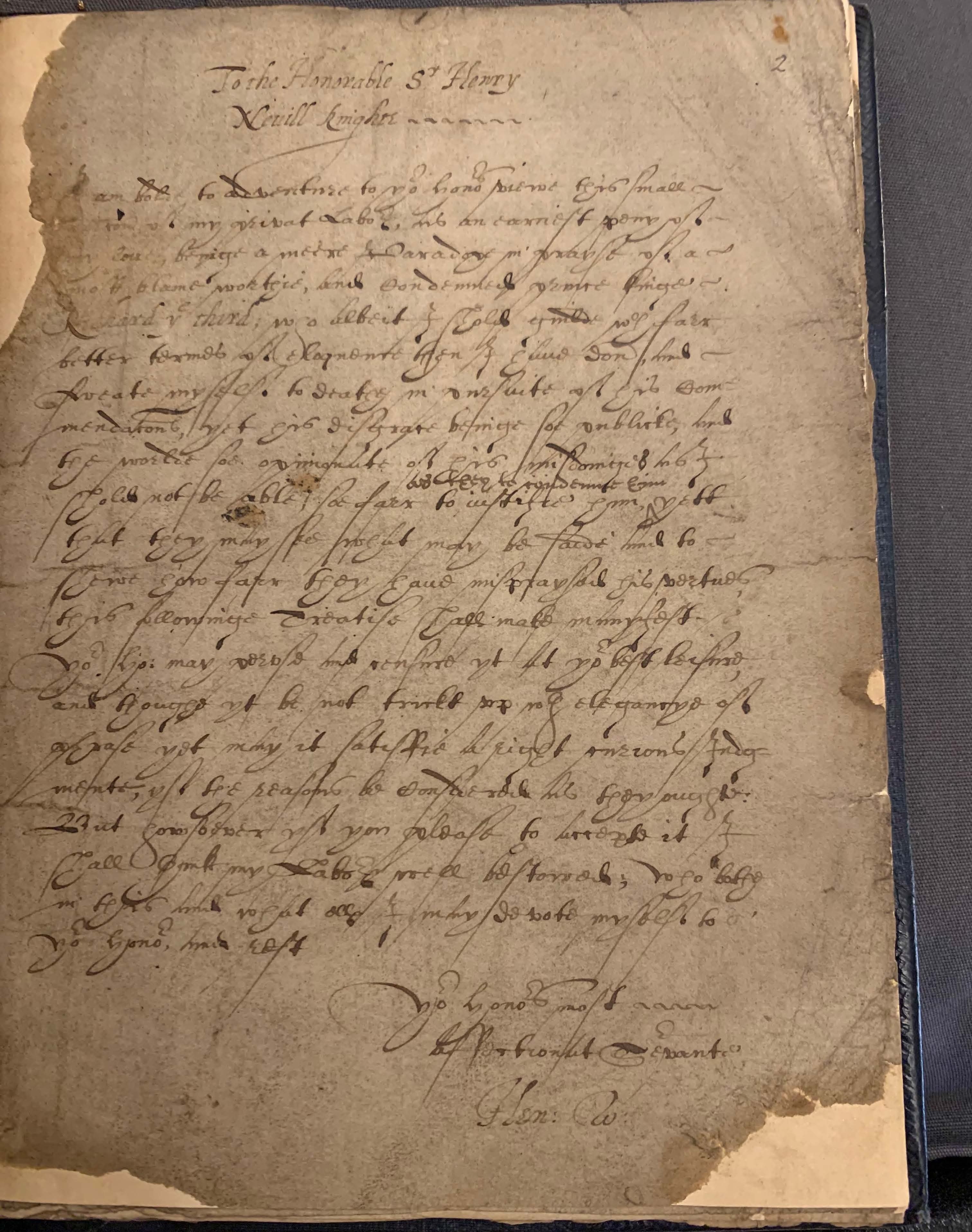
A defence addressed to Neville
The manuscript opens with an unmistakable address:
To the Honorable Sir Henry Neuill knight.
The writer offers his “private labours” as “an earnest penny of my love”—a token of his affection. His subject is a “most blameworthy and condemned prince,” whose disgrace has become so public that even an eloquent defence can scarcely prevail. Yet he wants Neville to see “what may be said” on Richard’s behalf:
Your Honour may peruse and censure it at your best leisure, and though it be not tricked up with elegancy of phrase, yet may it satisfy a right curious judgment, if the reasons be considered as they ought.
“Censure” here means judge. Neville is invited to weigh the argument. The dedication ends “Your Honour’s most affectionate servant, Hen: W:”; the initials have been identified by some with Henry Wotton and by others with Henry Wriothesley, Earl of Southampton. The identity remains unsettled.1
The essay is known as the Encomium of Richard III—an encomium being a work of praise. Its core text is attributed to William Cornwallis the younger. The two earlier versions preserve his dedication to John Donne, in full or abbreviated form. The Neville dedication belongs to the third version: the one that extends the attack to playwrights.4
Which version was dedicated to Neville?
A. N. Kincaid’s 1977 edition distinguishes three stages in the text’s development. The first survives in the Chatsworth manuscript. The Rawlinson manuscript expands it with historical examples and supporting arguments. The third makes more substantial changes to its targets and political meaning. Ramsden and Kincaid call this the “British Museum version,” after the manuscript dedicated to Neville, now British Library Add MS 29307.4
| Stage | Witnesses in Kincaid’s family tree | What changes? |
|---|---|---|
| Earlier text | Chatsworth | Cornwallis’s defence, dedicated to John Donne, attacks a hostile chronicler. |
| First expansion | Rawlinson | Historical examples and supporting material are added; the Donne dedication remains, with the names abbreviated. |
| Revised version | Neville manuscript; Cambridge; Huntington; two Folger manuscripts; Thorpe’s 1616 print | The attack broadens to chroniclers and playwrights. A substantial new passage puts duty to country above kinship and the interests of the ruler. |
The Neville manuscript and Thorpe’s print share the revised text, but Kincaid’s conjectural family tree gives them separate branches from a lost common source. The other manuscripts in this group contain the same substantial additions. Humphrey Dyson owned the Cambridge copy in 1611, establishing circulation during Neville’s lifetime and before Thorpe’s edition.4
Ramsden and Kincaid state the publication connection plainly:
It was substantially this revised version represented by the British Museum and associated manuscripts which was to pass into print in 1616.4
What the revised version added
John Casson drew attention to two theatrical references in the Neville manuscript. Kincaid’s collation shows where they entered the text. The first change widens the charge by replacing one target with two. The earlier text blames a single chronicler sympathetic to the Lancastrian dynasty. The revision removes “a favourer of the Lancastrian family,” makes “chronicler” plural and substitutes “and witty play-makers.” The second change comes at the end of Richard’s life: after recounting his death and the humiliation of his corpse, the revised essay adds that pamphlets and plays continue the injury to his name.
| Passage | Chatsworth and Rawlinson | The revised version, including Neville’s manuscript and Thorpe’s print |
|---|---|---|
| Who has misrepresented Richard? | “an indiscreet chronicler, a favourer of the Lancastrian family” | “indiscreet chroniclers and witty play-makers” |
| How does the attack continue after his death? | No reference to pamphlets or plays at this point. | A new clause complains that Richard is still made infamous in “pamphlets and plays.” |
The first passage sets the writers’ hostile accounts against Richard’s “laws and actions,” presented as the better witnesses to his government. The second makes the theatre an agent of continuing punishment: the king has been killed and his body abused, but his reputation is still being attacked. In the Neville manuscript it reads:
but that we must still make him more cruel infamous in pamphlets and plays.
Thorpe’s print preserves the same clause, reading “cruelly” for the manuscript’s “cruel.” The two theatrical references entered the essay at the same stage of revision; both survived into print.2,4
Neville is the named recipient of a defence that challenges Richard’s portrayal on stage, although its attacks identify neither Shakespeare nor a particular play.
The political additions
The same revision also sharpens the essay’s political argument. A substantial insertion declares that duty to one’s country outweighs ties of kindred and friendship, and that the public good takes precedence over the person appointed to govern:
the weal public is more to be regarded, than a person or magistrate that thereunto is ordained.
Ramsden and Kincaid read this as an intervention in the politics surrounding the Essex rising. More specifically, they suggest that the appeal to put country above kindred was directed at Neville, a kinsman of Robert Cecil whom the conspirators hoped to draw into their plans. They conjecture that “Hen. W.” was Southampton; the identity remains unsettled, but their argument draws attention to the political force of the changes in the version dedicated to Neville.
The insertion is politically daring in its original setting. It invokes the public good to justify Richard’s killing of the princes. Yet the inherited text also insists that subjects cannot adequately judge kings. Ramsden and Kincaid see this tension as evidence of a defence being adapted to a new political purpose. Neville was being asked to judge a work whose revisions challenged both the received portrait of Richard and the obligations owed to rulers.5
Thomas Thorpe’s edition, 1616
Thorpe published the revised defence as “The Prayse of King Richard the Third,” the opening essay in Essayes of Certaine Paradoxes. His imprint supplies the date, 1616: seven years after he published the Sonnets, and one year after Neville died.2,3
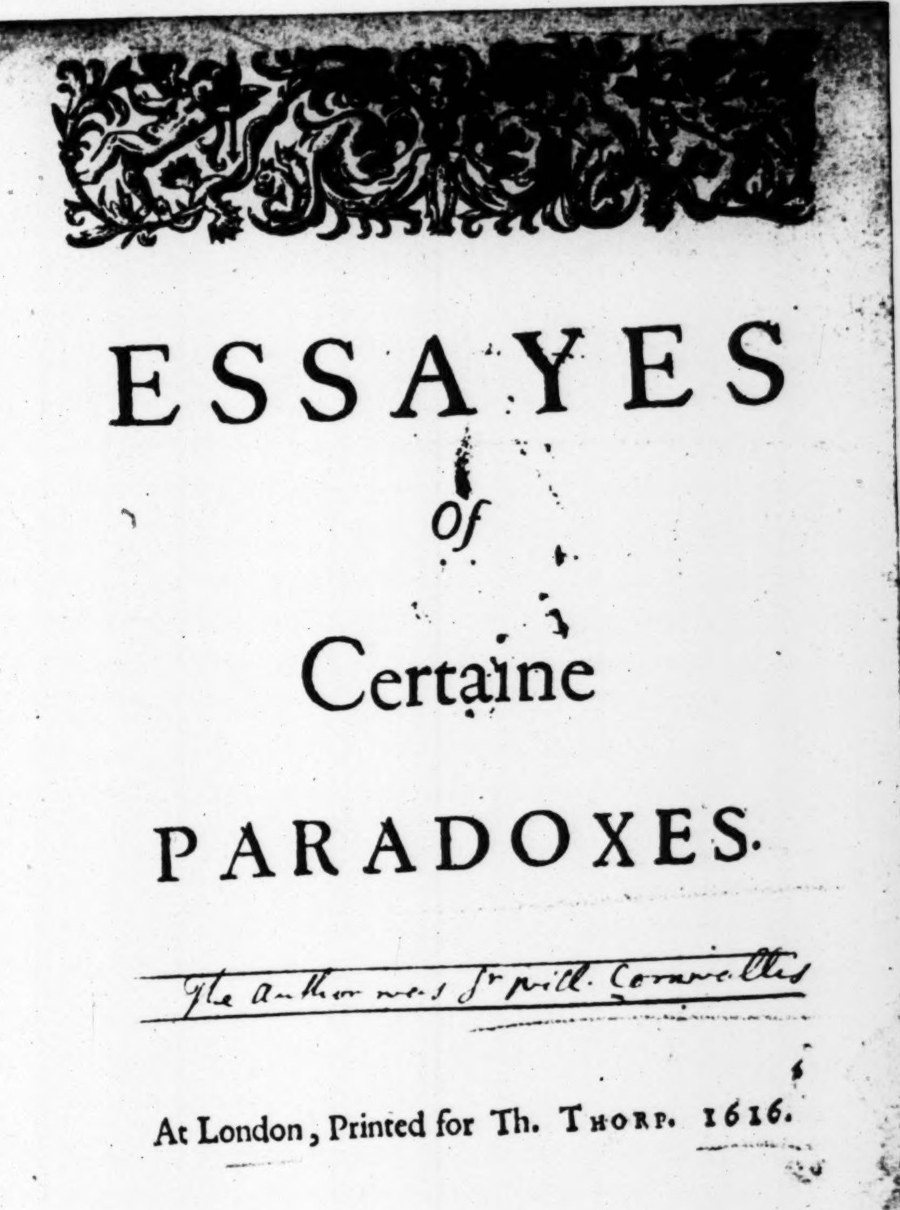
The printed book omits the Neville dedication but preserves both attacks on theatrical representations. The publisher of the Sonnets thus printed the revised version that also survives in a manuscript dedicated to Neville.
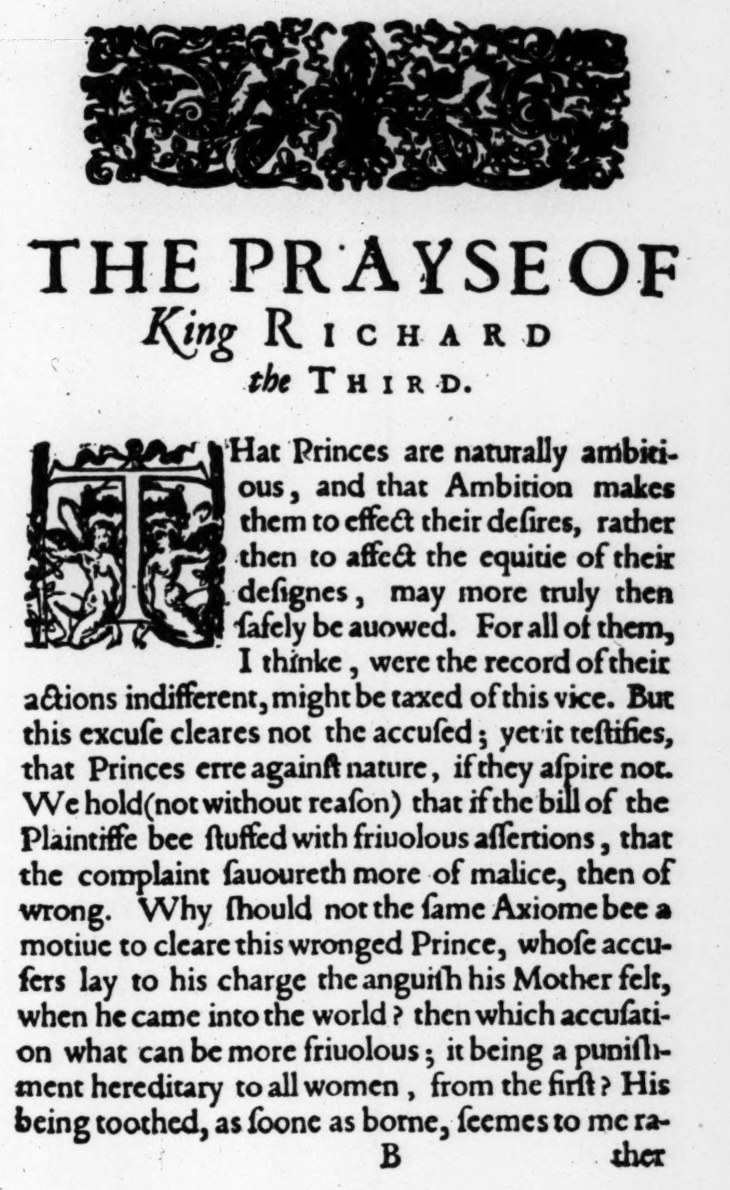
The revised version makes its paradoxical character explicit. A paradox here is an argument that deliberately challenges received opinion: the essay even turns accusations about Richard’s birth and bodily deformity into points in his favour. The earlier Chatsworth and Rawlinson versions lack the closing disclaimer. The revised version shared by Neville’s manuscript and Thorpe’s print adds it: “yet for all this know I hold this but a Paradox,” in the printed wording. Neville’s dedication also calls the work “a mere paradox.”4,1
Christopher Brooke and the unnamed dramatist
Christopher Brooke, a writer linked to Neville’s political and literary circle, praised the dramatist who had put Richard III on stage. In his 1974 study of Neville’s political career, the historian Owen Duncan groups Brooke and Neville with John Hoskyns and Richard Martin among the parliamentary opposition to the court. The Convivium Philosophicum also lists Brooke alongside Sir Henry Neville, Donne and other members of that circle.6
In The Ghost of Richard the Third (1614), Brooke’s Richard praises the writer who had already brought his story to the stage:
To him that Impt my Fame with Clio’s Quill;
Whose Magick rais’d me from Obliuions den;
That writ my Storie on the Muses Hill;
And with my Actions Dignifi’d his Pen:
He that from Helicon sends many a Rill;
Whose Nectared Veines, are drunke by thirstie Men:
Crown’d be his Stile, with Fame; his Head, with Bayes;
And none detract, but gratulate his Praise.Yet if his Scoenes haue not engrost all Grace,
The much fam’d Action could extend on Stage;
If Time, or Memory, haue left a place
For Me to fill; t’enforme this Ignorant Age;
To that intent I shew my horrid Face;
Imprest with Feare, and Characters of Rage:
Nor Wits, nor Chronicles could ere containe,
The Hell-deepe Reaches, of my soundlesse Braine.7
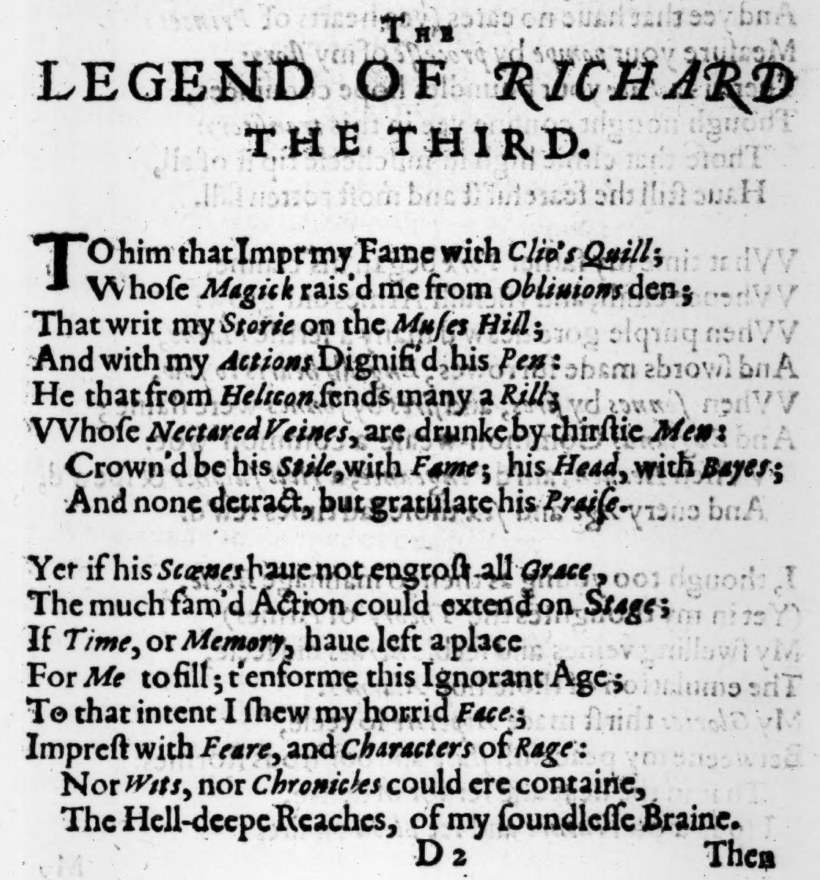
Brooke praises the dramatist who raised Richard from “Oblivions den” without naming Shakespeare. “Clio’s Quill” invokes the Muse of history; Helicon, the Muses’ mountain, supplies the streams of poetry. His turn from the writer’s “Pen” to “Scoenes” and action “on Stage” makes the theatrical tribute explicit. A writer linked to Neville’s political circle thus celebrates the author of the staged Richard III before offering his own continuation.6,7
Brooke’s poem appeared in 1614, while Neville was alive; Thorpe’s Paradoxes followed in 1616, the year after his death. The two works adopt different rhetorical stances towards Richard’s reputation: Brooke crowns the dramatist with fame and bays, while the Neville-dedicated version of the Encomium attacks the “witty play-makers” who helped blacken the king’s name.2,7
Notes and sources
For the proposed identifications as Henry Wotton and Henry Wriothesley, Earl of Southampton, see Ramsden and Kincaid, introduction, pp. vi–vii. British Library, Add MS 29307, dedication of the Encomium of Richard III. See also the appendix transcription (p. 33) headed “Dedication of MS. Additional 29307” in William Cornwallis, The Encomium of Richard III, ed. A. N. Kincaid, introduction by J. A. Ramsden and A. N. Kincaid (London: Turner & Devereux, 1977), edition catalogue.↩︎
[William Cornwallis], Essayes of Certaine Paradoxes (London: printed for Thomas Thorpe, 1616), “The Prayse of King Richard the Third,” beginning sig. B1r; STC 5779, ESTC S105004, TCP A19354. Complete 1616 scan; TCP text. Title and opening images are Archive leaves n0 and n4.↩︎
Shake-speares Sonnets (London: George Eld for Thomas Thorpe, 1609); first-edition witness and publication history, Shakespeare Documented.↩︎
Ramsden and Kincaid, Encomium, introduction pp. iv–x; text and apparatus pp. 15–15a and 32–32a. The earlier witnesses are Chatsworth (Hardwick MS 44) and Bodleian Rawl. D. 718. The independently collated later group comprises Cambridge St John’s MS I.33, Huntington HM 199, Folger V.b.303 and V.a.132, British Library Add MS 29307, and the 1616 print. The conjectural tree (p. x) places the Neville manuscript and print on separate branches of a lost common source; it does not identify the surviving manuscript as the printer’s copy. The quoted publication statement is on p. vi; Cambridge’s 1611 ownership is on p. viii. Stowe 268 is an eighteenth-century copy of Folger V.a.132, excluded from independent collation. The final “Paradox” sentence is also marked as an addition on p. 32. The theatrical variants appear at pp. 15a and 32a, the latter recording “cruelly] Cruell A.” Prose quotations modernize spelling while preserving that difference and the dedication’s spelling of Neville’s name; Brooke’s verse retains printed spelling. Bold emphasis is added here and does not reproduce Kincaid’s typographical apparatus. John Casson discusses the two references in “The Earl of Southampton, Richard III, Shakespeare and Henry Neville”, p. 5.↩︎
William Cornwallis the younger, The Encomium of Richard III, ed. A. N. Kincaid, introduction by J. A. Ramsden and A. N. Kincaid (London: Turner & Devereux, 1977), pp. 18–20 and facing apparatus; introduction, pp. v–vii, edition record. The quotation follows Kincaid’s edited text, p. 19, not a diplomatic transcription of Add MS 29307. The public-good argument is a later addition within a defence that also asserts princely privilege. The identification of “Hen. W.” with Southampton and the pre-rising presentation scenario are the editors’ conjectures, pp. vi–vii; the rising was in February 1601 in modern year numbering. Alison Hanham, review, The Ricardian 4, no. 60 (March 1978), pp. 23–26, especially pp. 25–26, review, stresses the work’s paradoxical genre rather than treating its praise as straightforward rehabilitation.↩︎
Owen Lowe Duncan, Jr., The Political Career of Sir Henry Neville: An Elizabethan Gentleman at the Court of James I (Ph.D. dissertation, Ohio State University, 1974), pp. 227–228, OhioLINK dissertation. This is Duncan’s explicit political grouping, not a contemporary statement of a private alliance. Michelle O’Callaghan, “‘Talking Politics’: Tyranny, Parliament, and Christopher Brooke’s The Ghost of Richard the Third (1614),” The Historical Journal 41, no. 1 (1998), pp. 97–120, especially pp. 102–106, article, gives the Convivium company and parliamentary setting. Its name-list says Sir Henry Neville; the identification with Billingbear rather than his namesake remains a separate question.↩︎
Christopher Brooke, The Ghost of Richard the Third (London: George Eld for Laurence Lisle, 1614), “The Legend of Richard the Third,” sig. D2r, STC 3830, TCP A16936, printed page. The passage praises an unnamed dramatist; Shakespeare’s proper name is absent. Lisle, not Thorpe, published Brooke’s book.↩︎