Oxford and departure
In The Taming of the Shrew, Lucentio arrives in Padua to study:
LUCENTIO
Tranio, since for the great desire I had
To see fair Padua, nursery of arts,
[…]
Here let us breathe and haply institute
A course of learning and ingenious studies.
— The Taming of the Shrew, 1.11
Like Lucentio, Henry Neville came to Padua on his own educational journey. He matriculated at Merton College, Oxford, on 20 December 1577, but his time there was probably brief. He received a licence to travel abroad in April 1578 and began his continental journey with Savile that year. The exact departure date is unknown; the journey lasted about four years.23
Savile, his Oxford tutor, was then in his late twenties. Born in 1549, he had become a fellow of Merton in 1565 and established his reputation in mathematics and astronomy before Neville arrived. The historian of science Mordechai Feingold, in The Mathematicians’ Apprenticeship (1984), describes him as “one of the most influential intellectual figures at Oxford in the period after 1570.” His lectures of 1570–75 covered the history of Greek mathematics as well as astronomy.4
Our most detailed records of the trip cover 1580–82, when letters and a companion’s diary follow the company through Germany and Central Europe into Italy, connecting Neville with astronomers, collectors, private libraries and the book trade.5 Some records name Neville directly; others concern Savile. This account assumes that Neville generally accompanied his tutor, though their movements were not necessarily identical at every stage.
Paris was an early destination. The historian of mathematics Robert Goulding dates Savile’s meeting with Joseph Scaliger, the classical scholar and historian of ancient chronology, to 1579. Andreas Dudith later recalled that Savile had seen François Viète’s Canon mathematicus in Paris while it was still in the author’s hands. Viète was a French mathematician whose work helped develop symbolic algebra; the Canon concerns trigonometry and its tables. By August 1580 Savile was corresponding with Johannes Praetorius, a mathematician and astronomer teaching at Altdorf near Nuremberg.6
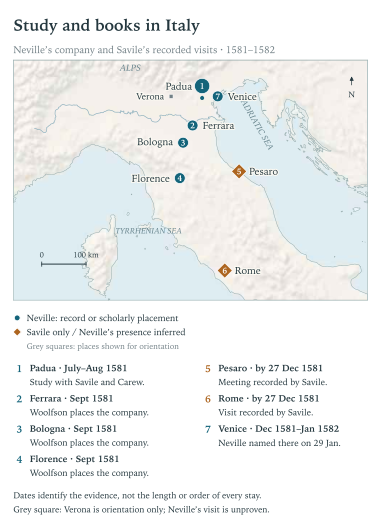
The overview map locates the principal places mentioned in the journey. Its numbered entries give dates and distinguish Neville’s recorded or scholarly placements from evidence concerning Savile or an inferred visit.
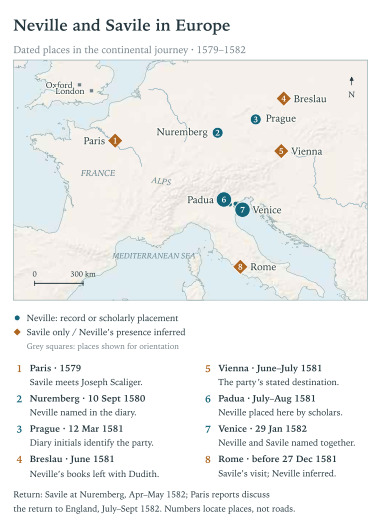
The travelling company
Arthur Throckmorton (c.1557–1626), son of Sir Nicholas Throckmorton, Elizabeth’s former ambassador to France, kept the diary that provides our closest view of the travelling company.
On 10 September 1580, at Nuremberg, Throckmorton listed Robert Sidney, Henry Neville and Savile among his companions. The destination appears below the entry as “Noromberg.”7
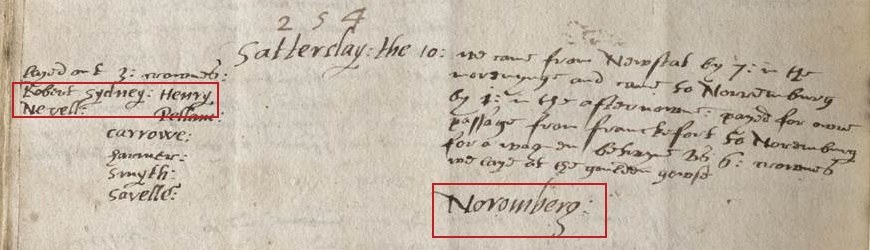
Neville’s travelling companion Robert Sidney was the younger brother of the poet Philip Sidney. Robert joined the company in 1580 for the German journey to Prague. Writing to Robert on 18 October 1580, Philip encouraged him to remain with Savile and study alongside Neville:
I have written to Mr Savile. I wish you kept still together; he is an excellent man; and there may, if you list, pass good exercises betwixt you and Mr Neville; there is great expectation of you both.
“List” means wish or choose. Later in the same letter, Philip sent his greeting to the company:
Commend me to Master Neville, Master Savile, and honest Harry Whyte, and bid them be merry.8
Ten days later, on 28 October, their father Sir Henry Sidney wrote to Robert about Neville’s father:
There can be no greater love than of long time hath been, and yet is, between Sir Harry Neville and me, and so will continue till our lives end. Love you those we have done, and do.
In another letter, dated to late 1580 by Robert Shephard and Noel Kinnamon in their 2007 article on the Sidney family correspondence, Sir Henry welcomed Robert’s friendship with the younger Neville and Savile:
I hear you are fallen into consort and fellowship with Sir Harry Neville’s son and heir, and one Master Savile. I hear of singular virtues of them both. I am glad of your familiarity with them.8
Robert and Philip Sidney’s sister was Mary Sidney Herbert, Countess of Pembroke, the poet and translator. Her sons were William Herbert, Earl of Pembroke, and Philip Herbert, Earl of Montgomery—the brothers to whom Shakespeare’s First Folio was dedicated in 1623. Neville’s travelling companion was their uncle. Chapter 49 follows Neville’s own dealings with William Herbert, including the political reconciliation he helped arrange in 1612.8
Robert was himself a substantial poet. His autograph notebook, now British Library Add MS 58435, contains sonnets, songs and other verse, with revisions and competing arrangements. Addressed to his sister, the Countess of Pembroke, the collection seems to have remained, as Hilton Kelliher and Katherine Duncan-Jones observe, “almost unknown outside the family circle at Penshurst and Wilton.” His daughter Mary Wroth’s imitations of his songs offer evidence of its life within the family. Its copying postdates the journey, but it illustrates how extensive poetic writing could circulate within a literary household while remaining scarcely visible to the wider public.9
George Carew (c.1556–1612), of Antony in Cornwall and later an ambassador, was travelling with Neville and Savile by September 1580, as the classical scholar Robert B. Todd records in his 1996 article “Henry and Thomas Savile in Italy.” Carew was the younger brother of the antiquary Richard Carew (1555–1620), author of The Survey of Cornwall, and uncle of Richard Carew the younger (c.1580–1643), who would accompany Neville to France. The elder Richard’s writing returns in the discussion of The Merry Wives of Windsor in Chapter 25.10
Carew shared Savile’s mathematical interests. Jonathan Woolfson reconstructs their Italian journey from Throckmorton’s diary in Padua and the Tudors: English Students in Italy, 1485–1603 (1998), drawing out the language lessons, book purchases, manuscript work and observations of civic life that accompanied their travels.
Robert Sidney’s letter of 1 November records his arrival at Prague the previous day, after a journey through Ingolstadt, Augsburg, Munich and Regensburg. The family letters establish Neville’s association with Robert; the intermediate stops belong to Robert’s explicit itinerary and provide the likely course of the group’s movement.11
Astronomy in 1581
At Breslau Savile joined the circle of Andreas Dudith, a Hungarian humanist, diplomat and former bishop who had become Protestant. Dudith was a patron and keen student of mathematical scholarship, bringing specialists into his household and seeking their help with difficult texts. In Prague, the physician and astronomer Tadeáš Hájek, known in Latin as Thaddaeus Hagecius, was studying comets. In 1581 Hagecius published a book about comets at Görlitz, Apodixis Physica et Mathematica de Cometis. Its opening pages print a letter from Andreas Dudith to Hagecius, dated Breslau, 1 February 1581. Dudith praises Savile’s learning in philosophy, mathematics and languages, and sends greetings from Savile and the astronomer Paul Wittich. He then asks Hagecius to greet Robert Sidney and Henry Neville on his behalf, praising the two young Englishmen for their learning and character. Wittich had spent several months with Tycho Brahe at his observatory in 1580 and was now working with Savile at Breslau (see Appendix I).12
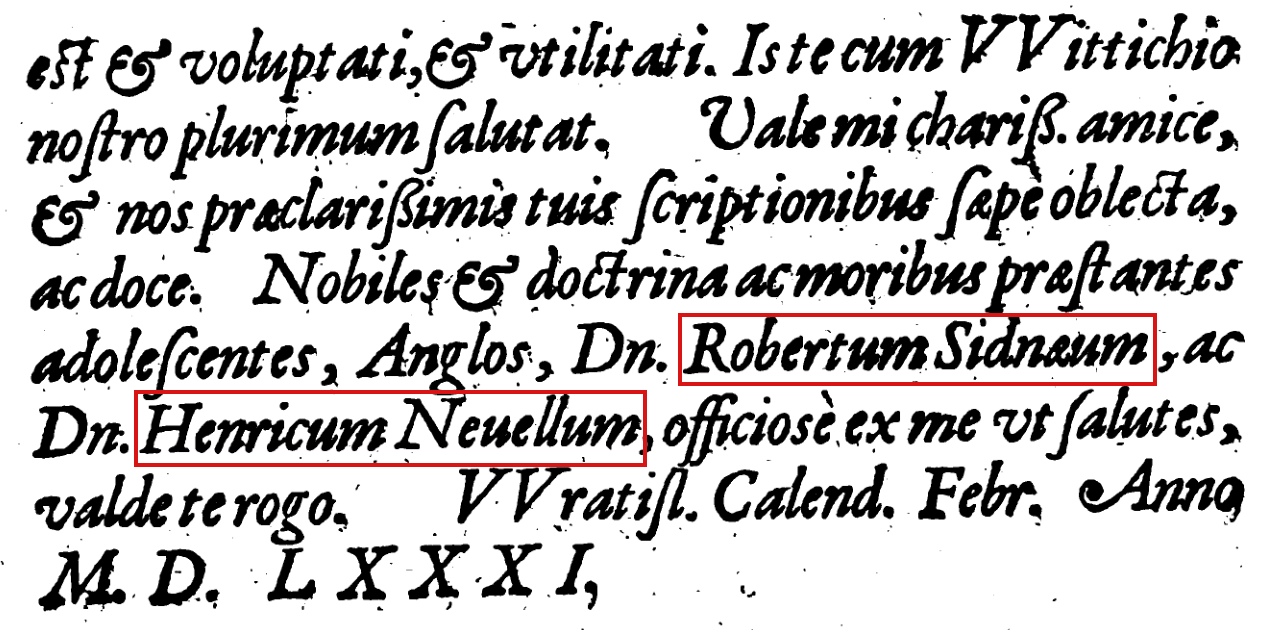
The book also contains Hagecius’s own address to Dudith. Here Hagecius recalls Savile visiting while he was writing about the comet. They discussed his work, and Savile shared his own knowledge so generously that Hagecius described the visit as both pleasant and especially useful. Having examined the work, Savile could explain it to Dudith.
By early February 1581 the travellers were temporarily apart: Savile was with Dudith at Breslau, while Robert Sidney and Neville were visiting Prague. On 4 February Dudith wrote to Hájek in Prague, reporting that Savile wondered why his English companions had not written. The editors identify those companions as Sidney and Neville.13
Throckmorton’s diary names the three companions together again on 12 March 1581: “R:S: H:N: and A:T:” — Robert Sidney, Henry Neville and Arthur Throckmorton.14
Introductions to libraries: Vienna
Dudith’s letters show the party preparing to move on. On 13 June 1581 he reported that Savile was getting ready to leave as soon as the English gentlemen arrived; the edition identifies them as Sidney and Neville. Nine days later Dudith wrote to Johannes Sambucus, the imperial historian and collector, introducing Savile and naming the two young men accompanying him. Dudith described Neville as coming from “the most ancient and illustrious family of the Nevilles, of the Red Rose.” Both young men, he added, were learned and modest. The recommendation was intended to open Sambucus’s library.15,16 Dudith also raised delays in publishing mathematical books from Sambucus’s collection, saying Savile could explain the problem further.16
On 27 June Dudith reported that Savile and his companions had departed for Vienna three days earlier. Todd associates Savile and Carew with manuscript copying at Vienna in 1581, supporting the scholarly purpose of the journey without independently placing Neville there.17 In his own letter of 18 July, Dudith was impatient for news. Where was Savile with his admired company? Why had no letter arrived? He sent greetings to Neville and asked after John Chamber, another mathematician from their English circle.18
Dudith writes to Neville
On 7 August 1581 Dudith wrote from Breslau to Neville, answering a letter Neville had sent him. He addressed him as “my most noble and equally most lovable Neville”—mi nobilissime idemque amabilissime Nevelle—and praised his gracious and complimentary letter. Dudith then asked him to put Henry Savile to work:
Excita, rogo te, maiorem in modum atque acrius stimula Savile ut mihi aliquid elaboret in obscura loca veterum mathematicorum et Copernicum veteribus comparandum aut, si credendum est Wittichio, anteponendum.
Rouse Savile, I ask you, and urge him still more strongly to prepare something for me on the obscure passages of the ancient mathematicians, and on Copernicus, who should be compared with the ancients—or, if Wittich is to be believed, preferred to them.19
Copernicus had proposed a moving Earth and a Sun-centred arrangement of the planets. Dudith was asking Neville to encourage Savile’s work on this comparison. Dudith also wanted instructions about books Neville had left at Breslau:
De libris tuis, quos hic reliquisti (de quo tibi magnam gratiam habeo), monebis quid fieri velis.
Concerning your books, which you left here (for which I am very grateful to you), you will tell me what you wish done.19
He asked Neville and Savile to find mathematical or philosophical works he had not seen, whether manuscripts in a library or printed books. He named works by Maurolico and Commandino and said he had long wanted to see Jean Borrel (Buteo)’s geometrical study of Noah’s Ark.19
The books Neville had left with Dudith indicate an earlier stay at Breslau; the letter’s dateline does not locate Neville there on 7 August.20
Dudith still missed Savile in December 1585. Writing to Hájek, he asked him to consult John Dee about finding another accomplished mathematician willing to live with him. He offered an annual salary, plentiful books and leisure: these studies needed “a companion and an encourager.”21
Padua and the search for books
Padua already belonged to the family’s history. Thomas Hoby records arriving there on 23 August 1554 and meeting Sir Henry Neville, the ambassador’s father, among the English company that included John Cheke and Thomas Wroth. Twenty-seven years before the son’s arrival at Padua with Savile, his father had been in the same Italian city during Mary’s reign.22
The younger Neville was at Padua in the summer of 1581. Will Tosh’s study of Anthony Bacon’s correspondence reports that Nicholas Faunt named him among the English there in a letter of 8 July. Woolfson, following Throckmorton’s diary, places Neville, Savile and Carew with Throckmorton in August and the group at Ferrara, Florence and Bologna in September. These accounts suggest Neville was in Padua earlier than the August meeting, but do not establish the dates or continuity of his stay.3
Padua was a university city whose scholarly life extended into private houses and collections. On 10 September Dudith urged Savile, if he came to Padua, to seek the friendship of Gian Vincenzo Pinelli, originally from Naples, together with Neville. He explained what Pinelli could offer:
Besides his other possessions, he has an excellent library of books of every kind and many manuscripts, which he will not withhold from you.23
Dudith also recommended Melchior Guilandinus, director of the botanical garden. His letter records proposed visits; it does not date the travellers’ arrival or departure.
Dudith had also sent greetings for Neville on 1 September, in a letter discussing objections to Copernicus.24 Savile’s dealings with Pinelli produced material results. Todd traces the copying and exchange of mathematical and philosophical manuscripts between their collections. Pinelli’s scribe copied texts for Savile; Savile left work and correspondence with Pinelli.17
Throckmorton’s diary gives the educational journey its everyday texture. At Padua he paid for Italian and lute lessons and bought Piccolomini’s natural philosophy; at Venice he bought Italian versions of Livy and Josephus, and at Florence histories of the Este family and Padua. He also noted the election of the university rector by the counsellors of its twenty-three nations. These are Throckmorton’s activities, illustrating the opportunities available to the travelling companions.25
Savile’s commonplace book records a parallel interest in government, religion, commerce, revenue, warfare, foreign relations and customs. Much of its material is in Italian, drawn from histories and the reports of Venetian diplomats and travellers. Woolfson associates it with Savile’s Italian travels, although some material may have reached him afterwards.25
The opening of The Taming of the Shrew belongs to this educational world. Lucentio arrives with his father’s approval and his servant Tranio, whose reply ranges through Aristotle, Ovid, rhetoric, music, mathematics and metaphysics.1 The plays’ Italian geography extends further: The Two Gentlemen of Verona sends its young men from Verona to Milan, while Romeo and Juliet makes Verona its centre and Mantua Romeo’s place of exile.26 Venice supplies the Venetian scenes of The Merchant of Venice and the opening of Othello.
Chapter 19 returns to Padua through Katherine Cooke, Henry Killigrew and the learned sisters of The Taming of the Shrew.
Study, illness and the return from Rome
Writing to Dudith on 24 November 1581, Wolfgang Zündelin, a member of his scholarly circle, expressed concern about Savile’s journey to Rome:
I wish his journey to Rome all the more success because of the greater danger that Englishmen face there nowadays. He has certainly taken every precaution that could be expected of a prudent man.27
Immediately afterwards, Zündelin reported that Neville had been writing to Dudith but had been prevented by illness. He described headaches attributed to bowel obstruction and said Neville had recovered after several days; a fever had been feared. He blamed the episode on nimiis laboribus, excessive work, and Neville’s infinita cupiditas, his boundless desire to learn everything. A second letter, to Nicolaus Rehdiger on 1 December, reported a relapse with smallpox and fever, under the care of the physician Girolamo Donzellini.27
Donzellini helped Dudith obtain books as well as practising medicine, placing Neville’s care within the same learned circle.
Savile certainly visited Rome during the Italian journey. On 27 December 1581 he wrote to Dudith from Venice:
When I had returned to Venice from my journey to Rome, your letters were delivered to me.28
The same letter describes Arabic mathematical manuscripts he had seen at Rome, including a work attributed to Archimedes and seven books of Apollonius’s Conics. Neville’s illness may have affected his participation; whether he accompanied Savile to Rome is unknown.2728
On 29 January 1582 Dudith supplied a firm location. Savile, he told Hagecius, was now in Venice with Neville—nunc Venetiis est cum Nevello. Dudith missed the stimulus Savile had brought to their mathematical studies.29
The journey home
Verona and the road north. Thomas Hoby’s account of his brother’s 1555 journey shows that Verona could be a stop on the road from Padua through Trent and Innsbruck. It was one possible route north for Neville and Savile, whose precise itinerary is unrecorded.22
On 20 April 1582, Alvise Lullini wrote to Savile from Venice, addressing the letter to him at Nuremberg. His opening describes his own stay at Verona, not Neville’s presence there. He began, in translation:
I did not long for you so impatiently while I was in Verona as I do now, having returned to Venice […]

The letter recalled their delightful conversations, promised help finding rare books, and described agents in Candia sending copyists to Patmos. It closed:
My greetings to Mr Neville.30
Savile was at Nuremberg by 15 May 1582.31
Writing from Paris on 29 July 1582, David Graham of Fintry named “il Signor Saviello” and “il Signor Noviello”—Savile and Neville—and reported their plan:
They intend to go to England within a few days.31
Graham does not say where they were when he wrote.
On 21 August 1582, Sir Henry Cobham, the English ambassador in Paris, wrote to Francis Walsingham:
There is also one Philippo Pigafetta of Vinsentia, a philosopher, who hath likewise given me to understand he desireth to go into England, being of young Mr Nevill’s acquaintance.32
“Young Mr Nevill” is very likely Henry Neville, who was travelling in Europe at the time.
On 17 September, Cobham returned to Pigafetta and his connection with Neville:
Il Signor Pigafetti, of whom I have written in my former letters to be the acquaintance of young Mr Nevell, is presently upon his parting towards England, together with Signor Aragon … He hath written a book of his long voyage passed in Turkey and Judea, the which he desireth her Majesty may see.32
Study with Savile: the Tacitus
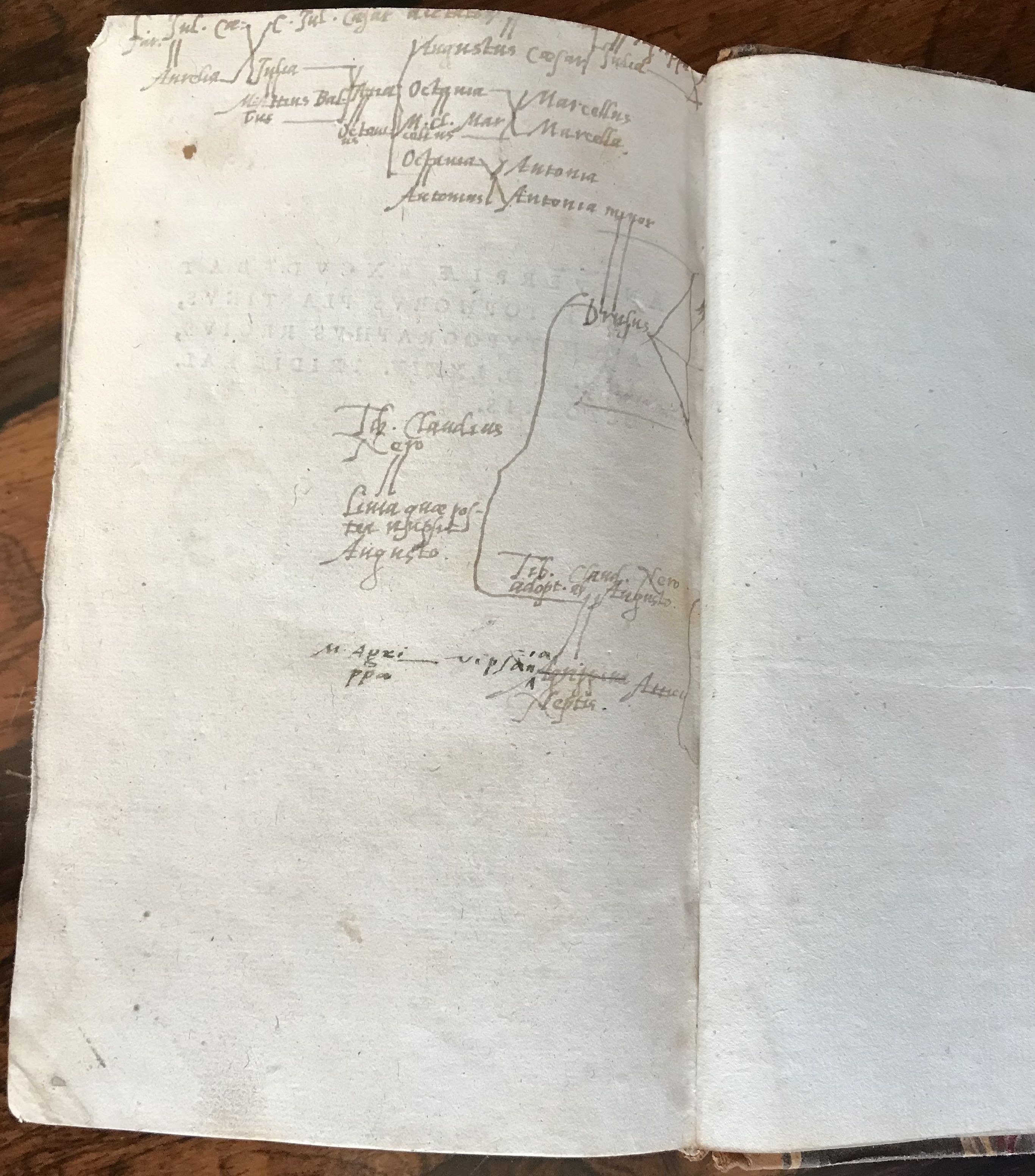
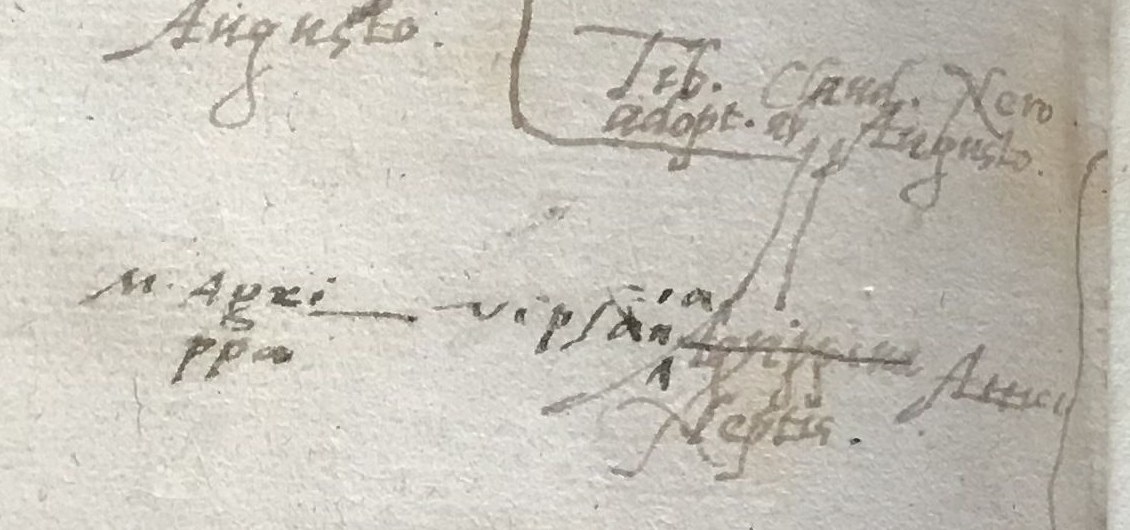
An undated imperial genealogy in the Tacitus now at Audley End offers a tangible glimpse of Neville’s study with Savile. In this 1574 edition, the principal hand is consistent with Neville’s italic writing; darker additions attributed to Savile clarify the identity and parentage of Vipsania, Tiberius’s first wife. The original “Atticus Neptis” correctly identifies her as Atticus’s granddaughter; the additions supply her name, Vipsania, and her father’s, “M. Agrippa.” The volume contains hundreds of annotations attributed to the two men, suggesting sustained work together. The intervention is undated; Chapter 16, “Tacitus in Neville’s Hands,” examines Neville’s use of Tacitus in his own writing.33
After the journey
In his Latin travel poem Iter Boreale (1583), Richard Edes names a “Nevillus” at Durham during Walsingham’s return from Scotland, describing him, in Dana Sutton’s translation, as “distinguished for his book-learning.” This may have been Henry Neville, recently returned from his travels; the identification remains unresolved, and the reference does not establish that he accompanied Walsingham into Scotland.34
On 25 August 1584, Hájek wrote to Robert Sidney that his son Simeon had returned home after visiting the Sidney family. According to Robert Shephard and Noel J. Kinnamon’s study of the correspondence, he also asked Robert to convey his greetings to Neville and Savile.35
Continental contacts continued after the travellers returned to England. In March 1588 Savile wrote to Hugo Blotius, librarian of the imperial library in Vienna, recommending his younger brother Thomas and conveying greetings from Sidney and Neville.36
Maps and dated stages
The Italian detail map and dated guide below complement the overview map near the beginning. Together they distinguish the recorded movements of Neville and his companions, the inferred route, and reports of their intended return.
The journey in dated stages
The stages below distinguish direct records of Neville from the movements of his companions. Some letters name him; others greet unnamed English gentlemen whom the editors identify as Neville and Sidney, as in Dudith’s letters of 4 February and 23 March 1581. Records of Savile’s movements alone cannot establish Neville’s presence. The guide therefore distinguishes explicit naming, editorial identification and an inferred shared route.37
1. 1579 · Paris. Goulding dates Savile’s meeting with Joseph Scaliger here to 1579. Dudith also recalled Savile seeing Viète’s Canon mathematicus in Paris before publication, without dating that encounter. These records concern Savile; they do not separately name Neville.6
2. 10 September 1580 · Nuremberg. Throckmorton’s diary names Robert Sidney, Henry Neville and Savile together.
3. 12 March 1581 · Prague. Throckmorton’s diary groups “R:S: H:N: and A:T:”, consistent with Robert Sidney, Henry Neville and Throckmorton himself.
4. June 1581 · Breslau. Dudith’s letters introduce Neville and Sidney and report Savile’s company leaving for Vienna on 24 June. Neville had left books with Dudith.
5. June–July 1581 · Vienna. The party’s stated destination. Todd associates Savile and Carew’s manuscript work with Vienna, but his publications give conflicting dates of 18 June and 18 July. This does not independently locate Neville.
6. July–September 1581 · Italy. Tosh reports Neville among the English at Padua in Faunt’s letter of 8 July. Woolfson places him with Savile and Carew there in August and the group at Ferrara, Florence and Bologna in September. The duration of Neville’s Padua stay is not established.3
7. Before 27 December 1581 · Rome. Savile’s own letter records his Roman visit, a meeting at Pesaro, and visits to Florence, Bologna and Ferrara. Neville may have accompanied him to Rome; the letter names only Savile as the traveller.
8. 27 December 1581 and 29 January 1582 · Venice. Savile wrote from Venice on 27 December after returning from Rome. On 29 January Dudith reported that Savile was there with Neville.
9. April–May 1582 · Savile in Nuremberg. Lullini addressed his letter to Savile at Nuremberg on 20 April. Todd dates Savile’s letter from Nuremberg to Pinelli to 15 May. The road north is unrecorded; Verona is a possible stop.
10. July–September 1582 · Reports from Paris. Graham’s letter of 29 July reports Savile and Neville preparing to leave for England within days. Cobham’s dispatches of 21 August and 17 September identify Pigafetta as an acquaintance of “young Mr Nevill.” These Paris reports connect Neville with the intended return and Pigafetta’s projected English visit, without establishing Neville’s location or the date of his crossing.38,32
Notes and sources
William Shakespeare, The Taming of the Shrew, 1.1, Folger Shakespeare Library, Lucentio’s opening speech. The excerpt preserves the verse lineation; the ellipsis marks the omitted lines. Neville’s documented visit to Padua is discussed later in this chapter.↩︎
For matriculation, Joseph Foster, Alumni Oxonienses, Early Series, III (Oxford, 1891), 1057. Andreas Dudith, Epistulae, pars VII, 1581–1589, ed. Nicolaus Szymański and Ida Radziejowska (Budapest: reciti, 2019), no. 1072, pp. 87–88, edition. Jonathan Woolfson, Padua and the Tudors: English Students in Italy, 1485–1603 (1998), biographical register, p. 260, entry for Henry Neville (1562–1615), citing TNA E 157/1, f. 3, for the April 1578 licence. J. R. L. Highfield, ‘An Autograph Manuscript Commonplace Book of Sir Henry Savile,’ Bodleian Library Record 7 (1963), 73–83, p. 79 nn. 3–4, records Merton’s grant of 3 April 1578 for study in France and overseas, and Savile’s presence in the college treasury on 14 April and 17 May (Merton College, Liber Aerarii, II, p. 39). The grant and licence are not departure records. Foster’s stated age of fifteen implies a birth in approximately 1561–62, earlier than the spring 1563 estimate discussed in Chapter 1. The matriculation entry names no tutor; the evidence for Savile’s role is given in the following note.↩︎
William Patrick Tosh, Testimonies of Affection and Dispatches of Intelligence: The Letters of Anthony Bacon, 1558–1601 (PhD thesis, Queen Mary, University of London, 2013), p. 53 and n. 17, thesis, citing Nicholas Faunt to Anthony Bacon, 8 July 1581, Lambeth Palace Library, MS 647, f. 110r. Tosh paraphrases the list naming Neville; the original folio has not been inspected for this account. Jonathan Woolfson, Padua and the Tudors (1998), pp. 129–130, dates the meeting with Throckmorton to August and the group’s onward travel to September. The July report precedes that meeting; the evidence does not establish an uninterrupted July–September residence. Woolfson’s approximately two-month stay concerns Faunt, not Neville.↩︎
Roger Kuin, ed., The Correspondence of Sir Philip Sidney, II (Oxford: Oxford University Press, 2012), p. 1006, n. 8, identifies Neville as a former student of Savile who was accompanying him on his continental journey; the note accompanies Philip Sidney’s letter to Robert Sidney of 18 October 1580. Mordechai Feingold, The Mathematicians’ Apprenticeship: Science, Universities and Society in England, 1560–1640 (Cambridge: Cambridge University Press, 1984), 47–48, 124–125; quotation at 124. Henry Savile and his brother Thomas both addressed Neville as their cousin: Henry in his letter of 10 May 1600 (TNA, PRO 30/50/2), and Thomas in an English note on a newsletter reverse (TNA, PRO 30/50/70/2). The probable maternal connection runs through Anne Savile, wife of Sir Henry Thwaites of Lund and daughter of Sir John Savile of Thornhill and Elizabeth Paston. Anne was probably the mother of Frances Thwaites, whose daughter Elizabeth Gresham was Neville’s mother. See J. W. Clay, “The Savile Family,” Yorkshire Archaeological Journal 25 (1920), 11; C. E. L., letter on royal descents, The Gentleman’s Magazine, February 1846, 153–154, especially 154, which describes Anne’s maternity as highly probable. Henry and Thomas belonged to the Bradley branch of the Savile family. Thomas’s accompanying note calls Neville his cousin. The newsletters are addressed to Thomas, carry Neville’s handwritten notes, and passed into the archive from Neville’s family papers. Together these establish their transmission from Thomas to Neville; Chapter 27 describes the covering note and the manuscript evidence. The precise common ancestor linking the proposed maternal line to the Bradley Saviles has not been established here.↩︎
Robert Shephard and Noel J. Kinnamon, “The Sidney Family Correspondence during Robert Sidney’s Continental Tour, 1579–1581,” Sidney Journal 25, nos. 1–2 (2007): 43–66, pp. 60–61; Jonathan Woolfson, Padua and the Tudors: English Students in Italy, 1485–1603 (Toronto: University of Toronto Press, 1998), pp. 129–131. For Arthur Throckmorton’s parentage and surviving travel diaries, see Magdalen College, Oxford, “The Life and Library of Arthur Throckmorton” (2015), https://www.magd.ox.ac.uk/blog/the-life-and-library-of-arthur-throckmorton/.↩︎
R. D. Goulding, ‘Savile, Sir Henry (1549–1622),’ Oxford Dictionary of National Biography (2004; revised 2024), sections ‘European tour’ and ‘Savile, Scaliger, and Casaubon,’ https://doi.org/10.1093/ref:odnb/24737. Andreas Dudith, Epistulae, VII, ed. Nicolaus Szymański and Ida Radziejowska (Budapest: reciti, 2019), no. 1219, pp. 453–454: Dudith to Johannes Praetorius, Breslau, 12 December 1584. Translation from the Latin; the recollection does not date the meeting. Goulding discusses this letter in ‘Henry Savile and the Tychonic World-System,’ Journal of the Warburg and Courtauld Institutes 58 (1995), p. 175 nn. 80–81. Mordechai Feingold, The Mathematicians’ Apprenticeship: Science, Universities and Society in England, 1560–1640 (Cambridge, 1984), p. 127 n. 16, cites Bodleian MS Savile 108, ff. 104–105, for the August 1580 letters. Robert B. Todd, ‘Henry and Thomas Savile in Italy,’ Bibliothèque d’Humanisme et Renaissance 58.2 (1996), 439–444, pp. 440–441. For the scholars’ identities and fields, see Anthony Grafton, Joseph Scaliger: A Study in the History of Classical Scholarship, Oxford University Press, publisher’s description; J. J. O’Connor and E. F. Robertson, “François Viète,” MacTutor History of Mathematics, University of St Andrews, including the account of the Canon mathematicus and Viète’s later algebraic notation; Martin Luther University Halle-Wittenberg, “Johann Praetorius (1537–1616)”, on his teaching of mathematics and astronomy and his appointment at Altdorf in 1576.↩︎
Arthur Throckmorton, travel diary, Canterbury Cathedral Archives, U85/38/14/1, entry for 10 September 1580; photograph supplied by the author. See also Robert B. Todd, “Henry and Thomas Savile in Italy,” Bibliothèque d’Humanisme et Renaissance 58 (1996), pp.439–444, at p.440.↩︎
Robert Shephard and Noel J. Kinnamon, “The Sidney Family Correspondence during Robert Sidney’s Continental Tour, 1579–1581,” Sidney Journal 25, nos. 1–2 (2007): 43–66, especially pp. 50, 57 and 64–65; Penshurst Papers, U 1475 Z53/26 (28 October 1580), Z53/22 (composite transcript), and C7/8 (18 October 1580). Quotations modernize spelling. Their analysis separates the late-1580 material from a March 1579 letter combined with it in an eighteenth-century transcript. Margaret P. Hannay, “Mary Sidney Herbert, Countess of Pembroke (1561–1621)” (2000), The Sidney Homepage, University of Cambridge, supplies the sibling relationships and her sons’ identities. For the two sons as dedicatees of the 1623 First Folio, see Folger First Folio 24. Philip’s advice about Savile and Neville: Roger Kuin, ed., The Correspondence of Sir Philip Sidney, vol. II (Oxford: Oxford University Press, 2012), p. 1006, letter to Robert, 18 October 1580; copy, Penshurst Papers, U 1475 C7/8.↩︎
Hilton Kelliher and Katherine Duncan-Jones, “A Manuscript of Poems by Robert Sidney: Some Early Impressions,” British Library Journal 1.2 (1975), pp. 107–144, especially pp. 107–108, 113–115; journal bibliography. Their tally is thirty-five complete sonnets, not sixty-six sonnets: sixty-six is the sum of the complete poems across the listed forms. The unfinished crown is discussed separately. Their 1596 proposal concerns transcription into this notebook, not the dates of composition of every poem. British Library, Add MS 58435 catalogue, records the autograph collection with revisions and the direction to the Countess of Pembroke. Peter Beal, “Robert Sidney,” Catalogue of English Literary Manuscripts, records full publication in 1981 and 1984. The autograph identification follows the scholars and catalogues. No evidence cited here establishes when Neville read any of these poems.↩︎
Robert B. Todd, “Henry and Thomas Savile in Italy”, Bibliothèque d’Humanisme et Renaissance 58 (1996), pp.439–444, at p.440. Todd places Carew, Neville and Robert Sidney with Savile at Nuremberg in September 1580. This supports shared travel, without establishing that Carew left England with Neville and Savile in 1578. George Carew’s identity and relationship to the elder Richard: Westminster Abbey, “Sir George Carew”. W. J. Jones, “Carew, Sir George (c.1556–1612),” Oxford Dictionary of National Biography (2004), as cited in the William & Mary Law Library account; Paul Hunneyball’s History of Parliament entry gives c.1560 instead. For Richard the younger (c.1580–1643), see Historic England, Antony, list entry 1000647. For Richard the younger’s own account of being sent to France with Neville to learn French, see his section in Samuel Hartlib, The True and Readie Way to Learne the Latine Tongue (London, 1654), pp. 45–49, especially p. 46; Wing H1002, ESTC R19399, EEBO-TCP A42982.↩︎
Robert B. Todd, “Henry and Thomas Savile in Italy,” Bibliothèque d’Humanisme et Renaissance 58, no. 2 (1996): 439–444, p. 440; Report on the Manuscripts of Lord De L’Isle & Dudley Preserved at Penshurst Place, II (London: HMSO, 1934), pp. 94–96, Robert Sidney to his father, 1 November 1580.↩︎
Thaddaeus Hagecius ab Hayck, Apodixis Physica et Mathematica de Cometis (Görlitz: Ambrosius Fritsch, 1581), preliminary letter from Dudith, dated Breslau, 1 February 1581, and Hagecius’s address to Dudith, sig. B2r. The praise of Savile and of Sidney and Neville has different grammatical subjects. For Wittich’s visit to Tycho and his work with Savile, see Robert Goulding, “Henry Savile and the Tychonic World-System”, Journal of the Warburg and Courtauld Institutes 58 (1995), 152–179, pp. 155–156, 163–175; discussed more fully in Appendix I.↩︎
Andreas Dudith to Tadeáš Hájek, Breslau, 4 February 1581, Epistulae, VII, no. 1041, pp. 40–41, especially p. 41, lines 21–22 and n. 14, critical edition. Dudith reports Savile’s surprise that his compatriots remain silent; the names Robert Sidney and Henry Neville, and their presence at Prague, are supplied by the editors in n. 14. The letter does not name them individually.↩︎
Arthur Throckmorton, diary, Canterbury Cathedral Archives, U85/38/14/1, entry headed “Sunday the 12,” 12 March 1581 (1580/81 in English year reckoning), manuscript page numbered 59. The quotation reproduces the initials only; the wording of the subsequent exchange with their host requires further transcription. Hana Ferencová, “Na cestě po Evropě,” Folia Historica Bohemica 33.1 (2018), 169–188, p. 180 nn. 55–56, prints the initials “R: S:, H: N: and A: T:”. Their expansion as Robert Sidney, Henry Neville and Throckmorton is interpretative; her preceding note suggests a different expansion of R.S. Her f. 60r reference differs from the visible page number 59. Published issue.↩︎
Dudith, Epistulae, VII, nos. 1055–1056, pp. 59–62. In no. 1055, the arrival is prospective; the identification of the English gentlemen is the editors’, n. 15. The family description is in no. 1056, p. 62: “ex antiquissima et illustrissima Nevellorum, Rosae Rubrae, familia.” Translation here; “of the Red Rose” preserves Dudith’s wording.↩︎
Dudith to Johannes Sambucus (János Zsámboky), 22 June 1581, Epistulae, VII, no.1056, pp.61–62, especially p. 62; compare the books left at Breslau in no.1072, pp.87–88. The commendation is not evidence that Sambucus actually admitted the party to his library. On the proposed printing arrangements, see p. 62, lines 17–21 and nn. 6–7: “Oro te ut eos retrahas aut aliis excudendos tradas”; Dudith adds “de quo plura ex domino Savile cognosces.” These are works Dudith wanted published, not an inventory of books Neville is known to have read.↩︎
Robert B. Todd, “Henry and Thomas Savile in Italy,” Bibliothèque d’Humanisme et Renaissance 58, no. 2 (1996): 439–444, JSTOR record. Todd’s 1996 article gives 18 July; his later “Geminus and the Ps.-Proclan Sphaera,” Catalogus Translationum et Commentariorum VIII (2003), p. 10 n. 17, gives 18 June for Bodleian MS Savile 10, f. 117v. The subscription must be checked before choosing between them; the June date also needs reconciliation with Dudith’s report of departure for Vienna on 24 June. Later entry.↩︎
Dudith, Epistulae, VII, nos. 1058 and 1062, pp. 65–66, 71–72.↩︎
Andreas Dudith, Epistulae, VII: 1581–1589, ed. Nicolaus Szymański and Ida Radziejowska (Budapest: Reciti, 2019), no. 1072, pp. 87–88,open critical edition. The edition identifies the source as Dudith’s autograph draft; the account here follows the printed edition, not a fresh manuscript transcription.↩︎
Andreas Dudith, Epistulae, VII: 1581–1589, ed. Nicolaus Szymański and Ida Radziejowska (Budapest: Reciti, 2019), no. 1072, 87–88, open edition.↩︎
Andreas Dudith, Epistulae, VII (1581–1589), ed. Nicolaus Szymański and Ida Radziejowska (Budapest: Reciti, 2019), no.1251, to Tadeáš Hájek, 20 December 1585, pp.532–534, especially p.534; critical edition. “Socio et incitatore” is translated here as “a companion and an encourager.” On p.533 Dudith asks Hájek for a frank assessment of Dee’s reported visions; he does not there explicitly reject them. In no.1265, dated 3 July 1587 by the editors, pp.555–556, he calls the alleged conversations with angels scarcely credible. The edition’s introduction, pp.15–17, describes Dudith’s role as intermediary and organizer of the mathematical discussions in his household, while distinguishing his enthusiasm from Savile’s and Wittich’s technical expertise. These later letters illuminate Dudith’s scholarly interests and patronage; neither establishes contact between Neville and Dee.↩︎
Thomas Hoby, The Travels and Life of Sir Thomas Hoby, Kt. of Bisham Abbey, Written by Himself, 1547–1564, ed. Edgar Powell (London: Royal Historical Society, 1902), pp. 116–117 (23 August 1554 and editorial identification of Sir Henry Neville of Billingbear), 120–121 (1555 Verona visit and itinerary); complete scan. Hoby writes on p.120, with spelling modernized, “We tarried a while at Verona, as well to see the town as the country about”; the route list on p.121 is headed “My brother’s journey out of Italy.” Page 116 also records the incoming route through Bassano. Hoby names Wroth and Cheke in the 1555 travelling company; his account does not place either Henry Neville on that route.↩︎
Dudith, Epistulae, VII, no. 1084, pp. 116–118, especially p. 117 and nn. 10–13. Page 118 also records Zündelin and Donzellini obtaining Greek commentators for Dudith. The quoted passage is translated from p. 117, lines 22–24; “you” translates the plural vobis, following the recommendation that Savile and Neville approach Pinelli together.↩︎
Dudith, Epistulae, VII, no. 1082, pp. 113–114.↩︎
Woolfson, Padua and the Tudors, pp. 129–131. His account follows Arthur Throckmorton’s contemporary diary; the purchases and lessons described here are Throckmorton’s. Magdalen College, “The Life and Library of Arthur Throckmorton” (30 September 2015), reports his purchase note in Pigna’s Historia de principi di Este (Ferrara, 1570), Magd. Q.11.12: bought in Florence on 23 September 1581. This independently supports Throckmorton’s September presence in Florence; it does not name Neville. https://www.magd.ox.ac.uk/blog/the-life-and-library-of-arthur-throckmorton/ Highfield, “Autograph Manuscript Commonplace Book,” pp. 78–80, proposes 1578–85, most probably 1581–82, while allowing that some sources may have been sent to Savile after his departure.↩︎
Shakespeare, The Two Gentlemen of Verona, 1.1 and 1.3; Romeo and Juliet, 3.3 and 5.1. The Verona reference in Lullini’s letter belongs to Lullini’s itinerary; it is not a Neville travel record.↩︎
Zündelin to Dudith, 24 November 1581, in Dudith, Epistulae, VII, no. 1100, pp. 148–150, especially p. 149. The editors quote the second report, Zündelin to Nicolaus Rehdiger, 1 December 1581, in n. 12. The attributed cause is Zündelin’s contemporary explanation. The quotation concerning Rome translates p. 149, lines 39–41: “Cui Romanum iter hoc felicius evenire cupio, quo plus est Anglis hodie periculi Romae. Omnes ille quidem cautiones adhibuit, quae in hominem prudentem cadere videntur.”↩︎
Henry Savile to Andreas Dudith, 27 December 1581, in Andreas Dudithius, Epistulae, VII: 1581–1589, ed. Nicolaus Szymański and Ida Radziejowska (Budapest: Reciti, 2019), no.1103, pp.156–158 (opening and Roman manuscripts, p.156), edition. Translation of “Cum ex itinere Romano Venetias rediissem, redditae mihi sunt tuae litterae.” The edition identifies a sixteenth-century copy in Milan, Biblioteca Ambrosiana, MS D 243 inf., f.19r–v. Neither this letter nor Zündelin’s illness reports establish that Neville and Savile separated for the Roman journey.↩︎
Dudith, Epistulae, VII, no. 1115, pp. 207–209, especially p. 208, lines 18–20.↩︎
Alvise Lullini to Henry Savile, Venice, 20 April 1582, The National Archives, SP 99/1, f. 8; manuscript. The address on the verso names Henry Savile at Nuremberg; this establishes the intended destination, not documented receipt. The quotations are translated from the Italian manuscript; the closing reads “Saluto il Sr. Nevillo,” with the title expanded in translation. Compare Calendar of State Papers, Foreign, Elizabeth, XV, no. 690, p. 633.↩︎
Todd, “Henry and Thomas Savile in Italy,” pp. 439–444; David Graham of Fintry to Dudith, 29 July 1582, Dudith, Epistulae, VII, no. 1129, pp. 251–253, especially p. 252, lines 10–13.↩︎
Cobham to Walsingham, 21 August and 17 September 1582, TNA SP 78/8, ff.22 and 43, August manuscript, September manuscript; Calendar of State Papers, Foreign, Elizabeth, XVI (1909), entry 266 and entry 339. Filippo is distinct from Marc’Antonio Pigafetta, author of the 1585 Itinerario. Quotations follow the manuscript passages with spelling and punctuation modernized and abbreviations expanded; Vinsentia is Vicenza. A possible identification is Pigafetta’s account of his 1576–77 journey, Viaggio da Creta in Egitto ed al Sinai, edited by Alvise da Schio (Vicenza, 1984). Lorenza Pamato dates its composition to 1579 and its dedication to Sixtus V to 1586: Notiziario Bibliografico 10 (April 1992), p.28. The account’s Ottoman Egypt–Sinai setting is a partial geographical match for Cobham’s “Turkey and Judea.” Two of Filippo’s translations appear in the 1780 Billingbear catalogue: Guidobaldo del Monte’s mechanics (1581) and the Emperor Leo’s military treatise (1586), discussed in Chapter 10. These are distinct from the travel account described by Cobham. Royal Berkshire Archives, D/EN/F37/1, entries for Le Mechaniche and Della guerra di Leone imperatore.↩︎
Tacitus, Opera, ed. Justus Lipsius (Antwerp: Christopher Plantin, 1574), Audley End copy, object 81038208, rear end page. Photographs and the Neville–Savile attribution are discussed by Ken Feinstein, “Part 7: Analyzing Tacitus Annotations of Henry Neville and Henry Savile”, 20 December 2019, especially the end-page discussion; see also “The Audley End Tacitus and Henry Neville”, 3 July 2023, for the hundreds of annotations. The teaching interpretation follows Feinstein’s identification of the hands; the annotation itself is undated and is not demonstrably from the continental journey. Suetonius, Tiberius 7.2, identifies Tiberius’s wife Agrippina as Marcus Agrippa’s daughter and Atticus’s granddaughter: text. The cancelled name is not transcribed here because its precise lettering remains uncertain. The photograph is reproduced in full; the uppermost portion of the genealogy is cut by the original photograph. The original description “Atticus Neptis” identifies Atticus’s granddaughter; the darker additions name Vipsania and her father, “M. Agrippa.” Vipsania was also called Agrippina. The correction clarifies identity and parentage rather than correcting the granddaughter relationship.↩︎
Richard Edes, Iter Boreale (1583), line 440, ed. and trans. Dana F. Sutton, The Philological Museum: translation, commentary, and introduction, §2, on Edes’s Oxford career. Sutton tentatively suggests Henry Neville; the poem supplies no forename and does not place him in Scotland. Edes’s likely acquaintance with Savile and the proposed connection with Neville’s continental studies are contextual inferences, not statements made by the poem. The identification is not independently established by the History of Parliament biography.↩︎
Robert Shephard and Noel J. Kinnamon, “The Sidney Family Correspondence during Robert Sidney’s Continental Tour, 1579–1581,” Sidney Journal 25:1–2 (2007), p. 60 and n. 51, citing Thaddeus Hájek to Robert Sidney, 25 August 1584, De L’Isle MSS, U1475 C68. Their wording is: “He also asked Robert to give his greetings to Masters Neville and Savile.” This is the scholars’ report, not a quotation from the manuscript. Their further conclusion that Hájek had met Neville and Savile during the 1581 visit is an inference; the original letter has not yet been examined for this account.↩︎
Mordechai Feingold, The Mathematicians’ Apprenticeship: Science, Universities and Society in England, 1560–1640 (Cambridge University Press, 1984), pp.130–131, especially p. 131 and n.45, citing Henry Savile to Hugo Blotius, 12 March 1588. This account follows Feingold’s published summary; the manuscript is not newly transcribed here.↩︎
Sidney letters: Shephard and Kinnamon, “Sidney Family Correspondence.” Dudith, Epistulae, VII, nos. 1040, 1041, 1046, 1055, 1056, 1058, 1062, 1072, 1082, 1084, 1100, 1115 and 1129; the 1 December letter is excerpted in no. 1100, n. 12. Lullini: Calendar of State Papers, Foreign, Elizabeth, XV, no. 690. The cited letters and notices include letters known through copies, print or editorial extracts, rather than solely surviving autographs.↩︎
Map and dated guide: Arthur Throckmorton, diary, Canterbury Cathedral Archives, U85/38/14/1, 10 September 1580 and 12 March 1581; Dudith, Epistulae, VII (2019), nos. 1056, 1058, 1072, 1103, 1115 and 1129 (especially pp. 65, 87–88, 156–158, 207–209, 251–253); Robert B. Todd, “Henry and Thomas Savile in Italy,” Bibliothèque d’Humanisme et Renaissance 58 (1996), p. 440 and nn. 13, 15; Jonathan Woolfson, Padua and the Tudors (1998), p. 130; Lullini to Savile, 20 April 1582, TNA SP 99/1, f. 8 verso. Throckmorton’s Florence purchase of 23 September 1581 is independently described by Magdalen College; it dates Throckmorton, not each companion. The map selects the principal stages discussed here rather than every intermediate stop. The dated guide follows selected episodes, not a claim that these were first visits. Pesaro, Florence, Bologna and Ferrara are named in Savile’s letter of 27 December; their exact visiting dates are not supplied there. Verona’s possible place on the road north is discussed above. Geography: Natural Earth shaded relief and Natural Earth, 1:10 million physical vectors (public domain) and GeoNames (CC BY), with no political boundaries or reconstructed roads. Breslau is marked as inferred from Neville’s books left with Dudith, Vienna as the party’s destination; the Italian placements follow the distinctions in the dated guide. Verona is a reference location, not an asserted stop by Neville.↩︎