Three books published during Neville’s lifetime describe his place among the Muses. John Chamber praises his eloquence, naming Thalia, the Muse associated with comedy. Charles Fitzgeoffrey calls him “Aonian Neville,” placing him among the Muses. George Carleton thanks Neville for making his poetry possible. These tributes, published in 1600, 1601 and 1603, give independent support to Jonson’s epigram and its allusion to the Muse.
Chamber: Thalia gave Neville eloquence
In 1600 John Chamber published his Latin edition of Barlaam’s Logistica in Paris. A prefatory poem addresses Neville as ambassador and credits him with repeatedly urging Chamber to bring the work into print. It also praises Neville’s own gifts:
Musa dedit varias artes, dedit ore rotundo
Fundere quae Velles, culta Thalia tibi.
The Muse gave you varied arts; cultivated Thalia gave you
the power to pour forth whatever you wished in rounded speech.1
Chamber borrows the language of Horace’s Art of Poetry, where the Muse gives the Greeks genius and fullness of expression. He applies that literary praise directly to Neville: Thalia has given him the power to express whatever he wishes.2 Thalia was associated with comedy and pastoral poetry. Chamber’s choice gives the compliment a particular literary character.3
The poem also credits Neville with helping Barlaam reach print. Chamber says he need not recount “how earnestly, or how often” Neville asked him to publish the book. He preserves Savile’s priority in recovering the work, while acknowledging Neville’s repeated encouragement.1
Fitzgeoffrey: “Aonian Neville”
A year later, Charles Fitzgeoffrey’s Affaniae welcomed Richard Carew the younger home from France. Describing Carew’s visit to the French court, the poem names his companions:
Qua tibi Aonii latus Nevilli
Phaebaeumque Trelaunium sequuto
Aulam invisere curiamque magni
Regis contigit, aemulam Tonantis.
There, following at the side of Aonian Neville
and Phoebean Trelawny, you had the good fortune
to visit the palace and court of the great king,
a rival to the Thunderer’s court.4
“Aonian” means belonging to Aonia, a poetic name for Boeotia, the Greek region containing Mount Helicon, home of the Muses. It can therefore also be translated “Boeotian,” as in Dana F. Sutton’s translation. The geographical name carries a literary association: Neville belongs among the Muses, just as “Phoebean” links Trelawny to Apollo.56
Carew himself confirms which Neville he accompanied. In an account published in 1654, he recalls that his father sent him to France with “Sir Henry-Nevill,” resident ambassador to Henri IV, to learn French.7
Carleton: Neville’s name shelters the poems
George Carleton’s Heroici characteres, printed at Oxford in 1603, names Neville on its title page. Its opening poem thanks him for enabling Carleton’s writing and asks his protection for the book’s poetic portraits of heroes:
Si licet, o nostris qui feceris otia musis,
Nominis umbra tui magnorum emblemata parva
Protegat Heroum …
If it may be, you who have made leisure for our Muses,
may the shadow of your name protect these little emblems
of great heroes …8
Carleton adapts Virgil’s language of a benefactor making poetic leisure possible. His acknowledgement is personal: Neville has helped create the conditions in which he can write.9
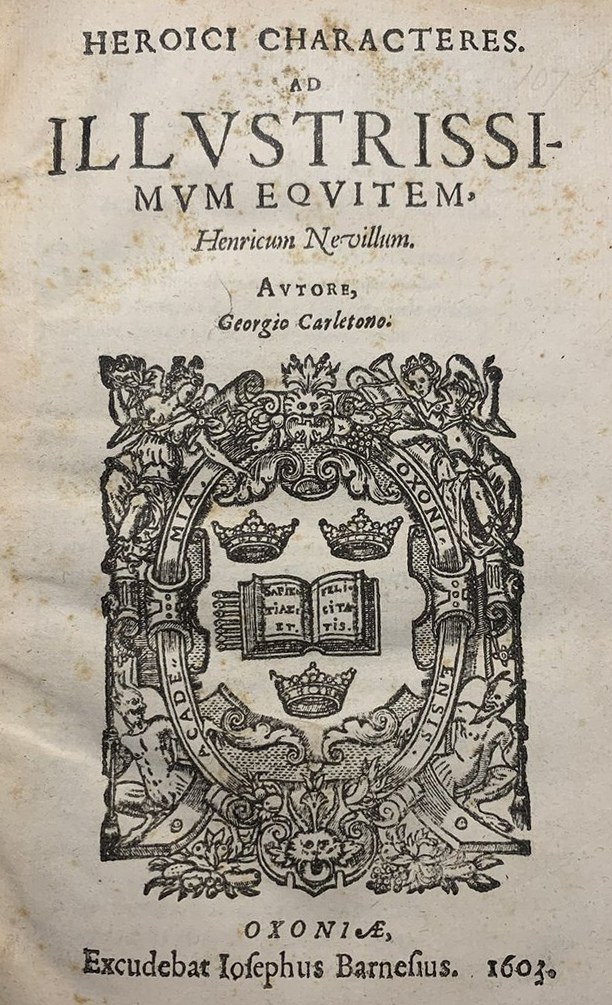
Carleton then turns to the language of tragedy:
Illa quidem maioribus attollenda cothurnis
Quis negat? ultro etiam tenuis tentamina musae
Agnosco, nec in hac quicquam me gloria laude
Sollicitat: nec me vatis pro crimine nomen
Obiectum fallit. Quin contra murmura vatum
Tu clypeo defende tuum. Cantata per orbem
Et sine vate sibi per se celeberrima gesta
Heroum, sat erit nostram tentasse Camoenam.
Who denies that those deeds deserve to be raised on greater buskins?
I readily acknowledge these efforts of a slender Muse;
no desire for glory in such praise entices me.
Nor am I unaware that the name of poet is cast as an accusation.
Rather, against the murmuring of poets,
defend your own with your shield. It will be enough
that my Muse has attempted the deeds of heroes, sung throughout the world
and supremely famous in themselves, even without a poet.10
The buskin, the boot of ancient tragic actors, stood for tragedy and its elevated style. Carleton contrasts that ambition with his own “slender Muse” and asks Neville to defend his poet from criticism. The appeal treats Neville as someone who can appreciate the distinction and protect the writer.
Neville asks to move the dedication
Carleton later recorded a request from Neville. Writing to Dudley Carleton on 22 October 1617 about reprinting his poems abroad with a new dedication to the prince, he recalled:
Sir Henry Nevil in his lifetime wished that the dedication had been altered, and the verses written to him placed in some other part of the book, which may be done with a little alteration.11
Neville wanted the verses retained, but moved away from the dedication. Carleton gives no reason for the request.
Notes and sources
Barlaam, Barlaami Monachi Logistica nunc primum Latinè reddita, & scholiis illustrata à Ioanne Chambero (Paris: Guillaume Auvray, 1600), Chamber’s prefatory poems, digitized leaves 7–8; address headed “Eiusdem. Ad illustriss. virum dominum Henricum Nevillum … ad Galliarum Regem legatum.” Augsburg, Staats- und Stadtbibliothek, 4 Math 43, address. Latin quotations normalize long s, ligatures, and u/v where needed. Translations are new renderings for this chapter. Varias is rendered “varied”; the name printed Sauillus is Savile. “The old man of Pelusium” is the poem’s learned designation of Ptolemy. The complete translation of the address reads: “Although you may count your lineage and ancestors in a long succession, / and the lofty halls of the prince stand open to you, / nothing amid such great fortune deserves greater esteem / than the honour of your virtue and the distinction of your talent. / Through that talent you govern all your affairs and conduct such weighty business; / through it you leave the earth behind and gladly approach the stars. / Gladly you approach the stars, where your abundant virtue, / making you immortal, claims you for the gods before your time. / You would seem to have achieved too little in rising above earth and the crowd, / unless the kindly company of Muses made your name resound. / The Muse gave you varied arts; cultivated Thalia gave you / the power to pour forth whatever you wished in rounded speech. / Euclid teaches you, opening his sources and elements; / the old man of Pelusium leads you to the stars. / Not content even with these things, you are accustomed to stir / the shade and buried ashes of Barlaam the monk. / I need not now recount how earnestly, or how often, you asked / that I should put his writings under the press. / Here, then, at last, are the monk’s learned writings for you, / now answering with learned sound beneath the blows of type. / Had Savile not been first in deserving this praise, / Barlaam would now owe his ransom to you. / For through your prompting and your request alike / the man’s Muse survives, which otherwise would have perished.”↩︎
Horace, Ars poetica, lines 323–324, read with the discussion of literary judgement, Greek example, and Roman calculation in lines 309–332. Latin text. The shortened quotation marks its omission. Chamber’s verbal adaptation supports the proposed allusion; it does not independently identify any work by Neville. Compare Horace’s “Grais ingenium, Grais dedit ore rotundo / Musa loqui …” (“To the Greeks the Muse gave genius; to the Greeks she gave speech with rounded fullness …”).↩︎
Hendrick Goltzius, Thalia, 1592, from The Nine Muses, Museum of Fine Arts, Houston, object 2020.54.2: collection record and inscription. For the pastoral use, Virgil, Eclogues 6.1–12, especially 6.2 and 6.8: Latin text. The two sources establish a range of association rather than an exclusive generic definition.↩︎
Charles Fitzgeoffrey, Affaniae: sive epigrammatum libri tres (Oxford: Joseph Barnes, 1601), III.41, pp. 129–130, “Ad Richardum Caraeum, Richardi filium, e Gallis reducem.” Latin edition, Dana F. Sutton; 1601 printed witness, p. 129. The printed abbreviation curiamq; is expanded as curiamque; Sutton’s transcription omits -que. The translation is new. The identification of Aureliae as Orléans corrects “Orange” in the accompanying modern English translation.↩︎
Charlton T. Lewis and Charles Short, A Latin Dictionary (1879), s.v. “Aonia,” especially II.B–C, entry, gives the geographical meaning and its use for the Muses and things associated with them. Dana F. Sutton translates “Aonii … Nevilli” as “Boeotian Neville’s person” in Affaniae III.41.↩︎
Fitzgeoffrey, Affaniae, III.30 (Harington) and III.31 (Bodley), in Sutton’s Latin edition. The comparison concerns the ways the same poet uses the vocabulary of the Muses for literary achievement and its support. Fitzgeoffrey praises Harington’s poetry and Bodley’s provision of a home for the Aonian divinities in his library. This vocabulary can characterize literary achievement or support for learning.↩︎
Richard Carew, “The True and Ready Way to learn the Latine Tongue … Exprest in an Answer to a Quere,” in Samuel Hartlib, The True and Readie Way to Learne the Latine Tongue (London: R. and W. Leybourn, 1654), opening autobiographical account, especially p. 46. EEBO-TCP A42982; digitized volume. This is retrospective testimony published after the events, not a contemporary travel diary. Carew was the son of the antiquary Richard Carew and nephew of George Carew, Neville and Savile’s travelling companion (Chapter 2). His recollection concerns learning French through practice, contrasted with learning Latin through grammatical rules.↩︎
George Carleton, Heroici characteres. Ad illustrissimum equitem Henricum Nevillum (Oxford: Joseph Barnes, 1603), title and opening poem, sigs. A2r–A3r. Digitized copy. Latin excerpt at A3r; translation is new. The reading umbra is from the page image. A few other words in the reproduction are damaged; no uncertain reading from those places is quoted here.↩︎
Virgil, Eclogues 1.6–10: Latin text. The shared expression for making poetic leisure supports the allusion. It does not specify the financial or institutional means of Neville’s assistance. Compare Virgil’s “deus nobis haec otia fecit”: a god has made this leisure possible.↩︎
Carleton, opening poem, sig. A3r, closing eight lines; Latin checked against the printed page, with long s and u/v normalized; translation is new, with English line breaks adjusted for sense. “Your own” refers to the poet asking for protection. For the theatrical and figurative senses of the buskin, see Charlton T. Lewis and Charles Short, A Latin Dictionary (Oxford: Clarendon Press, 1879), s.v. “cothurnus,” II.B; dictionary entry. Compare Horace, Ars poetica 80 and 275–280, especially “docuit magnumque loqui nitique cothurno”; Latin text. The buskin (cothurnus) signifies tragedy or its elevated style; the contrasting low shoe (soccus) signifies comedy.↩︎
George Carleton to Sir Dudley Carleton, Nuffield, 22 October 1617, The National Archives, SP 14/93, ff. 235–236, passage f. 236r; State Papers Online, MC4323685410, scan 340, right leaf. The document’s identity is independently controlled by the catalogue and Mary Anne Everett Green, ed., Calendar of State Papers, Domestic Series, James I, 1611–1618 (London, 1858), p. 489, entry 135; calendar page. The calendar summarizes the proposed alteration of the poems and dedication to the prince but omits the Neville sentence. Abbreviations are expanded and spelling and punctuation modernized. The letter does not give the book’s title: identification with Heroici characteres rests on its published Neville dedication and the context of Carleton’s printed poems. The proposed new edition is not established as completed.↩︎