Appendix J
Davies’s epigram to Shakespeare
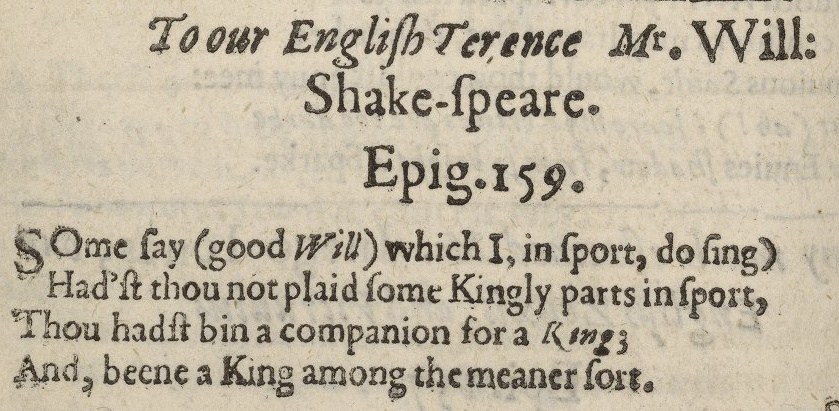
John Davies of Hereford’s The Scourge of Folly, registered in October 1610 and generally dated about 1611, contains an explicit address to Shakespeare. Epigram 159 is headed “To our English Terence Mr. Will: Shake-speare”:
Some say, good Will, which I in sport do sing,
Hadst thou not played some kingly parts in sport,
Thou hadst been a companion for a king,
And been a king among the meaner sort.
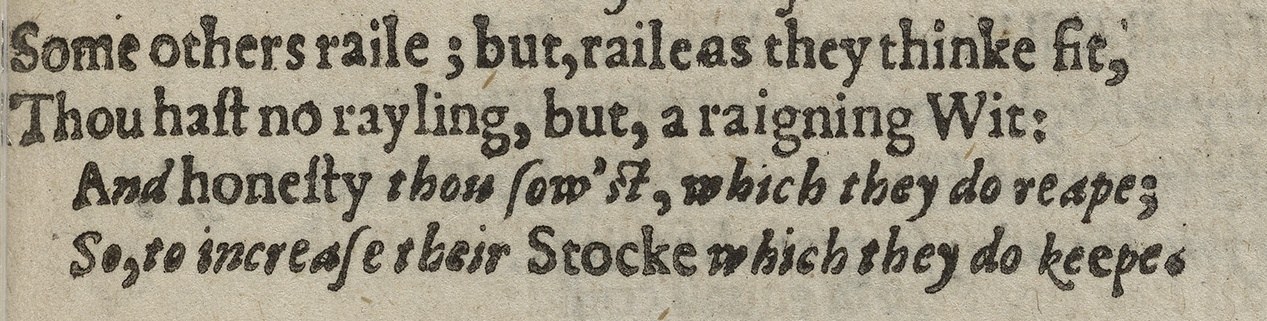
Some others rail; but rail as they think fit,
Thou hast no railing, but a reigning wit:
And honesty thou sow’st, which they do reap;
So to increase their stock which they do keep.1
“English Terence” carries a history of disputed literary credit. In “Black Comedy: Shakespeare, Terence, and Titus Andronicus” (2018), Shakespeare scholar Misha Teramura examines “the contemporaneous rumor that Terence’s plays were really authored by his noble friends.” The Roman biographer Suetonius recorded claims that Scipio and Laelius helped Terence write, and that work by these aristocrats appeared under Terence’s name. Teramura traces the tradition into the Renaissance: Montaigne and Roger Ascham both accepted versions of it. Davies’s heading thus invokes a dramatist whose name had long been associated with arguments about who wrote the plays attributed to him.2
Teramura also stresses Terence’s achievement as “a slave who became a successful dramatist.” He connects that career directly with the ambitions of London playwrights and Davies’s address to Shakespeare. Terence offered a model of artistic distinction across barriers of status; scepticism about his authorship could express resistance to an African former slave’s learning and eloquence. Both strands were available to a reader of Davies’s compliment: celebrated comic writing and a contested relationship between the named author, social rank and literary credit.2
Davies’s opening makes the “kingly parts” an obstacle to companionship with a king. The poem then changes the kind of sovereignty it attributes to its subject: Shakespeare has a “reigning wit.” Its final lines describe others reaping the honesty he sows.
“No-body,” “Some-body,” and “much ado”
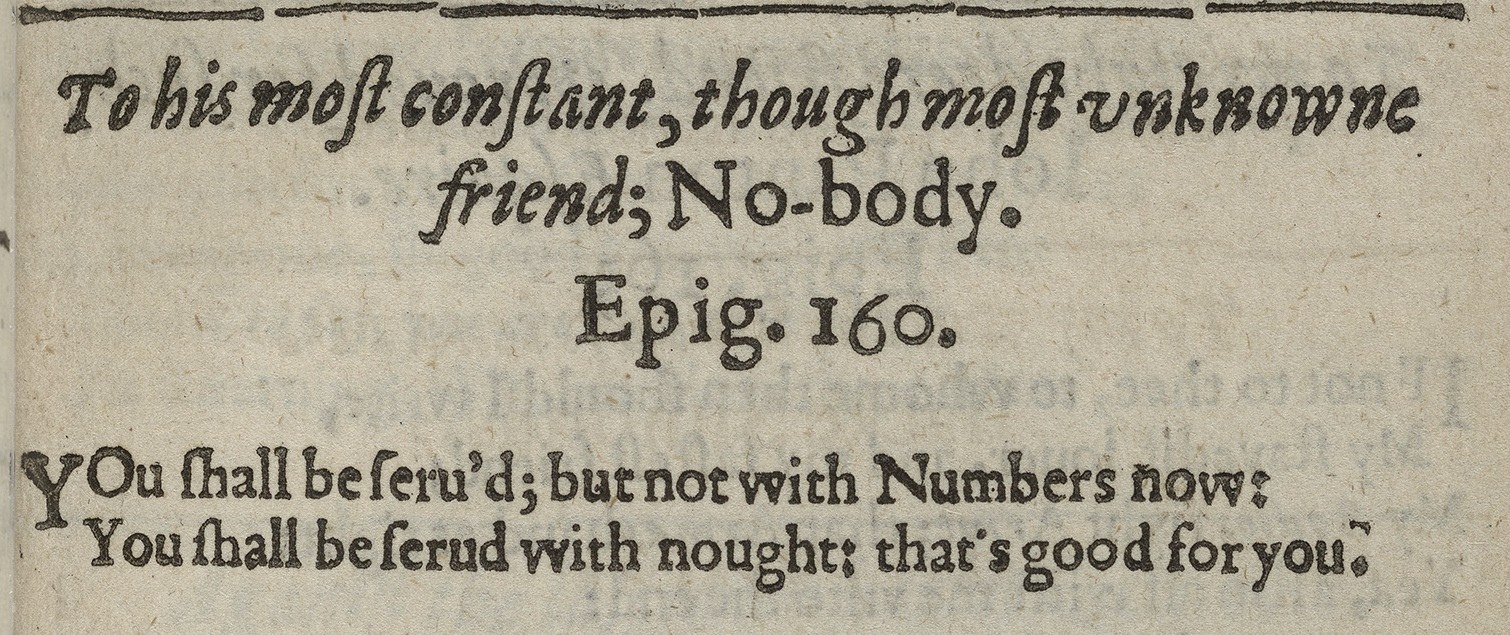
Immediately after the Shakespeare epigram, Davies addresses “his most constant, though most unknown friend; No-body.” Epigram 160 reads, with spelling modernized:
You shall be served; but not with numbers now;
You shall be served with nought; that’s good for you.
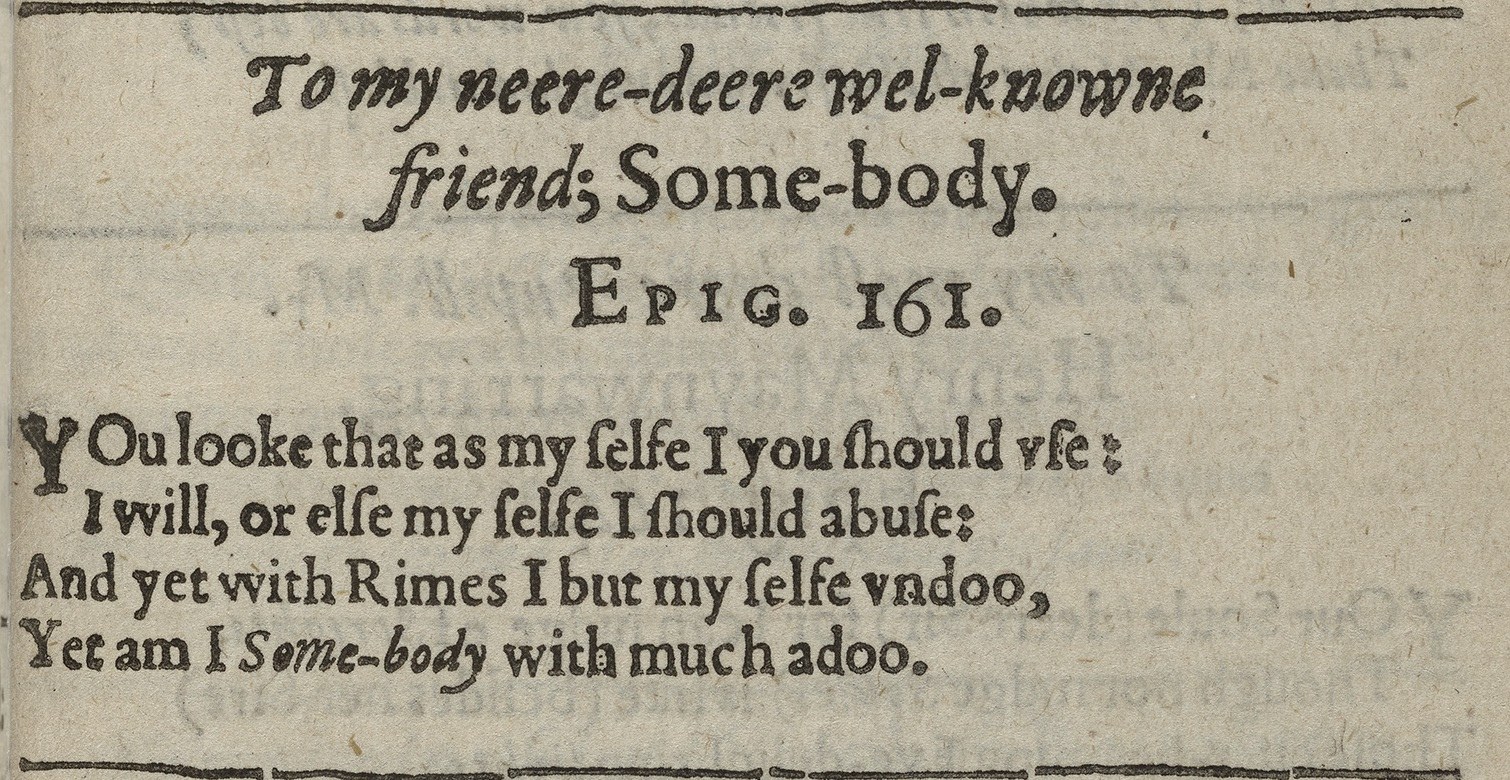
The next heading reverses unknown into well-known: “To my near-dear well-known friend; Some-body.” Epigram 161 says:
You look that as myself I you should use:
I will, or else myself I should abuse:
And yet with rhymes I but myself undo,
Yet am I Some-body, with much ado.1
The sequence is Shakespeare, No-body, Some-body. “Numbers” means verse as well as counting; “nought” answers the nameless friend with nothing. Read immediately after Shakespeare’s name and this play on nothing, the closing “much ado” points towards Much Ado About Nothing. Its first quarto was published in 1600 and named William Shakespeare on its title page.3
“I knew a man”
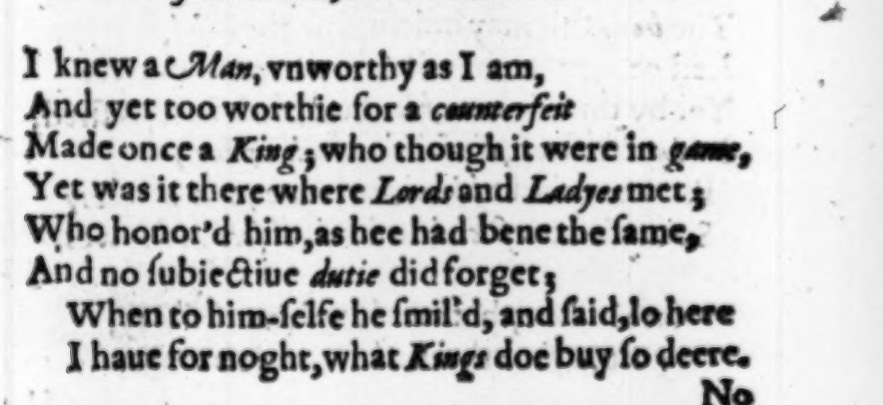
In 1616, the year after Neville’s death, Davies published A Select Second Husband for Sir Thomas Overbury’s Wife, Now a Matchless Widow. Its poem Speculum Proditori contains another account of a man playing king. The opening of the episode reads:
I knew a man, unworthy as I am,
And yet too worthy for a counterfeit,
Made once a king; who though it were in game,
Yet was it there where lords and ladies met;
Who honoured him, as he had been the same,
And no subjective duty did forget;
When to himself he smiled, and said, lo here
I have for nought, what kings do buy so dear.4
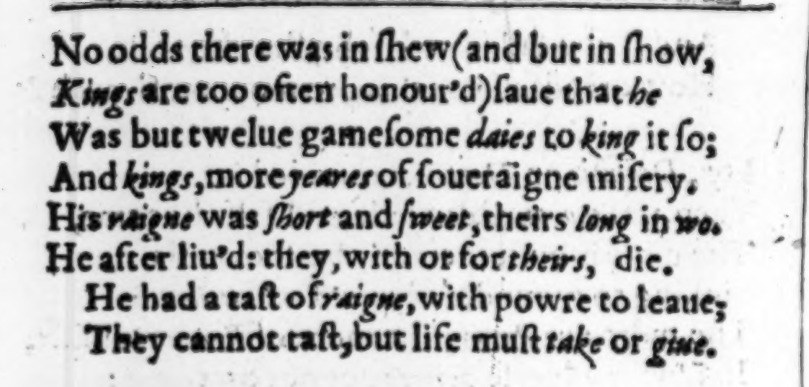
The next stanza gives the duration and outcome of his reign:
No odds there was in show (and but in show,
Kings are too often honoured) save that he
Was but twelve gamesome days to king it so;
And kings, more years of sovereign misery.
His reign was short and sweet, theirs long in woe.
He after lived: they, with or for theirs, die.
He had a taste of reign, with power to leave;
They cannot taste, but life must take or give.4
Davies continues the comparison. The temporary king makes friends of enemies through a bloodless performance. He “poisoned” people with sugar and perfumed wines, moved with guards without fearing assassination, and conversed with ladies without the suspicion that followed a real sovereign. The passage ends by asking who has the better reign: a king in reality or in pretence.
The relationship with the Shakespeare epigram is close in subject and wording: “kingly parts in sport” becomes a man made king “in game.” Both separate the person’s worth from the role he performs. Alexander B. Grosart, editor of Davies’s collected works, printed the two passages together in his 1878 introduction and proposed that the unnamed man was Shakespeare:
I like to think that this ‘man’ was Shakespeare, and that herein we have a designed supplement to the Epigram. Let the reader compare and judge.5
MacDonald Jackson also discussed both texts in his 2007 article on Davies and Sonnet 111, although he rejected Grosart’s identification of the unnamed man. He understood the twelve-day reign as that of a Christmas Lord or King of Misrule, and treated it as another version of Davies’s recurring comparison between performed and actual kingship.6
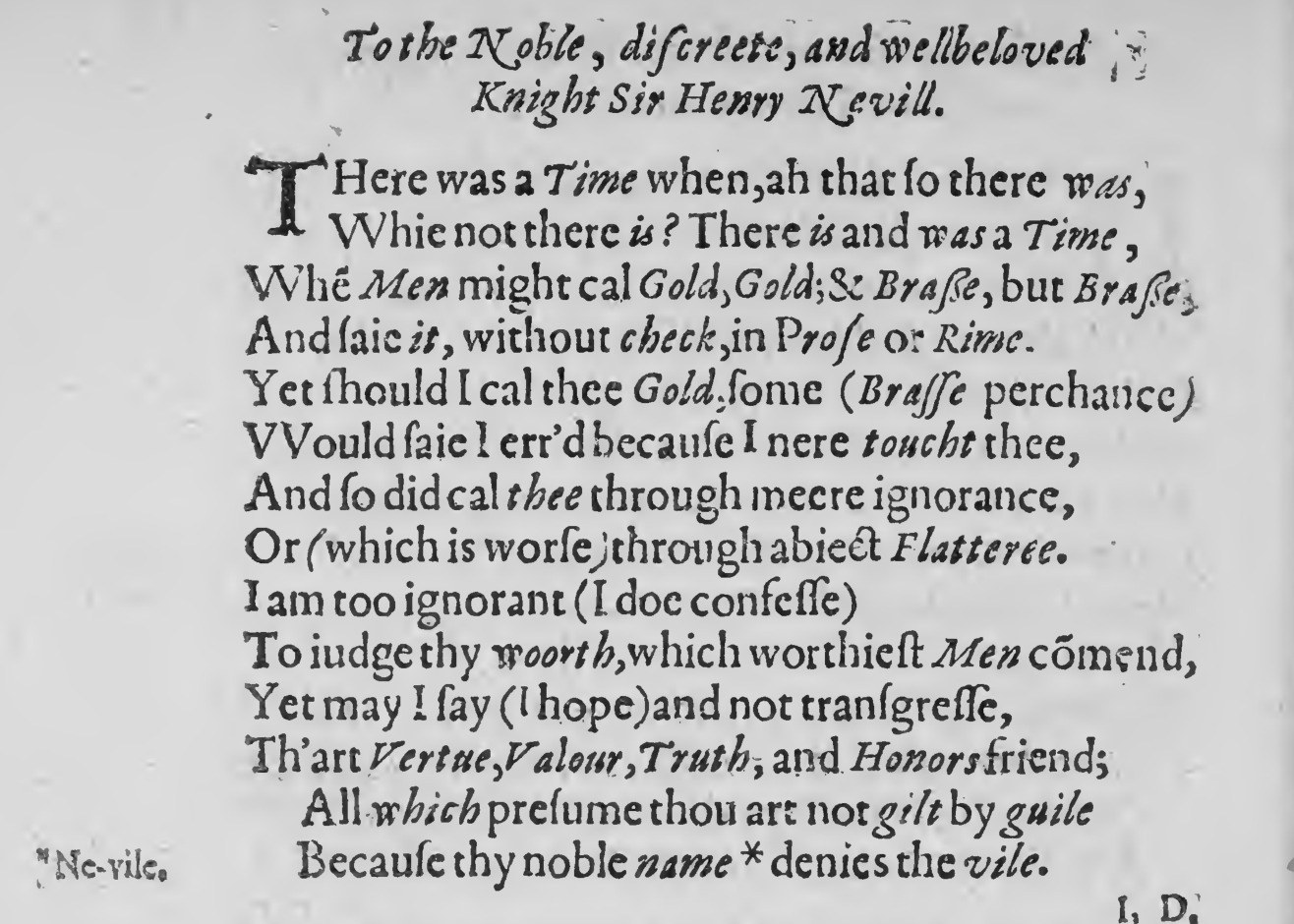
The language of “unworthy” and “worthy” also recalls Davies’s poem addressed to Neville in Microcosmos (1603):
I am too ignorant (I do confess)
To judge thy worth, which worthiest men commend.
In both passages Davies lowers himself while praising another man’s worth. The later phrase “too worthy for a counterfeit” also recalls the earlier poem’s distinction between gold and brass, genuine value and something merely “gilt by guile.” The poem to Neville makes true worth, obscured or misjudged by others, its central concern. This is a further connection between the unnamed man and Davies’s named praise of Neville, discussed in Chapter 48, “Microcosmos: Neville and Shakespeare.”4
For the Neville reading, the sequence is suggestive: Davies’s named address to Neville in 1603, his named address to Shakespeare around 1611, and this unnamed man in a book published in 1616. Neville had died on 10 July 1615. Publication after his death gives the opening “I knew a man” a possible retrospective force, but those words alone do not say that the man was dead. The fuller passage supplies a specific question for further research: can Neville be documented taking the part of a festive king for twelve days? No such occasion is identified in the evidence presented here.
Notes and sources
John Davies of Hereford, The Scourge of Folly (London: Edward Allde for Richard Redmer, undated, c.1611), epigrams 159–161, STC 6341; digitized edition. The registration date, 8 October 1610, and the probable publication year are discussed by MacDonald P. Jackson (2007). The full Shakespeare epigram is printed at the beginning of this appendix.↩︎
Misha Teramura, “Black Comedy: Shakespeare, Terence, and Titus Andronicus,” ELH 85.4 (Winter 2018), pp. 877–908, especially pp. 888–890, article. The first quotation is from p. 888; the second from p. 890. Teramura examines the racial and social politics of Terence’s reception and his relationship to Titus Andronicus. He does not argue for a concealed author behind Shakespeare; the application to Davies’s heading here is this book’s interpretation.↩︎
Folger Shakespeare Library, “Much Ado About Nothing, first edition,” Shakespeare Documented, STC 22304: London, Valentine Simmes for Andrew Wise and William Aspley, 1600; registration 23 August 1600. John Davies of Hereford, The Scourge of Folly, STC 6341, epigrams 159–161, pp. 76–77; registered 8 October 1610, conventionally dated [1611]. The “much ado” title echo is an interpretation of the wording and sequence, not an explicit naming of the play. Epigrams 160–161 are quoted in full with spelling modernized; the photographs preserve the printed forms.↩︎
John Davies of Hereford, A Select Second Husband for Sir Thomas Overburies Wife, Now a Matchlesse Widow (London, 1616), “Speculum Proditori,” TCP A19911, beginning at page-image marker tcp:9887:42; public TCP transcription. The two stanzas are quoted in full, with spelling modernized. The following three stanzas continue the royal comparison; their content is summarized in the text. The book’s publication year does not establish when Davies composed this passage. For the comparison with Neville’s worth, see Davies, Microcosmos (Oxford: Joseph Barnes, 1603), “To the Noble, discreete, and wellbeloved Knight Sir Henry Nevill,” lines 5–10 and 13–14; original page, TCP A19903. Spelling is modernized. The parallel is offered as a connection in Davies’s language and imagery, not an identification established by the unnamed poem.↩︎
Alexander B. Grosart, ed., The Complete Works of John Davies of Hereford, I (1878), “Memorial-Introduction,” p.lv, printed page. Grosart prints the Shakespeare epigram immediately before the “I knew a Man” stanzas and proposes a deliberate connection. His identification is explicitly conjectural. The quotation is checked against the printed page; line-end word divisions are joined.↩︎
MacDonald P. Jackson, “Shakespeare’s Sonnet CXI and John Davies of Hereford’s Microcosmos (1603),” Modern Language Review 102, no. 1 (January 2007), pp. 1–10, full text, discussion of “Speculum Proditori” and Davies’s other treatments of playing kings. His interpretation concerns festive misrule; it does not identify the unnamed man as Neville.↩︎