Henry Neville (1620–1694), the ambassador’s grandson, was a republican politician, satirist and translator of Machiavelli. The Isle of Pines appeared in 1668 without his name, first anonymously and then as the report of an invented Dutch voyager. The book tells of an English family founded after a shipwreck in Elizabeth’s reign and of a grandfather’s history preserved by descendants.1
A book published under another name
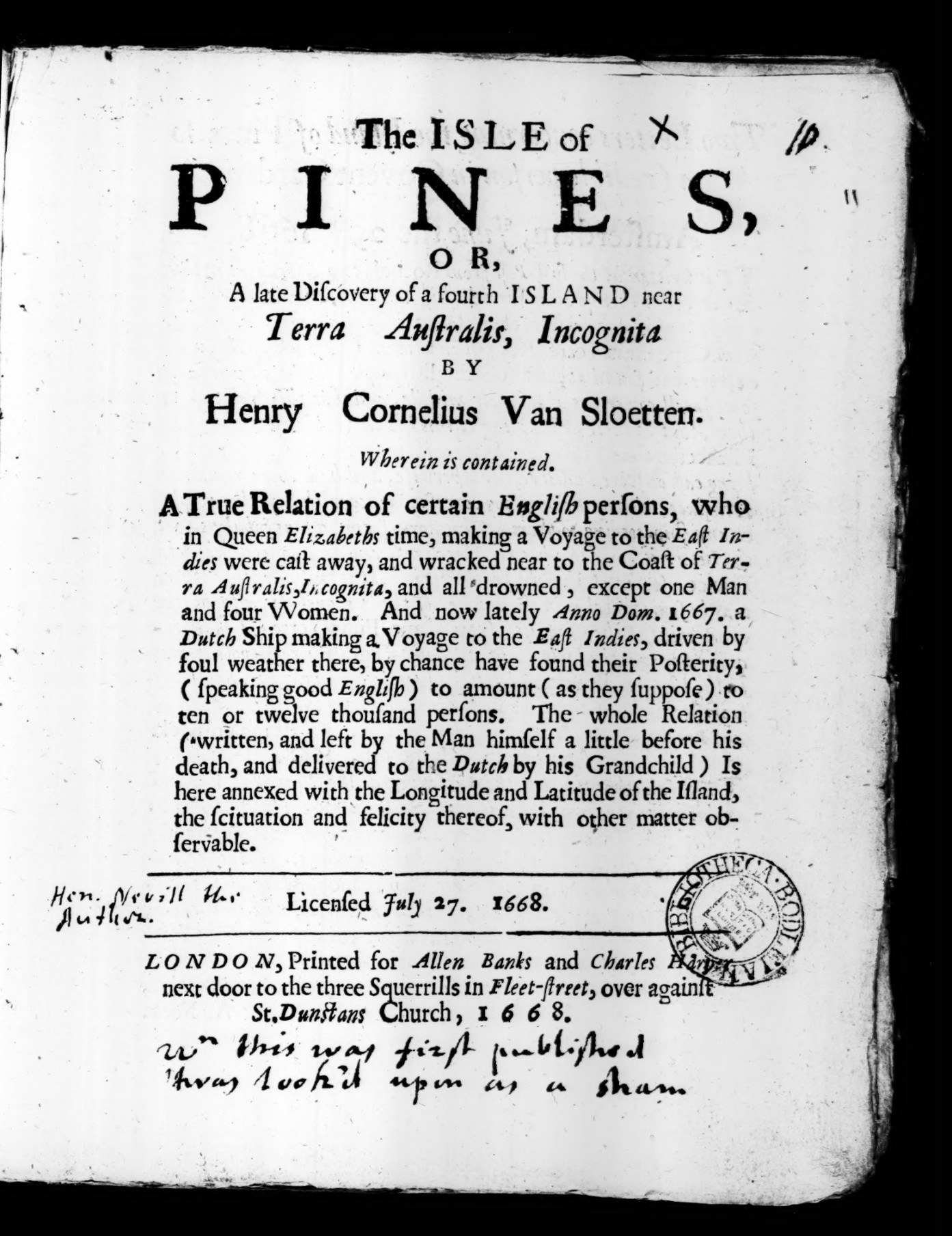
The combined edition, which sets the original castaway’s story within a Dutch visitor’s account, carries the invented voyager’s name on its title page:
The Isle of Pines,
or,
A late Discovery of a fourth Island near
Terra Australis, Incognita
By
Henry Cornelius Van Sloetten.2
Van Sloetten is a fictional discoverer and narrator; Henry Neville wrote the book. The title page also promises an account written by the original castaway and delivered to the Dutch by his grandchild. The assumed name and the story of the manuscript’s transmission work together to make an invented island sound like a reported discovery.
In the book, the founder, George Pine, survives a shipwreck with four women, including an enslaved African woman. Their descendants become the island’s population. When Dutch visitors arrive, George’s grandson William explains how the family has preserved its history:
What after passed (said he) during my Grandfathers life, I shall show you in a Relation thereof written by his own hand, which he delivered to my Father being his eldest Son, charging him to have a special care thereof …3
William brings out two sheets, reads them aloud and gives the visitors a copy. George’s own account ends with instructions to preserve the history and let strangers copy it, “that our name be not lost from off the earth.”4 A grandson thus brings his grandfather’s writing to a new audience. For a book written by the ambassador’s grandson, this is a suggestive choice of plot: family descent becomes the means of literary survival.
The Tempest on the Restoration stage
The timing makes The Tempest a particularly relevant comparison. London’s theatres reopened with the Restoration in 1660, after the parliamentary closure of 1642. On 7 November 1667, Pepys attended the first performance of Dryden and Davenant’s adaptation, The Tempest, or The Enchanted Island, at the Duke’s theatre. He recorded a packed house and the presence of the king and court. The Isle of Pines followed the next summer: its first part was licensed on 27 June 1668, and the combined edition on 27 July.5
The adaptation supplies a closer comparison than the general theme of a shipwreck. Hippolito, a young man brought up without seeing women, discovers sexual desire and refuses the idea that he must love only one:
HIPPOLITO
I will have all of that kind, if there be a hundred of ’em.6
George Pine’s island turns such unlimited desire into a founding history. In the play’s expanded sailors’ scenes, the survivors also attempt to establish a government, dispute who may rule, and bargain for offices. Neville’s fiction likewise turns isolation into an experiment in sexual and political order. After George’s death, his descendants need laws, punishment and eventually Dutch armed assistance. Natural plenty has not produced lasting innocence.7
Shakespeare’s original already sets Gonzalo’s ideal of abundance without labour against the ambitions and violence of the other castaways. Neville develops a comparable tension across generations. The 1667 adaptation brings sexual appetite and improvised island government into still sharper focus, immediately before the publication of The Isle of Pines. This gives the comparison a precise contemporary setting, although no evidence cited here places Neville at a performance. The quoted text was printed in 1670, following the adaptation’s 1667 stage debut.8
The sonnet at Audley End
Neville researcher John Casson discovered an unsigned English sonnet on the final blank page of a 1607 volume of Las Comedias del Famoso Poeta Lope de Vega Carpio at Audley End. It matches the younger Henry Neville’s distinctive handwriting.9 In Casson’s modernized transcription it begins:
At length into your fingers I am come
Wherein so close restraint I am to die,
That you to me my sighs and tears deny,
The only easers of my martyrdom.
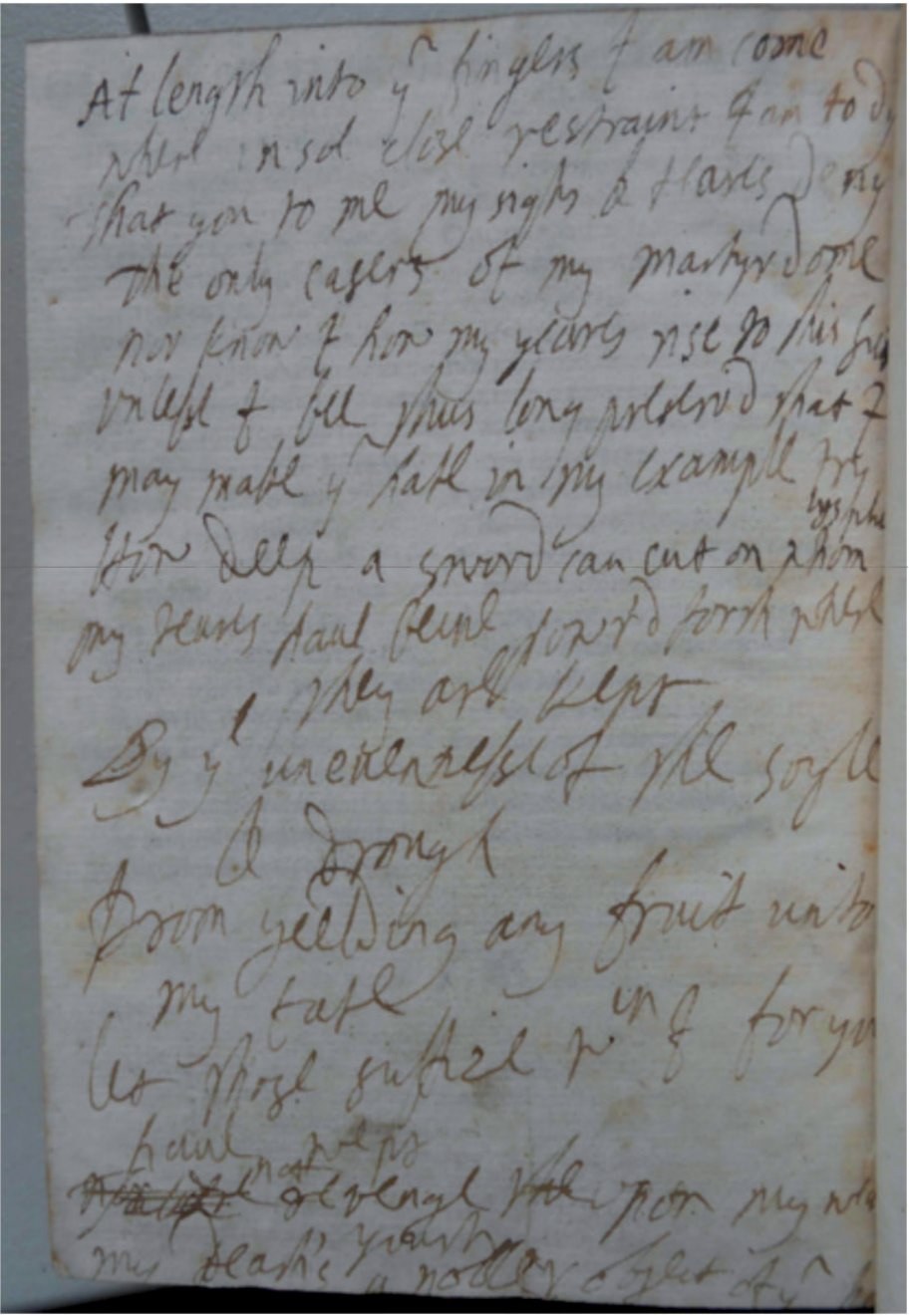
The poem is an English version of Garcilaso de la Vega’s Sonnet II. Its sequence follows the Spanish poem from captivity in the beloved’s hands, through the sword and fruitless tears, to a final appeal for death. This identifies the literary source; whether Neville translated it himself remains a separate question.10
The volume connects his writing with the surviving family collection, but its place in the earlier library needs care: no matching entry has yet been identified in the 1780 Billingbear catalogue.11
Notes and sources
J. M. Rigg, “Neville, Henry (1620–1694)”, Dictionary of National Biography, 40 (1894). He was the second son of Sir Henry Neville (d. 1629) and Elizabeth Smythe. Casson gives 1619 as his birth year; this book retains Rigg’s 1620. For his stepfather John Thorowgood’s bequest of French and Italian books in 1657, see Chapter 53.↩︎
The Isle of Pines (London: Allen Banks and Charles Harper, 1668), combined-edition title page. Capitalization and long s normalized in the excerpt; line arrangement follows the title. The image retains the historical annotations. For the anonymous first part and the successive publications, see Worthington Chauncey Ford, The Isle of Pines: An Essay in Bibliography (Boston: Club of Odd Volumes, 1920), “The Combined Parts” and “The Story,” public edition. The first part’s account of George Pine was subsequently enclosed within the Dutch narrator’s account.↩︎
The Isle of Pines, combined edition, p. 6. Long s normalized; the ellipsis marks the rest of the sentence. The following paragraph describes the two sheets, reading and copy.↩︎
The Isle of Pines, p. 15. The fictional family sequence is George Pine, his son Henry, and grandson William. The voyage licence in the narrative is dated 1569 (p. 7).↩︎
University of Exeter, Stuart Successions Project, John Denham’s 1660 theatre prologue and historical introduction, for the reopening; Samuel Pepys, Diary, 7 November 1667, for the first-day performance, audience and royal attendance. The production was the Dryden–Davenant adaptation: Royal Shakespeare Company, “Stage History”. Ford, “The Combined Parts,” records the first licence, 27 June, the continuation’s date, 22 July, and the combined licence, 27 July 1668. Licence dates should not be mistaken for exact dates of sale. Shadwell’s operatic revision belongs to 1674, after Neville’s book.↩︎
William Davenant and John Dryden, The Tempest; or, The Enchanted Island (1670), act III, Hippolito and Ferdinand’s conversation, 1670 text edited by Jack Lynch. The quotation is the adaptation’s wording, not Shakespeare’s original. Act II contains the sailors’ debate over government, election and offices.↩︎
The Isle of Pines, combined edition, George’s narrative and the continuation, especially pp. 16–26, 1668 scan. The governing family’s account retains distinctions between the four maternal lines and singles out descendants of the enslaved Philippa in the rebellions. Its account of order is therefore also an account of inherited hierarchy.↩︎
Shakespeare, The Tempest, 2.1, Gonzalo’s commonwealth and his companions’ replies. Gonzalo’s speech draws on Montaigne, “Of the Caniballes,” in John Florio’s Essayes (1603), I.30, text. The comparisons concern appetite, abundance and political order; they do not establish direct borrowing. Chapter 36 treats the ambassador’s lifetime and the Virginia evidence.↩︎
John Casson, “A Newly Discovered Seventeenth-century Sonnet”, Notes and Queries 64.3 (2017), 450–455. Casson compares the tall e, the forms of t, w and capital T, joined letters and abbreviations with Neville’s letters, Royal Berkshire Archives D/EN/F8/1/13 and D/EN/F8/1/9. The dated comparison is 20 January 1664 “old stile,” or 1665 in modern year reckoning; the other is undated. These details identify the distinctive hand, not the translator. Casson reports Katherine Duncan-Jones’s broad dating estimate, late 1620s to early 1640s; it does not securely date the inscription. His transcription records corrections and letters obscured by rebinding. The four lines quoted follow his modernized transcription on p. 450, with its line breaks and punctuation.↩︎
Garcilaso de la Vega, Obras (Madrid: Ediciones de La Lectura, 1911), Sonnet II, p. 207, compared with Casson’s complete transcription. Garcilaso and Lope de Vega are different writers. The source identification is the present book’s comparison, not a claim made in Casson’s article.↩︎
Catalogue of the Books in the Library at Billingbear, 7 November 1780, Royal Berkshire Archives, D/EN/F37/1. Searches of the available catalogue transcriptions under Lope, Vega, Carpio and Comedias produced no identifiable entry. This is a bounded non-result, not proof that the volume was absent from the family’s library. Casson documents the surviving Audley End volume; its ownership by the ambassador remains unestablished.↩︎