Katherine Cooke declares war at the end of a Latin poem. The recipient is her sister Mildred, wife of William Cecil, and the cause is a man’s proposed departure overseas. Bring him home, Katherine says, and Mildred is the best of sisters; let him sail and she is no sister at all. Katherine was Anne Killigrew’s mother and Henry Neville’s mother-in-law. She shares her name with Katherine in The Taming of the Shrew. Her poem adds a further point of comparison: a learned woman using sharp wit to press her wishes on those who could frustrate them.1
Neville married Anne Killigrew in December 1584. Katherine’s sisters included Mildred Cecil, Anne Bacon and Elizabeth Hoby, later Lady Russell. Their classical learning, translations and correspondence made the Cooke family a particularly distinguished example of women’s education in Elizabethan England. Katherine died on 27 December 1583, before her daughter married Neville.2
Katherine’s poem to Mildred Cecil
John Harington printed Katherine’s six-line poem in his commentary to Orlando Furioso in 1591, presenting the Cooke sisters as English examples of women’s learning. His marginal note explains the appeal to Mildred as a request for a kinsman’s return to Cornwall and the prevention of a journey overseas; Thomas Fuller later identifies the man as Katherine’s husband, Henry Killigrew.
Si mihi quem cupio cures Mildreda remitti,
Tu bona, tu melior, tu mihi sola soror:
Sin malè cessando retines, & trans mare mittis,
Tu mala, tu peior, tu mihi nulla soror.
Is si Cornubiam, tibi pax sit & omnia læta,
Sin mare Ciciliæ nuncio bella. Vale.
In English:
If you see to it, Mildred, that the man I long for is sent back to me,
You are a good sister, a better sister, my only sister.
But if by harmful delay you keep him back and send him overseas,
You are a bad sister, a worse sister, no sister to me.
If he goes to Cornwall, may you have peace and every happiness;
But if to sea, I declare war on Cecil. Farewell.
Amos C. Miller describes Katherine as a “formidable personality” and emphasizes the poem’s humour. He also records Cecil’s opposition to her marriage to Killigrew and Killigrew’s angry response. The poem’s balanced lines turn praise into its opposite: good, better, only sister becomes bad, worse, no sister. Katherine makes an appeal for help sound like a declaration of war.3
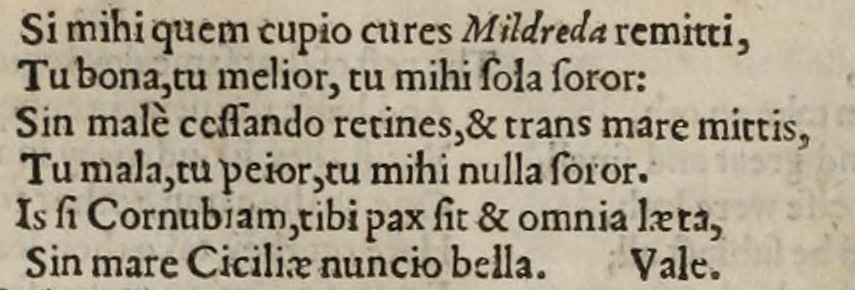
Image source: the 1591 printed edition, p. 314.
Books for both daughters
In The Taming of the Shrew, Baptista is a wealthy father in Padua with two daughters: Katherine, the outspoken elder sister, and Bianca, the younger, whom several men want to marry. Baptista insists that Katherine must marry first. While Bianca’s suitors wait, her lessons give them a way into the household: Lucentio poses as a Latin tutor and Hortensio as a music teacher.
Lucentio’s servant Tranio meanwhile impersonates his master, presenting Baptista with gifts for the sisters’ education:
And toward the education of your daughters
I here bestow a simple instrument
And this small packet of Greek and Latin books.— The Taming of the Shrew, 2.14
The Cooke sisters studied both Greek and Latin—the education represented by the books offered to Baptista’s daughters.2
Baptista accepts the gifts and sends the tutors to both daughters. The sisters respond very differently. Hortensio reports that Katherine has struck him over the head with his lute; Bianca turns her lesson into an opportunity to answer a suitor. The shared name connects Katherine Cooke with the outspoken Katherine of the play. Her poem also brings learning and a combative wit together, qualities the play develops differently through its two sisters.4
Bianca answers back
During Bianca’s lesson, Lucentio—using the tutor’s name Cambio—reads two lines from Ovid’s Heroides, then substitutes a declaration of love for the translation. Bianca answers through the same Latin phrases while Hortensio, calling himself Litio, tunes his instrument nearby:
BIANCA Where left we last?
LUCENTIO, [as Cambio] Here, madam:
[Showing her a book.]
Hic ibat Simois, hic est Sigeia tellus,
Hic steterat Priami regia celsa senis.BIANCA Conster them.
LUCENTIO Hic ibat, as I told you before, Simois, I am
Lucentio, hic est, son unto Vincentio of Pisa,
Sigeia tellus, disguised thus to get your love, Hic
steterat, and that “Lucentio” that comes a-wooing,
Priami, is my man Tranio, regia, bearing my port,
celsa senis, that we might beguile the old pantaloon.HORTENSIO, [as Litio] Madam, my instrument’s in
tune.BIANCA Let’s hear. [He plays.] Oh fie, the treble jars!
LUCENTIO, [as Cambio] Spit in the hole, man, and tune
again. [Hortensio tunes his lute again.]BIANCA Now let me see if I can conster it. Hic ibat
Simois, I know you not; hic est Sigeia tellus, I trust
you not; Hic steterat Priami, take heed he hear us
not; regia, presume not; celsa senis, despair not.— The Taming of the Shrew, 3.15
“Conster” means to construe or explain. Bianca answers Lucentio’s device with her own English meanings between Ovid’s phrases: “presume not” keeps him at a distance; “despair not” leaves him hope.
Katherine Cooke composes in Latin; Bianca uses a Latin exercise as cover for a private exchange. The resemblance is in the wit with which each makes learning serve a personal negotiation. Katherine promises affection or war according to her sister’s decision; Bianca combines encouragement with refusal to be rushed.
Sue Wiseman reads the lesson as a parody of schooling turned into comic seduction, emphasizing Bianca’s judgment in managing courtship. The comparison with Katherine’s poem gives that resourcefulness a concrete family setting for Neville: a woman whose classical learning could sharpen, rather than silence, her own demands.5,6
Anne’s Latin appeals
Katherine’s daughter Anne used Latin in two surviving letters: to Thomas Windebank on 6 March 1601 and to Robert Cecil in May 1602. In the latter, she quoted Seneca while pleading for Neville’s release from the Tower. Katherine had appealed to Mildred Cecil for her husband; Anne appealed to Mildred’s son for hers. Across two generations, mother and daughter made classical learning serve their own claims.7 The Seneca quotation and Anne’s manuscript are discussed in Chapter 31, “Macbeth: The Deed and Its Consequences.”
A family connection to Padua
Shakespeare places Katherine and her sister Bianca in Padua, where their father Baptista provides tutors and books. The city belonged to the experience of three men in Neville’s family:
— | — | — |
7 January 1549 | Henry Killigrew, Katherine Cooke’s husband and Neville’s future father-in-law. | Hoby records leaving Padua with Killigrew and Edward Murphin to see the Prince of Spain’s ceremonial entry into Mantua.8 |
August 1554 | The elder Sir Henry Neville, the ambassador’s father. | Hoby names Henry Neville among the Englishmen at Padua; his editor identifies him as the ambassador’s father.9 |
Summer 1581 | Henry Neville, travelling with Henry Savile. | Faunt’s letter of 8 July names Neville among the English at Padua, according to Tosh; Woolfson places him there with Savile in August.9 |
Neville had visited the city himself, as had his father and his future father-in-law. Padua therefore joins the family’s classical learning and Katherine’s name as another specific point of contact with the play.
Katherine’s poem lets us hear the wit of the woman whose daughter Neville married; Anne’s letter shows Latin used within his own household to argue for his freedom.
Notes and sources
John Harington, Orlando Furioso (1591), commentary to book 37, p. 314. Latin follows the printed witness, with long s normalized; English is a new prose translation, arranged to correspond to the six Latin lines. Harington’s marginal explanation describes the man as a kinsman; Thomas Fuller’s later account identifies him as Henry Killigrew. The final line’s “Ciciliæ” is rendered “Cecil” following that family context and the later English tradition. Miller, pp. 99–100, reproduces Fuller’s English version and proposes autumn 1571 for the poem, while explicitly acknowledging that its date and outcome are unknown. His separate report of Killigrew’s January 1572 appeal from Blois for recall because his wife was near childbirth, citing SP 70/122 f. 48, does not establish the poem’s date.↩︎
Marion E. Colthorpe, Elizabethan Court Day by Day, 1584, p. 46, 22 December; Gemma Allen, The Cooke Sisters: Education, Piety and Politics in Early Modern England (Manchester University Press, 2013), introduction. See also Colthorpe, “Court Women: Royal Household”, entry for Katherine Killigrew.↩︎
Amos C. Miller, Sir Henry Killigrew: Elizabethan Soldier and Diplomat (Leicester University Press, 1963), pp. 99–100 (Folger catalogue). “Formidable personality” is Miller’s characterization. On pp. 99–100 Miller quotes an April 1564 entry in Cecil’s diary recording Killigrew’s angry response to his opposition to the match, citing “Haynes, vol. 2, p. 755.” This records opposition to Katherine’s marriage; it does not establish the wedding date. The comparison with the play is developed here.↩︎
Shakespeare, The Taming of the Shrew, 2.1 and 3.1, Folger Shakespeare Library. The comparison concerns women’s use of classical learning in personal relationships, rather than an identification of Bianca with a particular Cooke sister.↩︎
Shakespeare, The Taming of the Shrew, 3.1, Folger Shakespeare Library. The passage is continuous, including Hortensio’s interruption; wording, speech prefixes and line breaks are preserved. The Latin comes from Ovid’s Heroides, letter 1, Penelope to Ulysses. For the lesson’s interplay of education and courtship, see Sue Wiseman, “Educating Shrews: Taming of the Shrew, women’s education, shrew stories”, Actes des congrès de la Société française Shakespeare 41 (2023), paragraphs 4–7. The comparison with Katherine Cooke’s poem is proposed here, not by Wiseman.↩︎
Karen Newman, “A Modern Perspective: The Taming of the Shrew”, Folger Shakespeare Library, on the taming-story tradition and Gascoigne’s Supposes as a source for the Bianca plot. The courtship intrigue and taming story have these literary and traditional precedents. The comparison developed here concerns the women’s learning and verbal resourcefulness, not a claim that the Cooke family supplied those plots.↩︎
Anne Neville to Thomas Windebank, 6 March 1601, TNA, SP 12/279, f. 30; Mary Anne Everett Green, ed., Calendar of State Papers, Domestic Series, Elizabeth, 1601–1603 (1870), p. 12, no. 20, preserving “perii quoad hoc mundum.” Anne Neville to Robert Cecil, Hatfield House, Cecil Papers 93/72, endorsed 23 May 1602; HMC, Salisbury, XII (1910), p. 164. The Latin in the second letter is read from the manuscript and omitted from the abbreviated calendar. These letters postdate the play’s usual early-1590s dating; they document Anne’s use of Latin within Neville’s household. See Chapter 31 for the Seneca passage and its comparison with Macbeth.↩︎
Thomas Hoby, The Travels and Life of Sir Thomas Hoby, Kt. of Bisham Abbey, Written by Himself, 1547–1564, ed. Edgar Powell (Royal Historical Society, 1902), p. 11. Under the heading 1549, Hoby dates the departure from Padua to 7 January and the prince’s entry into Mantua to 13 January. Powell’s footnote identifies Killigrew as the later diplomat, Marian exile and husband of Katherine Cooke. The printed page has been checked; the original manuscript has not been collated. This passage establishes his presence in Padua before the Marian exile, not a university degree or a dated stay there during Mary’s reign.↩︎
Jonathan Woolfson, Padua and the Tudors: English Students in Italy, 1485–1603 (University of Toronto Press, 1998), pp. 129–131, for Neville’s 1581 visit; see Chapter 2 for the itinerary and evidence. Thomas Hoby, The Travels and Life of Sir Thomas Hoby, ed. Edgar Powell (Royal Historical Society, 1902), pp. 116–117, records the English company at Padua on 23 August 1554; the editor identifies Sir Henry Neville of Billingbear, the ambassador’s father. William Patrick Tosh, Testimonies of Affection and Dispatches of Intelligence: The Letters of Anthony Bacon, 1558–1601 (PhD thesis, Queen Mary, University of London, 2013), p. 53 and n. 17, thesis, cites Nicholas Faunt to Anthony Bacon, 8 July 1581, Lambeth Palace Library, MS 647, f. 110r. The July report follows Tosh’s account; the original folio has not been inspected here. The July and August notices do not establish the duration of Neville’s stay.↩︎