Thomas Digges was a mathematician, astronomer and military writer. His wife, Anne St Leger, was Neville’s second cousin; their sons Dudley and Leonard were Neville’s second cousins once removed.1 His account of infinite heavens provides a context for Hamlet’s “infinite space.”
The passage appears in the First Folio of 1623 but is absent from the Second Quarto of 1604/5. Hamlet imagines limitless sovereignty within the narrowest confinement:
O God, I could be bounded in a nutshell and
count myself a king of infinite space, were it not
that I have bad dreams.2
In 1576 Thomas Digges published a diagram that placed the moving Earth around the Sun and extended the stars beyond the enclosing boundary of the traditional cosmos. His account of these infinite heavens circulated in English. Digges also joined Henry Savile and John Chamber, two scholars closely connected with Neville, in assessing John Dee’s proposed reform of the English calendar.
Digges’s infinite heavens
Digges added A Perfit Description of the Caelestiall Orbes to his father Leonard’s Prognostication Everlasting. His diagram preserves the circles of the planets but disperses the stars beyond them. Its inscription describes the stellar region as extending infinitely and calls it the palace of felicity, the court of celestial angels and the dwelling of the elect. Infinity is both an astronomical proposition and a religious vision: the heavens have become the limitless habitation of God and the blessed.3
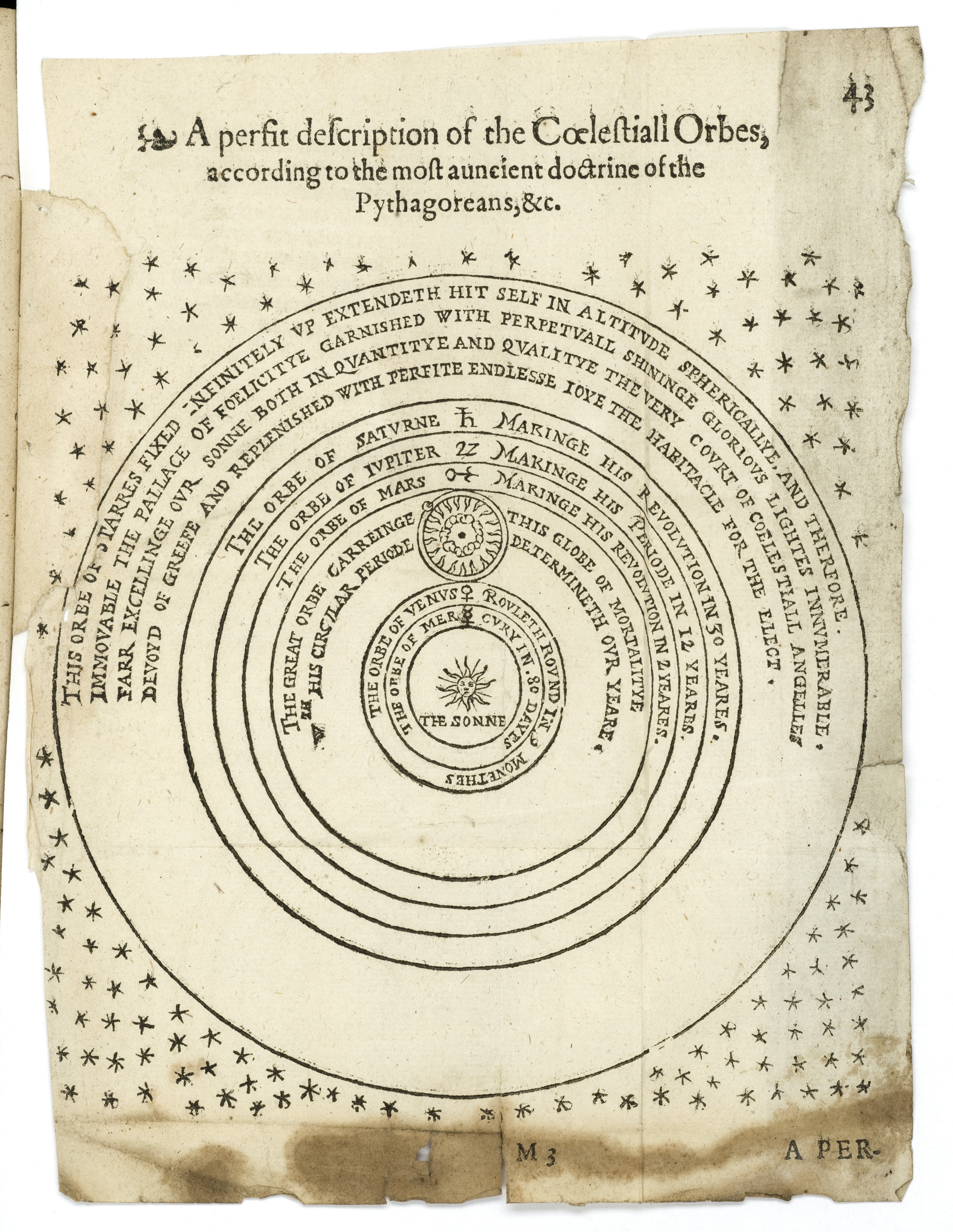
Digges’s accompanying prose makes the relationship between infinite space and divine sovereignty explicit. Describing “the glorious Court of the great God,” he writes:
to whose infinite power and Majesty, such an infinite place surmounting all other both in quantity and quality only is convenient [fitting].4
Peter Usher connects Hamlet’s imagined kingship of infinite space with Digges’s unbounded universe. Alan S. Weber also considers Digges a possible stimulus for Shakespeare’s interest in infinity, while distinguishing this comparison from Usher’s much more extensive interpretation of the play as a cosmic allegory. Digges joins “infinite power and Majesty” to “infinite place”; Hamlet joins “king” to “infinite space.” Both bring sovereignty and infinity together.5
The dramatic force remains immediate. Hamlet has just called Denmark a prison; even a nutshell could contain a king of infinite space, but his bad dreams frustrate that imaginative freedom. It is the kind of thought a former prisoner such as Neville might express: the imagination can escape the walls, only for bad dreams to close them in again. Digges supplies a contemporary context for the scale of the thought. As Stephen Johnston explains, his infinite heavens were also a vision of divine perfection set against the mortal world below.6
Savile, Chamber and the calendar consultation
The connection with Neville’s scholarly circle is documented in a different astronomical undertaking. John Dee submitted his calendar proposal to Lord Burghley on 26 February 1583. England still used the Julian calendar, while the Gregorian reform had removed ten days in countries that adopted it. Burghley’s report of the subsequent consultation names the readers of Dee’s proposal:
It was agreed by Mr. Digges, Mr. Savile, and Mr. Chambers, that upon their several Perusal of the Book written by Mr. Dee […]
These were Thomas Digges, Henry Savile and John Chamber. Each had examined Dee’s book. They agreed that an eleven-day correction was preferable if the calculation began at Christ’s birth, but accepted a ten-day correction reckoned from the Council of Nicaea. The latter would bring England into agreement with neighbouring countries.7
The revised scheme spread the ten omitted days across May, June, July and August, preserving festival dates and Trinity term. It was a practical attempt to reconcile astronomical calculation with the calendar by which religious, legal and commercial life operated. The proposal did not become English practice. Robert Poole’s study shows how mathematical assessment became entangled with ecclesiastical authority and opposition to adopting a reform associated with Rome.8
Savile had been Neville’s tutor and travelling companion. Chamber’s connection was also personal: his 1600 edition of Barlaam’s mathematical work addressed Neville and recalled his repeated requests for its publication. Chamber subsequently named Neville and Savile as executors of his will. The calendar consultation therefore places Digges in a common scholarly assessment with two men whose relationships with Neville are independently documented.9
Neville himself participated in correspondence about Copernicus. As Robert Goulding shows, Dudith asked him in 1581 to press Savile for explanations of difficult passages in the ancient mathematicians and in Copernicus.10
Notes and sources
“St. Leger, Sir Warham,” Dictionary of National Biography, L (1897), p.168, text; The Complete Peerage, I, p.35, Abergavenny pedigree. The cousin degrees are calculated from these pedigrees. For Anne’s subsequent marriage to Russell, see W. P. W. Phillimore, ed., The Visitation of the County of Worcester Made in the Year 1569 (1888), p. 119; Andrew Hadfield, “Shakespeare and the Digges Brothers”, Reformation 25.1 (2020), 2–17. Thomas’s military writing is discussed with Othello in Chapter 27; Dudley’s contributions to Foure Paradoxes with Coriolanus in Chapter 34. Michael Neill, ed., Othello, the Moor of Venice (Oxford: Oxford University Press, 2008), p. 197, note to 1.1.18, on the epistle to the reader in Stratioticos. For Dudley’s contributions and Muir’s source proposal, see Hadfield, “Shakespeare and the Digges Brothers,” 13–17; Thomas and Dudley Digges, Foure Paradoxes (1604), fourth paradox, p. 104. Thomas wrote the first two discourses, Dudley the last two. Dudley’s parliamentary defence and conversations with Neville are discussed in Chapters 9 and 49; Leonard’s First Folio tribute in Chapters 49 and 59. Maija Jansson, ed., Proceedings in Parliament 1614 (House of Commons) (Philadelphia: American Philosophical Society, 1988), p. 246, 14 May 1614; Calendar of State Papers, Domestic, James I, 1611–1618, p. 325, item 9, examination of 6 November 1615, underlying document TNA SP 14/83, f. 12; First Folio (1623), preliminary poem signed “L. Digges.” The examination recounts conversations before Neville’s death.↩︎
Shakespeare, Hamlet, 2.2. Quotation and lineation follow the Folger text; emphasis added here and in the other quotations. This exchange appears in the First Folio (1623), but not in the Second Quarto (1604/5); Folger marks it with pointed parentheses, as explained in its textual introduction.↩︎
Thomas Digges, A Perfit Description of the Caelestiall Orbes, appended to Leonard Digges, A Prognostication Everlasting (first published in this form in 1576). The figure reproduces the Wellcome copy of the 1605 printing, STC 6870, ESTC S115715, image L0049132, available through Wikimedia Commons under CC BY 4.0. For the circulation and significance of astronomical language, see Anna Cetera-Włodarczyk, Jonathan Hope and Jarosław Włodarczyk, “Unsphered, Disorbed, Decentred: Shakespeare’s Astronomical Imagination”, Shakespeare 17.4 (2021), 400–427.↩︎
Digges, A Prognostication Everlasting (1596), Perfit Description, sig. N2r, digitised edition. Spelling modernised. “Convenient” here means appropriate or fitting.↩︎
Peter Usher, “Advances in the Hamlet Cosmic Allegory”, The Oxfordian 4 (2001), 25–49, especially 42–44; Alan S. Weber, “What Did Shakespeare Know About Copernicanism?”, Romanian Journal of English Studies 9.1 (2012), 351–365, especially 360–362. Usher’s larger allegorical identifications are not required for this comparison. Weber also discusses the wider circulation of ideas of infinity: the parallel does not establish direct borrowing from Digges.↩︎
Stephen Johnston, “Like father, like son? John Dee, Thomas Digges and the identity of the mathematician”, in Stephen Clucas, ed., John Dee: Interdisciplinary Studies in English Renaissance Thought (Dordrecht: Springer, 2006), author’s publicly available text.↩︎
John Dee’s diary, ed. James Orchard Halliwell (1842), pp. 18–19, records delivery on 26 February 1583. Burghley’s “Report … of the Consultation …” is printed in Philosophical Transactions 21 (1699), 355–356. The identification of the three assessors follows Poole. The printed heading gives 25 March 1582; the editor of the reprint in The Gentleman’s Magazine, new series 36 (November 1851), 451–459, assigns it to 1583. The printed date and its chronological interpretation must be distinguished: 25 March was the English year boundary, so this is not simply an automatic conversion of a January or February Old Style date. The report documents consultation, rather than an instrument appointing a formal commission; it does not name Neville as an assessor.↩︎
Burghley, report, 355–356: May is reduced to 28 days, June to 29, July to 28 and August to 28, removing ten days in all. This revised May–August scheme is distinct from Dee’s original eleven-day proposal. Robert Poole, “John Dee and the English Calendar: Science, Religion and Empire”, Institute of Historical Research seminar paper (1996). Participation in this consultation does not establish that the assessors shared Digges’s views about the Earth’s motion.↩︎
John Chamber, ed., Barlaami Monachi Logistica (Paris: Guillaume Auvray, 1600), address to Henry Neville. For Neville and Savile as Chamber’s executors, see The National Archives, C 2/JasI/N4/24, Nevill v Reeve. Savile’s travels with Neville and Chamber’s connections are discussed in the chapters on Neville’s education and King Lear.↩︎
Robert Goulding, “Henry Savile and the Tychonic World-System”, Journal of the Warburg and Courtauld Institutes 58 (1995), 152–179, at 175 and n. 78. Goulding prints and translates the request to Neville; this is a citation of his manuscript-based study, not a new collation of the letter.↩︎
