Westmoreland should not be at Agincourt. Holinshed assigns Ralph Neville, Earl of Westmorland, to guard the Scottish frontier, yet the Folio play brings him to France and gives him a prominent place beside Henry V. In 1929, Robert Boies Sharpe, reading the play’s Agincourt names for compliments to Essex’s circle, suggested that this addition might honour Henry Neville:
A Sir Henry Neville … was ambassador to France … He was in the confidence of Southampton and took some part in the Essex plot … Honor may have been reflected from the title of Westmoreland to the family name of Neville …1
The connection is closer than a shared surname. Ralph Neville, Earl of Westmorland, was the ambassador’s direct ancestor.
Westmoreland at Agincourt
Holinshed leaves the earl and other captains in England “to keep the frontiers and marches of Scotland.”2
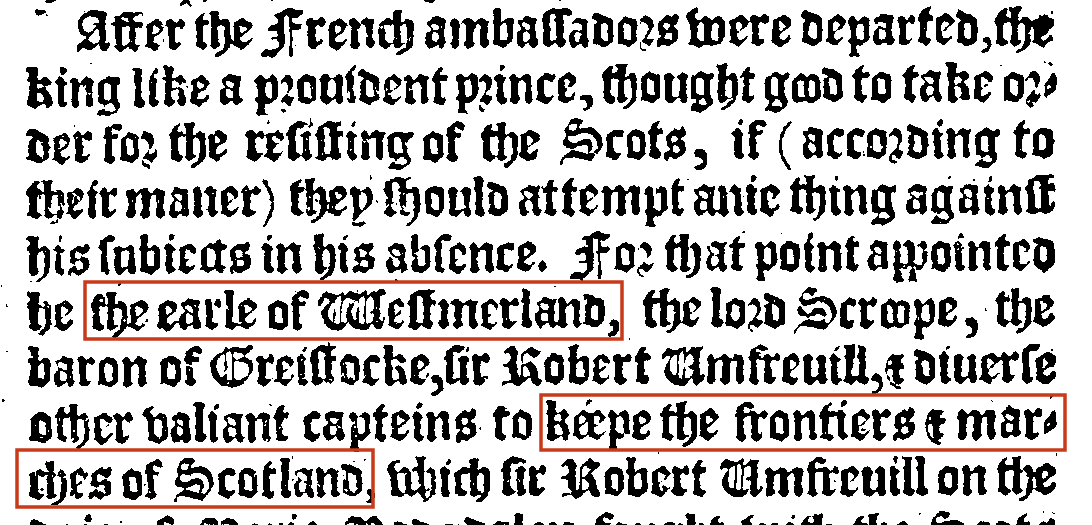
At the council of war, Holinshed gives Westmoreland the argument that England should conquer Scotland before attempting France. The Folio gives the corresponding warning to the Bishop of Ely (1.2), then makes Westmoreland prominent at Agincourt, where the chronicle does not place him.3
The play changes both his location and his role. In Holinshed, “one of the host” wishes for more English soldiers; Henry answers that he would not wish for another. The 1600 quarto assigns the wish to Warwick. In the fuller Folio text, Westmoreland prompts the St. Crispin’s Day speech:
WESTMORELAND O, that we now had here
But one ten thousand of those men in England
That do no work today.KING HENRY What’s he that wishes so?
My cousin Westmoreland? No, my fair cousin.
If we are marked to die, we are enough
To do our country loss; and if to live,
The fewer men, the greater share of honor.
[…]
— Henry V, 4.3.4
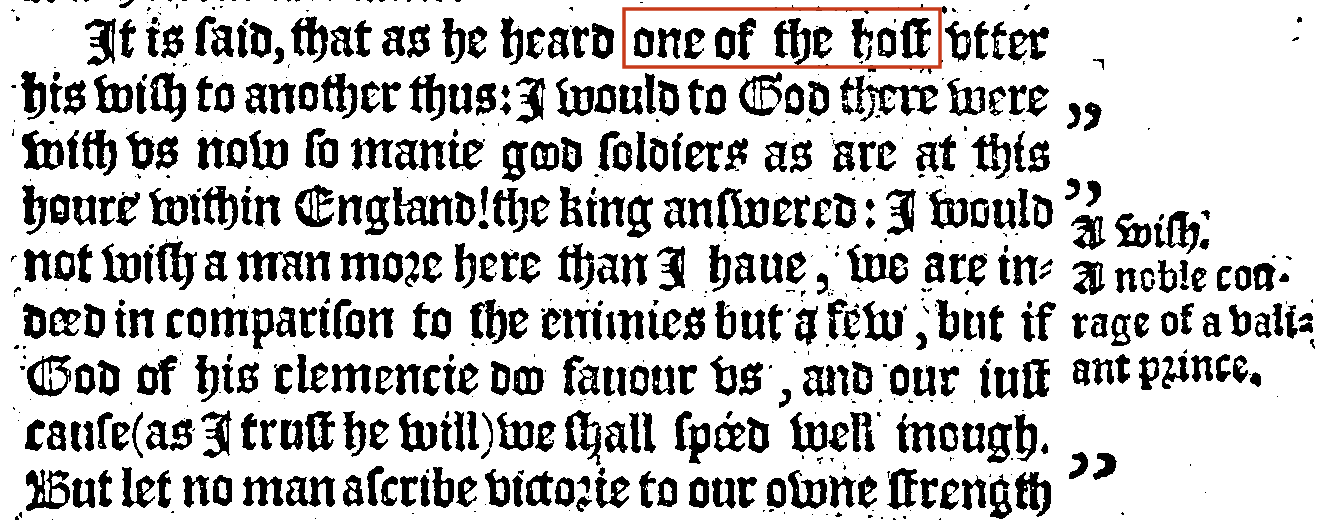
Henry repeatedly addresses Westmoreland as his cousin and entrusts him with proclaiming that anyone unwilling to fight may leave with a passport and money. After the speech, Henry asks whether he still wishes for more help. Westmoreland now wants fewer companions still:
WESTMORELAND
God’s will, my liege, would you and I alone,
Without more help, could fight this royal battle!
— Henry V, 4.3.
Westmoreland’s change of heart lets the audience hear the king’s appeal to fellowship and honour take effect on Neville’s ancestor.
James Whitelocke recorded the descent at his friend Neville’s death on 10 July 1615:
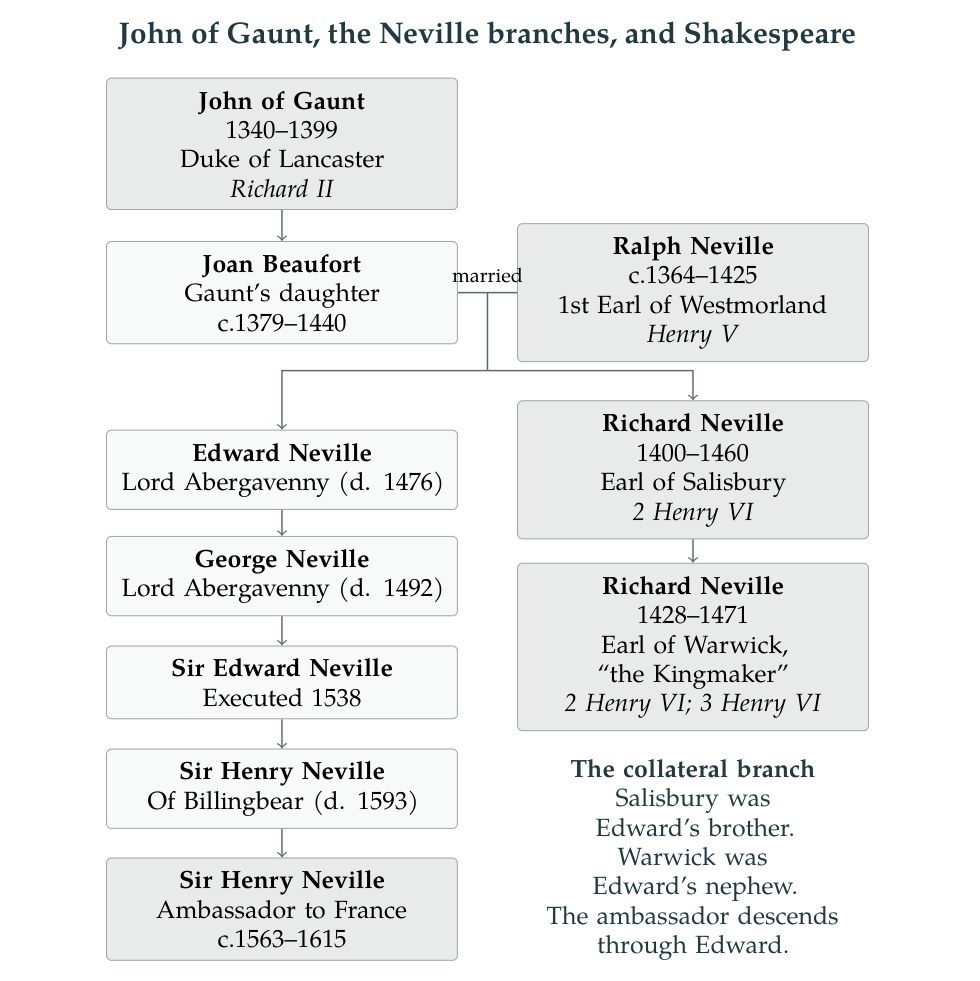
He was lineally descended from Edward Lord Abergavenny, fourth son of Ralph Neville, first Earl of Westmorland.5
Edward was the son of Ralph Neville and Joan Beaufort, John of Gaunt’s daughter. Through them, both Westmorland in Henry V and Gaunt in Richard II were the ambassador’s direct ancestors. The Neville earls of Salisbury and Warwick in 2 Henry VI belonged to the collateral branch shown alongside his own descent in the chart. The men holding those titles in Henry V were from different families.5
The opposite change occurs in Henry VIII: Neville’s grandfather, Sir Edward, disappears from the banquet episode in which Holinshed names him as the man Wolsey mistakes for the king. Chapter 38 examines that omission.
Chapter 20 discusses Gaunt and the wider Neville family in the histories. Appendix E examines Bradbeer and Casson’s proposed “Ne’vile” wordplay in the change from the quarto’s “ne’er so base” to the Folio’s “ne’er so vile.”
The king among his soldiers
The night before Agincourt offers another departure from the chronicle. Henry borrows Erpingham’s cloak, dismisses his companions and moves among his soldiers unrecognized. George R. Price, writing in Shakespeare Quarterly in 1961, proposed a source in Tacitus’s account of Germanicus. He found no corresponding night visit in the Agincourt chronicles and poems he examined, including Holinshed, or in The Famous Victories.6
In Annals 2.13, Germanicus wants to hear what his soldiers really think before battle. He distrusts officers’ reports, friends’ flattery and an assembly in which a few lead and the rest applaud. Richard Grenewey’s English translation, published in 1598, describes his solution:
That their minds would be best known, when they were by themselves; not overlooked: in eating and drinking they would utter their fear or hope. As soon as it was night, going out at the Augural gate, accompanied with one alone, in secret and unknown places to the watch: casting a savage beast’s skin on his back, he went from one place to another: stood listening at the tents: and joyeth in the praise of himself: some extolling the nobility of their Captain; …7
Both commanders conceal their rank under an outer garment and move through the camp before battle to hear soldiers speak freely. Like Germanicus, Henry hears himself praised. Pistol declares:
PISTOL The King’s a bawcock and a heart of gold, a lad
of life, an imp of fame, of parents good, of fist most
valiant. I kiss his dirty shoe, and from heartstring I
love the lovely bully. What is thy name?
— Henry V, 4.1.8
Shakespeare then makes the encounter more difficult. Bates and Williams question the campaign and the king’s responsibility for its dead. Concealing his identity allows Henry to hear criticism that rank would silence, but obliges him to answer without invoking that rank. The resemblance to Tacitus lies in the sequence—disguise, a night visit, unguarded speech and judgments of the commander—and Shakespeare develops it into an argument about the responsibilities of kingship.
Neville repeatedly used Tacitus to judge the conduct of rulers. His confession applied the historian to success and political judgment; his Advice, to a king’s loss of goodwill. Chapter 16 examines these and two further documented uses.9
His tutor and travelling companion Henry Savile had translated the Histories in 1591. The Germanicus episode belongs to the Annals, translated by Grenewey in 1598 and printed to be bound with a new edition of Savile’s translations.6
France in 1599
In 1599, as Henry Neville began his embassy to France, Henry V brought Anglo-French relations onto the English stage—not only through war and royal claims, but through French dialogue, interpreters and negotiations. Neville was conducting in France the kinds of business the play dramatizes: communicating between courts, examining royal obligations and negotiating their fulfilment.1011
Katherine learns English from Alice; the Boy interprets for a captured French soldier; Henry woos the princess across the language divide.11
KING HENRY O fair Katherine, if you will love me
soundly with your French heart, I will be glad to
hear you confess it brokenly with your English
tongue. Do you like me, Kate?
— Henry V, 5.2.12
The courtship takes place during negotiations for peace, with Katherine herself named among the articles. Henry’s demands are “enscheduled briefly” for the French negotiators to examine (Henry V, 5.2).12
Neville spoke French with Henri IV and used it in negotiations with Villeroy. Two of his own revised drafts survive: a French letter to the governor of Dieppe and the English–French text of a speech and memorial to Villeroy. The printed correspondence also includes his French letter of 10 June 1599 pressing Elizabeth’s demand for repayment.1314
Before leaving for France, on 19 February 1599, Neville told Thomas Windebank that he was checking and copying the bonds and contracts behind Elizabeth’s financial claims against the French king. He needed to “verify the particulars of every debt”; this would be “a chief part of my business there.”10
David Womersley cites this very letter in his 1995 article “France in Shakespeare’s Henry V.” His study reads the play’s fifteenth-century story against the politics of summer 1599; Neville’s letter documents Elizabeth’s pressure for repayment. Womersley approached the subject independently of the Neville authorship question.15
Womersley finds a telling combination of sympathy for France and ridicule of its court. Burgundy’s lament gives the suffering country a voice:
BURGUNDY
[…]
Why that the naked, poor, and mangled peace,
Dear nurse of arts, plenties, and joyful births,
Should not in this best garden of the world,
Our fertile France, put up her lovely visage?
Alas, she hath from France too long been chased,
And all her husbandry doth lie on heaps,
Corrupting in its own fertility.
[…]
— Henry V, 5.2.16
Womersley argues that this speech has no apparent counterpart in Holinshed or The Famous Victories, but resembles English accounts of the French civil wars. He also reads the choice politically: recalling France’s devastation pushes aside Henri IV’s claims about the prosperity of his reign.
In the 1600 quarto, Bourbon appears at Agincourt where the Folio gives us the Dauphin. Womersley reads the name as pointing towards Henri IV, and relates the ridicule and the attack on the Salic Law to rumours of the French king’s ambitions for the English succession.17
Neville’s dispatches confront the difficult ally behind these anxieties. On 24 September 1599, he explained Henri’s resentment of English assistance to Cecil through a maxim from Tacitus’s Annals: benefits remain welcome while repayable, but an overwhelming obligation breeds hatred.9
The fifth-act Chorus points to 1599 by imagining a triumphant return from Ireland for Elizabeth’s general—the allusion to Essex that helps date the play. Events disappointed that hope. Essex returned to court on 28 September against Elizabeth’s orders. On 8 October Cecil told Neville that he “was in the court before ever her Majesty knew it.” The Queen had excluded him from her presence and committed him to the Lord Keeper’s house.18
Three scholars, none arguing for Neville’s authorship, bring different features of the play into his world. Sharpe names the ambassador as someone Westmoreland might honour; the Folio makes that ancestor central to the St. Crispin’s Day exchange. Price’s proposed source lies in a historian Neville studied and used, published in English alongside his tutor’s work. Womersley’s account of its French politics draws on Neville’s own letter. The French dialogue adds a further connection with his work in France in 1599.
Notes and sources
Robert Boies Sharpe, “We Band of Brothers,” Studies in Philology 26.2 (1929), 166–176, especially 169 and 174–175; quotation from p. 175, with omissions marked by ellipses. His Neville discussion concerns the contemporary resonance of the title; he does not attribute the play to Neville. He also names Mountjoy, Charles Neville, sixth Earl of Westmorland, and Edmund Neville as possible contemporary connections.↩︎
Raphael Holinshed and continuators, Chronicles (London, 1587), III, 548, left column; 553, right column, STC 13569, TCP A68202. Digitized volume. Quotation spelling modernized. The Scotland assignment is also in Hall; the reproduced witness is Holinshed itself.↩︎
Holinshed, Chronicles (1587), vol. III, reign of Henry V, the council debate headed “The earle of Westmerland persuadeth the king to the conquest of Scotland,” TCP A68202. The 1623 Folio gives “But there’s a saying very old and true” to “Bish. Ely.”; TCP A11954. The Folger reading text, 1.2, retains Ely. Editions that reassign the speech to Westmoreland make a different editorial choice. Holinshed’s Westmoreland advocates a Scottish campaign, not withdrawal from warfare.↩︎
Shakespeare, Henry V, 4.3, Folger Shakespeare Library. For the contrasting Warwick assignment see 1600 quarto, scene 12. The excerpts preserve Folger lineation; the concluding ellipsis marks the continuation of Henry’s speech.↩︎
James Tait, “Neville, Edward (d.1476),” and W. A. J. Archbold, “Neville, Edward (d.1538),” Dictionary of National Biography, XL (1894). Together these identify Ralph and Joan’s son Edward, his son George, Sir Edward, and the two Billingbear Henry Nevilles. The George who succeeded as Lord Abergavenny in the next generation was Sir Edward’s brother; he is not an additional generation in this descent. James Whitelocke, Liber Famelicus, ed. John Bruce (London: Camden Society, 1858), p. 46, entry recording Neville’s death on 10 July 1615; spelling modernized. Chart dates: John of Gaunt, 1340–1399; Joan Beaufort, c.1379–1440; Ralph Neville, c.1364–1425. See John of Gaunt, Joan Beaufort, and James Tait, “Neville, Ralph (1364–1425)”. George’s death in 1492 is recorded in Tait’s biography of his son. The ambassador’s approximate birth year follows the age evidence discussed in Chapters 1–9. Where no birth year is supplied, d. denotes the year of death. For the collateral branch, James Tait, “Neville, Richard (1400–1460)”, identifies Salisbury as Ralph and Joan’s son and Edward’s brother; his “Neville, Richard (1428–1471)” identifies Warwick as Salisbury’s son. The Neville-family speeches are in Shakespeare, 2 Henry VI, 2.2, 3.2 and 5.1; Warwick also appears in 3 Henry VI. The three Neville references occur in the 1594 quarto, The First Part of the Contention: Internet Shakespeare Editions, 2.2, 3.2, and 5.1. Short quotations in the text use modern spelling and the Folger reading text. In the crest passage, Q1 reads “my fathers age” where the Folio-based text reads “my father’s badge”; the quoted words “old Neville’s crest” are present in both. See also Folger’s textual introduction.↩︎
George R. Price, “Henry V and Germanicus,” Shakespeare Quarterly 12.1 (1961), 57–60. Price proposes a plausible source, not a demonstrated borrowing. On pp. 58–59 and n. 3 he describes Grenewey’s 1598 Annals as printed to be bound with the new edition of Savile’s translations, with separate signatures; he also discusses possible access through Essex and Southampton. David Womersley, “3 Henry VI: Shakespeare, Tacitus, and Parricide,” Notes and Queries 32.4 (1985), 472 n. 7, notes earlier dramatic examples of disguised commanders making night rounds. The case here concerns the fuller sequence; disguise alone is not distinctive.↩︎
Tacitus, The Annales of Cornelius Tacitus, translated by Richard Grenewey (London, 1598), 36, Annals 2.13, STC 23644, TCP A13333; digitized edition. Spelling modernized; wording and syntax retained. Emphasis identifies the circumstances compared with the play, not an exact verbal borrowing.↩︎
Shakespeare, Henry V, 4.1, Folger Shakespeare Library. Pistol’s complete speech is quoted with Folger lineation.↩︎
Neville to Cecil, 24 September 1599, Ralph Winwood, Memorials of Affairs of State, ed. Edmund Sawyer (London, 1725), I, 108, citing Annals 4.18. Chapter 16 examines Neville’s uses of Tacitus and his relationship with Savile; Chapter 31 discusses the confession’s Tacitus maxim alongside Macbeth. Savile translated the Histories; Grenewey translated the Annals containing the Germanicus episode.↩︎
Henry Neville to Thomas Windebank, 19 February 1599, Calendar of State Papers, Domestic, Elizabeth, 1598–1601, ed. Mary Anne Everett Green (London, 1869), 163–164, vol. CCLXX, no. 42, especially 164. Wording follows the calendar’s modernized abstract. Year modernized; Julian day and month retained.↩︎
Shakespeare, Henry V, 3.4 and 4.4, Folger Shakespeare Library.↩︎
Shakespeare, Henry V, 5.2, Folger Shakespeare Library. Katherine is expressly included among the articles. Emphasis added. The 1600 quarto already contains the French lesson, ransom scene, royal wooing and settlement through written articles; see Internet Shakespeare Editions, quarto text. “French heart … English tongue” and “enscheduled briefly” are Folio readings.↩︎
The National Archives, PRO 30/50/2, f. 37r–v, revised French letter to the governor of Dieppe, October 1599; f. 51r and following leaves, English–French draft of a speech and memorial to Villeroy, docketed January 1599, understood as January 1600 under the old-style year convention. Neville to Cecil, Paris, 5 October 1599 O.S., reports the imprisonment of a captain by the governor of Dieppe: Winwood, Memorials, I, 115–116; the January negotiations at 147–150, especially 148–149. For his conversations with Henri IV and presentation of a written memorial, Neville to Cecil, Paris, 26 May 1599 O.S., ibid., 29–31; a French proposition to the king’s council is dated 21 May 1599 O.S. and printed at pp. 27–28.↩︎
Neville to Villeroy, Paris, 10 June 1599 New Style (31 May Old Style), printed in French under the heading “Sir Henry Neville to Monsieur Villeroy” and subscribed “Henry Neville”, in Ralph Winwood, Memorials of Affairs of State, ed. Edmund Sawyer (London, 1725), I, 43. His earlier French letter of 6 June and Villeroy’s answer are printed at pp. 37–39.↩︎
David Womersley, “France in Shakespeare’s Henry V,” Renaissance Studies 9.4 (1995), 442–459, especially 445 and 450 n. 34. The note cites Neville to Windebank for the repayment issue. Womersley does not attribute the play to Neville.↩︎
Shakespeare, Henry V, 5.2, Folger Shakespeare Library. The passage preserves Folger’s lineation. For Womersley’s source comparison and contemporary French context, see “France in Shakespeare’s Henry V,” pp. 445–448 and 458.↩︎
Womersley, 445–459, particularly 445–450 and 454–457. The Burgundy source comparison and the contemporary Bourbon/Salic Law interpretation are his arguments. The Bourbon–Dauphin distinction concerns the early printed versions. The 1599 topical setting does not establish that every Folio-only passage was performed in that year. The shorter 1600 quarto lacks the choruses; it was reprinted in 1602 and in 1619 with a false date of 1608. See Folger’s textual introduction. Quotations here follow Folger.↩︎
Shakespeare, Henry V, Act 5 Chorus. Robert Cecil to Neville, 8 October 1599, Edmund Sawyer, ed., Memorials of Affairs of State (London, 1725), I, 118–119. Quotation spelling modernized. For the 28 September return to Nonsuch, see Imogen Easton, “The Great Essex Coup Plot at Nonsuch,” Sutton Council Cultural Services, 28 September 2023. The date refers to his arrival at court.↩︎